Nucleotide synthesis and recycling
Representative bacterial routes; arrows may summarize several reactions.
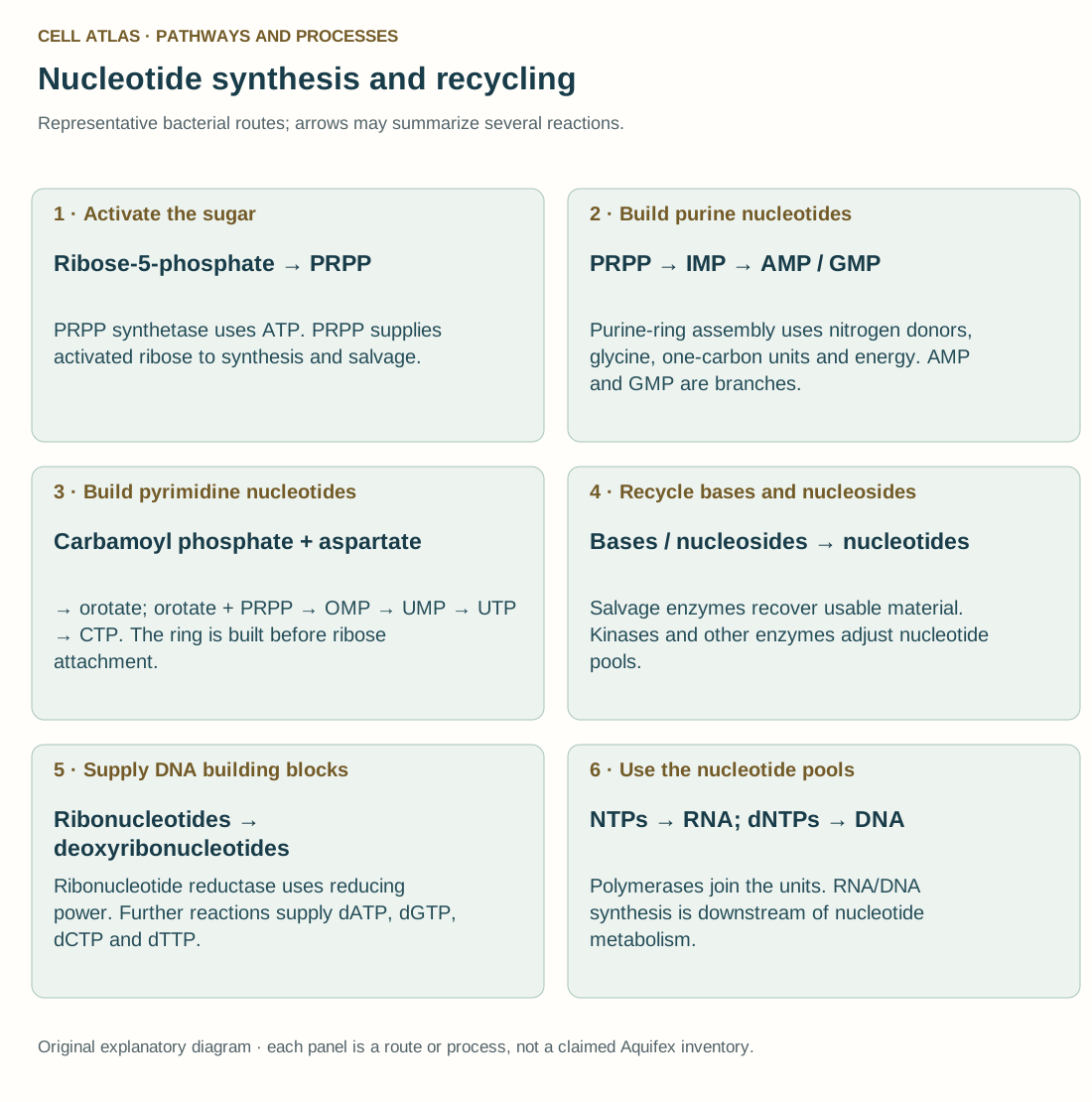
Open the full-resolution diagram ↗ · Explore the system pathways and annotated components →
1 · Activate the sugar
Ribose-5-phosphate → PRPP
PRPP synthetase uses ATP. PRPP supplies activated ribose to synthesis and salvage.
2 · Build purine nucleotides
PRPP → IMP → AMP / GMP
Purine-ring assembly uses nitrogen donors, glycine, one-carbon units and energy. AMP and GMP are branches.
3 · Build pyrimidine nucleotides
Carbamoyl phosphate + aspartate
→ orotate; orotate + PRPP → OMP → UMP → UTP → CTP. The ring is built before ribose attachment.
4 · Recycle bases and nucleosides
Bases / nucleosides → nucleotides
Salvage enzymes recover usable material. Kinases and other enzymes adjust nucleotide pools.
5 · Supply DNA building blocks
Ribonucleotides → deoxyribonucleotides
Ribonucleotide reductase uses reducing power. Further reactions supply dATP, dGTP, dCTP and dTTP.
6 · Use the nucleotide pools
NTPs → RNA; dNTPs → DNA
Polymerases join the units. RNA/DNA synthesis is downstream of nucleotide metabolism.
Evidence and scope
Original explanatory diagram based on the sources below. These are selected documented biochemical routes or mechanisms, not a complete species-specific reconstruction. Each arrow can summarize several reactions; panels may represent branches or alternatives. Genome annotations, protein models and organism-specific evidence remain in the detailed system map.