Amino-acid biosynthetic branches
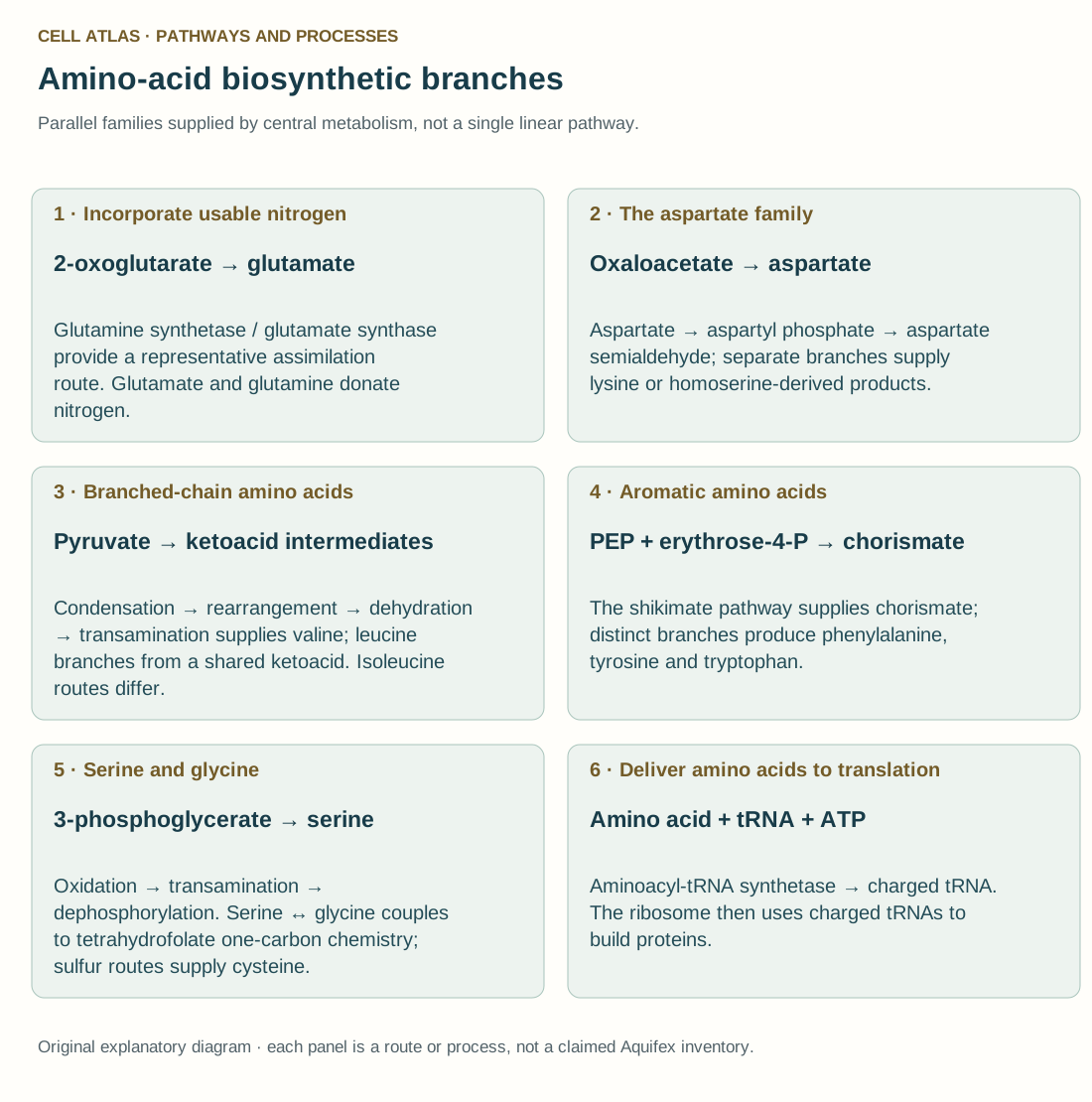
Parallel families supplied by central metabolism, not a single linear pathway.
Open the full-resolution diagram ↗ · Explore the system pathways and annotated components →
1 · Incorporate usable nitrogen
2-oxoglutarate → glutamate
Glutamine synthetase / glutamate synthase provide a representative assimilation route. Glutamate and glutamine donate nitrogen.
2 · The aspartate family
Oxaloacetate → aspartate
Aspartate → aspartyl phosphate → aspartate semialdehyde; separate branches supply lysine or homoserine-derived products.
3 · Branched-chain amino acids
Pyruvate → ketoacid intermediates
Condensation → rearrangement → dehydration → transamination supplies valine; leucine branches from a shared ketoacid. Isoleucine routes differ.
4 · Aromatic amino acids
PEP + erythrose-4-P → chorismate
The shikimate pathway supplies chorismate; distinct branches produce phenylalanine, tyrosine and tryptophan.
5 · Serine and glycine
3-phosphoglycerate → serine
Oxidation → transamination → dephosphorylation. Serine ↔ glycine couples to tetrahydrofolate one-carbon chemistry; sulfur routes supply cysteine.
6 · Deliver amino acids to translation
Amino acid + tRNA + ATP
Aminoacyl-tRNA synthetase → charged tRNA. The ribosome then uses charged tRNAs to build proteins.
Evidence and scope
Original explanatory diagram based on the sources below. These are selected documented biochemical routes or mechanisms, not a complete species-specific reconstruction. Each arrow can summarize several reactions; panels may represent branches or alternatives. Genome annotations, protein models and organism-specific evidence remain in the detailed system map.