Protein quality-control decisions
Representative bacterial processes; folding, rescue and degradation are alternatives.
Open the full-resolution diagram ↗ · Explore the system pathways and annotated components →
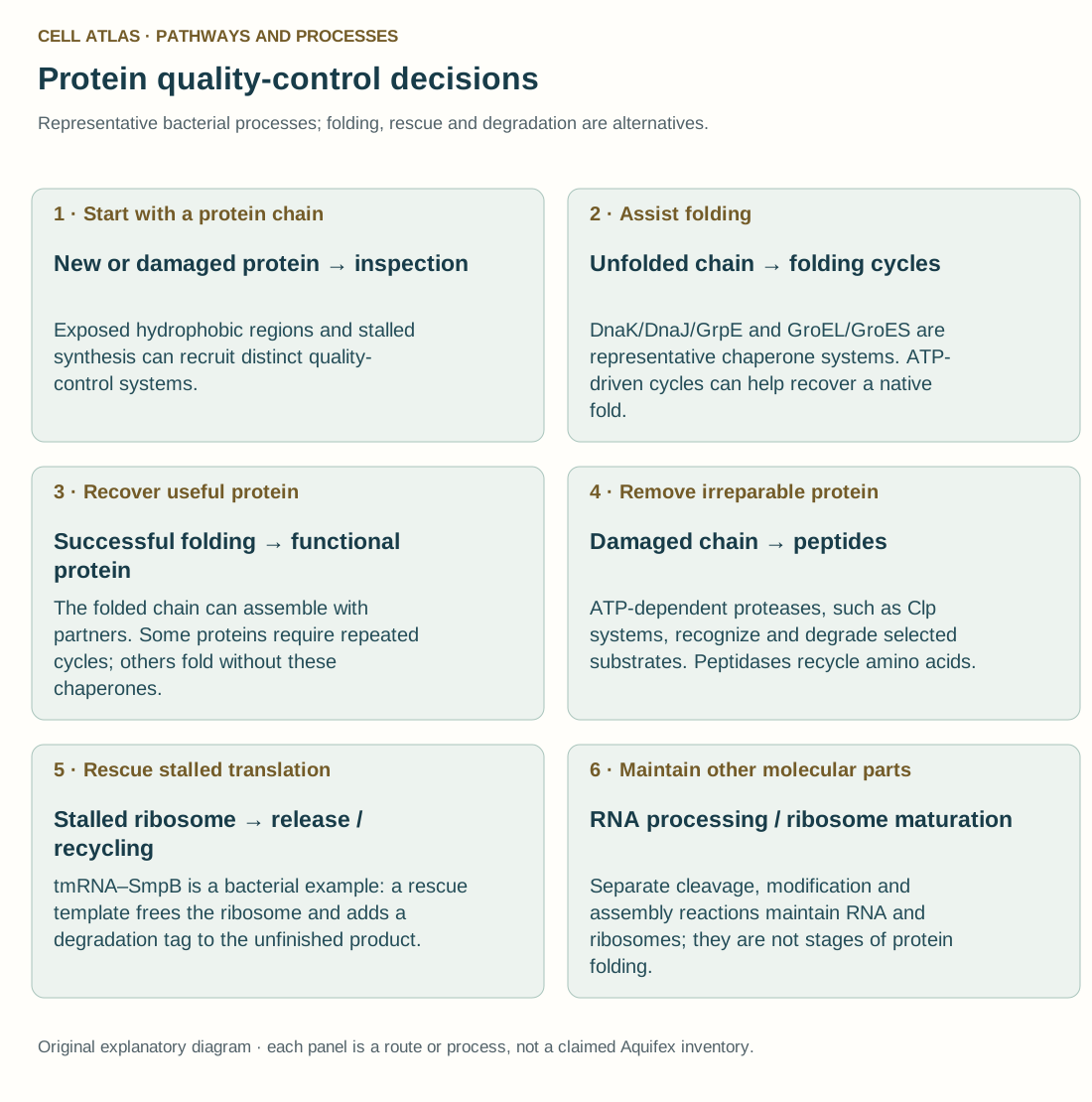
1 · Start with a protein chain
New or damaged protein → inspection
Exposed hydrophobic regions and stalled synthesis can recruit distinct quality-control systems.
2 · Assist folding
Unfolded chain → folding cycles
DnaK/DnaJ/GrpE and GroEL/GroES are representative chaperone systems. ATP-driven cycles can help recover a native fold.
3 · Recover useful protein
Successful folding → functional protein
The folded chain can assemble with partners. Some proteins require repeated cycles; others fold without these chaperones.
4 · Remove irreparable protein
Damaged chain → peptides
ATP-dependent proteases, such as Clp systems, recognize and degrade selected substrates. Peptidases recycle amino acids.
5 · Rescue stalled translation
Stalled ribosome → release / recycling
tmRNA–SmpB is a bacterial example: a rescue template frees the ribosome and adds a degradation tag to the unfinished product.
6 · Maintain other molecular parts
RNA processing / ribosome maturation
Separate cleavage, modification and assembly reactions maintain RNA and ribosomes; they are not stages of protein folding.
Evidence and scope
Original explanatory diagram based on the sources below. These are selected documented biochemical routes or mechanisms, not a complete species-specific reconstruction. Each arrow can summarize several reactions; panels may represent branches or alternatives. Genome annotations, protein models and organism-specific evidence remain in the detailed system map.