Stress defense and damage recovery
Separate protective reactions and repair routes; components vary among organisms.
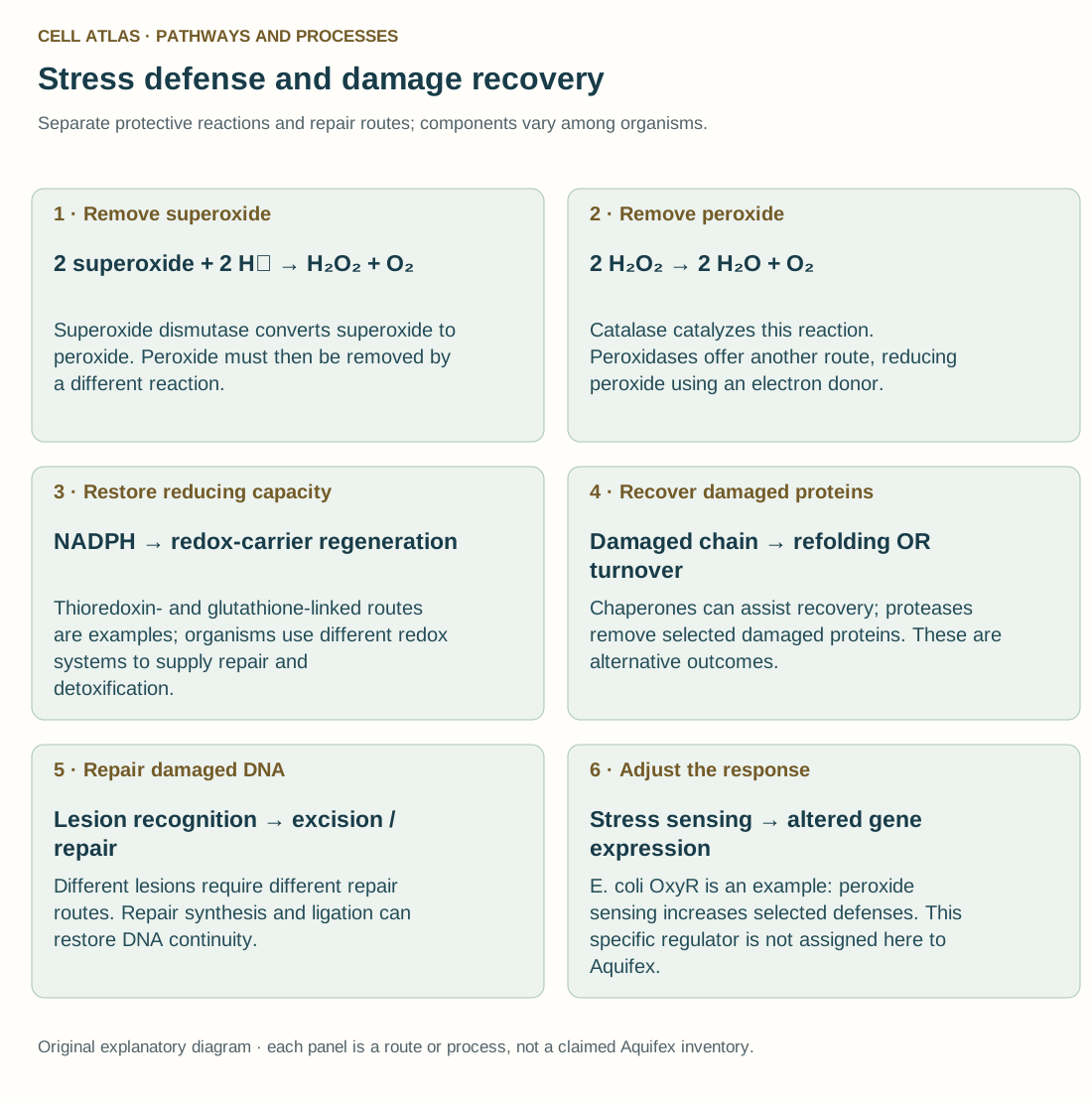
Open the full-resolution diagram ↗ · Explore the system pathways and annotated components →
1 · Remove superoxide
2 superoxide + 2 H⁺ → H₂O₂ + O₂
Superoxide dismutase converts superoxide to peroxide. Peroxide must then be removed by a different reaction.
2 · Remove peroxide
2 H₂O₂ → 2 H₂O + O₂
Catalase catalyzes this reaction. Peroxidases offer another route, reducing peroxide using an electron donor.
3 · Restore reducing capacity
NADPH → redox-carrier regeneration
Thioredoxin- and glutathione-linked routes are examples; organisms use different redox systems to supply repair and detoxification.
4 · Recover damaged proteins
Damaged chain → refolding OR turnover
Chaperones can assist recovery; proteases remove selected damaged proteins. These are alternative outcomes.
5 · Repair damaged DNA
Lesion recognition → excision / repair
Different lesions require different repair routes. Repair synthesis and ligation can restore DNA continuity.
6 · Adjust the response
Stress sensing → altered gene expression
E. coli OxyR is an example: peroxide sensing increases selected defenses. This specific regulator is not assigned here to Aquifex.
Evidence and scope
Original explanatory diagram based on the sources below. These are selected documented biochemical routes or mechanisms, not a complete species-specific reconstruction. Each arrow can summarize several reactions; panels may represent branches or alternatives. Genome annotations, protein models and organism-specific evidence remain in the detailed system map.