Building metal-containing enzyme cofactors
Fe–S, NiFe and molybdenum-cofactor routes are distinct, not consecutive stages.
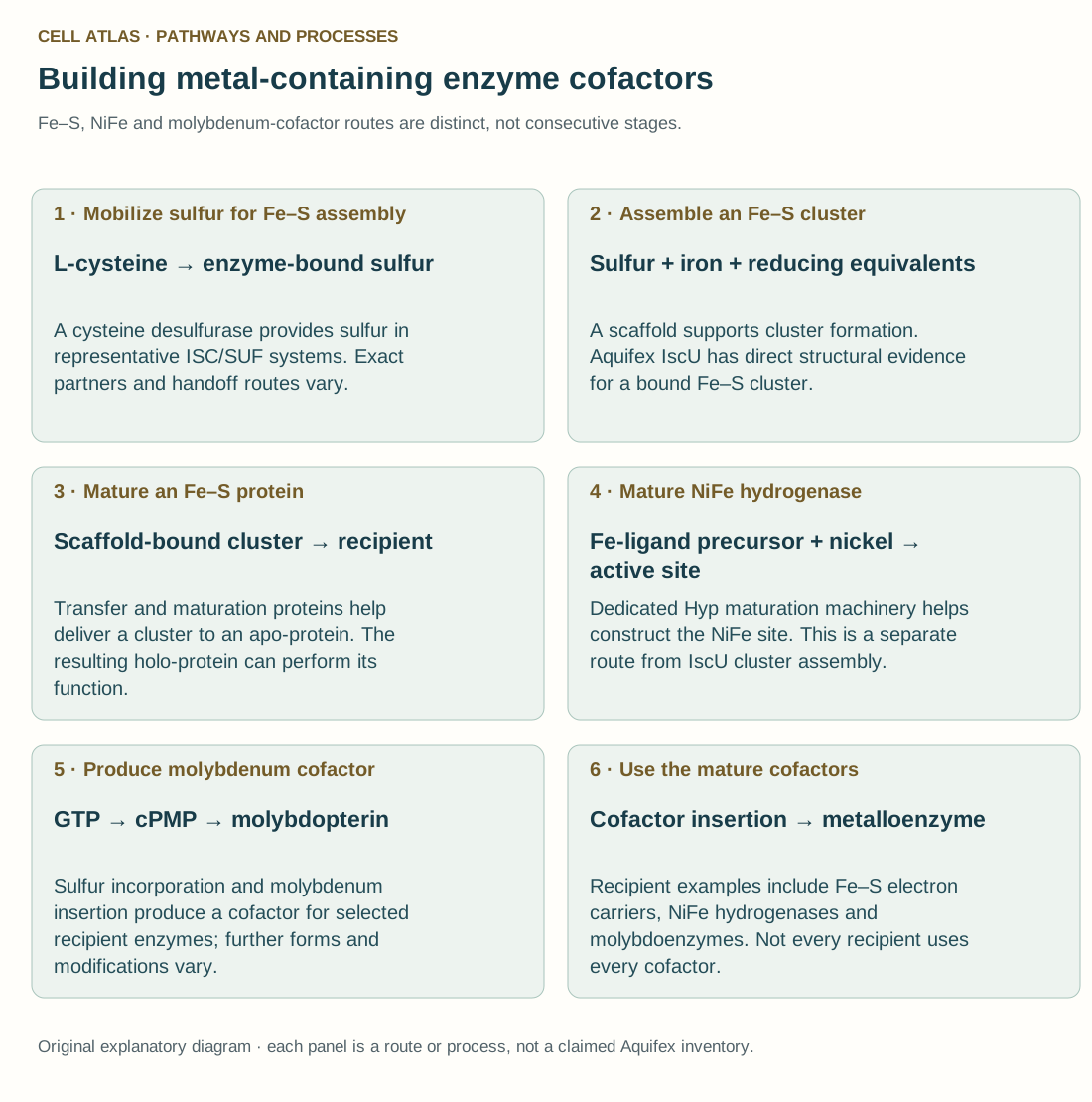
Open the full-resolution diagram ↗ · Explore the system pathways and annotated components →
1 · Mobilize sulfur for Fe–S assembly
L-cysteine → enzyme-bound sulfur
A cysteine desulfurase provides sulfur in representative ISC/SUF systems. Exact partners and handoff routes vary.
2 · Assemble an Fe–S cluster
Sulfur + iron + reducing equivalents
A scaffold supports cluster formation. Aquifex IscU has direct structural evidence for a bound Fe–S cluster.
3 · Mature an Fe–S protein
Scaffold-bound cluster → recipient
Transfer and maturation proteins help deliver a cluster to an apo-protein. The resulting holo-protein can perform its function.
4 · Mature NiFe hydrogenase
Fe-ligand precursor + nickel → active site
Dedicated Hyp maturation machinery helps construct the NiFe site. This is a separate route from IscU cluster assembly.
5 · Produce molybdenum cofactor
GTP → cPMP → molybdopterin
Sulfur incorporation and molybdenum insertion produce a cofactor for selected recipient enzymes; further forms and modifications vary.
6 · Use the mature cofactors
Cofactor insertion → metalloenzyme
Recipient examples include Fe–S electron carriers, NiFe hydrogenases and molybdoenzymes. Not every recipient uses every cofactor.
Evidence and scope
Original explanatory diagram based on the sources below. These are selected documented biochemical routes or mechanisms, not a complete species-specific reconstruction. Each arrow can summarize several reactions; panels may represent branches or alternatives. Genome annotations, protein models and organism-specific evidence remain in the detailed system map.