CHAPTER 01 · AN INTRODUCTION
The cloth in front of us
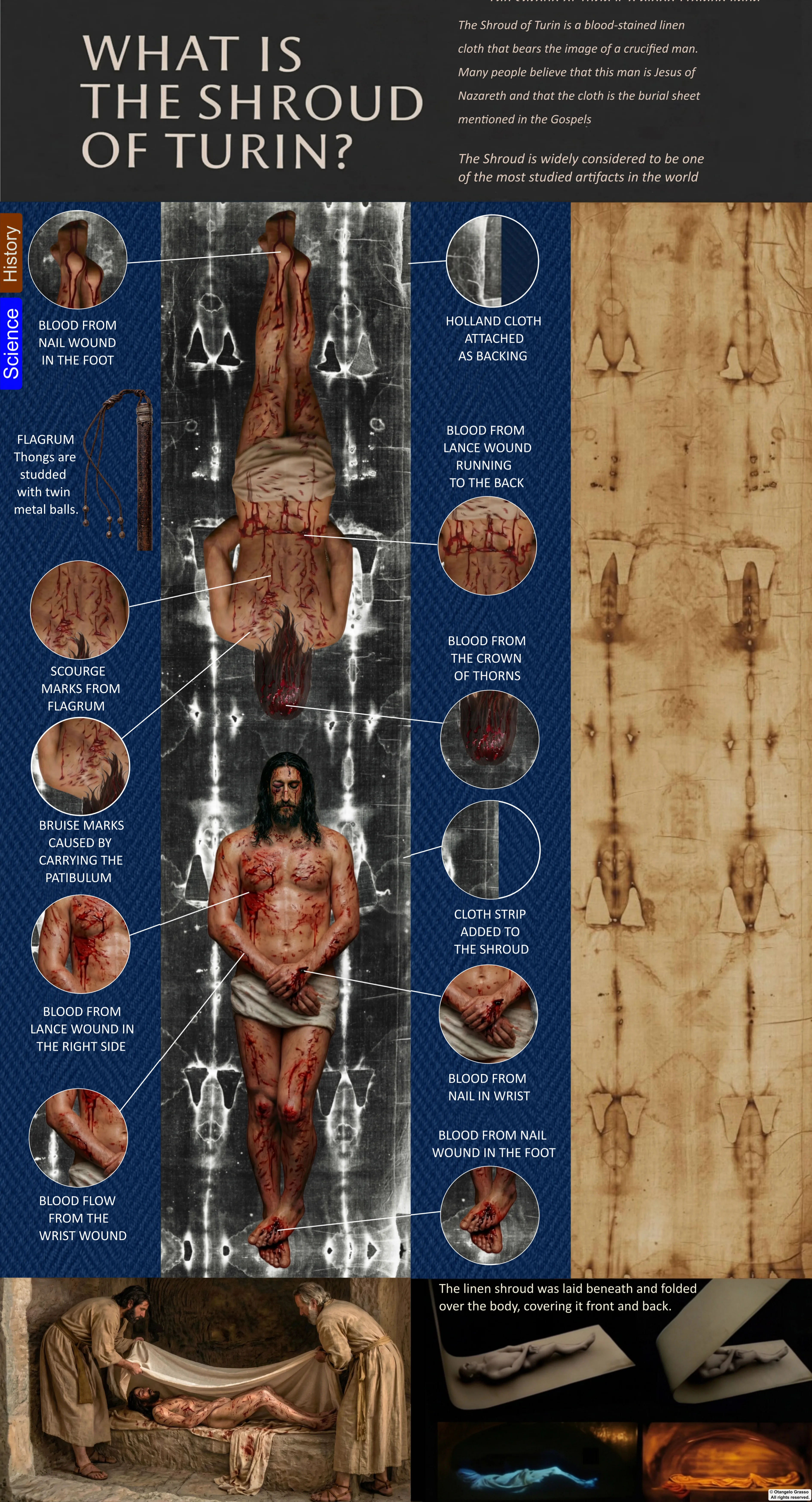
The Shroud of Turin is a long linen cloth preserved in Turin, Italy. Across its surface are two faint images of a human figure, one showing the front and one the back, arranged head-to-head. Its familiar approximate dimensions are 4.4 metres by 1.1 metres. Those visible features describe the object; they do not, by themselves, establish when it was made or who the figure represents.1
For many Christians, the figure recalls the Gospel narratives of Jesus’ death and burial. That connection explains much of the Shroud’s religious and cultural importance, but it is not written on the cloth: the object bears no name identifying the person depicted. The question of whether it is Jesus’ burial cloth is therefore a historical claim to be examined, not a fact that can be assumed at the outset.2
One object, several questions
The cloth presents a faint body image alongside stains, water marks, scorch damage, holes, seams, and repairs. These are features a viewer can observe, although the interpretation and dating of particular marks may be disputed. This chapter introduces the artifact and the way the atlas approaches it; later chapters examine the textile, image, stains, proposed injuries, photography, and scientific studies in detail.
It helps to keep three questions separate. What can be directly observed on the linen? What explanation best accounts for those observations? And what evidence connects this particular object to a person, place, or period? An answer to one question does not automatically settle the others. An unusual image, for example, may call for explanation without proving the identity of the person or the date of the cloth.3
A historical question, not a solved premise
The Shroud’s securely documented history and its proposed earlier history are treated in the historical chapters. The earliest surviving European records do not provide an unbroken chain back to the first century, and proposed links with earlier images or relics remain debated. Separately, a 1989 scientific paper reported that linen samples tested in 1988 had a calibrated radiocarbon date range of AD 1260–1390. The test, its scope, and later criticism are discussed in Chapter 19; the historical evidence and proposed earlier identifications are examined in Chapter 16.4
How to use the atlas
Begin with the illustrated panel and compare the views available in the interactive cloth display. Treat the image and marks as evidence to investigate, while recognizing that reconstructions and labels are interpretations. The following chapters take up particular topics one at a time, tracing claims to their sources and identifying where a conclusion goes beyond direct observation.
The books used for this project offer a pro-authenticity interpretation of the Shroud. They are valuable guides to the author’s argument and bibliography, but their conclusions should be weighed against the primary research they cite and the limits of that research. This introduction keeps the focus on the object and leaves the detailed arguments to the chapters devoted to them.5
References
- Vial, Gabriel. “The Shroud of Turin: A Technical Study.” Shroud Spectrum International 38–39 (1991). [Read the textile study].
- The New Testament burial accounts: Matthew 27:57–60; Mark 15:42–47; Luke 23:50–56; John 19:38–42. [Mark and John, NRSV Updated Edition]. These accounts describe Jesus’ burial; they do not identify the surviving Turin cloth.
- Schwalbe, Louis A., and Raymond N. Rogers. “Physics and Chemistry of the Shroud of Turin: A Summary of the 1978 Investigation.” Analytica Chimica Acta 135 (1982), 3–49. [Journal record].
- Damon, P. E., et al. “Radiocarbon Dating of the Shroud of Turin.” Nature 337 (1989), 611–615. [DOI and publication record].
- Grasso, Otangelo. The Shroud of Turin: A Forensic Summary of the Evidence, 3rd ed., Chapter 1; From Forensics to Faith (2026), Chapter 1; and The Image That Should Not Exist (2026), Chapter 1. These are the author’s interpretations and are cited as such. For a broad, source-based overview by the author, see “The Strongest Evidence Only: A Consolidated, Illustrated Critical Assessment of the Shroud of Turin and the Sudarium of Oviedo” (2026). [Download the author’s PDF].