A CLOSER LOOK · TRACES IN THE LINEN
What can a grain of dust remember?
A cloth can gather fragments of every place and every hand it encounters.
Look closely at an old textile and the story becomes smaller. Among the fibres may be dust, pollen, plant fragments and mineral particles. The challenge is to discover what those traces are, how they arrived, and whether they preserve a clue to the cloth’s earlier history.
Researchers have proposed that pollen and mineral particles associated with the Shroud are consistent with a journey through the Near East. Others question the identification of individual grains, the history of the samples or the geographical specificity of the mineral comparisons. This presentation follows the evidence from collection to interpretation.
1. A cloth gathers an environment, not a dated itinerary
An old textile is never just its woven fibres. Dust lodges between threads; pollen, spores and plant fragments settle on its surface; mineral grains travel with air, hands, storage materials and the objects placed beside it. These traces can preserve a record of contact. The hard question is how to separate the material’s original context from everything that happened during its later life.
This distinction matters especially for the Turin Shroud. The environmental evidence discussed here comes from different collection campaigns, different parts of the cloth and different methods. A tape pressed to the surface, dust removed by a vacuum filter, a plant shape perceived in a photograph, and an element detected by X-ray fluorescence are not interchangeable observations. They each have their own history, uncertainty and possible explanations.
The following account focuses on pollen, plant-related traces, dust and mineral comparisons. It does not treat any one of them as a shortcut to dating the linen. A trace can be compatible with exposure to a region without proving where the cloth was woven, when the trace arrived, or whether the Shroud is the burial cloth described in a religious text.
2. Max Frei’s tape samples: the original claim
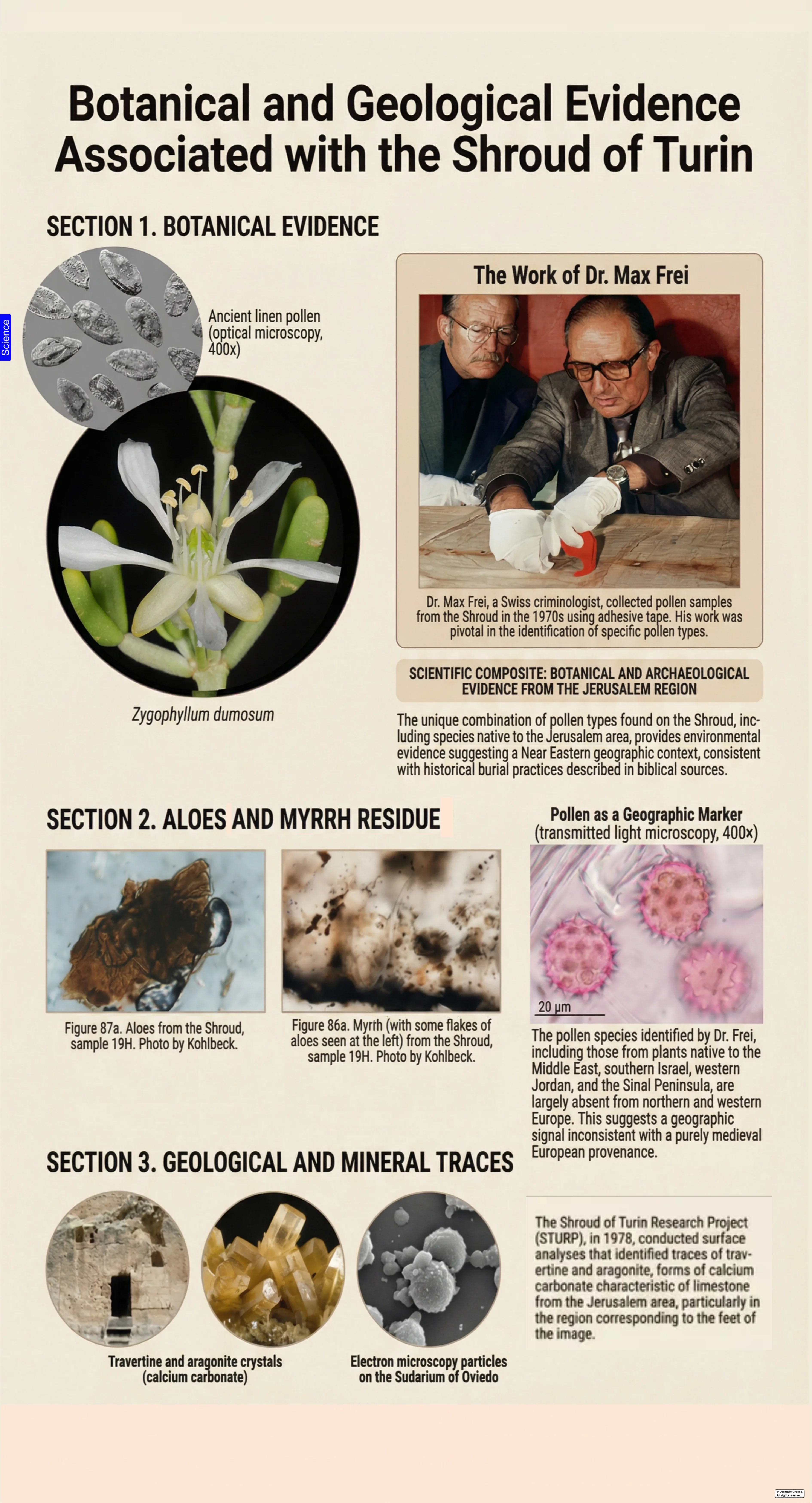
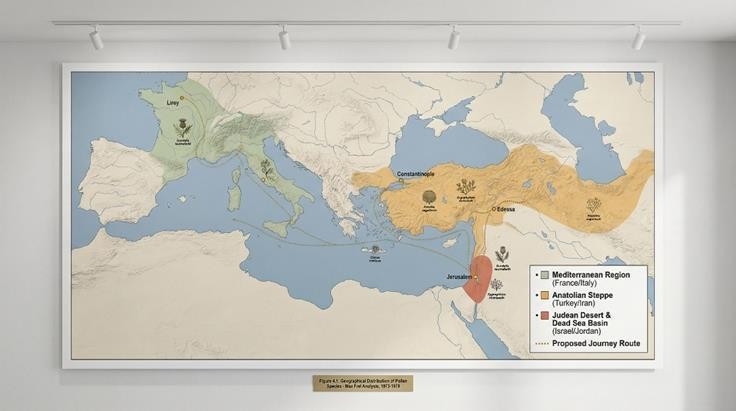
In November 1973, Swiss criminologist Max Frei-Sulzer was permitted to take surface samples during an examination of the Shroud in Turin. Frei pressed transparent adhesive tape against selected areas of the exposed face of the cloth, lifting fibres and particles for microscopic study. He returned to the Shroud during the 1978 examination and took further tape samples. Frei later reported dozens of pollen types, including grains he associated with plants from the Near East, Anatolia and other Mediterranean regions as well as Europe.1
Frei’s interpretation became historically influential because it seemed to offer a material complement to proposed pre-medieval journeys of the Shroud. If grains from plants with restricted ranges had been correctly identified and reached the cloth while it was in those regions, they could be consistent with such a journey. Frei’s own account also suggested possible routes by which pollen might have reached linen, including exposure to plants and aromatic substances.
But pollen is not a label with a date and place attached. It can be transported by wind, carried on clothing or other textiles, introduced in storage or display spaces, and transferred during sampling or laboratory work. Even an accurate species identification identifies a botanical source; it does not by itself establish when or how the grain reached this particular cloth. To turn a taxonomic list into a travel history, researchers need robust sampling records, secure chain of custody, appropriate environmental controls, independent identification and comparisons broad enough to test other possible routes.
3. Why the pollen identifications remain disputed
Palynology—the study of pollen and spores—depends on comparing a grain’s visible structure with reference specimens. Some grains have distinctive features; others share features across related taxa. The level of identification matters: a result secure at family level may not justify naming a species, and a plant’s modern distribution cannot automatically be projected unchanged into every past period.
Frei published his findings in specialist and Shroud-focused venues, but the complete body of work was not presented as a modern, independently replicated forensic study with a fully documented sampling protocol and blinded taxonomic review. After his death in 1983, the tapes passed through later custodians and were examined by other researchers. A 1999 study by Uri Baruch, Avinoam Danin and Alan and Mary Whanger reported pollen observations and botanical interpretations, including proposed Near Eastern indicators.2 That later examination is relevant, but it does not erase questions about the original sampling environment, tape handling, storage history or whether each original grain can now be confidently re-identified.
Critics have questioned the degree of taxonomic certainty that can be extracted from the preserved tape preparations, including whether adhesive obscures or alters the surface features needed for identification. They have also pointed to the need to explain unusual concentrations or distributions on individual tape segments and to distinguish grains lifted from the cloth from material introduced elsewhere in the process. The core issue is not whether pollen exists on the tapes; it is whether the grains’ identities, provenance and deposition history are documented well enough to support a specific geographic itinerary.3
Marzia Boi proposed a different reading of some of the pollen types in a 2017 paper. Her analysis argued that grains often identified as Gundelia tournefortii may instead resemble Helichrysum, and discussed several plant groups as possible sources of aromatic substances used in ancient anointing and burial practices.4 The distinction is important: Boi’s paper examined published pollen images and compared them with reference pollen; it was not a new, independently controlled collection from the Shroud. Her interpretation is a scholarly proposal, not a demonstrated identification of the original burial substances.
The fair summary is that the pollen record remains contested. Some researchers regard the Near Eastern identifications as meaningful and supported by later examination; others consider the evidence too compromised or ambiguous to carry the geographic weight placed on it. The available work does not warrant presenting the entire list as a proven sequence of stops.
4. Three different claims: pollen grains, plant shapes and burial substances
Some accounts place microscopic pollen findings beside claims that flower or plant silhouettes can be seen in enhanced photographs of the Shroud. These are separate lines of argument. A pollen grain is a physical particle examined under magnification; a proposed plant image is a visual identification made from a faint, complex image. One cannot independently validate the other.
In Flora of the Shroud of Turin, botanist Avinoam Danin and collaborators proposed that forms in photographs correspond to plants including Gundelia tournefortii and Zygophyllum dumosum, species associated with the eastern Mediterranean region.5 The authors’ botanical expertise makes the proposal worth documenting, but the underlying shapes are faint and the identifications depend on interpretation. Without a blinded test in which independent observers compare image regions with both candidate and non-candidate plants, pattern recognition can be affected by expectation. These proposed silhouettes should therefore be described as interpreted images, not recovered specimens or established plant impressions.
The burial-spice hypothesis is another step beyond identification. The Gospel of John mentions myrrh and aloes in its account of Jesus’ burial (John 19:39–40), and Boi discussed whether some pollen might relate to aromatic materials. That cultural and textual context explains why researchers have asked the question; it cannot establish that the Shroud’s grains came from those substances. A botanical match, a plant image and a historical account are distinct forms of evidence and require independent corroboration.
5. Riggi’s vacuumed dust and the later DNA studies
A second sampling method was used during the 1978 scientific examination. Giovanni Riggi di Numana collected dust and other particles with a small vacuum device, including material from areas near the cloth’s lower edges and from the space between the Shroud and its Holland-cloth backing. Unlike adhesive tape lifts, vacuum collection did not place tape adhesive directly against the particles. It still produced a mixed deposit shaped by the cloth’s full exposure and handling history; it is not a sealed archaeological layer with a known date.
In 2015, Gianni Barcaccia and colleagues analyzed DNA from dust samples supplied from this collection. They reported plant DNA attributed to multiple taxa and human mitochondrial sequences from multiple lineages. Some plant sequences were associated with species whose presence in Europe is historically recent, which is a useful warning against treating the entire biological residue as a first-century deposit. The authors discussed possible geographic implications, but the DNA came from accumulated dust, not from a dated section of the linen itself. It cannot tell which person or plant left a trace at which moment, and it cannot establish where the linen was made.6
A larger follow-up study published in Scientific Reports in 2026 examined twelve samples from the official 1978 collection using genomic sequencing and proteomic analysis. It documented a broad mixture of human and environmental material, including a dominant human mitochondrial signal matching the late collector Pierluigi Baima Bollone, alongside other human lineages. The authors found that the great majority of reads did not show the damage pattern expected for confidently ancient DNA; only a small fraction met their stated higher post-mortem-damage thresholds. They also identified modern or handling-related material in the samples.7
This newer work makes the accumulated-contamination problem tangible: the collection retains genetic contributions from people who handled the cloth or its samples. It does not test every pollen grain, resolve Frei’s disputed identifications, date the main linen or produce a reliable map of the Shroud’s travels. The study’s strong contribution is a detailed account of the biological complexity and contamination present in the 1978 material.
6. Limestone and aragonite: what the mineral comparisons show
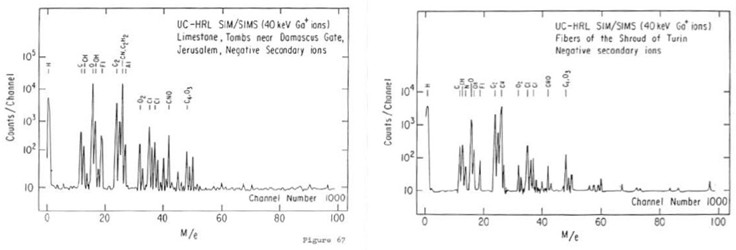
Mineral particles have also been used to argue for contact with Jerusalem. In a 1986 report, optical crystallographer Joseph Kohlbeck and Sister Eugenia Nitowski described calcium-carbonate particles from tape samples and compared them with material associated with Jerusalem tombs. Kohlbeck reported particles he identified as travertine aragonite and discussed a comparison made with Riccardo Levi-Setti’s scanning ion microprobe. The authors proposed that the resemblance was consistent with limestone from the Jerusalem area.8
The comparison is a hypothesis about geological compatibility, not a unique fingerprint. Calcium carbonate and aragonite occur in multiple regions; a close match between selected particles and one Jerusalem sample does not show that other sources were excluded. Interpretation also depends on the number and exact location of the Shroud particles, how the samples were collected and stored, the range of comparison samples, instrument resolution and the statistical treatment of similarities.
STURP’s X-ray fluorescence measurements provide a useful counterpoint. Morris, Schwalbe and London reported broadly uniform calcium and strontium across the areas they measured and suggested airborne dust as one possible explanation, including dust from the marble- and limestone-rich regions of northern Italy. They emphasized that their measurements were preliminary and did not uniquely identify the source of those elements.9 These whole-cloth elemental measurements are not the same experiment as Kohlbeck’s examination of individual particles, but they show why “calcium detected” cannot be translated directly into “Jerusalem tomb dust.”
Later investigators Giulio Fanti and Amir Sandler compared particles from Riggi’s vacuumed dust with geological material collected in Jerusalem, including material beneath the Holy Sepulchre and from Mount Zion. Their published analysis reported similarities in some reddish mineral particles and presented Jerusalem as a compatible source while acknowledging that similar geological signatures may occur elsewhere.10 This work adds a comparison using a different particle collection and analytical approach, but the samples still come from the same historically handled cloth. Different instruments do not by themselves make the historical contamination pathways independent.
7. What the environmental traces can—and cannot—tell us
Taken together, the studies show that the Shroud and the 1978 dust collection carry a complex environmental record. Researchers have reported pollen associated with Mediterranean and Near Eastern plants, interpreted possible plant forms in photographs, identified mineral particles compatible with more than one calcareous geological setting, and recovered DNA from numerous people and organisms. The material deserves continued study, but the studies do not all answer the same question.
A stronger provenance case would require accessible original sample inventories; precise maps linking each particle to its collection location; a documented chain of custody; blank and environmental controls from the sampling rooms; independent, blinded botanical identification; and a wide, geographically representative set of mineral comparisons. For DNA, it would require clear separation of ancient signals from modern handling contamination and replication from independently collected material. These standards do not prejudge the outcome; they make the proposed historical inference testable.
The most defensible conclusion is limited but useful: environmental traces can reveal contact, exposure and contamination, and some reported pollen and mineral observations are compatible with a Near Eastern setting. The evidence presently available does not establish a continuous route from Jerusalem, prove that the Shroud’s linen was manufactured there, or determine the cloth’s age. Those questions require evidence that can be independently dated and tied to a secure chain of custody.
References and further reading
- Max Frei-Sulzer, “The Pollen on the Shroud of Turin” (account and bibliography of Frei’s pollen work); see also Frei’s published summary of reported identifications, Shroud News 17 (1983). Frei’s findings are primary claims, not independent confirmation.
- Avinoam Danin, Uri Baruch, Alan D. Whanger and Mary Whanger, “Flora of the Shroud of Turin” (1999), report on pollen and proposed botanical images.
- Thomas Litt, “Kritische Anmerkungen zu den Pollenanalysen von Max Frei am Turiner Grabtuch” (1988); see the discussion and documentation collected in the Frei pollen research archive. For a critical independent review of Frei’s collection, see the linked analyses and correspondence there.
- Marzia Boi, “Pollen on the Shroud of Turin: The Probable Trace Left by Anointing and Embalming,” Archaeometry 59 (2017), 316–330; author-accessible paper. This is an alternative interpretation based on published images and reference material.
- Avinoam Danin, Alan D. Whanger, Uri Baruch and Mary Whanger, Flora of the Shroud of Turin (St. Louis: Missouri Botanical Garden Press, 1999). See the authors’ report; proposed image identifications remain interpretive.
- Gianni Barcaccia et al., “Uncovering the Sources of DNA Found on the Turin Shroud,” Scientific Reports 5, 14484 (2015); full text.
- Gianni Barcaccia et al., “DNA Signatures Preserved in the Official 1978 Sample Collection of the Shroud of Turin,” Scientific Reports (2026); full text and supplementary material.
- Joseph A. Kohlbeck and Eugenia L. Nitowski, “New Evidence May Explain Image on Shroud of Turin,” Biblical Archaeology Review 12, no. 4 (1986), 23–24; see also Nitowski et al., Environmental Study of the Shroud in Jerusalem: Field and Laboratory Report (1986).
- Raymond A. Morris, Larry A. Schwalbe and John R. London, “X-Ray Fluorescence Investigation of the Shroud of Turin,” X-Ray Spectrometry 9 (1980), 40–47; full text.
- Giulio Fanti and colleagues, “Analysis of Micro-particles Vacuumed from the Turin Shroud,” reporting microscopy and elemental comparisons of vacuum-collected particles with Jerusalem samples.
- Giovanni Riggi di Numana, Rapporto Sindone 1978–1982 (Milan: 3M Edizioni, 1982), sampling and dust report; discussed in the 1978 Shroud of Turin Research Project publications.
- Otangelo Grasso, The Shroud of Turin: A Forensic Summary of the Evidence, supplied author’s book, chapters on pollen, particulate traces and provenance. The book is a secondary synthesis; its reconstructions are distinguished above from primary measurements.