A CLOSER LOOK · THE LINEN
The Weaver’s Fingerprint
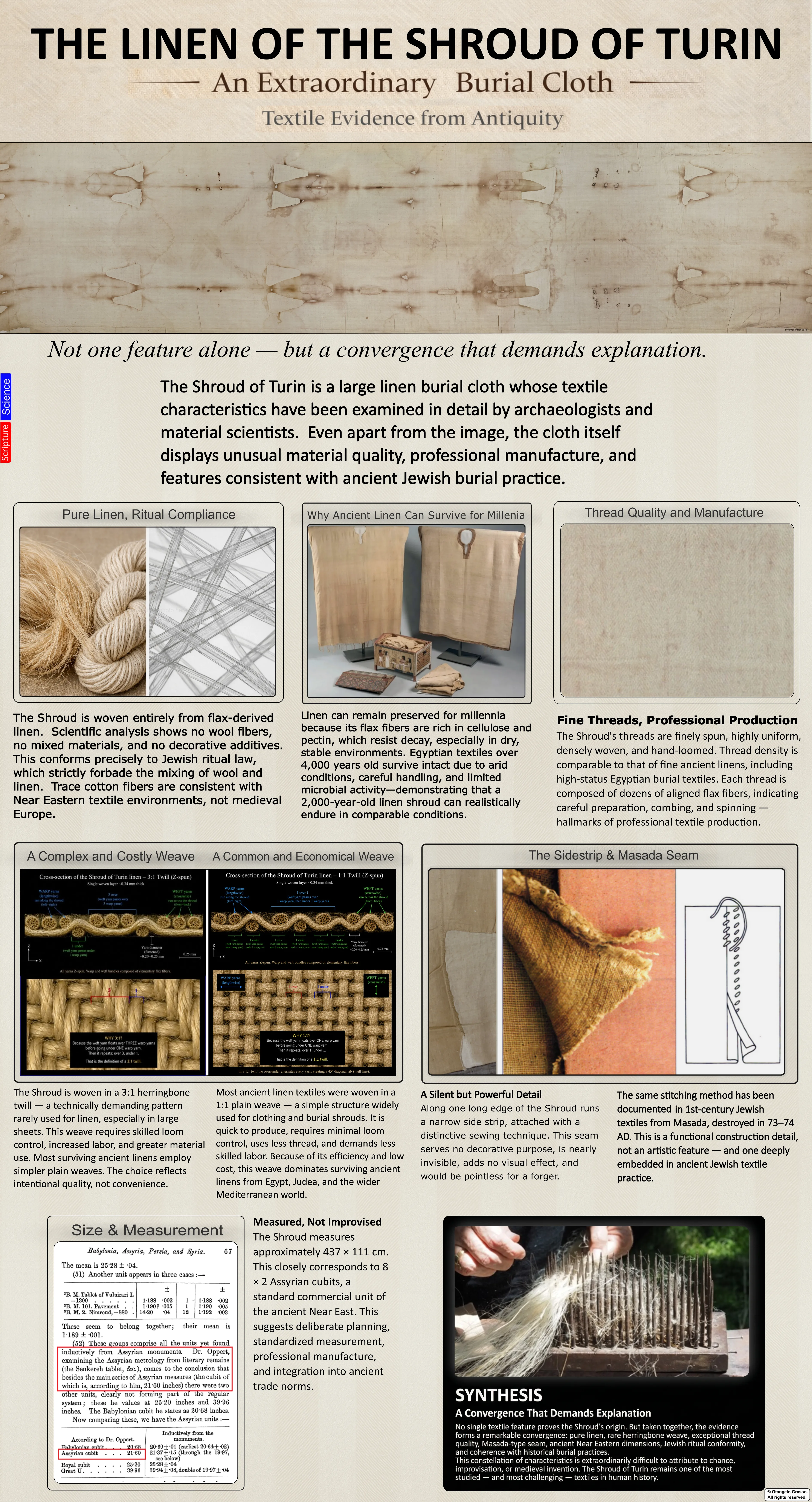
Before asking what the image means, look at the material that carries it: a handwoven linen cloth with a distinctive structure, a narrow side strip, and a history of examination and repair.
1. The cloth as a textile
The Shroud is a long, rectangular linen textile, commonly measured at about 4.3–4.4 metres long and 1.08–1.1 metres wide. A narrow strip is joined to one long edge. The exact dimensions vary slightly among reports because investigators may measure the main cloth, the attached strip, or conserved edges differently. The familiar form is a single main length of fabric, not a collection of small panels sewn together.1, 2, 3
“Linen” names the fabric; its plant fibre is flax. The yarns form a three-over-one twill: in a basic repeat, a weft thread passes over three warp threads and under one, shifting position on successive passes. The diagonal ribs reverse direction at intervals, producing the chevron or herringbone appearance. This describes the construction visible in the cloth. It does not by itself identify the workshop, date, intended use, or maker.
2. How experts examined it
Textile claims about the Shroud come from several kinds of evidence, and those kinds should not be blended. The 1969 Turin commission made observations but did not take or analyze a textile sample. In November 1973, textile specialist Gilbert Raes examined the cloth during a short authorized session and received a small sample cut from one end. It included part of the seam joining the main cloth to the side strip. Raes recorded the two pieces separately, measuring yarn counts and thread density and noting Z-direction twist in the warp and weft yarns. His report is an early direct technical description, but it is based on a very small sample from one location.1, 2
In 1978, the Shroud of Turin Research Project (STURP) documented the object during a five-day examination using photography, microscopy, spectroscopy and other methods. The team included textile and conservation specialists, but STURP did not conduct a comprehensive destructive survey of the entire weave. Gabriel Vial’s later technical study brought textile observations together with earlier measurements and photographs. Mechthild Flury-Lemberg examined the cloth directly during the 2002 conservation intervention. Each source answers a somewhat different question: sample measurement, broad visual inspection, interpretation of construction, or conservation history.2, 6, 7
That distinction matters because many popular descriptions sound more exact than the underlying evidence. A count from one fragment is not a whole-cloth map; a feature seen in a photograph is not the same as one documented under controlled direct examination; and a plausible reconstruction of loom operation is not proof that the historical cloth was made on that loom.
3. Flax, yarn and direction of twist
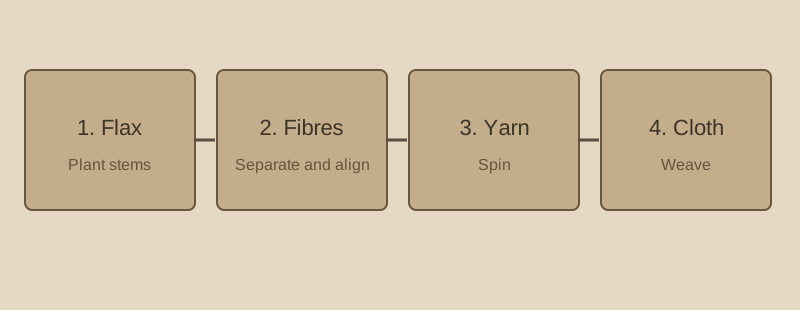
Flax stems are processed to release long fibres, which are aligned and spun into yarn. Both the warp (the lengthwise threads held under tension on the loom) and the weft (the threads passed across the warp) are reported as Z-twisted on the Shroud. “Z” describes the direction of the visible diagonal in the twisted yarn; “S” describes the opposite direction. The 2026 study by Rachel Freer-Waters and A. J. Timothy Jull examined two retained Arizona fragments from the 1988 radiocarbon sample and identified flax fibres and single Z-twisted yarns in both fragments.3
Twist direction can reflect regional practice, workshop convention, fibre behavior and intended textile quality. Much ancient Egyptian linen is S-spun, so the Shroud’s Z twist is not the dominant Egyptian pattern. That difference does not make Z-spinning a medieval invention: the 2026 authors note a rare early Egyptian Z-spun linen example. The defensible conclusion is that twist is useful comparative evidence, but no one twist direction supplies a calendar date or proves a specific place of manufacture.3, 4
The quality and uniformity of yarn can also be informative without being a clock. Skilled hand spinning can produce fine, strong yarn, while variation in thickness can occur in hand-produced textiles of many periods. The recent fragments were consistent with the reported construction of the main cloth; that supports their identification as Shroud material, but their yarn properties alone cannot tell us when the flax grew.
4. The three-to-one herringbone twill
In plain weave, warp and weft alternate over and under one another. In a 3/1 twill, the weft passes over three warp threads and under one; the point of interlacing shifts across rows, creating diagonal lines. To form a herringbone, the direction of that diagonal reverses. This requires a planned sequence of lifted and lowered warp threads. It is more complex than plain weave, but “complex” is not synonymous with “medieval.” Twills and patterned textiles have long histories across several regions.
What is unusual is the combination reported for the Shroud: linen, Z-twisted yarns, a 3/1 herringbone structure, its scale and density, and the particular weaving irregularities described by textile analysts. Freer-Waters and Jull found the two retained fragments consistent with flax, Z-twist, 3/1 twill, and, in fragment A1A, a preserved herringbone reversal. This confirms these features in the fragments examined. It does not establish that an identical cloth has been excavated from a first-century Judean tomb or that a close parallel has been found in medieval Europe.3, 6
The lack of a close surviving parallel cuts both ways. Textile preservation and excavation are uneven; specialist or imported cloth may be rare; and many archaeological textiles remain incompletely published. No securely dated textile identical in fibre, twist, density, weave, dimensions and finishing has been established for either proposed period. “No close parallel located” is a description of the comparative record, not proof that the cloth could not have been made in either era.3
5. The loom controversy: possibility and historical date
A loom holds the warp and creates openings, or sheds, through which the weaver passes the weft. The question is not simply whether a weaver could make a herringbone pattern, but whether the Shroud’s precise 3/1 chevron structure could be woven as a single-layer cloth on a loom type available in the proposed time and place.
Antoinette Merete Olsen tested a 3/1 chevron setup on a warp-weighted loom. In her experiment, the arrangement produced an additional shed and a double-weave effect, rather than the straightforward single-layer structure sought. Olsen’s experiment therefore challenges a casual claim that any ancient warp-weighted loom could readily produce the Shroud’s weave. It is a specific experimental result under a particular setup; it does not exhaust all possible ancient loom designs, tie-ups, or weaving methods.5
Another debate concerns irregularities in the cloth’s weave. Antonio Nicolotti interprets reported inversions and repeated irregularities as evidence of a particular multi-shaft drafting sequence and a horizontal treadle loom. That is a technically meaningful hypothesis: regular mistakes can sometimes preserve clues about loom setup. But to turn a loom inference into a date, researchers need a reproducible map of the defects, experimental demonstrations that distinguish competing causes, and comparative examples from securely dated textiles. The 2026 critical review of the textile evidence concludes that published observations may favor a multi-shaft or treadle-loom interpretation, but do not yet demonstrate that the structure is chronologically exclusive to medieval Europe.8, 9
Thus, the loom question has three levels: whether a setup can technically produce the weave; whether such a setup was historically present in a particular region; and whether the feature is exclusive enough to date this cloth. An experiment can answer the first level without settling the other two. The proper next work is whole-cloth, thread-level documentation and controlled reproduction on competing loom configurations—not treating either “ancient loom” or “medieval treadle loom” as established by the pattern alone.5, 8
6. Thread density, width and textile quality
Raes measured approximately 38.6 warp threads and 25.7 weft threads per centimetre in the main cloth sample. The side-strip sample had a different yarn thickness, though the measured weft count was similar. Later descriptions and the 2026 Arizona-fragment study report densities in the same general range; the retained fragments show roughly 37–41 yarns per centimetre in one direction and 26–29 in the other. These are high thread counts compared with many archaeological textiles in published northern European datasets, although those datasets are not a complete representation of Roman-period eastern Mediterranean or South Asian production.1, 3
Fine, dense cloth implies substantial labour and skill. It may be consistent with a high-quality or valuable textile, but density is influenced by fibre preparation, yarn thickness, loom practice, use and preservation. It does not uniquely identify a location or century. The same restraint applies to the Shroud’s width: a broad cloth calls for a loom and production arrangement able to handle it, but wide looms existed in more than one historical setting. To argue from width, one must compare actual loom evidence and textiles, not simply assume that broad fabric was impossible in one period.
7. The side strip and the Masada comparison
A strip roughly 7–8 centimetres wide is attached along one long edge of the main cloth. Raes saw the join in his 1973 sample. The seam and its construction later attracted attention because Mechthild Flury-Lemberg compared the joining technique with a seam or hem among textiles from Masada, the Jewish fortress occupied during the revolt against Rome and captured in 73/74 CE.1, 7
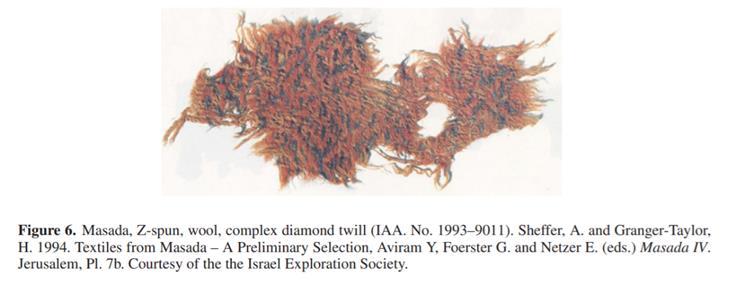
The comparison is often repeated as though the Shroud’s side strip were identical to a first-century seam. The claim is narrower: a particular compact joining technique has been compared with an archaeological example from Masada. The Masada textile differs from the Shroud in material and weave, and a seam type can persist or recur across periods. The published evidence does not show that this stitch is unique to Roman Judea. It offers a possible contextual parallel, not a direct date for the Shroud. A decisive assessment would require high-resolution, standardized documentation of the Shroud seam and the comparator, followed by a broad survey of seams from ancient, Byzantine, Islamic and medieval European textiles.7, 8
8. What excavated burial textiles show
Orit Shamir’s study compares the Shroud with Roman-period textiles from the Land of Israel and discusses a first-century burial textile from Akeldama in Jerusalem. The Akeldama textile is significant because it is an excavated funerary cloth from the relevant broad region and era. It is wool and plain woven, unlike the Shroud’s linen 3/1 herringbone twill. It therefore documents one form of burial textile use; it does not establish that all Jewish burial cloths were alike, nor does it provide a direct match for the Shroud.4
The difference is important whichever origin one considers. The Shroud should not be presented as typical first-century Judean burial fabric on the strength of a general statement that linen was used in burial. Conversely, a simpler excavated cloth cannot prove that a wealthy household or an imported textile could not have been different. The archaeological sample tells us what has actually survived and been recovered; it is not a complete inventory of every cloth used in antiquity.
The possibility of trade broadens the comparison beyond local production. Excavations at Berenike, a Roman Red Sea port in Egypt, recovered textile evidence discussed by Felicity and John Peter Wild as sails and other fabric associated with the port, within a trade network connected to the Indian Ocean. This demonstrates that textiles and textile materials moved across long distances into the Roman world. It does not connect the Shroud to India or establish its date. Any proposed eastern or South Asian origin remains a provenance hypothesis that requires direct, independently verifiable textile evidence.10, 8
A separate provenance discussion concerns reported non-linen fibres, especially cotton. Earlier investigators and later authors have discussed cotton traces associated with Shroud samples or dust. Those reports are not a secure geographic label for the linen: a stray cotton fibre may reflect a workshop, contact with another textile, later handling, conservation, or environmental transfer. Even identifying a plant species would not by itself show that the flax linen was woven in the same place as that cotton. Carlos Barta-Gil’s 2025 review compares proposed origins in Israel, Egypt, India and medieval Europe, and treats the combination of twist, weave, reported fibres, and trade as a hypothesis to assess. The textile evidence can make an eastern trade route historically conceivable; it cannot establish one without documented provenance and independently replicated fibre analysis.8, 13
9. What the 2026 Arizona-fragment study does—and does not—show
Freer-Waters and Jull examined two fragments retained from the sample removed for the 1988 radiocarbon test at the University of Arizona. They reported flax fibres, Z-twisted yarns and a 3/1 twill consistent with published descriptions of the main cloth; one fragment preserved a herringbone reversal. They found no visible repair in those pieces and no significant surface contamination in the small area they examined. Their results support the conclusion that the retained fragments are consistent with genuine Shroud linen, rather than an obviously different replacement cloth.3
The authors also set limits on that conclusion. The two fragments are small and may not represent the whole sampled corner, much less the full cloth. Their microscopy does not repeat the radiocarbon test, map carbon isotopes across the Shroud, or prove that no localized alteration could exist elsewhere. The study is relevant to textile identity and sampling discussion, but it is not a new date for the cloth. The 1988 laboratories’ published result remains a separate line of evidence and is treated in the atlas’s dating chapter.3, 11
This is why textile compatibility and radiocarbon dating must not be made to answer the same question. A weave may be compatible with a period without dating the flax. A radiocarbon result directly dates the carbon in the tested sample, subject to sample integrity and the measurement model. Textile analysis can clarify what was tested and how that sample relates to the larger cloth; it cannot, by itself, overturn or confirm a radiocarbon measurement.
10. The measured conclusion
The linen is a valuable witness because it preserves physical choices: plant fibre, spun yarn, weave structure, density, a side seam, and later conservation traces. Current evidence establishes a flax textile with Z-twisted yarns and a 3/1 herringbone twill; the 2026 fragments are consistent with the main cloth. The seam has been compared with a Roman-period Masada example, and the loom mechanics remain under active discussion.
These observations do not give the Shroud an exact date or prove where it was woven. They also do not support a simplistic claim that the textile is obviously ordinary medieval cloth or that one feature proves first-century manufacture. The most useful reading separates observed construction, experimental possibility, historical comparison and chronological inference. On that basis, the textile is unusual and technically informative; its precise provenance remains unresolved.
The author’s longer critical review develops the comparison of yarn, weave, loom evidence, side strip, archaeological parallels and dating limitations in greater detail. It is an interpretive synthesis; the underlying specialist studies are cited individually below.
References and further reading
- Gilbert Raes, “The Textile Study of 1973–1974,” English version in Shroud Spectrum International 38/39 (1991), pp. 3–6. Direct examination and measurements of the 1973 sample. [Read the report].
- Gabriel Vial, “The Shroud of Turin: A Technical Study,” Bulletin du Centre International d’Étude des Textiles Anciens 67 (1989), pp. 11–24. Textile analysis and comparative discussion. [English translation].
- Rachel Freer-Waters and A. J. Timothy Jull, “Analysis of textile fragments from the 1988 radiocarbon samples of the Turin Shroud,” npj Heritage Science 14, article 263 (2026). [Open access paper].
- Orit Shamir, “A burial textile from the first century CE in Jerusalem compared to Roman textiles in the Land of Israel and the Turin Shroud,” SHS Web of Conferences 15 (2015), 00010. [Article and DOI].
- Antoinette Merete Olsen, “The Shroud of Turin and the Extra Sheds of Warping Threads: How Hard Can It Be to Set up a 3/1 Chevron Twill, Herringbone on a Warp-weighted Loom?” EXARC Journal 2020/4. Experimental weaving study. [Read the article].
- Louis A. Schwalbe and Raymond N. Rogers, “Physics and Chemistry of the Shroud of Turin: A Summary of the 1978 Investigation,” Analytica Chimica Acta 135 (1982), pp. 3–49. [Journal record].
- Mechthild Flury-Lemberg, Sindone 2002: L’intervento conservativo – Preservation – Konservierung (Editrice ODPF, 2003). Conservation account and discussion of the side-strip seam and Masada comparison.
- Otangelo Grasso, “The Linen of the Turin Shroud: A Critical Assessment of the Textile Evidence” (2026), especially sections 2–12. Author’s interpretive review of 2026 fragment analysis, yarn, weave, loom controversy, seam comparison, archaeological context and limits of textile dating. [Download the full article PDF].
- Antonio Nicolotti, La Sindone di Torino in quanto tessuto: analisi storica, tecnica, comparativa (2018). Textile-historical argument concerning weave defects and loom type; discussed and critically assessed in reference 8.
- Felicity C. Wild and John Peter Wild, “Sails from the Roman Port at Berenike, Egypt,” International Journal of Nautical Archaeology 30, no. 2 (2001), pp. 211–220. [DOI].
- P. E. Damon et al., “Radiocarbon Dating of the Shroud of Turin,” Nature 337 (1989), pp. 611–615. [DOI]. Cited here only to distinguish the 1988 radiocarbon measurement from the 2026 textile study.
- Otangelo Grasso, From Forensics to Faith (2026), Chapter 2, “The Linen”; and The Shroud of Turin: A Forensic Summary of the Evidence, textile discussion. The author’s interpretations and proposed implications are identified as such in this article.
- Carlos Barta-Gil, “Cuestiones historiográficas sobre la procedencia del tejido de la Síndone de Turín,” Cuadernos de Arqueología de la Universidad de Navarra 33 (2025), pp. 187–212. Comparative discussion of proposed textile provenance. [DOI].
Related studies supplied for this project are also catalogued in the textile research collection and PDF article index.