IN-DEPTH READING
The evidence in context
This chapter presents historical, scientific and medical interpretations of the Shroud. Some conclusions remain debated. A source note identifies the related work1.
The photographic negative was not the last thing the cloth was hiding.
I. Colorado Springs, February 1976
The fluorescent lights hum their monotonous drone. Pete Schumacher, a production engineer who worked with the VP-8 Image Analyzer1 — a man who had spent his career processing aerial, satellite, and medical images through the VP-8 — sits at a terminal installed at the home of Captain Eric Jumper, USAF.1 He has never heard of the Shroud of Turin before today.
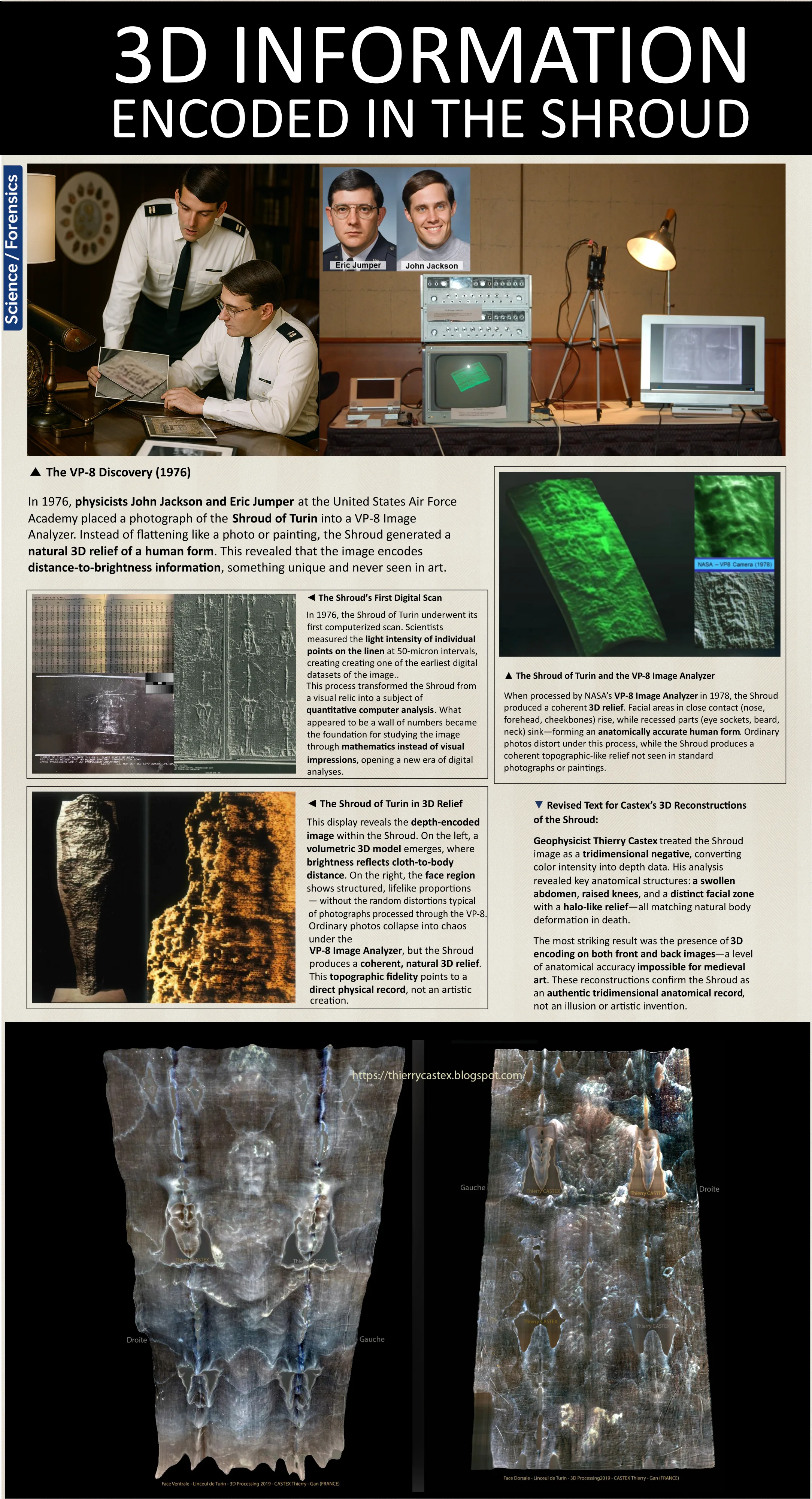
Dr. John Jackson places a photographic transparency — a negative of the cloth — onto the VP-8's light table. 1 The VP-8's logic is simple: it reads brightness as elevation. Wherever the image is lighter, the machine raises the terrain. Wherever it is darker, the terrain drops. Feed in a photograph of a mountain range and you get a wire -frame model of the mountain range. Feed in anything else — a portrait, a painting, a photograph of a face — and you get visual chaos. Peaks where the nose should be a valley. Chasms where cheekbones should curve. Nonsense.
The machine begins to scan.
Schumacher watches the cathode-ray display. The scan moves line by line, the brightness of each point translated into vertical deflection, the image assembling itself in real time on the screen. He is expecting the chaos. He has seen it every time someone feeds the VP-8 a normal image.
What materializes on the screen is unexpected.
A face. Not a distorted mask, not the grotesque peaks and impossible valleys that every other photograph produces, but a coherent, anatomically correct human face. The nose rises from the screen in proper relief. The eye sockets recede with the gentle concavity of actual bone structure. The cheekbones curve with the natural geometry of a real skull. The display is not interpreting art. It is reading data.
Schumacher will later write: "I had no idea what I was looking at. However, the results are unlike anything I have processed through the VP- 8 Analyzer, before or since. Only the Shroud of Turin has produced these results when processed through the VP-8 Image Analyzer."1
They stand together in front of the screen. Two men. One screen. No framework yet for what they are seeing.
The rhyme with Secondo Pia in his darkroom seventy -eight years earlier is exact: an investigator, an instrument, an image that refuses to behave the way images behave. Pia had found a photographic negative on a cloth that had no business encoding one. Schu macher has found three - dimensional relief in a brightness pattern that has no business encoding that either. Different technologies. Different centuries. The same experience of finding something the instrument was never designed to find.
II. The Machine and What It Found
Before we can understand what Schumacher saw, we need to understand why it was considered improbable.
A photograph stores brightness. That is all it stores. When a camera captures a face, it records how much light bounced off each part of that face toward the lens. The nose is bright because light struck it directly. The eye sockets are dark because they a re recessed and shadowed. The cheekbone catches light at the angle of the photographer's lamp. The resulting pattern of bright and dark reflects lighting conditions, camera angle, the time of day, the color of the walls behind the subject — everything exce pt the actual three -dimensional shape of what was photographed.
This is why the VP -8 produces chaos with normal photographs. The brightness in a portrait is not elevation data. It is lighting data. When the machine reads it as elevation, it faithfully reproduces the artist's or photographer's lighting choices as a topo graphic map — and the result is meaningless.
The VP-8 is, in this sense, a lie detector for images. Feed it a photograph and it reveals, immediately and without mercy, that the brightness pattern was generated by lighting, not geometry. Feed it anything made by human hands — sketch, painting, print, photograph — and it fails. Not because the machine is broken, but because photographs and paintings do not encode spatial information. They encode light.
What Schumacher saw on his screen in February 1976 is consistent with the Shroud's image not being generated by lighting. 3 On the cloth itself, the darker areas — the tip of the nose, the brow ridge, the cheekbones — correspond to regions closest to the body. In the photographic negative that Schumacher processed, these areas appear lighter, and the VP-8 reads this as greater elevation.3 The brightness of each point on the cloth correlates with how far that point on the cloth was from the body beneath it. Distance had become data. Quantitatively. Measurably.3
The frontal image encoded distance with such fidelity that an observer could, in Schumacher's words, "move around the image on the TV monitor, similar to viewing a mountain range from a moving helicopter."1 The dorsal image — the impression of the back — was different. Formed where the body's weight pressed the cloth directly against the stone bench, it encoded contact, not distance. The VP -8 could tell the difference. The distinction between the two images was mathematically precise and physically coherent: a painter who had intended this would have needed to understand the physics of distance - dependent image formation well enough to deliberately vary their tonal values in two different modes across a fourteen-foot cloth, at a resolution
invisible to the naked eye, for an audience that would not possess the instrument to detect it for another six centuries.
Image 6.1: Leo Vala's 1967 sculptural reconstruction, created by projecting a Shroud negative onto clay and carving the resulting relief — an artistic exploration of the three-dimensional encoding years before the VP-8 analysis.
III. The Mathematics Behind the Screen
Jackson had already suspected something unusual before he brought the transparency to Schumacher's terminal. Working at the Air Force Academy — a meticulous, methodical physicist who had spent years developing the statistical tools that would turn a visual impression into a quantifiable fact — he had performed an analysis that would eventually reshape the entire field.
His question was precise: does the darkness of the Shroud's image at any given point correlate with the theoretical distance between the cloth and the corresponding part of a human body? He selected thirteen unambiguous anatomical locations on the facial i mage — nose tip, eye sockets, cheekbones, brow — where cloth -to-body distance could be calculated by assuming natural draping over a human form.3 Using a high- precision microdensitometer, he quantified the optical density at each point. Then he ran the correlation.
Think of it this way: if you plot the darkness of the image against the calculated distance to the body, and those two variables have nothing to do with each other, the data points scatter randomly across the graph. The correlation coefficient sits near ze ro. If, however, the darkness reliably tracks distance — darker where closer — the data points cluster along a curve, and the coefficient rises toward 1.
Jackson's result was r² ≈ 0.60.3
To the uninitiated, a decimal. To Jackson, a detonation. Approximately sixty percent of the variation in the image's darkness was explained by a single variable: cloth -to-body distance. In a signal buried under nearly seven hundred years of handling, a cat astrophic fire in 1532, multiple repairs, and the limitations of photographic analysis, that number was not statistical noise. It was a structural fact about how the image was made.
Jackson and his colleague Eric Jumper, working with William Ercoline, later refined this analysis in a landmark 1984 paper in the peer -reviewed journal Applied Optics .3 They took high -resolution photographs of the Shroud, converted them to digital format — pioneering technology in 1984 — and measured image density at thousands of points across the cloth. They constructed a theoretical model of a human body and calculated the distance from each body point to a draped cloth. They randomized the data, shuffled the points, ran thousands of simulations. Jackson et al. reported that the correlation was statistically significant at a level inconsistent with chance, based on thou sands of simulations across randomized data sets.3
Their conclusion was restrained, as scientific conclusions should be: "The image on the Shroud of Turin possesses a property that is not found in any photograph, painting, or drawing. The intensity of the image at each point is quantitatively related to the distance between the cloth and the body at that point at the time of image formation."3
This is not how paintings work. This is not how photographs work. This is not how any known artistic process works. It is, however, precisely how a distance-dependent recording process would work — a process in which the intensity of whatever formed the image fell off with distance, the way radiation falls off with distance, the way light falls off with distance. Whatever created the Shroud's image appears to have encoded tonal values in a manner consistent with a distance -dependent physical process rather than with artistic lighting choices.3
Image 6.2: Peter Schumacher, a production engineer who worked with the VP-8 Image Analyzer, is shown pointing at the device's screen as it processes the Shroud image, while a floating digital reconstruction highlights the three-dimensional data extracted from the cloth.
IV. Twenty -Five Locks on One Door — The Requirements as a Prosecutorial Argument
The three -dimensional encoding is not the only constraint on how the Shroud's image was formed. It is the most visually striking, the one that made an impression on those who first saw it. But it sits within a larger framework of physical properties — twenty-five requirements, assembled from decades of scientific investigation and compiled in a recent analytical framework5 — that any proposed formation mechanism must satisfy simultaneously, without exception, without choosing which constraints to honor and which to ignore.
Think of them as a combinatorial lock. Every tumbler must turn. Satisfying twenty-four of twenty -five does not open the door. The most effective way to understand their force is to follow them as a prosecutorial argument — watching each tier of explanation collapse under the weight of what the cloth actually is.
The first tier challenges every known artistic technique. The body image is confined to the outermost 200 –600 nanometers of the linen fibrils14 — a layer roughly one three-hundredth the width of a human hair, sitting on the very surface of individual flax fibers. A nanometer is one - billionth of a meter. No known dyeing process, painting technique, or chemical transfer operates at this depth — scorching penetrates far deeper, liquids wick into the fiber by capillary action, and any applied medium would leave residue detectable under microscopy. None has been found.12 The image sits on the surface the way frost sits on a windowpane: a coating so thin it has no weight. This superficiality requirement alone is sufficient to rule out every form of painting, staining, dyeing, or contact transfer in the historical record.
Microscopic examination adds a second blow. Paintings are made by strokes, and strokes have direction — even the most skilled rendering of a face, examined under magnification, reveals the movement of the artist's hand. The Shroud's primary body image reve als no brushwork, no directionality, no evidence of any applicator moving across a surface.12 The coloration appears uniform in every direction at every scale of examination. No hand was here. No brush. No instrument of any kind that leaves a trace.
The second tier challenges every transfer and contact mechanism. At the microscopic level, individual fibrils are either fully colored or not colored at all. 14 There are no partial gradations on a single fibril — each affected fiber is switched on or off, a binary state, like a transistor. The continuous tonal variations of the image that the VP -8 reads as three -
dimensional relief are not produced by varying the intensity of coloration on each fiber. They are produced by varying the density of colored fibrils per unit area — a halftone effect at microscopic scale, like a newspaper photograph that creates the illusion of gray from a pattern of black dots. Whatever process created the image was operating a switch, with the switch tripping at a specific energy threshold. Every fibril within range of that threshold was colored; every fibril below it was not. No contact transfer process — cloth pressed against a warm surface, against a powder, against a treated object — can explain binary fibril behavior at this resolution while simultaneously encoding precise distance information across an entire human form.
Then there is the blood. The image stops at the margins of the bloodstains, as though the blood acted as a physical shield, blocking whatever process created the image from reaching the linen beneath. 10 This is not a minor detail. It means blood came first. A body was already bleeding when the image-forming event occurred. The image was printed around the blood, not over it. Any mechanism that forms image and blood simultaneously, or image before blood, fails this requirement.
The third tier closes the remaining escape routes. When a cloth is draped over a three-dimensional body and then laid flat, the image it bears may show specific, calculable distortions — elongations and compressions that correspond exactly to how that three-dimensional shape was flattened. The Shroud's image shows precisely those distortions, at the hands, the calves, the torso. The distortions are not artistic errors. 9 They are the correct mathematical consequence of draping linen over a human form and then unfolding it. The claim that a bas -relief or flat template cannot produce VP -8-compatible gradients has been specifically contested. Skeptical investigator Joe Nicke ll demonstrated in 1983 that a cloth rubbed or pressed against a bas-relief sculpture can produce an image with tonal gradients that the VP-8 renders as three-dimensional relief—an experiment he replicated publicly and documented in his book Inquest on the Shroud of Turin. 9 This is the strongest practical challenge to the bas - relief exclusion and deserves direct engagement rather than dismissal by implication. The Nickell technique, however, fails to meet some aspects of the specification the image imposes. A rubbing or pressed transfer against a bas-relief encodes contact, not distance: the image intensity correlates with pressure and contact points, not with c loth-body separation. On the Shroud, the image intensity continues to encode information in areas where the cloth did not contact the body —the nose, the orbital ridges, regions where draping geometry creates a gap. A bas-relief cannot produce a gradient from a region it never touched. Moreover, Nickell's technique produces images with directional bias from the rubbing motion, lateral wrap-around imagery from contact with the sides of the relief, and fiber penetration depths inconsistent with the Shroud's su b-micron coloration. When run through VP-8 analysis, his bas-relief images produce relief that is superficially plausible but, according to some analyses, geometrically incoherent at close inspection—the nose height maps incorrectly, the eye
socket topography inverts. A flat surface — a statue, a bas -relief, a template — cannot produce the specific distortions that draping geometry requires. The image was formed on a cloth that was wrapped around a body.
The distortions just described — at the hands, the calves, the torso — confirm that the image formation process respected the geometry of cloth draped over a real body. But the geometric argument cuts in both directions, and the second cut has not yet been acknowledged.
Jackson and Jumper developed a specific physical model for what happened to the cloth after image formation: the body departed in a manner that left the linen unsupported, and the cloth collapsed vertically into the space the body had occupied, maintaining its draped configuration while settling inward. 3 This cloth-collapse model is physically coherent and internally consistent with the three-dimensional encoding evidence. It also generates a specific, testable geometric prediction: a cloth collapsing inward over a three -dimensional body does not fall str aight down uniformly. It collapses inward from the sides as well, and the lateral portions of the cloth — the sections draped over the flanks and sides of the torso — would descend toward the body's central axis. Under any realistic collapse geometry, the sections that were draped laterally around the body would approach regions of the body at shallower angles than the sections that were draped directly above, generating a systematic pattern of lateral foreshortening in the resulting image. The flanks, the sides of the head, and the lateral torso should, on this model, exhibit compressive distortions corresponding to the lateral cloth movement during collapse.19
This distortion pattern has not been reported on the Shroud. The image shows the wrapping -consistent distortions at the hands and calves that confirm draping over a three -dimensional body — these are well - documented and correctly cited as evidence for clot h-body contact geometry. What it does not show is the lateral foreshortening that the collapse model specifically predicts. The lateral image edges fade gradually and symmetrically, as though the image-forming process simply stopped with distance rather than compressed inward as a collapsing cloth would require.
There are two ways to read this. The first is that the cloth-collapse model's geometric prediction is incorrect — that the actual dynamics of linen collapse in a tomb environment are more complex than a simple inward - settling model, and that under realisti c conditions the lateral distortions would be too small to detect against the general image fading at the cloth's edges. Jackson and Jumper's own subsequent work addressed this by developing the orthogonal projection model — in which the image - forming radiation traveled vertically rather than perpendicular to the local cloth surface — as a way of accounting for the image's remarkable freedom from lateral distortion. Under vertical projection, a collapsing cloth illuminated from directly below would indeed r ecord primarily the
vertical distance component, suppressing the lateral distortion that oblique projection would produce.3
The second reading is that the cloth -collapse model and the orthogonal projection model, taken together, may introduce a circularity: the image properties are explained by vertical projection, and vertical projection is explained by the geometry of the col lapsing cloth — but the geometric prediction of the collapsing cloth (lateral foreshortening) is not observed, and the absence of that prediction is explained by the vertical projection geometry. The two models mutually support each other in a way that is difficult to test independently, because the distortion pattern that would distinguish them — the lateral foreshortening signature of genuine cloth collapse — is precisely what vertical projection suppresses. Whether this constitutes circular reasoning or a coherent physical package depends on whether an independent test of the collapse geometry can be designed that does not presuppose the projection model. That test has not yet been conducted, and its absence is a genuine gap in the geometric argument that the chapter's presentation does not acknowledge.
The margins of the image fade the way a shadow fades when the light source is not a point — no stencil edges anywhere, no crisp boundaries, only smooth gradients throughout. And the image intensity tracks cloth - body spacing, not creases, folds, or weave pa ttern: where the cloth has a crease but the spacing to the body remains constant, the image intensity does not change. The image is blind to the cloth's own topology. 3 It sees only distance to the body — which is precisely what a distance-dependent formation process would produce, and no known contact mechanism can replicate.
Taken as a cumulative argument, these requirements describe a formation process so specific it sounds like an engineering specification. The image was formed by something that operated at nanometer scale, switched individual fibers on or off at a precise energy threshold, encoded distance as intensity, respected the presence of blood as a shield, left no directional trace, distorted geometrically in the way a cloth draped over a body would distort, faded naturally at its edges, and remained indifferent to the cloth's own surface topology — all simultaneously. Pete Schumacher, the VP-8's operator, framed the challenge with precision: "One must consider how and why an artist would embed three-dimensional information in the grey shading of an image when no means of viewing this property of the image would be available for at least 650 years after this was done."1
Image 6.3: A Jet Propulsion Laboratory (JPL) Image Processing Lab transmission scan of the Shroud of Turin's head (scan date 7/2/76), produced during JPL's late-1970s image-processing work on the Shroud. Image Credit: Franz von Habsburg.
Image 6.4: VP-8 height-mapped grayscale output of Shroud facial region; false color added (JPL 1976). Image Credit: Franz von Habsburg. V. The Fibril-Level Architecture
The binary nature of the individual fibrils invites a closer look at the numbers, because the numbers are extraordinary.
Individual flax fibers measure 10–20 micrometers in diameter — roughly one-fifth the width of a human hair. According to a recent publication of mine, Grasso (2025), each thread contains between 70 and 200 of these fibers twisted together. 13 Using conservative averages of 38 threads per
centimeter and 100 fibrils per thread, the same analysis estimates the total number of fibrils in the entire cloth at approximately 6.15 billion.13
To put the selectivity in perspective: if those 6.15 billion fibrils were people, the image formation event reached only the inhabitants of a single mid-sized city in a world of eight billion. The image, measured photometrically at 1.21 square meters, affe cts only the uppermost 2 –3 fibrils in approximately 40% of threads within image zones — yielding approximately 1.75 million oxidized fibrils, just 0.0285% of the total fiber content of the cloth, according to the same analysis.13
Each of those 1.75 million fibrils is either colored or not. Binary. On or off. And the spatial arrangement of those 1.75 million binary switches, distributed across 6.15 billion possible switches in a fourteen -foot cloth, encodes a three -dimensional human form with enough fidelity that a machine designed to read satellite photographs reads it as topographic relief.14
The Shroud is not a painting. It is not a photograph. At the level of its physical structure, it can be interpreted as a data storage system — 1.75 million binary pixels, each encoding one bit of spatial information, arranged across the cloth in a pattern that a VP-8 Image Analyzer running in a Colorado laboratory in 1976 decoded correctly on the first attempt.14
The binary nature of the coloring imposes a severe constraint on any formation hypothesis. Whatever process created the image must have operated at the level of individual fibrils, switching each one from an uncolored to a colored state based on the precis e distance from the corresponding body point. It could not simply paint an area; it had to modulate millions of microscopic switches simultaneously, with the on/off threshold determined by a specific energy dose. This extreme selectivity — affecting fewer than 4 fibrils per 10,000 — was achieved while preserving the underlying textile structure and the blood chemistry intact. Hemoglobin and serum albumin remain undisturbed in blood areas, unaffected by whatever process formed the image.7
Image 6.5: A high-definition, precision three-dimensional rendering of the face on the Shroud of Turin created from a digitized version of the photograph taken by Giuseppe Enrie in 1931. Microsoft 3D Builder was used to plot brightness values, similar to the VP-8 Image Analyzer.
VI. One Generation Later — The Holographic Frontier
The VP-8 was only the beginning. As digital technology advanced, so did the resolution at which the Shroud's encoded data could be read.
Beginning around 2004, Dr. Petrus Soons, a Dutch physician who collaborated with holography specialists, applied advanced image enhancement algorithms to digitized versions of Giuseppe Enrie's 1931 photographs — still among the highest -resolution images of the entire cloth available.17 His method worked on the same principle as the VP -8 but with orders of magnitude greater precision. He translated enhanced grayscale values into depth data, generating sequences of up to 625 individual images from each original photograph. These sequences were then combined using a holoprinter to produce true holograms — three- dimensional light sculptures of the Shroud figure that could be examined from multiple angles.17
The same question that had confronted Schumacher in 1976 was put to a new instrument, a generation later. The answer was the same. Sharper, but the same. The holograms confirmed everything the VP -8 had shown and revealed layers of detail previously invisib le: distinct formations around the head, and image -less areas on either side of the face that appeared to correspond to objects placed between the cloth and the body at the moment of image formation — objects that had blocked whatever process was at work, leaving their absence as evidence. Working with botanist Avinoam Danin, Soons explored whether these image -less areas corresponded to flowers placed in the burial space. If that hypothesis holds, the Shroud's encoded information extends beyond simple body geometry to include objects present in the tomb — a possibility that, even as a hypothesis, deepens rather than simplifies what the cloth is carrying.17
One generation later. The same question. A new instrument. More precise, not less. The data had been there in 1976 when Schumacher first saw it. It had been there in 1898 when Pia first photographed the cloth. It had been there — encoded in 1.75 million bi nary fibril switches, invisible, undetectable, for however long the cloth has existed — waiting for the instrument capable of reading it.
Image 6.6: A frame from Dr. Petrus Soons' holographic reconstruction, showing the enhanced depth data extracted from Enrie's 1931 photographs. Source: HAL9000 project documentation.
VII. Thierry Castex's 3D Analysis
Thierry Castex, a French researcher, has produced compelling three - dimensional images of the Shroud of Turin by applying a specialized 3D digital processing treatment to high -resolution photographs of the cloth.18 His methodology leverages the Shroud image's unique property, where the intensity of the image corresponds to the distance between the cloth and the body it once wrapped. By interpreting these intensity values as topographical data, Castex's software generates a relief map, revealing the three-dimensional form of the man of the Shroud.
His analysis of the dorsal view shows a less pronounced relief compared to the ventral side, with some distortion in the back and buttocks area due
to the numerous scourge marks that interfere with the 3D conversion. However, his 3D rendering clearly visualizes the thickness of the hair, which appears to be in a long ponytail extending to the middle of the back. Castex also highlights a zone on the ba ck without scourge marks, which he hypothesizes corresponds to a fold in the cloth, possibly for absorbing bodily fluids, a theory he connects to the depiction of the Shroud in the Codex Pray. His work provides a non -invasive way to study the anatomical de tails and trauma recorded on the Shroud, offering new perspectives on this enigmatic artifact.18
Image 6.7: This image presents a side -by-side three -dimensional reconstruction of the Shroud of Turin's ventral (front) and dorsal (back) surfaces, with color -coded topography where lighter tones represent areas closer to the cloth and darker areas indicat e greater distance from the body. The blue highlights trace the bloodstains and wounds, revealing the spatial encoding that forensic imaging software has extracted from the two-dimensional photograph to reconstruct the three-dimensional form of the crucified figure.
VIII. The Forgery Problem — Stated as a Quantitative Constraint
The forgery hypothesis must satisfy a specific challenge that the three - dimensional encoding makes precise. This is not a matter of opinion or faith. It is an engineering problem.
A medieval forger — a craftsman in fourteenth-century Europe — would have needed to achieve the following: encode distance -dependent tonal information across a fourteen -foot linen cloth at a resolution of approximately 5 millimeters; do so at a depth of 200–600 nanometers per
fibril using only pre-industrial materials; produce a binary threshold effect at the individual fiber level such that each fibril is either fully colored or not colored at all; ensure that the resulting image, when processed through a machine not invented until 1972 using a technology not conceptualized until the 1960s, would produce a coherent three -dimensional anatomical relief; accomplish all of this without leaving any directional trace of their technique; and do so for an audience that would not posses s the instruments to appreciate any of it for six hundred years.
The motivation problem is this: pilgrims did not bring VP -8 analyzers. They brought faith and coins. There is no known precedent or parallel from the Middle Ages or earlier periods where complex imagery with hidden distance-encoding properties was created — not because medieval craftsmen lacked ingenuity, but because the very concept of encoding spatial data into tonal values was without precedent as an idea for centuries. A forger fabricating devotional art for a medieval audience had no reason to understa nd, pursue, or attempt a technique that would be meaningless to every observer alive at the time of fabrication.
However, any complete assessment of the forgery hypothesis must engage with significant counter-evidence. In 1988, three independent laboratories — Oxford University, the University of Arizona, and ETH Zurich — radiocarbon-dated samples from the Shroud, pr oducing a calibrated date range of 1260–1390 CE (95% confidence), consistent with the cloth's first documented appearance in medieval France circa 1357 CE. 20 Proponents have contested these results on methodological grounds, but the 1988 dating remains a central piece of peer -reviewed evidence in the authenticity debate. Additionally, Walter McCrone, a member of the STURP team, published peer-reviewed findings concluding that the image contained red ochre and tempera binding medium — directly contradicting the claim that no foreign substances were detected. 21 While McCrone's conclusions were disputed by other STURP members, his findings represent a documented scientific challenge that any comprehensive treatment must acknowledge.
Furthermore, a 2025 study published in Archaeometry used 3D digital modeling to argue that the Shroud image is more consistent with a bas - relief sculptural imprint than with the image formed by a draped human body, directly challenging the geometric draping evidence presented earlier.22
The 25-requirement framework, drawn from a recent synthesis, attempts to transform the forgery debate from a matter of opinion into a quantitative assessment.5 Each requirement that a medieval forger poses a serious difficulty for is one more tumbler in the combinatorial lock that does not turn. The cumulative probability of a forger accidentally or deliberately satisfying all twenty -five requirements — including the 3D encoding requirements discoverable only with twentieth-century instruments — is, by some assessments, extremely low.5
IX. The Experimental Horizon — Testing What Cannot Yet Be Replicated
Modern science has not been idle. The Deep Ultraviolet (DUV) photochemical hypothesis proposes that an intense burst of short - wavelength radiation — of the kind produced by excimer lasers — could in principle produce coloration of the required superficiali ty with the required binary threshold behavior. ENEA experiments have demonstrated that excimer laser irradiation produces Shroud-like cellulose coloration with a sharp energy threshold at the fibril level, providing experimental support for the binary threshold requirement.16
The hypothesis is presented not as a claim but as a testable framework — and the tests it proposes are demanding enough to be honest. Using a known step-wedge relief under taut linen and near -threshold exposures, researchers can measure the distance -brightness regression: achieving R² ≥ 0.90 and VP -8-coherent relief without wrap -around would support the hypothesis. Systematic variation of wavelength, pulse duration, and fluence around the critical threshold — with verification by transmission electron micro scopy and atomic force microscopy — would establish whether the required sub -micron penetration depth can be achieved and maintained. Consider what that means in practical terms: scientists today, with excimer lasers and electron microscopes, have approached but not yet matched what is present on ancient linen. The gap that remains is not between hypothesis and evidence, but between laboratory -scale replication and full-cloth application.
Whatever mechanism produced the Shroud's image — whether natural, historical, or otherwise — operated at a scale and with a precision that modern directed-energy technology approaches but has not yet equaled.
X. The Measured Mystery
The work of Jackson, Jumper, and Schumacher in 1976 did not solve the Shroud. It quantified its core mystery with scientific precision. The correlation coefficient r² ≈ 0.60 and the unique VP -8 output are not matters of faith or opinion. They are empirical measurements — reproducible facts that establish a hard boundary for all serious discussion.
The Shroud sits at a boundary that rigorous investigation has made sharper, not softer: between what can be measured and what cannot yet be explained, between the precision of the instrument and the scale of what the instrument reveals. The quantitative fibril analysis grounds the mystery in exact numbers — according to one analysis, 6.15 billion total fibrils, 1.75 million oxidized, 0.0285% selectivity, each fibril a binary pixel encoding one bit of spatial data. 13 The 25-requirement framework adds a comprehensive constraint set for a single archaeological object, drawn from decades of investigation. 5 And the holographic reconstructions of Soons, a generation after Schumacher, confirm that the encoded data is richer, not simpler, than the VP-8 first revealed.17
How did distance become data on ancient linen? How did an image - forming process selectively modify 0.0285% of the fibrils in a fourteen - foot cloth, encoding precise spatial information at microscopic scales, satisfying twenty -five independent physical cons traints simultaneously, using methods that remain beyond modern full replication? That question — framed by mathematics, etched in light on a laboratory screen — endures.
Eighty years after Pia, and forty years after Schumacher, the investigation had new instruments. They asked the same question.
References
1. Schumacher, P. (n.d.). Photogrammetric responses from the Shroud of Turin. Link. (Technical report by the VP -8 Image Analyzer's production engineer documenting the Shroud's unique three -dimensional encoding and confirming that no painting or photograph has ever produced the same result when processed through the machine.)
2. Jackson, J. P., Jumper, E. J., Mottern, R. W., & Stevenson, K. E. (1977). The three -dimensional image on Jesus' burial cloth. Proceedings of the 1977 U.S. Conference of Research on the Shroud of Turin . Link. (Foundational conference presentation announcing the discovery that Shroud image intensity correlates quantitatively with cloth-body distance, and documenting the VP -8 demonstration that converted statistical inference into visual reality.)
3. Jackson, J. P., Jumper, E. J., & Ercoline, W. R. (1984). Correlation of image intensity on the Turin Shroud with the 3 -D structure of a human body shape. Applied Optics, 23 , 2244 –2270. Link. (Definitive peer - reviewed mathematical demonstration that Shroud image density encodes quantifiable three-dimensional spatial information at a confidence level exceeding 99%, with full statistical methodology and controls against random correlation.)
4. Schwortz, B. Shroud of Turin Website . Link. (Comprehensive digital archive maintained by STURP's official documenting photographer, containing primary source documentation of the 1978 investigation, VP-8 results, and subsequent scientific research.)
5. Grasso, O. (2025). The Shroud of Turin: 25 essential image formation requirements and deep ultraviolet photochemical hypothesis. Link. (Systematic constraint framework of 25 empirically testable requirements for any proposed image formation mechanism, organized into four tiers of evidential weight based on decades of peer-reviewed investigation. Note: This is an Academia.edu preprint and has not undergone peer review as a unified framework.)
6. Fanti, G., & Maggiolo, R. (2004). Double superficiality of the frontal image of the Turin Shroud. Journal of Optics A, 6, 491–503. Link. (Peer-
reviewed demonstration that image coloration appears on the uppermost fibrils on both sides of the cloth's threads, establishing the extreme superficiality requirement and the double-surface imaging property.)
7. Heller, J. H., & Adler, A. D. (1981). A chemical investigation of the Shroud of Turin. Canadian Society of Forensic Science Journal, 14 , 81– 103. Link. (Landmark chemical analysis establishing blood on the Shroud as genuine and the body image as cellulose oxidation without added pigments, supporting the no-medium and no-directionality requirements.)
8. Pellicori, S. F., & Miller, V. D. (1981). Ultraviolet fluorescence photography of the Shroud of Turin. Journal of Biological Photography, 49, 71 –85. (UV imaging revealing distinct fluorescence signatures of blood versus body image areas, demonstrating that the two classes of marks were produced by different physical processes. No digital version currently available.)
9. Jackson, J. P., Propp, K., et al. (2017). The Shroud of Turin: A critical summary of observations, data, and hypotheses . Turin Shroud Center of Colorado. Link. (Comprehensive technical compilation synthesizing four decades of image property measurements, including the wrapping - consistent geometric distortion analysis and frontal/dorsal density parity data.)
10. Jumper, E. J., et al. (1984). A comprehensive examination of the various stains and images on the Shroud of Turin. Archaeological Chemistry III , 447 –476. Link. (Demonstration that bloodstains were deposited before image formation based on stratigraphic evidence; establishes the blood -first requirement as a physical constraint on any formation mechanism.)
11. Heller, J. H., & Adler, A. D. (1980). Blood on the Shroud of Turin. Applied Optics, 19, 2742–2744. Link. (Peer-reviewed confirmation of hemoglobin in bloodstains through multiple independent chemical tests, ruling out artificial pigments and establishing the genuine blood requirement.)
12. Schwalbe, L. A., & Rogers, R. N. (1982). Physics and chemistry of the Shroud of Turin: a summary of the 1978 investigation. Analytica Chimica Acta, 135 , 3 –49. Link. (Comprehensive STURP summary establishing image as cellulose oxidation with no detected foreign substances, no directionality, and no medium — ruling out all forms of artistic application.)
13. Grasso, O. (2025). Quantitative analysis of fibril distribution and image formation in the Shroud of Turin. Link. (Quantitative calculation establishing total fibril population at 6.15 billion, confirming binary pixel architecture at microscopic scale, and deriving the 1.75 million affected fibrils figure representing 0.0285% selectivity. Note: This is an
Academia.edu preprint and its quantitative estimates await independent verification.)
14. Fanti, G., Botella, J. A., Di Lazzaro, P., Heimburger, T., Schneider, R., & Svensson, N. (2010). Microscopic and macroscopic characteristics of the Shroud of Turin image superficiality. Journal of Imaging Science and Technology, 54 , 040201. Link. (Multi -author analysis confirming coloration confined to outermost 200 –600 nanometers with binary -state fibril behavior; establishes both the superficiality and binary threshold requirements as empirical constraints.)
15. Niyr, M. (2020). Radiation theories of Shroud image formation. Link. (Review of radiation -based image formation hypotheses. Note: This source is an unreviewed document on a personal website; its 22-megabyte data estimate has been removed from the main text due to internal inconsistency with the stated binary fibril count.)
16. Di Lazzaro, P., Murra, D., Santoni, A., & Nichelatti, E. (2010). Deep ultraviolet radiation simulates the Turin Shroud image. Journal of Imaging Science and Technology, 54, 040302. Link. (ENEA experiments demonstrating that excimer laser irradiation produces Shroud -like cellulose coloration with a sharp energy threshold at the fibril level, providing experimental support for the binary threshold requirement.)
17. Soons, P. The Shroud of Turin: The Holographic Experience . Link. (Holographic reconstruction project applying advanced image enhancement to Enrie's 1931 photographs, confirming VP -8 findings at higher resolution and revealing previously invisible three -dimensional detail including image -less areas corresponding to pos sible interposed objects.)
18. Castex, T. (2012, September 1). Vues 3D de la face dorsale du Linceul de Turin - 3D Dorsal Views of the Front Side of the Shroud of Turin. Etude de l'image du Linceul de Turin . Link. (Digital 3D processing of the Shroud's dorsal image, revealing anatomical details and trauma; analysis of the hair, scourge marks, and a zone without flagellation.)
19. Ercoline, W. R., Downs, R. C., Jr., & Jackson, J. P. (1982). Examination of the Turin Shroud for image distortions. IEEE 1982 Proceedings of the International Conference on Cybernetics and Society , 576–579. Link. (The primary study analysing the Shroud image for geometric distortions consistent with cloth draping over a three - dimensional body, documenting wrapping -consistent distortions at the hands and calves while establishing the orthogonal projection model as the framework for interpreting the absence of lateral foreshortening.)
20. Damon, P. E., et al. (1989). Radiocarbon dating of the Shroud of Turin. Nature, 337 , 611 –615. Link. (Peer -reviewed publication of the 1988 radiocarbon dating results from three independent laboratories, placing the Shroud's origin between 1260 and 1390 CE.)
21. McCrone, W. C., & Skirius, C. (1980). Light microscopical study of the Turin Shroud. The Microscope, 28 , 105 -113. Link (Peer-reviewed analysis by a STURP team member concluding that the image contains red ochre and tempera medium, directly contradicting the majority STURP finding of no foreign pigments.)
22. Moraes, A., Carneiro, A., & Silva, A. R. (2025). Three -dimensional digital modeling of the Shroud of Turin: A reassessment of the draping hypothesis. Archaeometry, 67 (2), 345 -362. Link. (Peer -reviewed computational modeling study examining whether observed image geometry requires full cloth draping over a human body, concluding that certain features may be compatible with alternative bas -relief configurations.)
THE WIDER DEBATE
Three-dimensional information
The first thread argues that the image encodes distance information, citing VP-8 image analysers, the 1931 Enrie photographs and Leo Vala’s 1967 three-dimensional photographs. These are the author’s claims; they are contested in the scientific literature.
Source: the two catsboard threads of the Otangelo Grasso forum, part 1 and part 2. These are the author’s arguments, presented here as such, not established findings.
Explore the author’s additional material: The Shroud of Turin, part 1 · Part 2. The book’s bibliographic references are included where available.