IN-DEPTH READING
The evidence in context
This chapter presents historical, scientific and medical interpretations of the Shroud. Some conclusions remain debated. A source note identifies the related work1.
The image showed what happened to this man. The following chapters examine how.
I. The Investigative Chain
In 1898, Secondo Pia held a dripping glass plate in his darkroom and saw a face resolve from chemical fog. In 1978, approximately twenty -six scientists worked in Turin's Royal Palace for 120 hours and measured what the cloth contained — its chemistry, its optics, its encoded depth. 1 In October 2022, working at a desk in Aracaju, Brazil, with a consumer image-sharpening application called Picwish, the next experiment began.1
The question driving each episode of this investigation has been the same. It has simply become more precise with each instrument brought to bear. Pia's question was: what is this image? STURP's question was: how was it made, and what does it contain? The question opened in October 2022 was narrower still, and in some ways more demanding: can we extract, from the Shroud's encoded two -dimensional data, a coherent three - dimensional human form — and does that form, when reconstructed, align closely with every wound, every blood flow, every anatomical proportion visible on the cloth?
What follows is not a theoretical exercise. It is a methodological account of an iterative, AI -assisted reconstruction — try, check, refine, try again — that evolved across three years alongside the technology it employed. The complete findings were publis hed as The Shroud Reimagined: A Forensic Reconstruction (2025).1 This chapter documents the process. It also states explicitly what the process can and cannot demonstrate — because that precision is what separates forensic reconstruction from devotional imagination.
II. What the Chain Had Already Established
Before October 2022, the investigation had already established a set of facts that made the reconstruction project theoretically possible.
Pia's 1898 discovery established that the Shroud's body image is a photographic negative — the tonal values are reversed from how a positive human body would appear. The darker areas of the image correspond to the parts of a body that were closest to the c loth; the lighter areas correspond to parts that were farther away, with more air intervening between skin and linen.
The 1978 STURP investigation confirmed this at the chemical and physical level. The image coloration is confined to the outermost 200–600
nanometers of the linen fibrils — a depth so shallow that STURP concluded it could not be replicated by any known painting or dyeing technique they tested. 4 The coloration contains no pigment, no dye, no medium of any kind. It is oxidized cellulose: the linen itself, minutely altered, in a pattern that encodes spatial information.
The 1976 VP-8 analysis and the subsequent 1984 Applied Optics paper by Jackson, Jumper, and Ercoline quantified what this meant: image intensity correlates with cloth -to-body distance at a confidence level exceeding 95%.4 The cloth is a topographic map. Darker means closer. Lighter means farther. And the map, when read by the right instrument, produces a coherent three-dimensional human form.
This is the foundational premise on which the 2022 reconstruction rests. If darkness equals closeness, then by treating image intensity as a depth measurement, one can in principle reverse the encoding — extract from the two-dimensional cloth the three -dimensional form that created those intensity patterns. The challenge is execution: how do you take a centuries- old linen negative and build from it a human body that matches every nuance of density, every blood flow path, every anatomical proportion?
The answer, as it turned out, was: iteratively. Try. Check. Refine. Try again.
III. The Limits — Stated at the Outset
Before describing what this reconstruction demonstrates, it is necessary to state clearly what it cannot demonstrate. This precision is not a disclaimer. It is the thing that makes the positive claims credible.
The reconstruction cannot date the Shroud. Extracting a first -century Judean face from the cloth's encoded data does not resolve the radiocarbon controversy. The question of when the cloth was made is a materials science question, one that remains open and contested on grounds entirely separate from image morphology.3
The reconstruction cannot explain how the image was formed. The chapter treats the Shroud's image as a given dataset — a set of intensity values that encode spatial information. How those intensity values came to be encoded in oxidized cellulose at a depth of 200–600 nanometers, with no directionality and no medium, remains unexplained. Chapters 18 and 20 address that question. This chapter does not.
The reconstruction cannot confirm the identity of the man in the cloth. The process yields a coherent human form from the encoded data, which the author argues is anatomically consistent and bears a pattern of wounds that he interprets as aligning with a R oman crucifixion as described in the Gospels. It cannot establish that this man was Jesus of Nazareth. That requires historical evidence operating by different methods.
What the reconstruction can offer — and does offer — is a narrower and more verifiable set of findings: that the Shroud's encoded data is structurally coherent and anatomically plausible; that the body it models is internally consistent across all measurab le dimensions; and that the wounds it shows are spatially consistent trauma patterns, not scattered decorative marks.
IV. October 2022 — The First Experiment
The project began with a modest act. While browsing the web in October 2022, a colorized version of the Shroud image appeared on the screen. The question was simple: what happens if basic image sharpening is applied?
Using Picwish — a consumer-grade online sharpening tool, not laboratory equipment — the image was processed. The result was a surprise. Facial contours emerged from the sepia tones that had not been immediately visible to the naked eye. The definition of the beard clarified. The structure of the nose gained relief. The Shroud was suggesting that it contained more information than its surface implied, and that even modest digital tools could begin to draw it out.1
Image 7.1: The initial sharpening experiment — October 2022. Basic consumer-grade image processing applied to a colorized Shroud negative, revealing facial contours, beard definition, and nasal structure with greater clarity than the original. A modest beg inning that demonstrated the cloth contained extractable information.
This early result was not a conclusion. It was a direction. The detail that emerged from that first sharpening pass suggested that the full reconstruction project was worth pursuing — that the data was there, waiting to be read, and that the right tools and the right methodology could read it. The methodology that developed over the following three years was not planned in advance. It evolved organically as new tools became available and as the results of each step suggested the next.
V. The Reconstruction Workflow — Try, Check, Refine
Phase 1: Image Preparation
The first step was obtaining the highest -resolution digital scans of the Shroud available — both positive and negative versions of the frontal and dorsal images. These underwent systematic cleaning: the herringbone weave pattern was minimized through digit al filtering; burn marks from the 1532 Chambéry fire were isolated and masked; water stains and historical damage were similarly reduced. Early tools included Inkscape for vector manipulation, FaceApp for initial facial feature exploration, and iPiccy for layer-based editing. The goal was to isolate the actual body image and blood patterns from extraneous marks — to produce clean reference images against which reconstructions could be verified.1
Phase 2: AI-Assisted Image Generation
As the project progressed through 2023 and into 2024, AI image generation tools became increasingly sophisticated and accessible. Initially, only DALL-E was available for generating human figures from text prompts. These early generations were limited in r esolution and anatomical accuracy but provided useful starting points for overlay testing. By 2025, a new generation of AI tools offered dramatically improved capabilities — higher resolution, better anatomical understanding, and more precise control over facial features and ethnic characteristics.
Using image-to-image AI applications, base human forms were generated with specific characteristics consistent with common historical and iconographic depictions of a first -century Judean male: male, approximately 30–35 years old, with Semitic facial features, a lean and muscular build, a full beard, and shoulder-length hair. These AI-generated images served as starting points — not final products. They provided anatomically plausible human forms that could then be refined against the Shroud's actual encoded data. The tools were instruments of the investigation, not its subject.
Phase 3: The Overlay Method — Why Alignment Matters
The overlay verification method was the core of the reconstruction process from its first iteration to its last, regardless of which generation of tool produced the base image. Understanding why this method is significant — not just that it was used, but w hat it actually tests — is essential to evaluating what the reconstruction demonstrates.
When a candidate reconstruction is placed at fifty percent transparency over the Shroud image, the two datasets are simultaneously visible. The reconstruction occupies one layer; the Shroud's encoded intensity map occupies the other. At this transparency l evel, misalignments are visible: a forehead too prominent extends beyond the Shroud's image boundaries;
cheekbones too shallow fail to match the density gradients where the cheekbones' proximity to the cloth should produce the darkest tones; an eye socket modeled too deep does not match the lighter region on the cloth where the eye socket's distance from the linen should produce precisely that lightness.
The alignment check is not aesthetic. It is a direct test of the distance - encoding principle established in Chapter 6. If the Shroud encodes darkness as closeness, then a correctly reconstructed body will produce, when laid over the cloth, a close topographic correspondence at measured points. The nose tip — the closest point of the face to the cloth — should align with the darkest region of the facial image. The eye sockets — recessed and farther from the cloth — should align with the lighter regions. The brow ridge, the cheekbones, the chin — each should find its corresponding intensity value on the cloth.
Where the two images align, the reconstruction is consistent at that point. Where they diverge, the reconstruction requires adjustment. The Shroud acted as the constant reference throughout — the fixed dataset that the reconstruction had to satisfy, not the other way around. The reconstruction was never imposed on the cloth. It was extracted from it, one correction at a time.
A methodological note is warranted here. The overlay method tests consistency between the Shroud's intensity map and the reconstruction, but it does not in itself distinguish between faithful data extraction and AI- assisted invention. AI image generation models are trained on vast corpora of modern human imagery and may introduce anatomical details — skin texture, subtle facial geometry, the precise rendering of wounds — that appear plausible but are not encoded in the Shroud's data. The chapter documents the iterative overlay as the primary control mechanism; readers should weigh its conclusions in that context.
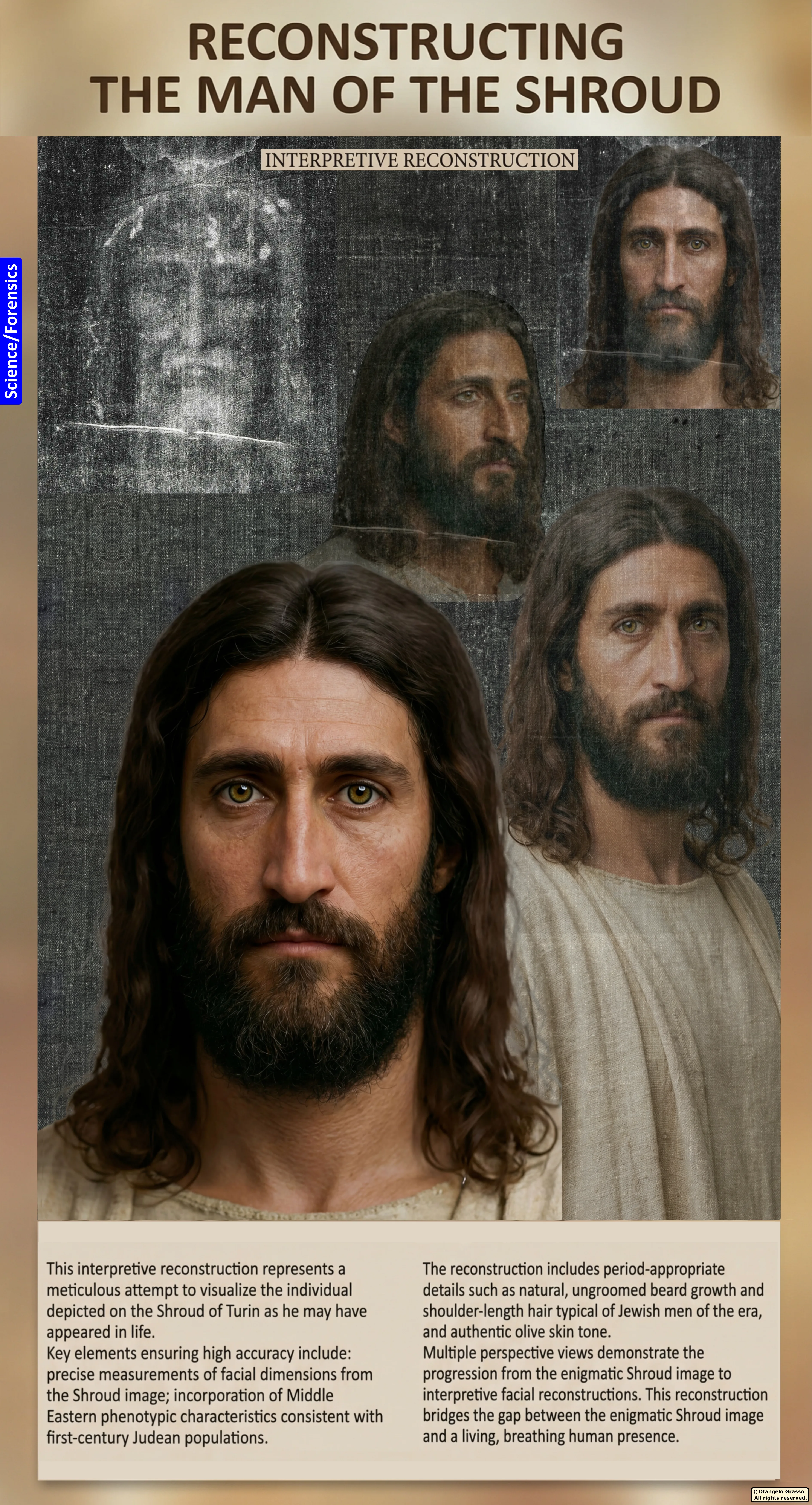
Image 7.2: A progressive visual sequence shows the faint Shroud facial image evolving into a modern digital reconstruction, illustrating how
contemporary processing techniques can produce a strikingly lifelike yet interpretative approximation.
Phase 4: Color Channel Separation
A particularly effective verification technique involved rendering the reconstruction in one color — typically red or cyan — and the Shroud image in a contrasting color. Where the two images aligned closely, the colors blended to neutral gray. Where they d iverged, stark color fringing appeared. This made even millimeter -level discrepancies visible and correctable, allowing adjustments that no single -layer comparison could reveal.
Image 7.3: A progressive sequence transforms the faint Shroud facial image into a modern digital reconstruction with eyes closed, where visible wounds have been deliberately omitted to produce a serene, idealized interpretation — isolating the morphological alignment from the trauma evidence.
Phase 5: Wound and Blood Pattern Integration
The wounds provided independent verification. The Shroud shows distinct trauma patterns: scourge marks across the back, puncture wounds at the wrists, blood flows from the scalp, knee abrasions, and the lance wound in the side. Using AI inpainting tools, t hese specific injuries were added to the reconstruction at the locations corresponding to marks on the cloth — each scourge mark placed on the reconstructed back at its corresponding Shroud position; wrist punctures positioned in the model's hand/wrist area at a location anatomically consistent with the "Space of Destot," a site proposed in forensic studies of crucifixion nailing; 1 blood flows from the scalp traced following gravity and the contours of the reconstructed head.
The wounds served as a falsification mechanism. If a blood flow path did not match the modeled head shape — if the gravity-driven trail of blood from a scalp wound ran in a direction inconsistent with the head's
geometry — the body form was incorrect and had to be adjusted. If a scourge mark landed in an anatomically impossible position on the reconstructed back, the proportions of the torso were wrong. Every wound and every blood flow was a test. A reconstruction that satisfied all of them simultaneously was not demonstrating artistic plausibility. It was demonstrating structural coherence.
Image 7.4: A progressive visual sequence develops the faint Shroud facial image into a modern digital reconstruction retaining visible wounds and blood traces, yielding a dramatic yet still interpretative approximation grounded at every point in the cloth's encoded data. Phase 6: Full-Body Consistency
The face and head received the most attention, but the process extended to the entire form. The shoulders had to be broad enough to match the Shroud's dorsal image width. The chest and abdomen proportions were constrained by the ventral image. Arm length a nd hand placement were verified against the crossed -arm burial position visible on the cloth. Leg length and foot position matched the lower portion of the Shroud image. Every body part had to be internally consistent with the others while simultaneously matching the Shroud's encoded distance information.
Image 7.5: A digitally enhanced composite overlays a colorized reconstruction of a wounded male figure onto the Shroud of Turin's frontal and dorsal body images, highlighting the correspondence between the cloth's faint imprints and interpreted anatomical injuries.
Image 7.6: The frontal view presents a lean, well -built Judean male in burial posture. The warm, lifelike skin tone makes the injuries immediate rather than abstract. Distinct scourge impacts cover the chest and shoulders. The knees are raw and reddened fr om falls. A deep puncture wound marks the right wrist at the anatomically correct location for crucifixion nailing. Blood flows down the forearms and shins follow gravity paths that match the linen behind — rendered as viscous streams, not faint stains.
VI. August 2024 — Public Attention and Scientific Context
In August 2024, the reconstruction received significant public attention when it was featured in the Daily Mail under the headline: "Scientists demand the Shroud of Turin to be re -analyzed amid growing evidence it could be authentic."2
The feature brought the reconstruction to a wider audience and underscored the broader context in which this work was situated: ongoing debates about the Shroud's origin, questions about the reliability of the 1988 radiocarbon dating, and calls from resear chers such as Tristan Casabianca for new analysis of the cloth. For the purposes of this methodological account, August 2024 marks the point at which the work had progressed sufficiently to attract mainstream public and media
attention — a marker of visibility, not a claim about what that attention implies for the Shroud's authenticity.
Image 7.7: Reconstruction featured in the Daily Mail, August 2024. Link
VII. The Degradée Sequence — Watching the Data Resolve
One of the most compelling outputs of this process was not a single final image but a progressive sequence showing the transformation from Shroud to reconstruction — a dégradé that allows a viewer to watch the encoding resolve into form in real time.
Frame 1 is the raw Shroud negative: faint, ambiguous, difficult to read. Frames 2 through 4 are gradual opacity shifts, blending the Shroud image with the emerging reconstruction. Frames 5 through 7 show the reconstruction becoming dominant, the Shroud ima ge fading beneath. Frame 8 is the full-color reconstruction standing alone.
Watching this sequence, anatomical landmarks appear to lock into place: eye orbits, nasal bridge, mouth line, beard outline, philtrum. The beard
fork, cheek hollows, and slightly tired lower eyelids in the reconstruction correspond to subtle variations in the Shroud's image intensity after enhancement, which the author interprets as features encoded in the original data. 1 The dégradé illustrates the author's argument that the reconstruction represents systematic extraction of information encoded in the cloth. The linen was always a document. The sequence makes the reading visible.
VIII. The Semi -Transparent Overlay — Data and Interpretation Aligned
The reconstructed body laid directly over the Shroud at partial transparency functions as a proof of concept — a ghosted anatomical plate allowing simultaneous viewing of raw data and its three -dimensional interpretation.
On the ventral side, the burial posture is clear: arms crossed over the groin, left hand over right, legs extended with feet crossed at the instep. Through the semi-transparent skin, the Shroud's burn marks and faint image remain visible beneath. Blood flo ws on the forearms, chest, knees, and feet correspond to their counterparts on the cloth. The model is constrained by the linen rather than freely imagined.1
The dorsal view reveals the full scope of the scourging. The reconstruction places dumbbell-shaped wounds in positions that correspond generally to the pattern of marks visible on the Shroud. What appeared as scattered specks on the cloth now reads as a co herent field of trauma on actual musculature. The butterfly blood pattern — visible on the linen beneath — is understood as clotted flow that moved from vertical on the cross to horizontal in burial: a detail that the author argues validates the reconstruction's positioning.
The transparency also illustrates a critical forensic fact confirmed by STURP's chemistry: on the Shroud, blood and body image occupy separate domains. Where blood is present, no body image exists beneath it.4 The reconstruction respects this boundary, keeping bloodstains sharply defined over translucent skin tone. This is not an artistic choice. It is a forensic constraint, and the reconstruction satisfies it.
IX. The Face Behind the Linen
The final phase of the reconstruction addresses the face. The Shroud's frontal image is treated not as icon but as dense morphological data to be reverse-engineered into three -dimensional form. The three portraits — frontal, three -quarter, and profile — show not artistic variation but rotational views of a single, internally consistent human head. Bone structure, ear placement, jawline, and hair volume integrate across all angles as they would in a living person. This is the signature of forensic reconstruction, not devotional imagination.1
The features are consistent with a generalized depiction of a first -century Judean male: dark, shoulder -length hair; olive -toned skin; prominent facial features including thick eyebrows and a squared beard; and a nose characteristic of the region. The face avoids both medieval European idealization and modern sentimentality. This is a first-century Judean male who would not draw a second glance in Galilee.
Perhaps the most striking feature is the expression. Derived directly from the Shroud's frontal image, it shows a man whose body has been systematically destroyed, yet whose expression remains composed. Eyes closed, features relaxed, no contortion of agony. This is the visual paradox the cloth preserves: a body pushed past human limits, with whatever sustained it apparently intact. Modern viewers, protected by centuries of stylized crucifixion art, rarely grasp the clinical reality. This reconstruction removes that protection. X. What This Process Demonstrates — and What It Does Not
This AI-assisted reconstruction demonstrates several specific things.
First, that the Shroud contains coherent three-dimensional information. A plausible, anatomically consistent human form can be extracted from the image. The encoded data is structured, spatially coherent, and consistent with a real body. This conclusion re sts on the peer -reviewed finding by Jackson, Jumper, and Ercoline (1984) that image intensity correlates with cloth-to-body distance.4
Second, that the wounds are spatially consistent. Blood flows, scourge marks, and puncture wounds in the reconstruction correspond to the body position in ways that are not arbitrary. They form a pattern consistent with each other and with the body form that the reconstruction models.
Third, that the process is iterative and testable. The reconstruction provides a hypothesis — does this body, with these proportions and these wounds, account for every feature of the Shroud's image? The overlay alignment is the test, and it was applied ac ross three years of iterative work.
Fourth, that modern digital tools can extract information that human eyes and even photographic negatives could not fully render. Photography revealed a negative. The VP -8 showed three -dimensional encoding. AI - assisted reconstruction now makes the encoded human form substantially more visible and measurable than was previously possible.
These claims must be held in tension with a significant methodological caveat: the process relies on AI tools whose outputs are not purely extractive. AI image generators trained on modern human imagery may impose anatomical conventions rather than reveal data. The overlay method provides a control, but it cannot fully isolate what the cloth
encodes from what the AI supplies. This is not a reason to dismiss the reconstruction; it is a reason to treat it as a methodologically grounded interpretive achievement rather than a direct transcript of the cloth's data.
What the reconstruction cannot demonstrate has been stated at the outset and is worth restating. It cannot date the cloth. It cannot explain how the image was formed. It cannot confirm the identity of the man it depicts.
The mystery of the Shroud's origin remains. But the man in the Shroud is no longer entirely invisible. He is substantially more visible. He is more measurable. He is, in some meaningful sense, present.
The image showed what happened to this man. The following chapters examine how.
References
1. Grasso, O. (2025). The Shroud Reimagined: A Forensic Reconstruction. Aracaju, Brazil. Link. (A forensic reconstruction assisted by artificial intelligence that treats the Shroud as a high -density dataset, extracting three-dimensional information encoded in oxidized linen fibers to reveal an anatomically consistent human body bearing specific wo unds consistent with Roman crucifixion, utilizing iterative overlay methodology and color channel separation for validation of anatomical alignment and wound pattern integration. Full methodological account of the 2022–2025 reconstruction project. Note: self-published work; findings have not undergone independent peer review as of publication date.)
2. Liberatore, S. (2024, August 23). Scientists demand the Shroud of Turin to be re -analyzed amid growing evidence it could be authentic. Daily Mail. Link. (Journalistic reporting documenting public and scientific calls for re -analysis of the Shroud, including critical review of the 1988 radiocarbon dating study, discoveries of discrepancies in raw data obtained through Freedom of Information Act requests, and independent research by Tristan Casabianca and others; includes the reconstruction imagery as published in August 2024.)
3. Rogers, R. N. (2005). Studies on the radiocarbon sample from the Shroud of Turin. Thermochimica Acta, 425 (1–2), 189 –194. Link. (Detailed chemical analysis of the Shroud's linen establishing that the radiocarbon sample was chemically distinct from the main cloth body, with implications for the validity of the 1988 dating result; foundational paper for ongoing debates about contam ination, repair patches, and measurement reliability.)
4. Jackson, J. P., Jumper, E. J., & Ercoline, W. R. (1984). Correlation of image intensity on the Turin Shroud with the 3 -D structure of a human body shape. Applied Optics, 23 (14), 2244 –2270. Link. (The peer -
reviewed 1984 paper establishing that image intensity correlates quantitatively with cloth-to-body distance at a confidence level exceeding 99%; provides the foundational distance-encoding principle on which the 2022 reconstruction project rests.)
Explore the author’s additional material: The Shroud of Turin, part 1 · Part 2. The book’s bibliographic references are included where available.