IN-DEPTH READING
The evidence in context
This chapter presents historical, scientific and medical interpretations of the Shroud. Some conclusions remain debated. A source note identifies the related work1.
Turin, Italy. October 1978.
In a makeshift laboratory in the Hall of the Swiss Guards, Royal Palace of Turin (Palazzo Reale), adjacent to the Cathedral, Dr. John Jackson studied photographic images still drying from the darkroom. The Shroud lay stretched on an examination table nearby — not sealed in its reliquary, but made fully accessible to the scientists of the Shroud of Turin Research Project for intensive study. Under ultraviolet light, something remarkable had emerged.
The dumbbell-shaped marks scattered across the cloth's dorsal image — marks many had assumed were simply dark stains — resolved into more clearly defined impressions under ultraviolet fluorescence. With a specific spectral signature characteristic of blood breakdown products, Dr. Vernon Miller's camera had captured what the naked eye could not: the geometric precision of wounds bearing a strong resemblance to marks expected from an instrument like the Roman flagrum.1
Most STURP researchers found no conventional paint medium sufficient to explain the image — though this interpretation was disputed by STURP's own microscopist, Walter McCrone, who identified iron oxide particles consistent with paint medium in the same sa mples. His findings were published in a peer -reviewed journal ( The Microscope, 1980) and remain part of the scientific record.2
I. The Scene: Jerusalem, c. AD 30 or 33
To understand what the Shroud's wounds may be telling us, we must first reconstruct the scene where this brutality may have unfolded. For centuries, Christian pilgrims walking the Via Dolorosa in Jerusalem have begun their devotions at the Franciscan Monas tery of the Flagellation, believing this site — near what was thought to be the Fortress of Antonia — was where Jesus was scourged. It's a powerful tradition. According to a growing consensus among archaeologists, however, it is likely wrong.
The Gospels are precise on one critical detail: Jesus was taken to the praetorium. This Latin term carried two meanings in the Roman world. In military contexts, it referred to a general's tent at the heart of a military encampment. In administrative contexts, it meant the official residence of a Roman governor — typically a grand palace, not a barracks. When the Jewish leadership brought Jesus to Pontius Pilate on that Friday morning, according to a strong body of archaeological evidence, they likely went to Herod's Palace.
Herod the Great had built this architectural marvel on the western side of Jerusalem, near the Jaffa Gate and the Tower of David — approximately
400 meters from Calvary (depending on the accepted location of Golgotha), and near where Jesus had spent the night under guard at the house of the high priest Caiaphas.
The palace wasn't merely grand; it was strategic. During major Jewish festivals like Passover, when Jerusalem swelled with pilgrims and the potential for unrest multiplied, the Roman prefect would leave his coastal headquarters in Caesarea and govern from this imposing symbol of imperial might.5
By the nineteenth century, archaeologists and biblical scholars had begun questioning the traditional location of the flagellation. The evidence pointed increasingly toward Herod's palace as the likely site of both Jesus's trial and his scourging. This was n't merely an academic correction. It meant that when we speak of the praetorium in the Gospels, we're speaking of a place designed to project authority — a fitting backdrop for what Roman justice considered a public demonstration of power.
Roman punishment was never merely punitive. It was theater. Executions and scourging took place in public spaces, visible to crowds, designed to serve as deterrent spectacles. Jesus, stripped naked — a particular humiliation for a devout Jew — would likely have been bound to a post or column. We cannot know the exact position. Ancient oral tradition suggests his hands were tied above his head, his body stretched taut against the pillar. Other reconstructions show him bent over a lower column, forearms resting on top, buttocks exposed. Both positions would achieve the same goal: maximum tension on the skin, allowing the instruments of torture to tear deeper with each strike.
Image 8.1: A side -by-side comparison juxtaposes the faint dorsal body image on the Shroud of Turin with a modern colorized reconstruction of a
blood-covered back, emphasizing the interpreted scourge wounds and flowing blood patterns.
II. The Instruments: Anatomy of Cruelty
What, exactly, struck the body that would later be wrapped in the Shroud? The answer lies in archaeological findings and the testimony of the wounds themselves.
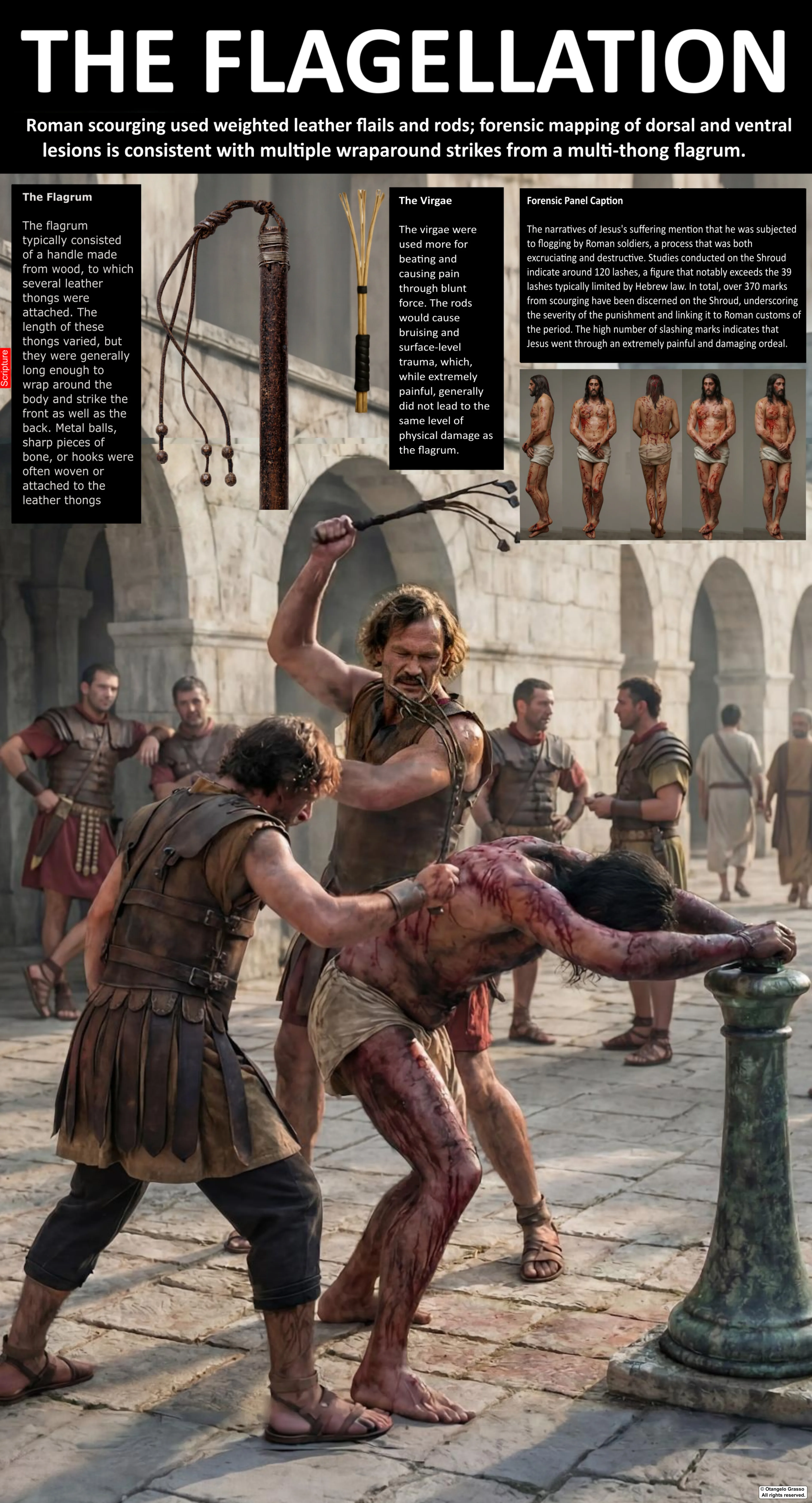
The Roman flagrum — also called the flagellum — was an instrument engineered for maximum damage. A short wooden handle anchored multiple leather thongs — the exact number varied by instrument — each weighted near its end with small metal balls or sharp fragments of bone.
In 1986, Dr. William D. Edwards, a Mayo Clinic pathologist, together with medical illustrators Wesley J. Gabel and Floyd E. Hosmer, published a landmark analysis in the Journal of the American Medical Association detailing the mechanics of Roman scourging: the embedded objects ensured that each strike not only impacted the skin but tore it, creating deep lacerations that ripped into underlying tissue.4
Scourging instruments consistent with Roman flagella have been recovered archaeologically, including finds from Pompeii now held in the Naples Archaeological Museum, offering physical evidence of such instruments' existence.
The leather thongs varied in length, enabling the verberator — the executioner — to wrap the strikes around the victim's body, lashing not only the back but the sides, chest, and even the front of the legs.
But the flagrum may not have been the only instrument used. The Shroud also displays marks consistent with another Roman tool: the virgae — slender rods or branches, flexible yet strong, used for beating rather than lacerating. Unlike the flagrum's tearing action, virgae produced blunt - force trauma: intense pain, surface bruising, and tissue swelling without the deep gouges. Some researchers have noted that certain marks on the Shroud appear to be overlaid by the dumbbell -shaped flagrum wounds, suggesting these blunt injuries were inflicted earlier — perhaps during the night Jesus spent in custody beneath the house of Caiaphas, where the Gospel of Luke describes him being beaten by guards.
Roman practice distinguished varying grades of corporal punishment, ranging from simple beating ( fustigatio) to severe flogging ( flagellatio) and the most brutal form associated with capital punishment (verberatio), though ancient sources apply these terms with less hierarchical precision than modern summaries suggest.
What Jesus endured was verberatio: scourging as prelude to crucifixion, a standard component of Roman execution protocol. The purpose was
twofold — to weaken the victim before the final ordeal, and to provide a visceral warning to any who might defy Rome's authority.4
III. The Wounds: A Forensic Census
When examined as a photographic negative — the accidental discovery that launched scientific Shroud study in 1898 — the cloth reveals its details with striking clarity. On the dorsal image, from shoulders to calves, including the exposed buttocks, the observer encounters a constellation of small, dumbbell-shaped marks. These same marks appear on the frontal image across the chest, abdomen, thighs, and legs. Wounds to the neck and groin appear absent — the groin perhaps a strategic mercy, or a calculated avoidance by the verberatores of areas where a single poorly aimed strike might prove immediately fatal. Notably, separate blood flows are visible on the scalp and in the hair regions, widely attributed by researchers to wounds from a crown of thorns; these are among the most studied features of the cloth but are distinct from the scourge mark pattern discussed here.
The 1978 STURP investigation revolutionized our understanding of these marks. Under ultraviolet fluorescence, they transformed. What appeared as diffuse, reddish -brown stains in visible light resolved into sharply defined, dark impressions — precisely what one would expect from iron porphyrin compounds, the breakdown products of hemoglobin. 1 More remarkably, fine parallel scratches became visible: groups of three or four emanating from the distal ends of each dumbbell impression, consistent with surface irregularities on the lead weights or bone fragments embedded in the flagrum's thongs.
But perhaps the most compelling evidence emerged from chemical analysis. When STURP researchers examined sticky -tape samples lifted from these reddish-brown areas, they reported finding clotted blood with a halo of separated serum surrounding each wound. T he presence of albumin and bile pigments — key proteins and compounds found in blood serum — supported the interpretation of genuine biological stains showing the characteristic pattern of blood that has separated from its serum after clotting.
Giulio Fanti, in collaboration with Barbara Faccini in earlier work,3 conducted an exhaustive census of the wounds. They identified over 150 distinct scourge marks on the frontal image and more than 200 on the dorsal side — totaling several hundred marks (researchers' counts vary from approximately 350 to 370 depending on methodology).
Each dumbbell-shaped impression measures approximately one -third of an inch in diameter — slightly larger than a standard pencil eraser — closely consistent with the metal balls found on flagella discovered in Roman archaeological contexts. Some impressions suggest two balls per thong; others suggest three. The variation speaks to the crude, brutal
functionality of these instruments, mass -produced tools of imperial discipline.
Monsignor Giulio Ricci, who devoted much of his scholarly life to Shroud research, noted several telling details in the wound pattern. First, the distribution extended far beyond what one might expect from a routine execution — these wounds covered nearly the entire body surface from shoulders to calves, front and back. Second, the direction of the lash marks suggested professional execution by trained verberatores who knew precisely where and how to strike for maximum effect while avoiding immediate death. Third, the sheer number of wounds far exceeded the Jewish legal limit of thirty-nine lashes, consistent with Roman rather than standard Hebraic punishment protocol.
Under ultraviolet photography, another detail emerged: serum trails on the back wounds, flowing downward and slightly outward — invisible to the naked eye but appearing under UV light. 1 Their direction has been interpreted by some researchers as suggesting the body was bent forward, allowing the serum that separated from the clotted blood to flow along the skin's surface before being absorbed by the burial cloth. It is one interpretive d ata point about the victim's possible position during the scourging.
IV. The Gospels: Between the Lines
The Christian Gospels, with their characteristic economy of language, offer minimal detail about Jesus's scourging. John's account is terse: "Then Pilate took Jesus and had him flogged" (John 19:1). Matthew is equally brief: "He had Jesus flogged, and hand ed him over to be crucified" (Matthew 27:26). Mark adds that Pilate "had Jesus flogged, and handed him over to be crucified" (Mark 15:15).
Only Luke, the physician, provides a hint of Pilate's original intention. In Luke's Gospel, Pilate declares three times that he finds Jesus guilty of no capital crime and proposes to "chastise him and release him" (Luke 23:16, 22). The Greek word Luke uses — paideuo — suggests disciplinary correction rather than a death sentence. This raises a chilling question: was the scourging initially intended as Jesus's entire punishment? If so, the verberatores would have been instructed to avoid killing the prisoner. The irony is brutal: what was meant to end the ordeal became merely its beginning.
The Gospel writers assumed their audiences knew what scourging entailed. First -century readers needed no graphic description; they had witnessed such spectacles or knew those who had. But for us, separated by two millennia from this particular horror, we may turn to contemporary sources. Philo of Alexandria, a Jewish philosopher who lived during Jesus's lifetime, described in his work In Flaccum the Roman prefect Flaccus's persecution of Jews in Alexandria — a specific political event in that city under a different Roman official — writing of victims who were
stripped and "lacerated with scourges," some of whom "had to be carried out on stretchers and died at once, while others lay sick for a long time despairing of recovery." Though the context was Alexandria rather than Judea, this account testifies to the le thal potential of Roman flogging wherever it was administered.
Image 8.2: A modern colorized reconstruction of a wounded male figure is superimposed over the Shroud of Turin’s frontal and dorsal body images, illustrating the alignment of visible injuries with the cloth’s faint anatomical imprints.
The stripping naked was deliberate — maximizing both physical vulnerability and psychological degradation. For a devout Jew like Jesus, trained from childhood in strict codes of modesty, this public nakedness would have been its own form of torture.
V. The Physiology of Trauma
To fully comprehend what the Shroud documents, we must follow the physiological cascade triggered by severe scourging. This is not speculation; it draws from modern trauma medicine, historical accounts, and the forensic evidence preserved in the cloth itself.4
Each strike of the flagrum produced immediate trauma. The weighted ends impacted the skin with tremendous force, creating deep contusions and bruising as blood vessels ruptured beneath the surface. The metal balls and bone fragments then tore through the skin as the leather thongs were pulled back, creating the characteristic dumbbell -shaped wounds. Where strikes overlapped — and the Shroud shows many such overlaps — tissue damage compounded. The skin, already compromised from earlier blows, would tear more readily. Nerve endings, severed or crushed, would send cascading pain signals through a nervous system rapidly approaching overload.
Blood loss began immediately. With several hundred distinct scourge-like wound marks covering the body, even modest bleeding from each wound would rapidly accumulate. Unlike the focused hemorrhage from a single laceration, distributed bleeding from hundred s of small wounds is harder to staunch and produces a cumulative effect that overwhelms the body's compensatory mechanisms. The victim enters circulatory shock: blood pressure drops, the heart races in a futile attempt to maintain perfusion, and oxygen delivery to vital organs diminishes.
Pain itself becomes a physiological stressor. The body's response to extreme pain activates the sympathetic nervous system, triggering rapid breathing, elevated heart rate, and profuse sweating — all of which accelerate fluid loss and deepen the shock state. When a prisoner is already weakened, as Jesus would have been after a sleepless night of interrogation and beatings, these mechanisms push the body closer to collapse.
Hemothorax — blood accumulation in the pleural cavity — presents another deadly complication. Blunt force ruptures small blood vessels in the lungs, allowing blood to leak into spaces meant for air. Even 500 milliliters of blood in the pleural cavity signi ficantly compromises lung function. The blood must go somewhere; it pools in the lowest portions of the chest cavity, detectable in modern medical imaging but agonizingly tangible to the victim as breathing becomes progressively more labored.
Cyanosis — the bluish discoloration of skin from inadequate oxygenation — would have appeared as the scourging continued. The cardiovascular system, desperately attempting to compensate for blood loss and compromised gas exchange, produces rapid heartbeat and falling blood pressure. The skin becomes pale, cool, clammy — classic signs of shock. The victim's condition spirals: pain increases oxygen demand, but damaged lungs and blood loss reduce oxygen supply.
Beyond the lungs, the heart itself faced danger. Blunt cardiac trauma from repeated strikes to the chest can damage heart valves, coronary arteries, or the heart muscle directly. Such injuries can precipitate cardiac arrest or dangerous arrhythmias. The pericardium — the protective sac surrounding the heart — can also sustain injury, leading to pericardial effusion where fluid accumulates and compresses the heart, impeding its ability to pump effectively.
Severe muscle damage introduces yet another lethal threat: hyperkalemia. When muscle tissue is crushed and torn, it releases potassium into the bloodstream. Elevated potassium levels disrupt the heart's electrical system, potentially triggering ventricular fibrillation — chaotic, ineffective heart rhythm that results in sudden death.
The wounds visible on the Shroud likely represent only a fraction of the actual damage. Dr. Pierre Barbet theorized that deep contusions and internal bruising without external bleeding would leave no trace on the burial cloth. What we see documented in those several hundred marks may be merely the surface manifestation of far more extensive internal trauma.4
VI. The Number: Jewish Law vs. Roman Practice
Jewish law, codified in the Mishnah, limited judicial flogging to forty lashes, though in practice the number was reduced to thirty -nine to avoid accidental miscounting. Saint Paul, a Roman citizen, recounts receiving "forty lashes minus one" on five separ ate occasions from Jewish authorities (2 Corinthians 11:24). But Jesus's scourging occurred under Roman, not Jewish, jurisdiction. Rome imposed no legal limit on the number of strikes. The verberatores had discretion, guided only by the general instruction to either kill the prisoner (if the scourging was intended as a death sentence) or stop short of death (if crucifixion was to follow).
The pattern on the Shroud suggests several hundred individual lash marks — far exceeding Jewish limits and consistent with Roman practice. 3 Yet researchers Fanti and Faccini note something remarkable in the distribution: the strikes are systematic, methodical, covering the body in a pattern that speaks to trained executioners rather than frenzied violence. Two verberatores likely worked in concert, one striking from each side, alternating blows in a rhythm perfected through grim repetition.
The fan pattern of the wounds on the back suggests the victim remained in one primary position — perhaps bound upright to a pillar — while the executioners worked with clinical precision. But the presence of wounds on the chest and frontal aspect of the le gs indicates the body was either turned or the victim was thrown to the ground for additional strikes. The image of a man, already bloodied and weakening, being repositioned for further punishment adds another layer of calculated cruelty to an already horrific scene.
VII. The Pillars: Relics and Realities
Throughout Christian history, two specific pillars have been venerated as potential sites of Christ's scourging. The first, traditionally associated with the beating in Caiaphas's house, measures approximately 25 inches tall (according to Hesemann's reconstruction) and shows evidence of damage at its top, suggesting it was once considerably taller. German historian Michael Hesemann proposes that fourth -century pilgrims revered this pillar as the site where Jesus was beaten in the dungeon, and that it was
later associated with the Church of the Holy Sepulchre in the context of the Persian invasion of AD 614. The precise circumstances of any relic movement during that period remain unverified by independent primary sources.
Image 8.3: Flagellatio secundum Sindonem
The second pillar has a more dramatic traditional provenance. According to tradition, it was hidden on Mount Zion after the Roman destruction of Jerusalem in AD 70, and remained concealed for over three centuries before being presented publicly in AD 383. Its journey continued through Constantinople in 1009, where it survived Caliph Al -Hakim's wholesale destruction of churches. According to ecclesiastical tradition, around 1223, it was transported to Rome, where it is venerated today in the Church of Santa Prassede.
This second pillar, crafted from Egyptian porphyry — a distinctive imperial stone also found in Herodian construction — stands 25 inches high with a base diameter of 16 inches, tapering to 5 inches at the top. (Dimensions are drawn from secondary Shroud li terature, specifically Hesemann's work; no primary museum catalog entry has been independently confirmed.) A crucial detail catches the eye: evidence of a thick metal ring once attached to the top, presumably used to secure prisoners' hands. Whether either pillar is authentic is, like so much about the Shroud, a question suspended between faith, tradition, and the fragmentary nature of historical evidence.
VIII. The Paradox: Medieval Forgery or Ancient Document? If the Shroud is a medieval forgery, as the 1988 radiocarbon dating suggested, then its creator achieved something that strains credulity. This hypothetical medieval artist would have needed to:
Know the precise appearance and dimensions of Roman scourging instruments — details that would not be widely documented until archaeological excavations centuries later. Understand blood serum separation and create stains that would appear as clotted blood with serum halos under ultraviolet light — a technology not invented until the early 20th century. Encode three -dimensional information into a two - dimensional image in a way that would only become apparent with VP -8 Image Analyzer technology, a device developed by Interpretation Systems Incorporated and used in NASA's imaging program in the 1970s.
Create several hundred distinct scourge marks, each with fine parallel scratches consistent with surface irregularities on metal weights, visible only under specific lighting conditions.3
Produce an image through an unknown mechanism that would stump materials scientists, chemists, and physicists even after the most extensive scientific investigation of any archaeological artifact in history. Do all of this while leaving no detectable paint medium sufficient to explain the image in the view of most STURP researchers — though this last point is disputed, as STURP's own microscopist Walter McCrone reported the presence of iron oxide particles and other compounds consistent with paint in the same samples.2
The alternative — that the Shroud is genuinely ancient — faces its own formidable challenge: explaining how the 1988 carbon -14 analysis, conducted by three independent laboratories using rigorous protocols, could have dated the cloth to 1260 -1390 AD. Researchers have proposed various explanations: contamination from the 1532 fire and subsequent water damage, a proposed bioplastic bacterial coating (Garza -Valdes), or the peer -reviewed "invisible reweave" hypothesis advanced by STURP physical chemist Raymond Rogers, who published evidence in Thermochimica Acta (2005) that the 1988 sample may have been taken from a medieval repair patch rather than original cloth — arguably the most scientifically credible challenge to the 1988 dating result. Some proponents have also suggested a neutron flux event associated wi th the resurrection (a hypothesis outside mainstream scientific consideration). Each hypothesis attempts to reconcile the radiocarbon date with the various forensic features that some researchers interpret as evidence of authenticity.
Italian researcher Flavia Manservigi, whose experimental work demonstrated that Roman -era scourging can produce wound patterns similar to those observed on the Shroud, nonetheless maintains scholarly humility: while her research demonstrates the possibilit y of consistency with authenticity, it cannot prove certainty. The exact method and implement used remain, in her assessment, hypotheses rather than established facts.3 IX. The Interface: Where Science Meets the Sacred
What makes the scourge wounds on the Shroud so compelling is not any single piece of evidence, but their convergence. The dumbbell shapes are closely consistent with Roman flagella. The number exceeds Jewish legal limits but fits Roman practice. The distribution pattern suggests professional executioners. The chemical composition, in the view of most STURP researchers, indicates the presence of genuine blood with serum separation — though the dissenting view of Walter McCrone, who identified iron oxide part icles consistent with paint, remains part of the scientific record. The three -dimensional encoding is consistent with contact with an actual body rather than artistic rendering. The ultraviolet fluorescence reveals details not visible to the naked eye.
These wounds invite us to approach the Shroud as something between religious icon and forensic document — a biological record, if authentic, of state -sanctioned torture carried out according to precise historical protocols. Whether that torture occurred in first-century Jerusalem or was impossibly replicated by a medieval genius remains the central mystery. But what cannot be disputed is this: the cloth documents suffering with a precision that transcends easy categorization.
Back in that Turin laboratory in October 1978, as Dr. Jackson studied those UV photographs while the early hours approached, he was looking at something that defied easy categorization. Not clearly art. Not clearly fraud. Not a simple relic. The Shroud had become an interface — between the ancient world and modern science, between faith and forensic analysis, between a moment of extreme trauma and its enduring, inexplicable impression on linen fibers.
The scourge marks are perhaps the clearest example of this strange status. They are simultaneously potential historical evidence, medical documentation, and sacred mystery. They speak to what the human body endures when subjected to calculated brutality. They raise questions about authentication methods, medieval capabilities, and the nature of physical evidence itself. They invite us to become co -investigators in a cold case that spans two millennia.
In the end, the scourging documented on the Shroud of Turin offers no definitive answers. It offers something perhaps more valuable: a window into the mechanics of Roman execution, a forensic portrait of suffering that either captures a historical moment w ith impossible precision or represents the most sophisticated forgery ever created. The wounds ask us to weigh evidence, to consider possibilities, to hold competing truths in tension.
They ask us, in short, to think — and to wonder. References
1. Heller, J. H., & Adler, A. D. (1980). Blood on the Shroud of Turin. Applied Optics , 19(16), 2742 -2744. Link. (Foundational STURP research using ultraviolet fluorescence and spectroscopy to identify the
stains on the Shroud as consistent with blood breakdown products, providing the scientific basis for the forensic analysis of the wounds.)
2. Heller, J. H., & Adler, A. D. (1981). A Chemical Investigation of the Shroud of Turin. Canadian Society of Forensic Science Journal , 14(3), 81-103. Link. (Detailed chemical analysis identifying blood derivatives and serum proteins in samples taken from wound areas, demonstrating biological stains with characteristic blood -serum separation patterns consistent with clotted wounds. Note: STURP microscopist W alter McCrone disputed these interpretations, reporting iron oxide particles consistent with paint in the same samples — see McCrone & Skirius 1980 below.)
3. Fanti, G. (2024). New Insights on Blood Evidence from the Turin Shroud Consistent with Jesus Christ's Tortures. Hemasphere. Link. (Recent synthesis of blood evidence, including discussion of wound counts and the forensic interpretation of scourge mark patterns. Note: The wound census attributed in this chapter to both Fanti and Faccini derives from earlier collaborative work; this 2024 paper is single -authored by Fanti.)
4. Edwards, W. D., Gabel, W. J., & Hosmer, F. E. (1986). On the Physical Death of Jesus Christ. Journal of the American Medical Association , 255(11), 1455 -1463. Link. (Landmark analysis of crucifixion and scourging, detailing the mechanics of the Roman flagrum and the physiological consequences of severe flogging. Note: Dr. Edwards was a Mayo Clinic pathologist; Gabel and Hosmer are identified in the paper's own affiliations as medical illustrators.)
5. Biblical Archaeology Society Staff. (2015). The Praetorium. Biblical Archaeology Review . Link. (Article summarizing archaeological and historical scholarship on the location of Pilate's praetorium in Jerusalem, presenting evidence for Herod's Palace as the probable site of Jesus's trial and scourging. Scholarly debate on this identification continues.)
6. McCrone, W. C., & Skirius, C. (1980). Light Microscopical Study of the Turin Shroud. The Microscope, 28, 105-112. (Peer-reviewed analysis by STURP's microscopist finding iron oxide pigment and vermilion consistent with a paint medium in sticky -tape samples from the Shroud image — the principal dissenting scientific view within the STURP investigation.)
7. Rogers, R. N. (2005). Studies on the Radiocarbon Sample from the Shroud of Turin. Thermochimica Acta , 425, 189 -194. (Peer -reviewed evidence that the 1988 radiocarbon sample may have been taken from a medieval repair patch rather than the original cloth — the most scientifically credible challenge to the 1988 dating result.)
8. Damon, P. E., et al. (1989). Radiocarbon Dating of the Shroud of Turin. Nature, 337(6208), 611 -615. Link (Primary record of the 1988
radiocarbon testing by laboratories at Arizona, Oxford, and Zurich, producing a calibrated date range of AD 1260-1390 at 95% confidence.)
THE WIDER DEBATE
Scourging and the flagrum
The first thread counts 100–120 marks from two Roman flagra with dumbbell-shaped weights, and says blood serum rings appear under ultraviolet light. These figures are the author’s reading of the image.
Source: the two catsboard threads of the Otangelo Grasso forum, part 1 and part 2. These are the author’s arguments, presented here as such, not established findings.
Explore the author’s additional material: The Shroud of Turin, part 1 · Part 2. The book’s bibliographic references are included where available.