IN-DEPTH READING
The evidence in context
This chapter presents historical, scientific and medical interpretations of the Shroud. Some conclusions remain debated. A source note identifies the related work1.
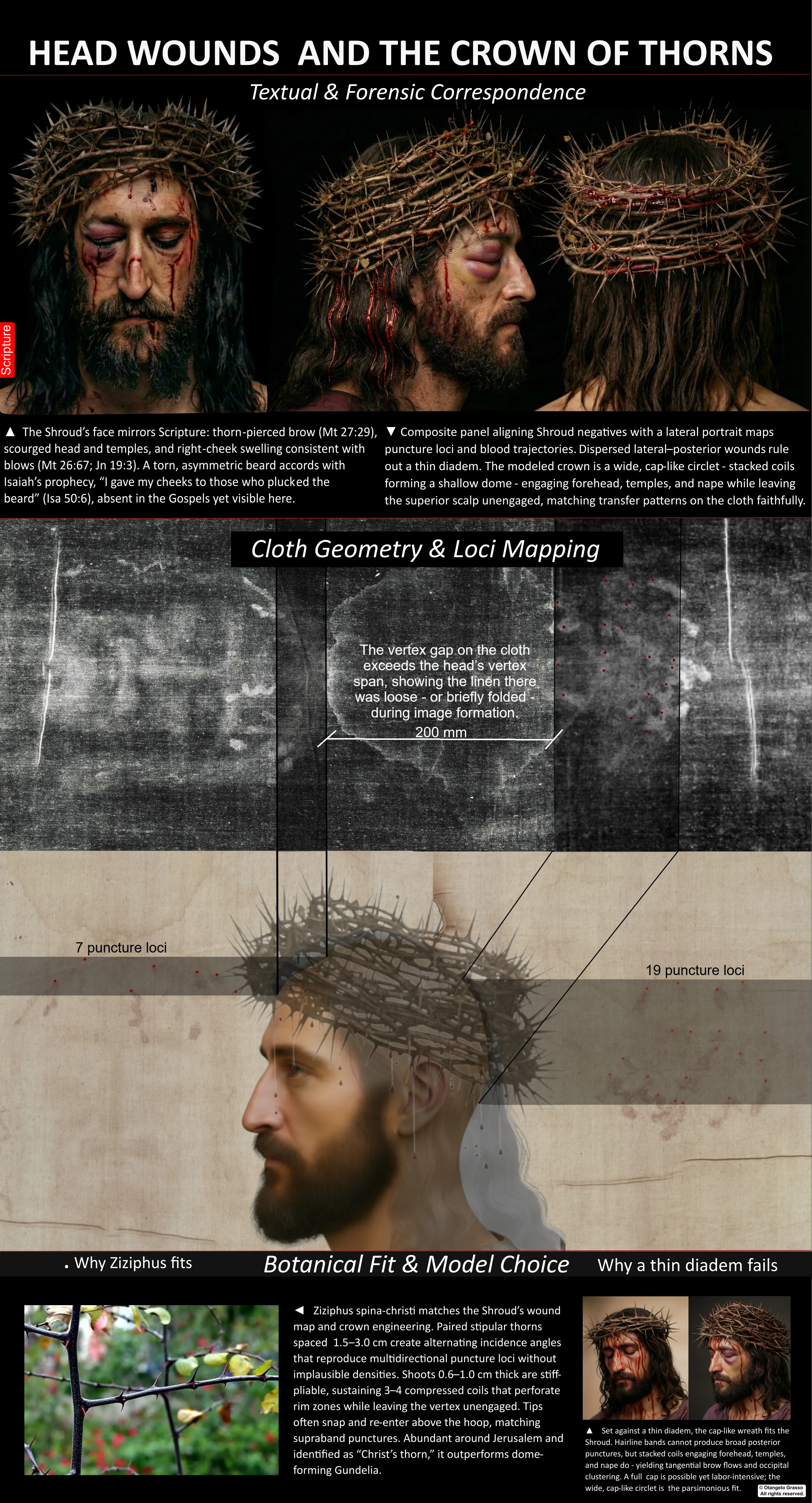
Not a circlet. That is the first thing the evidence establishes — and it overturns a thousand years of artistic tradition in a single forensic observation. Between 28 and 37 distinct blood loci have been identified on the head alone, distributed across the forehead, temples, sides, and occipital region in a pattern that no thin brow-band could produce. Here is the detective problem this chapter must solve: a strip of linen approximately 15.7 centimeters wide runs between the frontal and dorsal head images on the Shroud — the zone that would have overlain the very crown of the skull. It is forensically pristine. No clots. No smears. No droplets. Nothing. If a helmet of thorns had wounded the vertex, blood must have transferred there. It did not. The wound pattern surrounding this silence, and the clean absence at its center, are together the most geometrically precise piece of evidence the Shroud preserves. Read together, they describe an object that has been misrepresented in art for a millennium.1
I. The Pattern That Shouldn't Exist
Stand before a high -resolution, digitally enhanced scan of the Shroud's head region — one captured at 1200 dots per inch or higher, where individual linen fibers become discernible. At first you see only the face: serene, eyes closed, bearded, with long ha ir parted in the middle. The image is faint, sepia-toned, like a ghost imprinted on fabric.
Now look at what isn't the image.
Dozens of dark, irregular rivulets track downward from the hairline. Among them, one has attracted particular forensic attention: the so-called reversed epsilon — a rivulet that follows the path of the supraorbital vein, curves at the brow, and descends to ward the nasal bridge. This epsilon pattern is diagnostically significant. It indicates a wound that bled, partially clotted, and then bled again — consistent with movement, physical exertion, or pressure change accompanying the carrying of a heavy object.3 At the temples, finer tracks trace the zygomatic arch. At the back of the head, in the dorsal image, the staining is dense and complex — multiple flows converging in the occipital region, some overlapping, some bifurcating.
These are not part of the body image. They are separate. They are blood.
Forensic bloodstain pattern analysis distinguishes between contact transfers, gravity-driven flow patterns, drip stains, and saturation stains. The Shroud's head stains are overwhelmingly contact transfers of flow patterns. Each dark rivulet represents blo od that originated at a puncture
point, flowed across the skin according to gravity and surface tension, and was then pressed into the linen when the burial cloth was drawn over the head.
Count them.
Forensic analysts have. Conservative counts identify 28 distinct blood loci — discrete points of origin for rivulets. More inclusive counts, accounting for partial transfers and hair-obscured marks, suggest up to 37. Each locus represents a penetrating wou nd. Each wound drew blood. And each one, when plotted on a three -dimensional model of a human skull, tells us something specific about the object that created it.4
All four Gospels record the instrument: a crown of thorns, set on his head by soldiers during the mockery in the Praetorium. The forensic question is not whether such an object existed. The bloodstains are physical evidence. The question is: what was its physical form?
Was it the delicate circlet of Western art — a thin band of twisted brambles resting on the brow like a laurel wreath? Or something more encompassing — a cap-like structure covering the entire cranial vault?
The answer is written in geometry. And it contradicts centuries of artistic tradition.
Image 9.1: Pierre Barbet (1884 –1961), Chief Surgeon at the Hôpital Saint-Joseph in Paris, whose systematic forensic examination of the Shroud in the 1930s and 40s produced the first clinical analysis of its wound patterns — approaching the cloth as a traum a document rather than a devotional object. Image: Link II. The Problem with the Pretty Pictures: Barbet's Reasonable Error
For most of Christian history, the crown of thorns has been visualized as a circlet. Walk through the galleries of the Vatican Museums, the Uffizi, the Prado. From the agonized realism of Caravaggio's Ecce Homo to the
mystical serenity of Fra Angelico's frescoes, the crown is almost universally depicted as a woven ring, its thorns radiating outward like a dark, twisted halo. It sits high on the forehead, a symbol of suffering rendered with terrible beauty.
This image is devotionally powerful. It is aesthetically coherent. It has shaped the Western imagination for a millennium.
According to the bloodstain evidence on the Shroud, it is almost certainly incorrect.
The first person to recognize this was not a theologian or an artist. He was a surgeon.
Dr. Pierre Barbet was the Chief Surgeon at Saint Joseph's Hospital in Paris. In the 1930s and 40s, working from the best photographic prints then available, he conducted the first detailed forensic medical analysis of the Shroud's wounds. Barbet brought a clinician's eye to the task — he understood tissue trauma, vascular anatomy, and the physics of bleeding. A veteran battlefield surgeon of the First World War, he had seen what metal did to flesh at close range.
What he saw on the Shroud baffled him.
The bloodstains were not confined to a narrow band at the forehead. They appeared to originate from points scattered across the scalp: high on the frontal bone, at the temples, and with particular density at the occiput — the back of the skull. The dorsal image showed heavy, complex staining in the nuchal region that a simple brow circlet could not explain. Barbet traced rivulets that seemed to flow from wounds at the very crown of the head.
His clinical conclusion was direct: a thin circlet resting on the brow could not produce this wound distribution. The pattern demanded a source of injury that covered a much larger area of the scalp. In his 1950 work A Doctor at Calvary , Barbet proposed an alternative — a pileus or cap, a hemispherical latticework of thorny branches designed to cover the entire cranial vault like a helmet, with spines pointing inward.
Barbet's helmet hypothesis was brilliant forensic reasoning based on the evidence he had. It made anatomical sense. For decades it dominated the scientific discussion.
But Dr. Barbet was missing a crucial piece of evidence. A piece found not in the bloodstains themselves — but in the empty space between them.
Image 9.2: Full -body crucifixion reconstruction. Barbet obtained unclaimed cadavers from anatomy laboratories and constructed an actual cross to position the deceased body in a crucifixion posture, confirming that the Shroud's anatomical proportions were c onsistent with gravitational forces acting on a genuinely crucified corpse rather than an artist's imaginative composition.
III. The Geometry of Absence: The Bridge That Shouldn't Be Clean
Here we must shift from pathology to geometry — from what the wounds show to what the cloth proves.
The Shroud is a single piece of linen, approximately 4.4 meters long by 1.1 meters wide. The body was laid lengthwise on one half; the other half was drawn up over the head and down the back, enveloping front and back of the body. This created two distinct body images: a frontal image and a dorsal image, separated along the cloth's length.
Now, measure carefully. From the top of the frontal head image to the beginning of the dorsal head image, there is a gap. Researchers call this the vertex bridge. It measures approximately 15.7 centimeters — about 6.2 inches.
Compare that to anatomy. The actual front-to-back skull depth of an adult male, measured from the frontal hairline over the curve of the cranium to the posterior hairline at the occiput, averages 12 to 14 centimeters.
The cloth bridge is longer than the skull is deep.
This is not a minor discrepancy. It is a foundational fact. It means the linen did not make contact with the vertex — the top of the head. The cloth draped loosely across a gap, tented by the hair beneath it, and never touched the scalp at the skull's apex.
Now recall Barbet's helmet hypothesis. A cap -like crown of thorns, by definition, covers the vertex. Its thorns would puncture the richly vascularized scalp at the very crown of the head. Even if the crown was
removed hours before burial, vertex wounds would have bled. Blood clots can be re-mobilized by post-mortem handling — the washing of the body, the application of oils and spices described in John 19:39 –40, the simple friction of wrapping. If the vertex had been wounded, forensic science predicts contact smears, drip stains, or hair -wicked streaks on that 15.7 - centimeter bridge.
Examine the bridge under spectral analysis and 1200 DPI enhancement.
The bridge is forensically pristine.
No clots. No smears. No droplets. No streaks. The silence is absolute.
This geometry of absence is the single most powerful argument against the helmet model. It is not based on interpreting ambiguous stains. It is based on the definitive lack of evidence where evidence must exist if the hypothesis were true.5
Barbet made a reasonable error. He looked at the presence of blood and asked what could cause it. He did not have the imaging technology or the geometric analysis to fully appreciate what the absence of blood in the critical zone was saying. The clean vert ex bridge forces rejection of any crown model that requires significant vertex trauma.
Whatever form the crown took, it wounded the perimeter of the skull. Not its apex. IV . The Circlet Reborn: A Low-Seated, Multi-Coil Wreath
If not a helmet, and not a simple brow band — then what?
The evidence points to a third option: a low-seated, multi-coil circlet. Not a single thin hoop, but a wreath of thorny branches wound around the head two, three, or even four times — creating a cylindrical band several centimeters tall. It sits low on the head, encircling the cranial perimeter below the vertex. Its thorns point inward, toward the scalp.
This model is Roman military improvisation under time pressure, constrained by available materials and driven by a specific, cruel theatrical purpose: mockery.
The Praetorium, early on a Friday morning. Jesus of Nazareth, condemned by Pontius Pilate, is handed over to the cohort for the pre-crucifixion ritual of humiliation. The soldiers decide to complete the parody of kingship. A faded military cloak becomes a royal robe. A reed becomes a scepter. For the crown, they look around the garrison courtyard. There, stacked against a wall, are bundles of brushwood — fuel for the watch fires.
A soldier grabs two green branchlets, each about as long as his forearm. He bends one into a rough circle, large enough to fit over a man's head. The thorns catch on his palms. He continues. To give it stability, he winds a second coil around the first, th en a third. Where the ends meet at the back, he twists them together. The thorns interlock, adding friction and holding the shape.
Construction time: three to five minutes.
He now holds a crude, structurally sound crown of thorns. It is not a delicate circlet. It is a substantial object — but it is nevertheless a circlet in its fundamental geometry. It engages the perimeter of the skull across a band several centimeters wide, from the brow around the temples to the nape of the neck. Because it sits low, and because the mass of hair on the head creates clearance, it does not engage the vertex.
This is the model that fits all the evidence.4
V . The Forensic Signature: Experimental Reconstruction
In 2024, researcher and engineer Mark Fisher presented the results of a physical reconstruction experiment. His goal was to test the wound mechanics of a multi -coil circlet against the actual stain pattern on the Shroud.
The setup used a mannequin head with a silicone scalp layer approximately 3 mm thick, simulating human scalp depth. A circlet was constructed from rods fitted with artificial thorns of varying lengths, simulating the 2–4 cm thorns of Ziziphus spina-christi, mounted to point inward. High-resolution cameras recorded every contact event.
When the circlet was first placed on the mannequin, it did not sit on the scalp. It hovered, suspended on the tips of the longest inward -pointing thorns — the halo effect. To seat the crown required significant downward force.
When force was applied, simulating a soldier striking it with a reed as Matthew 27:30 describes, several phenomena emerged. First: tangential penetration and triads. The flexible branches bent under pressure. Thorns did not strike perpendicularly like nails. Instead, they engaged at shallow angles — a single thorn would pierce the silicone, travel subcutaneously for 5–15 mm, exit, and due to ongoing branch flexion, re -enter the skin a short distance away. One thorn created three wounds. A circlet with 20 thorns could produce 50–60 visible puncture points.2
Second: thorn breakage and supraband punctures. Under high compression, some thorns snapped near their bases. The broken fragments, still caught in the coil, were driven inward, creating wounds 3 –5
centimeters above the primary plane of the circlet. This explains what Barbet interpreted as high vertex wounds. They are not evidence of a helmet. They are evidence of a violently seated circlet.
Third: posterior concentration. The region where branch ends overlapped at the back of the head had double or triple thorn density, producing a concentrated cluster of wounds — mirroring the heavy, complex bloodstaining seen on the Shroud's dorsal occipital region.
Fourth: repeatability. The circlet was removed and replaced multiple times, simulating adjustment. Each reseating created new punctures — but all remained within the perimeter band. The vertex was never engaged.
Fisher's experiment provided the mechanical link between the circlet model and the Shroud's complex wound pattern. It demonstrated how a simple, low-seated wreath produces diffuse, severe scalp wounds without violating the clean vertex bridge.
VI. The Botanical Detective Story: Why Ziziphus spina-christi Fits
The Gospels say thorns, but what species? The Roman soldiers used what was available. A credible reconstruction must satisfy botanical constraints: native and abundant near Jerusalem in early spring; thorn geometry capable of producing 2–4 cm deep punctures at sufficient density; branch mechanics pliable enough to coil yet stiff enough to hold shape.
Ziziphus spina -christi — the Christ's thorn jujube — satisfies every criterion. It thrives in the semi -arid regions of the Jordan Valley and Judean foothills and was extremely common around Jerusalem. At each node on a branch, it produces paired stipular thorns: one typically straight at 2–4 cm, the other slightly recurved. Node spacing is tight, at 1.5 –3.0 cm. Young green shoots are flexible enough to coil without snapping yet have sufficient memory to maintain a hoop shape. It is the precise balance of pliability and rigidity that rapid crown construction requires.
Consider the mathematics. A three -coil circlet with a 65 -centimeter circumference has approximately 30 nodes per coil — 90 nodes total. Each node carries 2 thorns, yielding 180 thorn tips pointing inward. Even at only a 25–35% penetration rate, accounting for hair cushioning and glancing blows, that yields 45 –63 puncture events. Given the triad effect — one thorn producing 1.5 or more wounds — the total visible wound count could easily reach 60 –90, which brackets the Shroud's estimated 28 –37 visible loci while accounting for wounds obscured laterally or by hair.
The alternative candidate, Gundelia tournefortii, has been championed by some researchers primarily due to pollen grains reportedly found on the Shroud by Max Frei in the 1970s. But Gundelia has spiny, globe -like flower heads, not plaitable branches. Constructing a circlet from it is
mechanically counterintuitive. Subsequent palynologists found Frei's preserved samples too degraded for definitive species-level identification, and the methodological challenge extends to Danin's own flower -image claims. Botanist Avinoam Danin and Alan Whanger's identification of floral outlines on the Shroud image—including proposed Chrysanthemum coronarium, Cistus creticus, and other species —has been contested on specific botanical grounds. Palynologist Thomas Litt and colleagues reviewing the imaging evidence noted that the supposed floral forms lie at or below the resolution threshold where reliable morphological identification is possible, and that confirmation bias in pattern recognition cannot be excluded without blind-evaluation protocols that have not been applied.6 Botanist Uri Baruch, who collaborated with Danin on the 1999 pollen analysis, was careful to separate the pollen count findings —which he treated as the stronger evidence —from the flower -image identifications, which he regarded as more speculative. The geo graphic specificity of the combination argument rests more securely on the pollen data than on the image identifications, and the two lines should be distinguished rather than treated as mutually reinforcing confirmation.A Gundelia-based crown would almost inevitably be cap - like, directly conflicting with the clean vertex bridge.
Ziziphus fits every constraint. Gundelia creates more problems than it solves.4
VII. The Mathematics of Cruelty: Point-Clouds and the Sudarium Corroboration
Forensic science thrives on independent verification. For the Shroud, this comes from another ancient cloth: the Sudarium of Oviedo.
The Sudarium is a smaller linen cloth — approximately 84 × 53 cm — kept in the Cathedral of Oviedo, Spain. Tradition identifies it as the face cloth of John 20:7, placed over the head after death. It bears no body image, only bloodstains and stains consistent with pulmonary edema fluid — a mixture of blood and plasma that can seep from the nose and mouth of a crucifixion victim whose death involves suffocation and cardiac stress. Critically, the Sudarium has a custodial history completely independent of the Shroud, traceable to Jerusalem in the early centuries and then to Spain via North Africa by the seventh century. If two unrelated cloths show bloodstain patterns that geometrically match, the probability of coincidence approaches zero.
In 2023, researcher Pedro Rocamora performed a sophisticated geometric analysis. He took the coordinates of bloodstain centroids from the Shroud's frontal and occipital head regions and from the Sudarium's occipital region, then used a statistical process called point -cloud registration to map these stains onto a 3D model of a human skull. The results were striking. Parabolic fit of the occipital stains produced an R² of 0.718,
indicating a strong, non-random curved distribution matching the back of a skull. Procrustes disparity values of 0.0143 and 0.0176 — both well below the 0.05 threshold for near-perfect shape similarity — indicated the two cloths' stain patterns were statistically consistent with a single source. Mahalanobis distance values of approximately 1.10 and 1.42 fell well within the same-source statistical range.
When projected onto a skull model, the combined blood loci from both cloths traced a narrow, well-defined perimeter band. Not a diffuse, vertex- covering cloud. Exactly the pattern a low-seated circlet would produce.5
The blood on the Shroud and the blood on the Sudarium came from the same head, wounded by the same object — an object that lacerated the perimeter of the skull, not its crown.
VIII. The Clotting Paradox and the Remobilization Problem
The most common rebuttal from defenders of the helmet model is what might be called the clotting hypothesis: perhaps the vertex wounds clotted completely and dried before burial, while perimeter wounds — kept moist by sweat and movement — remained transferable. The clean bridge, on this account, simply means the vertex blood was dry.
This argument deserves serious consideration before it is tested against the forensic timeline.
The timeline is as follows. The crown was placed during the mockery in the Praetorium, before 9 AM. Jesus carried the crossbeam, was crucified, and died by approximately 3 PM. The crown was likely removed before or during crucifixion — it is never mentione d at the cross. This gives vertex wounds at least three to six hours to begin clotting before death, and several more hours before burial preparation began.
But three objections compound. First: differential clotting. Why would vertex wounds clot perfectly while nearly identical perimeter wounds in the same vascular bed remained transferable? No physiological mechanism is offered. Second: remobilization. The b ody was washed. Water, followed by oily unguents, re -hydrates and can re -mobilize dried blood clots — especially combined with the physical manipulation of wrapping a body. Research by Giulio Fanti demonstrated this experimentally: clotted scalp blood, subjected to simulated ancient burial preparation, transferred readily to linen. 1 Third: the hair factor. The scalp is covered in hair, a potent capillary wick. Blood from vertex wounds would be drawn into the hair above the vertex. When burial spices were applied, that hair-borne blood could easily transfer to the overlying cloth — yet the vertex bridge shows no hair-wicked stains.
The clotting hypothesis requires a series of improbable favorable coincidences: vertex wounds clotting faster, drying more thoroughly, resisting remobilization by washing and oils, and their blood failing to wick into overlying hair — all simultaneously. I t is an auxiliary assumption stacked upon an auxiliary assumption to preserve a failing model.
The circlet model requires none of these gymnastics. It offers a direct, evidence-led explanation.
The vertex was not wounded.
IX. Engineering Economy and Roman Psychology
Beyond forensics and botany, we must consider human factors: time, skill, and intent.
A multi-coil circlet requires one or two branches, one structural join, and three to five minutes. Inherently stable hoop geometry. Soldiers can do it while laughing and jeering.
A helmet or cap structure requires a base ring, vertical supports, horizontal weavers, and dozens of ties to prevent collapse. Modern attempts, even with advance planning, take over an hour. It demands patience and coordination entirely at odds with the scene of brutal, hasty mockery.
And consider the semiotics. The soldiers were staging a parody of kingship. The props had to be recognizable. In the Roman world, crowns — stephanoi — were wreaths: laurel for the victor, oak for the civic hero. A helmet of thorns is simply a torture device. A wreath of thorns is a mock crown. The circlet was the semantically correct choice for their cruel theater. They were not designing for maximum trauma. They were designing for maximum humiliation. The cruelty of the crown lay in its meaning, not merely its mechanism.
The engineering and psychological evidence again converges on the circlet.4
X. The Paris Relic: An Enduring Riddle
Housed in Notre -Dame Cathedral in Paris is the relic venerated as the Crown of Thorns — a circle of woven rushes approximately 21 centimeters in diameter, devoid of thorns. Its documented history begins in 1238, when King Louis IX acquired it from Constantinople.
Its 21 -centimeter diameter is noteworthy: it fits the circlet model's dimensions precisely. But its rush construction is problematic — too soft
to anchor thorns firmly — and its cleanliness argues against direct contact with a heavily bleeding scalp. One possibility is that the original thorny branches were woven into or around this rush core, with individual thorns later distributed as relics — over 70 churches claim one. Another is that the Paris ring is a later devotional object designed to display what remained. It is a fascinating piece of historical tradition, but the primary forensic evidence remains the blood on the cloths.
XI. Synthesis: The Crown Reconstructed
The evidence has been triangulated from multiple, independent directions.
The Shroud's geometry establishes that the 15.7 -centimeter clean vertex bridge excludes full vertex trauma. The wound topology places the 28–37 blood loci in a perimeter band, not a diffuse scatter. Experimental mechanics demonstrate that a low -seated, multi-coil circlet with inward thorns produces tangential wounds, triads, supraband punctures, and posterior concentration — all matching the Shroud's pattern. Botany confirms that Ziziphus spina-christi provides the ideal thorn geometry and branch pliability for rapid circlet construction. The Sudarium of Oviedo provides independent geometric corroboration, its stain pattern tracing the same perimeter band on the same skull. And the engineering and psychological evidence confirms that a circlet was the only i nstrument consistent with both the time available and the theatrical logic of Roman mockery.
The Crown of Thorns was a multi -coil circlet of Ziziphus spina - christi branchlets, hastily constructed by Roman soldiers, forcibly seated onto the head. It created a devastating perimeter of scalp wounds while leaving the vertex untouched — resulting in the precise, paradoxical bloodstain pattern preserved on the Shroud of Turin.
The mockery failed to understand what it was making.
The walk was three hundred and fifty meters. It took most of what remained. References
1. Fanti, G. (2024). New Insights on Blood Evidence from the Turin Shroud Consistent with Jesus Christ's Tortures. Hemasphere. Link. (Experimental forensic study demonstrating that clotted scalp blood subjected to simulated ancient burial preparation — washing and oil application — transfers readily to linen, undermining the differential - clotting objection to the circlet model and supporting interpretation of the crown wound pattern as perimeter -distributed rather than vertex - covering.)
2. König, L., Schmölders, R., Jühling, M., et al. (2023). Some experiments and remarks regarding the possible formation of blood stains on the Turin Shroud: stains attributed to the crown of thorns, the lance wound and the belt of blood. International Journal of Legal Medicine , 137, 863 – 878. Link. (Experimental forensic study replicating crown -of-thorns wound mechanics using reconstructed instruments, documenting the triad penetration effect, thorn breakage producing supraband punctures, and posterior concentration patterns consistent with the Shr oud's bloodstain distribution.)
3. Heller, J. H., & Adler, A. D. (1980). Blood on the Shroud of Turin. Applied Optics , 19(16), 2742 –2744. Link. (Foundational STURP research using ultraviolet fluorescence and spectroscopy identifying the head stains as genuine blood, including analysis of the epsilon -pattern rivulet on the forehead as evidence of re -mobilized bleeding consistent with post-wounding movement.)
4. Grasso, O. (2024). Crown of Thorns on the Turin Shroud: Image - Constrained Architecture and Botanical Attribution to Ziziphus spina - christi. Academia.edu. Link. (Botanical and architectural analysis identifying the crown as constructed from Ziziphus spina-christi based on wound pattern evidence, thorn geometry calculations, branch pliability requirements, and the multi-coil circlet construction model.)
5. Grasso, O. (2024). Crown of Thorns: Circlet or Helmet. Academia.edu. Link. (Comparative architectural study examining the clean vertex bridge as geometric constraint eliminating the helmet model, with point -cloud registration analysis of Sudarium of Oviedo bloodstains providing independent corroboration of the perimeter -band wo und distribution consistent with a low-seated circlet.)
THE WIDER DEBATE
The scalp and the forehead
The first thread reads the scalp bleeding as consistent with a crown of thorns and discusses the “reversed 3” mark on the forehead. The second thread lists the thorn-cap bloodstains among the features a forger would need to reproduce.
Source: the two catsboard threads of the Otangelo Grasso forum, part 1 and part 2. These are the author’s arguments, presented here as such, not established findings.
Explore the author’s additional material: The Shroud of Turin, part 1 · Part 2. The book’s bibliographic references are included where available.