IN-DEPTH READING
The evidence in context
This chapter presents historical, scientific and medical interpretations of the Shroud. Some conclusions remain debated. A source note identifies the related work1.
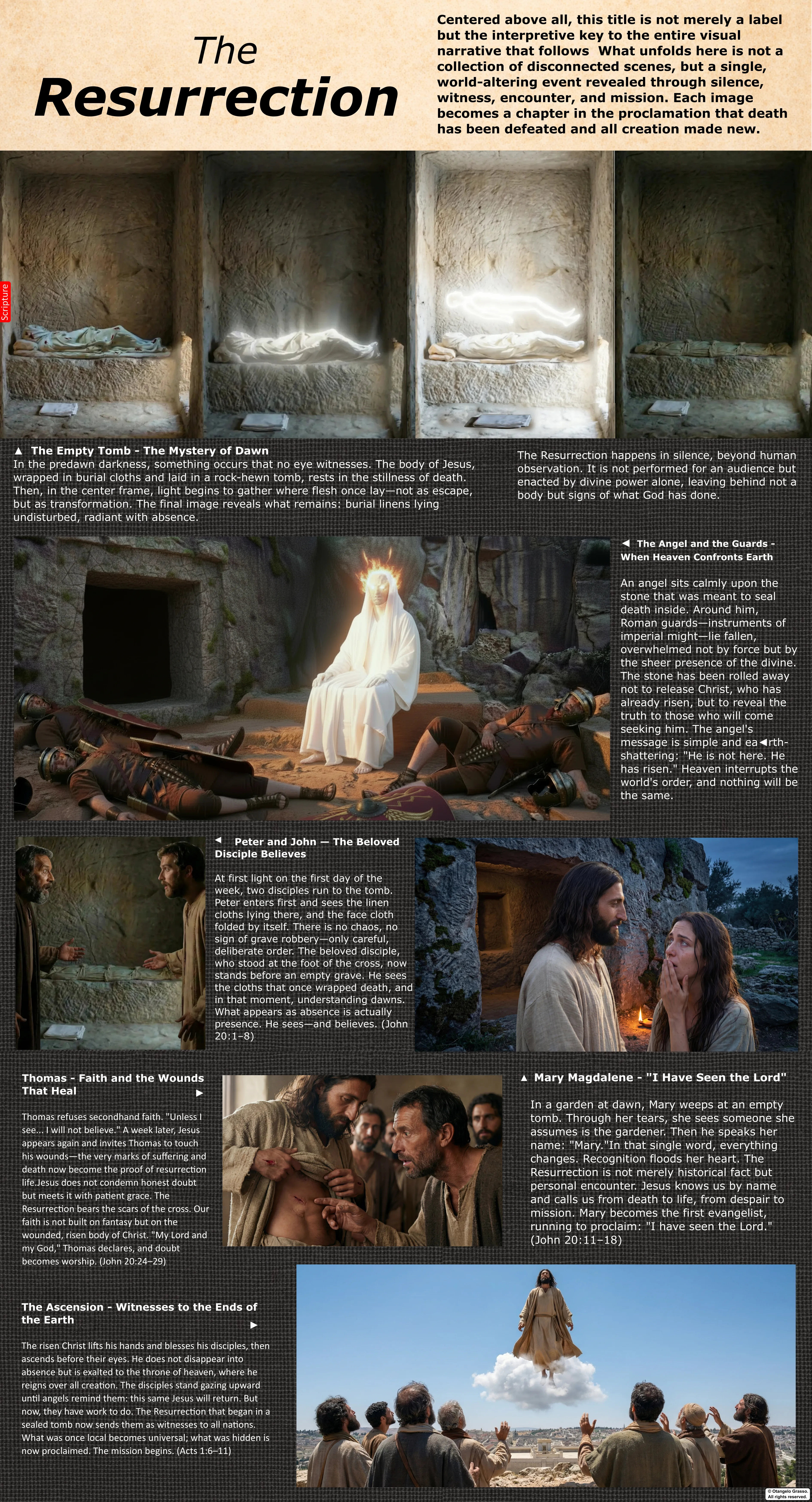
PART I: THE SCENE OF THE CRIME The First Investigators: Peter and John at Dawn
Jerusalem. Pre-dawn. The first day of the week.
Two men run through the olive groves toward a tomb cut into limestone. They are running not toward hope but toward the confirmation of their deepest dread. Mary Magdalene's report—they have taken the Lord out of the tomb—has propelled them from hiding into the open streets of a city that executed their teacher three days ago.
John, the younger, reaches the tomb first. He stoops at the low entrance and stops.
In the grey light, he sees them: the burial linens —the othonia—lying on the stone bench. Not scattered. Not torn. Simply there. He does not enter.
Peter arrives, breath ragged, and pushes past. He enters the cramped space. His eyes adjust. He sees the same scene —but processes it differently. The othonia are not in disarray. They are lying (keimena) exactly where a body should have been, now collapsed, hollow. And separate from them, set apart with deliberate care, is the face cloth —the soudarion—folded and placed in a location of its own.
Then John enters. He sees what Peter sees.
The Gospel records what follows in a single, stark sentence: "He saw and believed" (John 20:8).
What physical evidence was before them? What does that evidence rule out? And what does it leave standing, when each natural explanation has been tested against it? That is the investigation this chapter conducts. Chapter 14 ended with the cloth inside a sealed tomb. The question of how it came to be found empty and undisturbed begins here.
PART II: THE ANATOMY OF A BURIAL Three Cloths, One Testimony
To understand what Peter and John witnessed —and what it means forensically—we must first decode the precise terminology of the burial. John's Gospel is not vague. It deploys three distinct Greek terms with clinical specificity, and each carries evidentiary weight.
1. The Othonia (Ὀθόνια): The Collective Burial Linens
Does John use the plural when the Synoptic Gospels speak of a single shroud, a sindōn?
The term is a plural Greek noun meaning linen cloths—a specific term for burial wrappings, not a generic word for fabric. Here we must pause: why The answer lies in the word's structure. Othonia is a diminutive of othonē, meaning fine linen cloth. In the plural, it functions as a collective noun referring to all the linen textiles used in burial —not strips of bandaging, but the ensemble of materials that together comprised the burial preparation.1 John is describing a scene with multiple components, not a mummy wrapped in strips.
The linguistic precision elsewhere in his Gospel is instructive. In John 11:44, Lazarus emerges "bound hand and foot with keiriai"—strips or bindings that had to be deliberately unwound. John does not use that term for Jesus. He uses othonia, and the distinction is not accidental. Lazarus was unwrapped and returned to mortal life. Jesus left his grave clothes behind.
The critical evidence appears in John 19:40: "They took the body of Jesus and bound it in othonia, with the spices, according to Jewish burial custom." The verb "bound" ( edēsan) does not imply mummy -style wrapping but rather the securing and stabilizing of a body within burial linens. The spices—myrrh and aloes, approximately seventy -five pounds according to John 19:39 —were not rubbed into the skin but sprinkled, placed within t he folds of the linen textiles. This is consistent with the Jewish legal require ment that all blood -stained materials be buried with victims of violent death, so that bodily integrity for resurrection would be preserved.1
When John writes that Peter saw "the othonia lying there" (John 20:6), he describes a collapsed bundle—the shroud and its integrated wrappings — still occupying the configuration of a body, but empty. The Greek verb keimena (lying) appears three times in verses five through seven. That repetition is deliberate. These linens were not dragged off, not unraveled, not stuffed in a corner. They occupied the space of the body, now vacant, as if the body had departed from within them.
2. The Sindōn (Σινδών): The Primary Shroud
The Synoptic Gospels use singular language consistently. Matthew 27:59 records that Joseph of Arimathea "wrapped it in a clean sindōn." Mark 15:46 and Luke 23:53 echo this. The sindōn was a sheet —a linen cloth specifically used as a shroud —large enough to envelop a body, fine enough to be expensive, and ritually clean.
Its relationship to the othonia is one of part to whole. The sindōn was the central, largest component of the othonia. John does not contradict the
Synoptics; he complements them. His concern is not to enumerate cloths per se, but to describe their arrangement in the tomb —a coherent, collapsed linen ensemble from which the body had departed.
The Shroud of Turin is, by definition, a sindōn: a single, large piece of linen measuring approximately 4.36 by 1.10 metres, woven in a 3 -to-1 herringbone twill pattern consistent with first -century Roman-era textile production.2 If authentic, it is the primary component of the othonia that Peter and John saw lying empty on that bench.
3. The Soudarion (Σουδάριον): The Separate Face Cloth
John is meticulous in his distinction: the soudarion was "not lying with the othonia, but folded up in a place by itself" (John 20:7). The term derives from the Latin sudarium—sweat-cloth. In Jewish burial practice following violent death, such a cloth served a specific, temporary function: to cover the face during transport to the tomb, absorbing blood and bodily fluids draining from the nose and mouth.
The soudarion was never part of the othonia collection. It was auxiliary and separate—placed on the head during the hasty preparations by Joseph and Nicodemus, removed at the tomb to allow the Shroud to make direct facial contact, then set aside in its own location. On Sunday morning, it remained e xactly where it had been left on Friday evening: folded, separate, deliberate.
The cloth preserved in the Cathedral of Oviedo, Spain —traditionally identified as this soudarion—provides a corroborating line of evidence. Dr. José Villalaín of the University of Valencia conducted over six thousand simulation experiments, concluding the cloth was applied while the body was still upright on the cross, at approximately seventy degree s forward tilt.3 Its bloodstains show blood of type AB matching the Shroud, and pollen embedded in its fibers is consistent with plant species native to the Jerusalem region. 4 The Sudarium's documented presence in Spain from the seventh century predates any known history of the Shroud in medieval Europe —which means if these two cloths correspond, the correspondence was not arranged. It was discovered, centuries later, by the science required to recognize it.
The Precision as Evidence
This precise vocabulary —othonia, sindōn, soudarion—is not John's literary invention. It reflects the actual materials present in that tomb. And it is this precision, this attention to the mundane and forensically specific, that lends the narrative its evidential character. If John were constructing a lege nd, why distinguish the soudarion from the othonia at all? Why mention its folded state? Why repeat keimena three times? These are the touches of eyewitness memory —the small, inconvenient details that do not serve a narrative purpose but authenticate the scene. Legend produces
less mundane detail with the passage of time. Memory preserves the inconvenient particular.
PART III: THE LOGIC OF ELIMINATION Testing Each Alternative Against the Physical Evidence
With the vocabulary established, we can reconstruct the logical process that carried John from observation to belief. The forensic investigator performs the same process: examine the physical evidence, then test each alternative explanation against it, eliminating those that cannot account for what is actually present.
The Physical Evidence on the Stone Bench
The othonia were lying (keimena)—occupying the space of the body, now vacant. The Greek verb carries the sense of reclining, resting in position— stillness suggesting undisturbed placement. These were not cloths tossed aside in haste. They were undisturbed in another critical sense: the spices. John 19:39 records approximately thirty -four kilograms of myrrh and aloes placed within the folds of the linen. Unwrapping such a body would have spilled spices across the bench and floor —a chaotic aftermath of aromatic powder and stiffened, blood -caked linen. No such disorder is recorded. The soudarion was not crumpled but entetuligmenon—rolled or folded—"in a place by itself" ( eis hena topon). This is a deliberate, calm action. The opposite of panic.
Alternative 1: Theft by Friends
Could the disciples have stolen the body to fabricate a resurrection? The psychological evidence argues immediately against it. John 20:19 records that on the evening of that same day, the disciples were behind locked doors "for fear of the Jewish leaders." These were men in hiding, expecting arrest. They are not the profile of conspirators engineering a hoax. More decisively: those who later died for their testimony died for their claim that they had encountered a risen Jesus. People die for beliefs they h old sincerely; they do not die for frauds they themselves constructed.
The forensic evidence is equally unaccommodating. Friends stealing the body would have taken it wrapped —the most practical method, avoiding ritual impurity from direct contact with a corpse. If they chose to unwrap it, they would have left a scene of disru ption: blood -caked linens torn open, aromatic powder spilled, the stiffened limbs of a rigor-locked corpse dragged through the cramped space. The neat, collapsed othonia and the deliberately folded soudarion are not consistent with theft by any normal reconstruction of how theft works.
Alternative 2: Theft by Enemies
Could the religious authorities or Roman administration have removed the body? Their stated motivation was to prevent resurrection claims.
Removing the body achieves the opposite —it creates an empty tomb the disciples can exploit. When the disciples began preaching the Resurrection in Jerusalem weeks later, the authorities' most devastating counter -move was available to them: produce the corp se. They did not. The most consistent explanation is that they could not. The forensic failure is equally complete. Enemies removing the body would have taken it intact and hidden it. They would not have carefully unwrapped it, folded the soudarion, and left expensive burial linens behind as evidence linking them to the scene. The calm order of the tomb is not consistent with enemy action under any reconstructible motive.
Alternative 3: The Wrong Tomb
Could the women —and subsequently Peter and John —have gone to the wrong tomb in the pre -dawn darkness? The objection has surface plausibility and little beneath it. The tomb belonged to Joseph of Arimathea, a named member of the Sanhedrin. It was new —no one had yet been laid in it (John 19:41). Mary Magdalene had been present at the burial on Friday evening and had watched where the body was placed (Mark 15:47).
More decisively: a wrong tomb would contain either an intact, wrapped corpse belonging to someone else, or old skeletal remains. It would not contain freshly abandoned, collapsed burial linens still carrying the scent of myrrh and aloes, with bloodstained fabric corresponding to the wounds of the man buried two days earlier. The wrong -tomb hypothesis cannot account for the specific physical evidence that Peter and John examined.
Alternative 4: Hallucination or Later Legend
Hallucinations are subjective and personal. They do not create physically empty tombs that multiple independent witnesses can enter and examine. They do not produce material evidence: collapsed linen cloths, a folded face cloth, a stone rolled aside. Mary went to the tomb and found it physically empty before any vision occurred. Peter and John entered a physical space and closely inspected physical objects. These are characteristics of historical event, not shared psychological projection.
The legend hypothesis carries a further difficulty. Legend develops over time, accruing mythic detail, smoothing contradictions, inflating the miraculous toward the archetypal. The resurrection accounts move in the opposite direction —they are sparse, speci fic, and filled with psychologically humanizing details that serve no narrative purpose: Mary mistaking Jesus for a gardener; Thomas demanding physical proof; Peter and John arriving at different speeds with John reaching the entrance first but not enterin g. These are the touches of memory, not invention. Significantly, John's Gospel —often considered the latest of the four — contains the most specific, mundane details about the burial: the weight of the spices, the separate face cloth, the deliberate folding, the precise Greek
terminology for each component. Legend produces less detail over time. Eyewitness memory preserves the inconvenient particular.
What Remains
Each natural explanation, when tested against the physical evidence, is found insufficient on its own terms. Theft—by friends or enemies—cannot account for the undisturbed order of the scene. Wrong tomb cannot account for the specific physical contents. Hallucination and legend cannot account for the material, physical emptiness of the space that multiple witnesses independently examined.
What the physical evidence is most consistent with is an event for which forensic science does not have a classification: a body departing from burial linens without mechanical disturbance, without decomposition, within a thirty -six-hour window that the bl ood chemistry independently corroborates. Science can name the constraints of this event with considerable precision. It cannot name its mechanism. That is not evasion. It is the honest boundary of the discipline.
PART IV: THE SHROUD AS THE SINDŌN Corroborating the Testimony
The Shroud of Turin, if authentic, is the physical sindōn—the primary component of the othonia that Peter and John saw. Its scientific profile is consistent with the Johannine account in ways that reward careful examination.
1. An Incomplete Burial, Exactly as Described
The body on the Shroud was not prepared according to the full Jewish burial ritual. The image shows a body unwashed: blood clots remain intact on the scalp from the crown of thorns; the wound in the side still shows the flow of blood and clear fluid; scour ge marks across the back and legs have not been cleaned. A completed Jewish burial would have involved ritual washing, removal of all blood, and anointing with oils. None of this occurred—precisely as the Gospel timeline demands, given that the burial was compressed into under four hours before the Sabbath.
The spices were applied dry, not as anointing oil. Microscopic analysis has detected traces of aloes and myrrh within the Shroud's fibers, but not incorporated into the skin surface. 5 They were sprinkled among the folds of the cloth—exactly as John 19:39–40 describes. The body was wrapped in rigor mortis: the image shows a figure frozen in the posture of crucifixion death—shoulders slightly raised, chest expanded, legs bent at the knees—consistent with a burial that could not wait for the stiffness to pass.3 2. The Forensic Signature of a Non-Mechanical Separation
The most evidentially significant characteristic of the Shroud is not what it shows but what it does not. It does not show the disturbances that accompany any normal removal of a body from burial cloths.
The bloodstains are intact. Biochemical analysis confirmed the presence of real human blood through detection of haem derivatives, bilirubin, and intact protein structures. 6 The bilirubin content is elevated far above normal levels—consistent with the massive haemolytic stress of scourging and crucifixion trauma, explaining why the blood appears reddish -brown rather than the black of normally aged blood. More critically: the blood transferred to the linen with anatomical fidelity. No smearing. No tearing. No disturbance of the delicate fibrin clots that would have formed on the wounds over thirty-six hours.
When blood clots on skin, it forms a bond with the textile surface. Removing a cloth from clotted blood inevitably disturbs the clot—it tears, smears, pulls away in fragments. Even the most careful mechanical peeling creates detectable disruption at the fi ber-blood interface under electron microscopy. The Shroud shows none of this.6 The blood patterns are anatomically coherent, obeying gravity across every wound site. The only mechanism the evidence is most consistent with is one in which the body ceased to be in contact with the cloth without mechanical force applied to either.
The thirty -six-hour window is written in the blood chemistry itself. Fibrinolysis—the enzymatic dissolution of the fibrin network —follows a measurable progression at tomb temperatures of fifteen to twenty degrees Celsius: firm and intact at zero to twelve hours; softening at edges from twelve to twenty -four hours; partial dissolution with serum separation from twenty-four to thirty-six hours; significant weakening after thirty-six to forty-eight hours. The Shroud shows partial fibrinolysis—clots that had begun breaking down but remained structurally present. This is most consistent with approximately thirty to thirty -six hours of contact, then clean separation. 6 From Friday at sunset to Sunday at dawn is approximately thirty-six hours. The chemistry agrees with the chronology.
The absence of decomposition is the final marker. Putrefaction produces gases, fluids, and chemical staining that would have saturated the burial cloth within forty to seventy -two hours in a Mediterranean environment. The Shroud shows no trace of putrefaction.2 The body did not decay in the cloth. It departed before decomposition could begin.
3. Three-Dimensional Information Consistent with Cloth Collapse
When a cloth wraps a three -dimensional body and the body is removed mechanically—unwrapped, pulled, lifted—the cloth is displaced, dragged, stretched. When a body departs in a manner that leaves the cloth unsupported, the cloth collapses into the space the body once occupied, maintaining its configuration while settling inward.
The Shroud's image contains three -dimensional spatial information consistent with the second scenario. In 1976, physicists John Jackson and Eric Jumper —whose VP -8 Image Analyzer work has been a recurring landmark throughout this investigation—analyzed the cloth using a device developed for aerospace imagery analysis that converts image intensity into topographical relief. When applied to ordinary photographs or paintings, it produces distorted, meaningless output. When applied to the Shroud, it produced an accurate, anatomically coherent three-dimensional relief of a human body. 7 Image intensity correlates with cloth -to-body distance: the nose, being closest, is darkest; the recessed eye sockets are lightest. This is not a property any known painting or contact-print process can produce. It is a property consistent with an image f ormed while the cloth was draped over a three -dimensional body —and then left behind when that body was no longer present beneath it.
Methodological Note: The Geometry of the Draping
The question of how the Shroud's image formed cannot be separated from a more fundamental one: how was the cloth arranged? Before any proposed mechanism is evaluated, the geometry of the cloth itself must be established—because geometry does not explain th e image, but it filters explanations. It defines the physical conditions within which any proposed mechanism must operate.
More than seventy years before modern laboratory investigation, Paul Vignon approached the cloth as a geometric and anatomical problem. Writing in 1902, he imagined transverse slices through the body and asked how a linen sheet would behave when draped ove r those forms. He described a cloth that sagged under gravity, approaching near contact at protruding anatomical features —the nose, the brow, the calves —and lifting progressively away from recessed regions. From this, he proposed that image intensity varie d with cloth -to-body distance. His diagrams, though qualitative, anticipated a principle not mathematically formalized for decades.
Jackson and his colleagues later tested different projection models against the actual tonal variations of the Shroud image. A projection perpendicular to the body surface produced distortions inconsistent with human anatomy. Only a vertical mapping —one al igned with the direction of gravity rather than the local orientation of either surface —preserved anatomical coherence and matched the observed distortion field. Image intensity behaved as a function of vertical separation between cloth and body.
This introduced a constraint of considerable importance. The image could not have formed under conditions of tight wrapping—such configurations generate lateral distortions absent on the cloth. Nor could it have arisen from a fully flattened sheet, which w ould erase the distance gradients required for three -dimensional encoding. The cloth must have been in a minimally taut, gently draped configuration: neither clinging tightly to the
body nor hanging without structure. Across independent methodologies— historical geometry, mathematical analysis, laboratory experimentation, and computational simulation—the same conclusion emerged.
What this implies for the physical event in the tomb is subtle but unavoidable: the geometry inferred from the Shroud corresponds not to violent disturbance but to collapse without disruption—to cloths that could remain in position even as the body they en closed was no longer present within them. The scientific reconstruction is consistent with the ancient description recorded in John's Gospel: the othonia lying, empty and undisturbed.7
Image 15.1: Independent methodologies —Jackson's mathematical proof of vertical mapping and the experimental and simulation work on drape and field geometry —converge on an identical conclusion: the image on the Shroud of Turin was formed while the cloth was in a minimally taut, gently draped configuration over the body. Image source: Link
PART V: THE RESURRECTION AS TRANSFORMATION Not Resuscitation — Something Categorically Different
The empty othonia testify to something categorically different from mere revival. The Gospels are careful to distinguish what happened to Jesus from other raisings in Scripture, and John's language about the burial cloths is central to that distinction.
When Lazarus is raised in John 11:44, he comes forth "bound hand and foot with keiriai." He is still wrapped in his grave clothes. The first words Jesus speaks are: "Unbind him, and let him go." Lazarus needed to be unwrapped. He returned to ordinary, mortal life —still subject to death, still bound by the limitations of flesh.
Jesus left his grave clothes behind. The Gospel appearances describe a body both continuous with what suffered and transformed beyond its former constraints. It is continuous because it bears the wounds: when Jesus appears to the disciples, he shows them his hands and his side (John 20:20); when Thomas demands proof, Jesus invites him to touch the nail marks (John 20:27). The scars remain —not as defects but as marks of identification. Yet the body is transformed: it appears in a locked room without opening the door (John 20:19, 26); it is unrecognizable to Mary Magdalene until Jesus speaks her name (John 20:14–16).
The Shroud embodies this paradox at the material level. It is a record of terminal suffering—every wound described in the Gospels is present and forensically verifiable. Yet by all forensic indicators, the cloth ceased to be in contact with a decomposing body. The body that left these marks did not decay. Something that forensic science cannot classify or replicate intervened between the formation of the image and the dissolution of the fibrin bonds. The cloth was left behind as a witness to what was—not what is.
PART VI: THE OPEN SYNTHESIS
The forensic trail ends at a precise boundary. We have mapped the scene: collapsed othonia, a folded soudarion, pristine blood transfers, a thirty - six-hour chemical window, complete absence of decomposition. We have tested each natural alternative against the physical evidence and found each insufficient on its own terms.
Here is what the evidence establishes: a body was placed in this tomb. The burial was incomplete. The cloth recorded the body's configuration with forensic fidelity. Blood transferred to linen and began the first stages of fibrinolysis. The body ceased to be in contact with the cloth within approximately thirty to thirty-six hours. The separation left no mechanical trace. No decomposition occurred. The cloth was left in place, undisturbed.
Here is what the evidence does not establish: the mechanism by which the separation occurred. Science can describe the event's boundaries with considerable precision. It cannot identify its cause. That is not a failure of investigation. It is the honest limit of what material evidence can reach.
The Shroud does not prove the Resurrection. Proof belongs to mathematics and formal logic. What the Shroud does, in concert with the testimony of John's Gospel, is corroborate the specifics —the hasty burial with dry spices, the brutality of the wounds, the thirty-six-hour timeline— and pose a challenge to any interpretation that dismisses it. Those who conclude the cloth is medieval must account for how a fourteenth-century artisan encoded three-dimensional distance information7 without pigment or medium, produced forensically accurate blood evidence with trauma - consistent chemistry, 6 and depicted crucifixion details that diverge from medieval artistic convention but align with first -century Roman practice. Those who conclude the cloth is authentic must account for what process created an image that decades of sophisticated research have not been able to replicate, and what occurred in that tomb during thirty -six hours of darkness.
The investigation does not compel a verdict. It demands that the question be taken seriously.
Two thousand years later, the question posed by the empty othonia and the folded soudarion remains—now whispered by a length of linen in
Turin: what happened here? The cloths remain. The investigation continues. What happened to them next —how they passed through centuries, through fire and flood and war and controversy, to come to rest under bulletproof glass in a cathedral in northern Italy —is the cold case this book now turns to examine.
References
1. McCane, B. R. (2003). Roll Back the Stone: Death and Burial in the World of Jesus. Trinity Press International. Link. (Authoritative study of first-century Jewish burial practices, establishing the legal and ritual requirements governing interment of victims of violent death, including the burial of blood-stained materials with the body.)
2. Rogers, R. N. (2005). Studies on the Radiocarbon Sample from the Shroud of Turin. Thermochimica Acta , 425(1 –2), 189 –194. Link. (Chemical analysis arguing for 1st -century origin based on vanillin content in lignin, the Maillard reaction hypothesis for image formation, and documented absence of decomposition markers on the cloth.)
3. Heras Moreno, G., Villalaín Blanco, J. D., & Rodríguez Almenar, J. M. Comparative Study of the Sudarium of Oviedo and the Shroud of Turin. Proceedings of the 1st International Congress on the Sudarium of Oviedo. Link. (Forensic comparison correlating bloodstain patterns, blood type AB, and anatomical correspondences between the two cloths; includes Villalaín's 6,000 -experiment simulation analysis of the cloth's application geometry during transport.)
4. Danin, A., Whanger, A. D., Baruch, U., & Whanger, M. (1999). Botany of the Shroud: The Study of Floral Images and the Pollen Grains on the Shroud of Turin . Danin Publishing. Link. (Botanical study identifying pollen grains consistent with species native to the Jerusalem region, providing geographical corroboration for the cloth's proposed origin.)
5. Danin, A. (2010). Botanical Study of the Shroud of Turin. Shroud.com. Link. (Comprehensive botanical report identifying plant material and evidence of dry powdered spices consistent with the burial preparation described in John 19:39–40.)
6. Heller, J. H., & Adler, A. D. (1981). A Chemical Investigation of the Shroud of Turin. Canadian Society of Forensic Science Journal , 14(3), 81–103. Link. (Biochemical analysis confirming real human blood through haem derivatives and elevated bilirubin consistent with severe haemolytic trauma; documents the undisturbed blood -fiber interface central to the forensic separation problem.)
7. Jackson, J. P., Jumper, E. J., & Ercoline, W. R. (1984). Correlation of Image Intensity on the Turin Shroud with the 3 -D Structure of a Human Body Shape. Applied Optics , 23(14), 2244 –2270. Link. (VP -8 study demonstrating the Shroud's image encodes three -dimensional distance
information from a real human body, including the vertical-mapping proof that constrains the cloth's draping configuration during image formation.
THE WIDER DEBATE
The burial cloths in John 20
The first thread lists the burial texts (Matthew 27:59, Mark 15:46, Luke 23:53, John 19:40, John 20:5–7) and the Greek terms othonion (linen cloths), soudarion (head cloth) and keiria (binding wrappings). The author reads John 20:7 as the face cloth folded in a separate place.
Source: the two catsboard threads of the Otangelo Grasso forum, part 1 and part 2. These are the author’s arguments, presented here as such, not established findings.
Explore the author’s additional material: The Shroud of Turin, part 1 · Part 2. The book’s bibliographic references are included where available.