IN-DEPTH READING
The evidence in context
This chapter presents historical, scientific and medical interpretations of the Shroud. Some conclusions remain debated. A source note identifies the related work1.
A Forensic Reconstruction
THE FINAL BREATH
Jerusalem. Friday — either the 14th or 15th of Nisan, a question unresolved in New Testament scholarship. 3:00 PM.1
Silence falls over Golgotha.
The last agonized cry — Tetelestai — has echoed against the quarry walls and faded. The man on the central cross, whose placard reads "Jesus of Nazareth, King of the Jews" in Hebrew, Latin, and Greek, hangs motionless.a His head, which moments earlier moved in the gasping rhythm of asphyxiation, now rests forward, chin to chest. Still. The two thieves on either side continue their slow suffocation. They will fight for breath for hours, perhaps through the night. But the man in the middle is dead. The centurion, a professional in these matters, confirmed it; the precise words, if any, are unrecorded in the Gospels.
What follows is not merely a burial. It is a race against time — a collision of Roman law and Jewish custom, a sequence of actions compressed into four desperate hours. This reconstruction proceeds from the premise that if the Shroud is a 1st-century artifact, its features constrain and illuminate a sequence of events from deposition to entombment — a chronicle written not in ink but in blood, linen, and bodily chemistry.2
But before we trace what happened in those four hours, we must name the forensic question that makes them remarkable: the blood transfers on the Shroud appear intact. The clots appear undisturbed. The serum halos surrounding each wound appear complete and unsmeared. A cloth removed from a body after hours of contact by any normal mechanical means would show microscopic disruption at every point where fabric bonded to dried blood. The Shroud reportedly shows none. How a cloth was placed upon this body, recorded it with remarkable precision, and then separated from it without disturbing the clots — that is the chapter's central forensic question. The four hours between cross and tomb are where the answer begins.
PART I: CONFIRMATION AND CONSTRAINTS (3:00–3:30 PM)
Death on a cross is rarely swift. Roman soldiers have seen men appear dead only to revive when taken down. What follows is not additional cruelty but official procedure. A legionary steps forward with his lancea — a Roman light spear or lance — and drives it into the right side of the body, a wound consistent, according to Edwards et al. (1986), with an upward thrust between the fifth and sixth ribs, angled toward the heart.1
The Gospel of John records what happens next: immediately, blood and water flowed out. Modern forensic pathology offers an explanation consistent with what John's eyes saw. The pericardial sac can accumulate serous fluid, especially after trauma. In a post -mortem body, blood in the
right atrium has already begun separating — red cells settling by gravity, serum rising above them. When the spear withdraws, both drain out in visible distinction. A beating heart creates pressure; a spear thrust into a living body produces pulsing arterial spray. A dead heart merely releases fluid by gravity. The Shroud's corresponding wound — an elliptical opening measuring approximately 4.4 by 1.4 centimetres — shows a pattern consistent with this: a central blood clot encircled by a clear serum halo, a signature researchers interpret as consistent with post -mortem haemorrhage captured in linen.1
The Legal and Ritual Countdown
Jewish law — Deuteronomy 21:22–23 — mandated burial on the day of execution. The approach of the Sabbath at sunset, compounded by this particular Friday being the Passover preparation day, created an absolute temporal boundary.3 The timeline is unforgiving, and it runs as follows: death confirmed at 3:00 PM; Joseph of Arimathea requesting the body from Pilate by 3:15; Pilate summoning the centurion for verification and granting permission by 3:30; Joseph purchasing burial linen b y 3:45; his return to Golgotha by 4:15; the deposition beginning at 4:30 and the body removed from the cross by 5:00; transport to the tomb, approximately forty metres within the same quarry complex, beginning at 5:15; arrival at the tomb and the removal o f the sudarium at 5:45; burial preparation commencing and the tomb sealed by 6:30, when the Sabbath begins.8
For context: traditional Jewish burial required a full day — multiple ritual washings, anointing with oils, dressing in fresh garments, proper positioning, mourning rites. The women who witness this hasty burial will return Sunday morning to finish what had been left undone. They will find the tomb empty.
PART II: THE DEPOSITION (4:30–5:00 PM)
When they lower the crossbeam — soldiers and companions wrestling with wood and dead weight — they encounter a body already locking into position. Rigor mortis has begun. Muscles stiffen as cellular ATP depletes, typically starting two to six hours after d eath. If the Shroud preserves a contact image formed while the body was in this state, the rigidity recorded may reflect the crucified posture at the time of wrapping — with relaxation occurring only after rigor passed, at twenty-four to forty-eight hours.4
The evidence researchers identify as consistent with rigor is as follows. The arms remain partially extended at approximately fifty -five degrees from the torso — the crucifixion position, held by nails through the wrists. The hands are positioned right ove r left across the pelvis, placed deliberately against rigor's resistance to preserve modesty. The head tilts forward twenty to twenty -five degrees, chin to chest — the final posture recorded at death. The legs remain slightly flexed at the knees, the body having died while pushing on nailed feet to breathe. The right shoulder sits
noticeably higher than the left, indicating a slight rightward twist at the moment of final collapse.
The Extraction
Roman crucifixion used three or four nails. The Shroud's wound pattern is consistent with three. One nail is commonly interpreted as penetrating both feet, the left overlapping the right, in a configuration consistent with Roman practice documented in the Jehohanan remains, though the precise anatomical location (calcaneus vs. metatarsal area) is debated among researchers. Two nails pierce the wrists — each through what French surgeon Pierre Barbet identified as the space of Destot, a narrow gap between carpal bones which Barbet argued could bear the full weight of a suspended body without tearing through flesh, a claim that has been contested by later researchers including Zugibe, whose experiments suggest palmar nailing may be mechanically feasible under c ertain conditions.5
Separately, it has been observed that a nail in the radial wrist area can sever or traumatize the median nerve. Median nerve injury causes thenar muscle weakness, leading the thumb to adduct and flex into the palm — a paralytic consequence the victim canno t override. The Shroud's ventral image shows only four fingers on each hand, with both thumbs not visible — an observation researchers argue is consistent with the anatomical consequence of median nerve trauma rather than artistic convention.6 Whether this distinguishes the image from medieval artistic tradition is a reasonable inference, though one that depends on assumptions about what a skilled medieval forger would or would not have known.
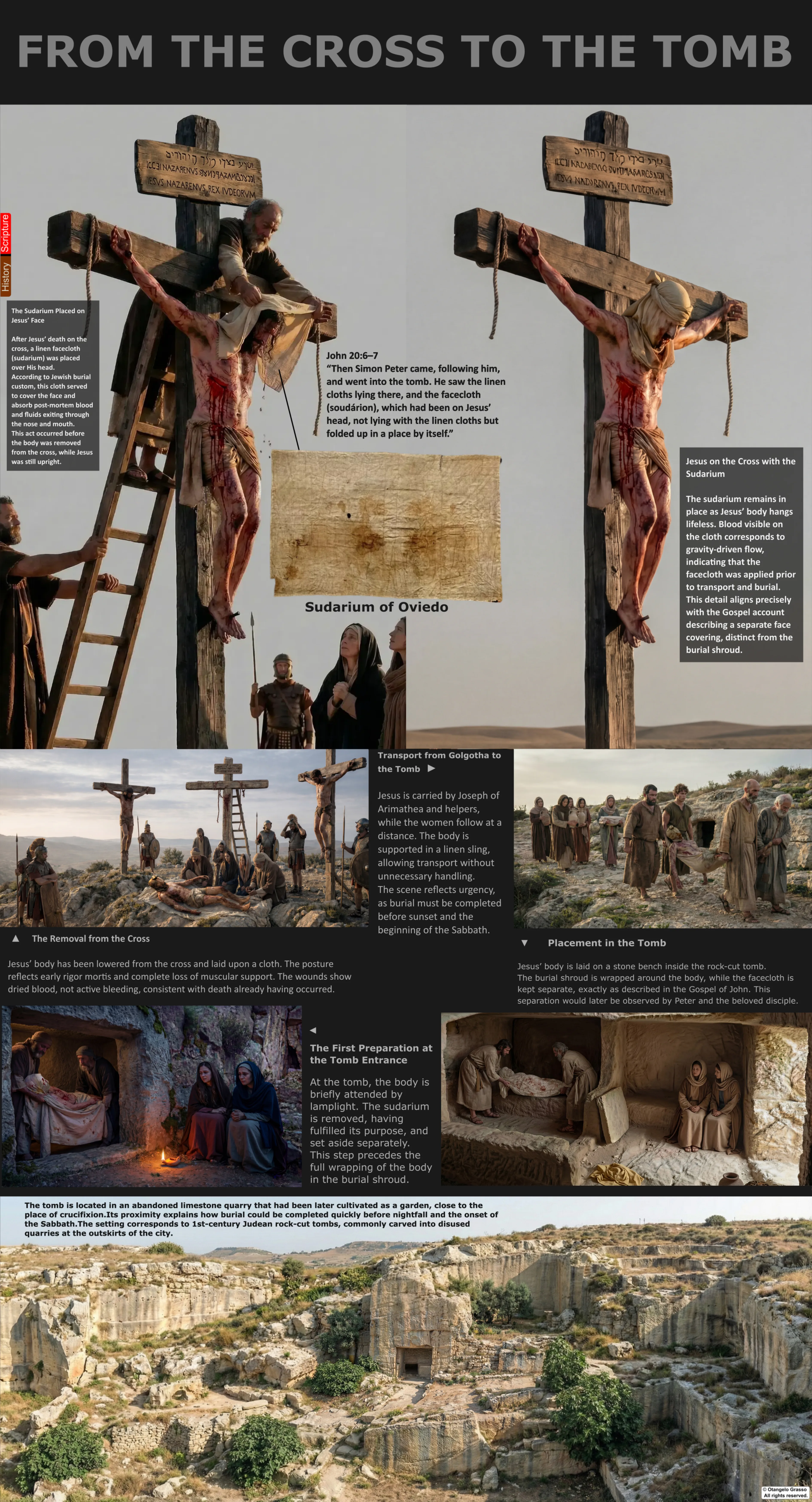
Image 14.1: According to the Gospels, Joseph of Arimathea, assisted by Nicodemus, gently lays Jesus' wounded body on a stone slab as they prepare to wrap him in a linen burial shroud.
Blood as a Biological Timestamp
As they work, blood continues to move — not by heartbeat, but by gravity and post-mortem dynamics. The dorsal image shows transverse rivulets across the lower back, flows running horizontally, perpendicular to the spine. These could not have formed while the body was vertical. They are consistent with the body being laid horizontal within hours of death, while blood remained liquid. 7 Some researchers have reported what they interpret as contact impressions on the left heel consistent with handling during transport, though this observation has not been formally published in peer-reviewed literature. From such impressions it is possible to infer at least two people carrying the body, hands gripping ankles and heels, navigating the rocky path from the quarry. The Gospels name Joseph of Arimathea and Nicodemus (John 19:39–40).
PART III: TRANSPORT AND THE SUDARIUM (5:00–5:45 PM)
John's Gospel provides precise topography: at the place where Jesus was crucified, there was a garden, and in the garden a new tomb — and since the tomb was nearby, they laid Jesus there (John 19:41 –42). The traditional site of the Holy Sepulchre places th e rock -cut tomb approximately forty metres from the proposed site of Golgotha within the same quarry complex — a ten -minute carry of an awkward, rigid corpse.8 Ten minutes. Not long. Long enough to need a face cloth.
The Face Cloth
There is an immediate practical problem: the face. The scalp bears dozens of puncture wounds from the crown of thorns. The face shows bruising and swelling from beatings. Blood and fluids drain from the nose and mouth — the natural post -mortem purge. Jewis h custom and human dignity demand the face be covered during transport.
Enter the sudarium — literally "sweat cloth," a handkerchief -sized linen measuring approximately 84 × 53 cm, documented in Spain since the early seventh century, when it was reportedly brought from Jerusalem during the Persian invasion of 614 AD, and housed in the Cámara Santa of Oviedo since King Alfonso II built that chapel in the early ninth century.4 Tradition identifies it with the face cloth mentioned in John 20:7, folded separately from the burial shroud after the tomb was found empty. Tradition alone, however, does not constitute evidence. What transforms this artifact from relic to datum is the c onstellation of forensic correspondences documented between its bloodstained fibers and those of the Turin Shroud — correspondences spanning multiple evidentiary domains, reported by several research groups over three decades.9
The Sudarium of Oviedo is an independent corroborating witness. Its documented presence in Spain from at least the early seventh century — more than seven centuries before the Shroud's first documented appearance in Western Europe in the 1350s — precludes any hypothesis
of coordinated medieval fabrication. If these cloths converge, the convergence was not arranged.
Image 14.2: The Sudarium of Oviedo is a small, bloodstained linen cloth traditionally believed to have covered the face of Jesus after the crucifixion. Unlike the Shroud of Turin, it bears no body image, but displays complex patterns of blood and fluid con sistent with contact with a wounded, deceased individual.
Textile and Material Concordances
Both cloths are hand-spun linen with Z-twist yarn direction — a spinning technique characteristic of first -century Near Eastern textile production but less typical in medieval European manufacture. Microscopic examination reveals fibers of approximately eq uivalent thickness despite divergent weave structures: the Sudarium exhibits a simple taffeta weave, functional and domestic; the Shroud employs a sophisticated 3 -to-1 herringbone twill, an expensive fabric likely originating in Syrian workshops. These dif ferences do not contradict common origin. They reflect complementary burial functions. The coarse, absorbent sudarium served as an immediate face covering during transport, staunching fluids and protecting dignity. The fine, costly shroud would receive the body for permanent burial.
Anatomical Trauma Patterns
Under forensic medical examination, the Sudarium's stains are consistent with a specific, traumatized face — and that face is consistent with the Shroud's. Both cloths bear evidence of nasal injury with right -side swelling and deviation; the affected area measures approximately 100 mm² on the Sudarium and 90 mm² on the Shroud, a difference within measurement tolerance. Both show right cheek prominence affecting blood flow patterns in corresponding ways. Both depict a beard distributed
unevenly, fuller on the left than the right. Both preserve a distinctive elongated blood clot running from the right corner of the mouth, its morphology specific enough that researchers characterize it as having good correspondence between the two cloths.
Most diagnostically, both cloths preserve evidence of crown -of-thorns wounds — multiple small penetrating injuries concentrated in the frontal and occipital scalp. One study, presented at the International Congress on the Sudarium of Oviedo, reports approx imately 75% geometric concordance in the occipital and nape region, where the Sudarium was fastened — though this has not been independently replicated in peer - reviewed literature. Notably, the Sudarium's forehead shows only one crown-of-thorns clot, while the Shroud's forehead displays several. This is not contradiction. It is information: the sudarium, covering the face from the crown, received direct contact with the forehead's largest wound, while the nape wounds transferred extensively where the cloth was fastened. The distribution asymmetry is consistent with, rather than undermining, shared origin.
Fluid Dynamics and Post-Mortem Physiology
Perhaps the most medically specific congruence involves the composition and behavior of expressed fluids. Both cloths contain bloodstains mixed with pale fluid — not serum separated by settling, but edema fluid from the lungs. Crucifixion is most consistent with a terminal cascade involving asphyxiation, hypovolemic shock, and cardiac arrest. Fluid accumulates in the pleural space and pulmonary tissues; upon death, relaxation of the thoracic cage can expel this fluid through the trachea, mixing with blood from traumatic injuries. The Sudarium's central stains have been reported in congress proceedings to exhibit approximately one part blood to six parts edema fluid — a ratio consistent with acute pulmonary edema in victims of compressive respiratory death, t hough this claim awaits peer - reviewed publication and independent verification.
The Shroud's facial zone shows the same fluid mixture at the nose and mouth, with flow trajectories that appear to encounter the same anatomical obstacles: the epsilon-shaped forehead clot, the right -cheek swelling, the beard. When overlay studies register the Sudarium's fluid stains onto the Shroud's face, flow paths on the Sudarium correspond to these anatomical obstructions. The long mouth-corner clot matches. The epsilon drop's edge remains on the Shroud while its center was on the Sudarium — a partial- transfer pattern consistent with both cloths having contacted the same wound in sequence, the sudarium removed first, leaving the clot's periphery adherent to the burial cloth.
Image 14.3: A composite illustration compares bloodstain patterns on the Sudarium of Oviedo with a reconstruction showing a cloth wrapped around a crucified victim's head. The image emphasises how the stain morphology corresponds to fluid flows produced while the body remained in a vertical position. Image source: Link
Spatial Geometry and Quantified Correspondences
In the 1990s, Alan Whanger applied his Polarized Image Overlay Technique to compare the cloths, alternating superimposed images through crossed polarizing filters. He reported forty -nine points of congruence on the Sudarium's frontal aspect and fifty on it s reverse — counts he described as exceeding his established threshold for positive identification. More refined geometric analyses followed. Barta and colleagues, employing computer -assisted correlation with controlled scaling, reported that the occipital and nape regions achieve maximum alignment under a specific transform: same -scale constraint, rotation of approximately 19°, and translation consistent with cranial curvature. Under this registration, approximately six of eight identifiable clot clusters in the Shroud's occipital crown -of-thorns zone correspond spatially to stains on the Sudarium — a 75% concordance in the region least susceptible to selective matching.9
Quantified facial metrics are also cited. Both cloths reportedly yield a forehead-to-nose-tip length of 8 cm. Nasal surface area is claimed to measure 2,280 mm² on the Sudarium versus 2,200 mm² on the Shroud — a difference within measurement tolerance. The lip-area stains coincide when one accounts for the physical consequence of the sudarium draping over a protruding nasal bridge while the shroud was laid flat. This is not special pleading. It is physical modeling. It must be noted, however, that many of these specific measurements and ratios originate from non -peer- reviewed congress proceedings and have not been independently confirmed in mainstream scientific journals.
Chemical and Biological Markers
Both cloths have yielded results interpreted as blood type AB under ABO testing, though forensic serologists have noted that reliable ABO typing from ancient textiles is methodologically problematic due to degradation and contamination, making this finding provisional. AB occurs in approximately 3 –5% of European populations, with somewhat higher prevalence in the Middle East. Blood typing alone cannot establish identity; the shared type modestly shifts probability without compelling it. Immunological testin g has verified the presence of albumin and immunoglobulin in stained fibers from both artifacts, confirming genuine biological material rather than pigment or later contamination. Both cloths reportedly contain residues consistent with aloe and myrrh — substances associated with Jewish burial customs (John 19:39 –40). Palynological studies have reportedly identified pollen from plant species native to the Jerusalem region on both cloths, though these findings — particularly Max Frei's work on the Shroud — have been contested on methodological grounds and have not been independently replicated in peer -reviewed literature. X -ray fluorescence analysis detected elevated calcium concentrations at the nasal region of both cloths — consistent with dust accumulation at the point of closest contact with the face.9
The Objection from Separability
A common objection holds that the Sudarium and Shroud cannot share origin because, when overlaid flat without adjustment, their stains fail to align. This objection misstates the claim. The comparative literature explicitly cautions that flat -surface super position is only a first approximation, and that stains do not necessarily coincide when the cloths are unfolded and laid flat. The sudarium was fastened to the head, folded along its midline, wrinkled and shaped by contact with a three - dimensional skull. The Shroud lay on a slab, relatively unwrinkled. Different application geometries, different tensions, different post - deposition handling — all guarantee that a rigid, translation-only overlay produces mismatch. The question is whether, under physically pl ausible transformations bounded by these known handling differences, the stain patterns converge on a single anatomical source. The reported 19° rotation, the nose-bridge correction, the posterior -register optimization are not ad hoc manipulations. They ar e attempts to reverse the actual mechanical history of two cloths applied differently to the same head.9
Provisional Conclusion on the Sudarium
Numerous congruence claims, documented across several evidentiary domains and reported by multiple investigators over three decades, have survived successive rounds of critique and refinement. No single correspondence compels; however, their cumulative wei ght, particularly given the cloths' separate geographic histories, makes a coincidental explanation difficult to sustain. The Sudarium's documented presence in
Spain from the early seventh century precludes any hypothesis of coordinated medieval fabrication.9
Forensic Perspective: Function Before Interpretation
The Sudarium of Oviedo contributes a category of evidence distinct from that of the Shroud. It bears no image, no chromatic encoding, no spatial relief. Its testimony is purely physiological: blood and fluid dynamics transferred under conditions governed b y gravity, contact pressure, and post-mortem processes. Its stain morphology therefore speaks not to identity directly, but to handling conditions. Downward flows from nasal and oral regions imply orientation constraints. Mixed blood and pale fluid indicate respiratory and vascular collapse consistent with extreme thoracic trauma. The cloth records a moment in the sequence when fluid management, not burial display, was the governing necessity. Within this framework, the Sudarium functions most plausibly as a temporary absorbent covering applied during removal, transport, or preliminary preparation — a role entirely consistent with Jewish burial sensibilities and with the Gospel description of a head cloth found separately within the tomb.
That conclusion is the strongest version of the Sudarium case, and it deserves to stand as written. Before Part IV proceeds, however, two methodological questions embedded in that conclusion require direct examination — because the cumulative argument is o nly as strong as its least scrutinised components.
On the Counting of Congruences
The congruence claims summarised above are sometimes presented as independent probabilities whose cumulative weight resists coincidental explanation. This framing is intuitive and rhetorically effective. It is also, as stated, statistically incomplete — and the gap matters.
A count of matching features constitutes a valid probabilistic argument only under two prior conditions, neither of which has been made explicit in the comparative literature on the two cloths. The first is that the population of possible features examined must be defined in advance. A blood-stained textile of any origin presents an indefinitely large number of measurable attributes — stain dimensions, fluid composition ratios, clot morphologies, fiber orientations, spatial distributions across dozens of anatomical zones, chemical constituents, and so on. If a researcher selects, after examining the cloths, those features that appear to match and counts them as congruences, the resulting number describes the analyst's attention, not a probability. To know wh at any given congruence count means, one must know how many features were examined in total and what matching rate would be expected between two independently bloodstained cloths under the null hypothesis.11
The second condition is that the selection procedure must be blinded and specified before the comparison is made. Whanger's Polarized Image Overlay Technique — which generated the congruence counts on the Sudarium's frontal and reverse aspects — was not co nducted under pre - registered, blinded conditions. This does not mean the counts are fabricated; it means that the well-documented mechanism of confirmation bias — the unconscious weighting of confirming evidence over disconfirming evidence — cannot be rule d out as a contribution to the total.12 A blinded analyst, examining the same two cloths without knowing which features previous researchers had selected, might arrive at a meaningfully different count.
None of this demolishes the Sudarium evidence. The anatomical specificity of individual correspondences — the epsilon-shaped forehead clot, the edema -fluid mixture, the occipital wound geometry — is genuinely striking and does not depend on the point-count framework. The physically modelled 19° rotation and the partial -transfer pattern of the mouth-corner clot are testable claims, not count-dependent inferences. The Sudarium case rests most securely on these specific, mechanistically grounded correspondence s, not on a cumulative count whose statistical validity has not been formally established.
On the Shared AB Blood Type
The identification of AB blood type on both cloths is cited here as a point of convergence. It warrants a quantitative assessment before being carried further.
ABO blood type is a class-level identifier, not an individual-level one. AB occurs in approximately 3–5% of the general population, with somewhat higher prevalence in certain Near Eastern populations. The probability that two randomly selected individuals from a Near Eastern population both carry the AB phenotype is therefore on the order of 0.1 –0.25% — small, but not negligible, and far from sufficient on its own to establish that the two cloths contacted the same person rather than two different AB -type individuals. Forensic blood grouping at the ABO level achieves class inclusion, not individualization. That distinction is foundational to forensic serology and is routinely stated in evidentiary contexts to prevent overinterpretation.10
This does not mean the blood type evidence is worthless. Within a broader cumulative argument, a shared rare phenotype shifts probability in the direction the argument points. But the shift is modest, and presenting it as though it independently corroborat es common origin overstates its discriminatory power. It belongs in the argument as one contributing factor among many, with its actual weight made explicit rather than absorbed into the rhetorical force of the list.
Image 14.4: The scene illustrates the ancient Jewish practice of burial, where the body was wrapped in linen strips and cloths, sometimes together with a larger shroud, before being laid in a rock-hewn tomb.
PART IV: THE TOMB AND PROVISIONAL BURIAL (5:45 –6:30 PM)
Joseph of Arimathea offers his own new tomb — an act of extraordinary generosity and considerable legal risk. Jewish law normally forbade burying executed criminals in family tombs until decomposition was complete, but a new, unused tomb could be appropriated without defiling ancestral remains. The tomb matches the typical first -century Jerusalem burial cave: a low entrance, a small antechamber, an inner chamber with a stone bench. A large disk stone seals the entrance.
The Critical Moment: Removal of the Sudarium
By lamplight, they bring the body inside and carefully position it on the stone bench. Now comes the pivotal action: they remove the sudarium.
The evidence on the Shroud itself is consistent with this removal. The frontal image contains detailed impressions of the face — the nose, cheeks, forehead, and beard recorded with anatomical fidelity, along with direct blood transfers from the scalp wound s. None of this would exist if the sudarium remained as a barrier between face and linen. The sudarium covered the journey from cross to tomb. The Shroud would then make unobstructed contact with what the sudarium had been protecting.9
The Incomplete Burial
The forensic data encoded on the Shroud is consistent with a process truncated by time. 2 The body appears to have been unwashed — intact blood clots and embedded dust particles are present at the heels. It was incompletely anointed — while Nicodemus brought approximately a hundred Roman pounds (roughly 32 kilograms, or about 72 imperial
pounds) of myrrh and aloes (John 19:39), chemical analyses suggest these spices were sprinkled dry on the linen rather than applied as oils in the prescribed full anointing. 7 The body was naked — the Shroud's dorsal image shows no evidence of undergarments, consistent with the Gospel account that the soldiers had divided the garments among themselves (John 19:23 –24). Everything about this burial speaks of intention frustrated by deadline.
The Act of Wrapping
Despite the rush, someone arranged the body and cloth with remarkable care. The Shroud measures approximately 4.36 metres in length — far more than required for a body of roughly 1.70 metres. The linen was laid lengthwise on the bench. Dry spices were sprinkled on the lower half. The body was placed on this prepared surface. Then the upper half of the cloth was drawn over the head, down across the face, chest, abdomen, and to the feet.
The Shroud presents a roughly thirteen -centimetre gap at the top of the head — the so-called epicranium gap — where no image appears. Forensic analyst Monsignor Giulio Ricci reconstructed the probable sequence: the Shroud was first laid over the back of th e head, receiving blood from the crown-of-thorns wounds. Then the excess cloth was brought forward over the skull. Rather than continuing immediately over the forehead, someone folded the excess back on itself, creating a small overlap and leaving the forehead momentarily accessible. Then the cloth was smoothed down into final position. Ricci suggests this deliberate fold was made to allow one final intimate gesture — a last touch on the forehead — before the linen was sealed into place. John also mentions othonia — linen cloths or wrappings (John 19:40) that some researchers interpret as binding strips used to secure the shroud at specific points on the body, though the precise meaning and function of the term is debated by scholars. These were not the Shro ud itself but supplementary bands, holding the large cloth in approximate contact. Their binding was loose and provisional, intended to hold until the full ritual washings could be completed after the Sabbath.
Those washings never occurred.
PART V: THE SEALING (6:30–7:00 PM)
Amber light filters through the low entrance. Outside, the first stars pierce the deepening blue. Final gestures: the Shroud is smoothed into position, the binding strips secured. The sudarium — still damp from the journey, still carrying its evidence of transport — is folded and set aside in a separate place. Why folded and separate? Perhaps as a deliberate marker: this cloth covered the face during transport. When the women return, they will know exactly what has and has not been done. That folded cloth becomes, on Sunday morning, a datum in itself.
Several men position themselves at the great disk stone. With coordinated effort they roll it forward along its channel. Stone grinds against stone. Silence. Matthew's Gospel adds that Pilate ordered the tomb sealed and a guard posted — the nature of the s eal, likely clay or wax by Roman convention, is inferred from period practice rather than specified in the text (Matthew 27:65–66).
From the Temple mount, three blasts of silver trumpets echo across the valley. The Sabbath has begun.
Inside the tomb, in perfect darkness, the body lies wrapped in expensive linen, positioned with care against impossible haste, attended by love under the constraint of time. The biological clock begins its forensic count.
PART VI: THE SILENT HOURS — A FORENSIC INTERVAL
The Contact Window: Thirty to Thirty-Six Hours
From Friday evening to Sunday before dawn: approximately thirty-five to thirty-six hours. This window matters because of what the Shroud shows — and crucially, what it does not.
Present on the Shroud: intact blood clots, both ante -mortem and post - mortem, each surrounded by clear serum halos; rigor -based body posture recorded in the image; chemical signatures of myrrh and aloes on the fibers; a superficial, non -pigmented image enco ding three -dimensional distance information.2
Absent from the Shroud: macroscopic decomposition staining, which typically appears after forty to seventy -two hours under ambient conditions; putrefaction fluids from liquefied tissue, appearing after three to five days in warm conditions; adipocere, the waxy substance of fat decomposition; bacterial or fungal colonization of blood proteins; and — most significantly — any reported disturbance of the blood-cloth bonds.7
The forensic conclusion proportionate to the evidence is this: the body was in contact with the cloth long enough to transfer blood and form an image, but not long enough for decomposition to begin. This is most consistent with approximately thirty to thirty-six hours of contact in a cool, hypogeal environment. However, while blow flies in Mediterranean environments can potentially locate a body within hours in open conditions, a sealed rock tomb would effectively preclude insect access regardless of the bo dy's state of preservation.
The Chemistry of Image Formation
Los Alamos chemist Raymond Rogers — the same meticulous investigator whose vanillin analysis featured in the radiocarbon controversy — hypothesized a Maillard reaction between volatile compounds released by the body and the linen's starch -and-saponin surface coating. A body after death and extreme trauma releases urea,
ammonia, and other reactive compounds. Linen prepared with starch provides the reactive substrate. The result, under this hypothesis, is an extremely superficial yellowing of only the outermost linen fibers, at a depth of approximately 200–600 nanometres — thinner than the diameter of a single fiber.2
Image intensity correlates with proximity: the nose, being closest to the cloth, appears darkest; the recessed eye sockets appear lightest. This relationship encodes three-dimensional spatial information in the cloth — a property not understood until the a ge of computer imaging, when researchers using the VP -8 image analyzer found the Shroud image contains mathematically consistent relief data unlike that produced by painting or conventional photography. Rogers acknowledged the profound constraint this plac es on any replication: conditions must be extraordinarily specific — an unwashed body, dry aromatic spices, a starch-coated linen, contact lasting thirty to forty hours, and separation before decomposition begins. Every variable must align precisely.
Blood Evidence: The Clock in the Clot
Biochemical analysis by Dr. John Heller and Dr. Alan Adler confirmed the presence of real human blood through detection of haem derivatives, bilirubin, and intact protein structures. 7 The bilirubin content, elevated above normal levels, is consistent with the haemolytic stress of scourging and crucifixion trauma. Blood clots, once formed, undergo fibrinolysis — the gradual enzymatic dissolution of the fibrin network. At typical tomb temperatures of fifteen to twenty degrees Celsius, this process proceeds more slowly than at body temperature, though the precise timeline remains dependent on variables not fully characterized in the peer -reviewed literature on post -mortem fibrinolysis. The Shroud's blood reportedly shows partial fibrinolysis — clots that had begun breaking down but remained structurally present. This is consistent with a contact period on the order of thirty to thirty-six hours.
The Separation Problem
Blood bonds to fabric. Fibrin proteins physically entangle with textile fibers at a microscopic level. After hours of contact, blood essentially adheres cloth to skin. Any mechanical separation — even the most delicate peeling — creates microscopic disrupt ion: torn clots, smeared serum, distorted fibrin networks, fiber damage at the bond interface. Under electron microscopy, the Shroud's blood -fiber interface reportedly shows none of this disturbance. 7 The blood -linen bonds appear intact and undisturbed.
Forensic science can outline the logical possibilities for how separation might have occurred. Careful mechanical removal appears inconsistent with a complete absence of microscopic disruption at the fiber -blood interface; even the most delicate peeling ty pically creates detectable disturbance. Decomposition -mediated separation — as liquefaction
proceeds, bonds dissolve and the cloth could theoretically be removed from remaining tissue — is inconsistent with the complete absence of decomposition markers on the linen, and a skeletal structure would not produce the anatomically coherent image presen t on the cloth. A third category — non-mechanical separation in some form not captured by forensic frameworks — lies entirely outside the scope of forensic science to evaluate, describe, or corroborate.
What the discipline can observe, assuming the reported evidence is taken at face value, is a set of physical characteristics consistent with a separation event that was non -disruptive to the blood -cloth interface, occurred within a thirty -to-thirty-six-hour window, and left no decomposition markers. The cause of that event is a question for a different order of inquiry — one that forensic science can neither answer nor foreclose.
PART VII: SUNDAY MORNING — THE EMPTY TOMB
Mark's Gospel records: when the Sabbath was past, Mary Magdalene, Mary the mother of James, and Salome bought spices so that they might go and anoint him. Very early on the first day of the week, when the sun had risen, they went to the tomb (Mark 16:1 –2). They come to finish Friday's incomplete work. Their practical concern on the walk: who will roll the stone away from the entrance for us? They know its weight requires multiple men.
They arrive to find the problem already solved — and replaced by a far greater mystery.
The stone is rolled aside. The guards are absent. The tomb is open. Peter and John find the linen burial cloths lying in position, as if the body had simply withdrawn from within them, leaving the wrappings collapsed but orderly.
And there is the sudarium: which had been on his head, not lying with the linen cloths but folded up in a place by itself (John 20:7). Three forensic details. First, "had been on his head" is completed past action — it was used during transport, not during final burial. Second, it is not lying with the linen cloths but separate and distinct — as it had been left on Friday evening. Third, it is folded — not crumpled, not discarded, but arranged with intention.
Peter sees this and goes home marvelling. John sees it and believes. Both understand what the order means. Robbers do not unwrap corpses, fold face cloths, and arrange everything neatly. Hurry leaves chaos. This was order.
The sudarium covered the journey from cross to tomb. The Shroud covered the hours of waiting in darkness. Both were left behind — as if to
say: these were needed for death. They are not needed for what comes next.
EPILOGUE: THE CONSTRAINED TRAJECTORY
A forensic reconstruction based on the Shroud's physical features is consistent with a tight and coherent sequence: death at Hour 0; rigor mortis beginning; blood beginning post-mortem settling. By Hour 0.5, the lance confirms death and releases post-mortem fluid by gravity. By Hour 2, the body is removed from the cross and the nails extracted. By Hour 2.5, transport has begun and the sudarium placed over the face. By Hour 3, they arrive at the tomb; the sudarium is removed; the Shroud is applied with direct facial contact. By Hour 4, the tomb is sealed and the Sabbath begins. From Hours 4 through 36, the body remains in contact with the Shroud: blood transfers, image forms, fibrinolysis advances. No decomposition occurs. At approximately Hour 36, the separa tion event: the body absent; blood -cloth bonds reportedly intact; cloth collapsed inward. At approximately Hour 38, discovery: the stone rolled aside, the tomb empty, the cloths arranged in order.
What makes the Shroud exceptional is precision. This is not a painting depicting crucifixion — its properties are consistent with it being a recording of one. Wound patterns consistent with Roman crucifixion practice. Rigor mortis posture. Post -mortem phys iology. First -century burial customs. Textile chemistry. All encoded in linen with a degree of forensic fidelity that demands serious examination. Every blood flow obeys gravity. Every wound is consistent with the Gospel timeline. Every absence — washing, anointing, decomposition — aligns with the four - hour Friday window and the thirty-six-hour contact period.
The Shroud does not answer the question of what happened in that tomb. It only insists, with the maddening precision of physical evidence, that the question is worth asking.
The cloth was in the tomb. The question of how it left it is Chapter 15's. References
1. Edwards, W. D., Gabel, W. J., & Hosmer, F. E. (1986). On the Physical Death of Jesus Christ. JAMA, 255(11), 1455–1463. Link.
2. Rogers, R. N. (2005). Studies on the Radiocarbon Sample from the Shroud of Turin. Thermochimica Acta, 425(1–2), 189–194. Link.
3. Safrai, S. (1976). Home and Family. In S. Safrai & M. Stern (Eds.), The Jewish People in the First Century. Fortress Press. Link.
4. Heras Moreno, G., Villalaín Blanco, J. D., & Rodríguez Almenar, J. M. Comparative Study of the Sudarium of Oviedo and the Shroud of Turin. Proceedings of the 1st International Congress on the Sudarium of Oviedo. Link.
5. Barbet, P. (1953). A Doctor at Calvary. P. J. Kennedy & Sons. Link.
6. Hartman, V. E., et al. (2013). Crucifixion and Median Neuropathy. Brain and Behavior, 3(3), 243–248. Link.
7. Heller, J. H., & Adler, A. D. (1981). A Chemical Investigation of the Shroud of Turin. Canadian Society of Forensic Science Journal , 14(3), 81–103. Link.
8. Gibson, S., & Taylor, J. E. (1994). Beneath the Church of the Holy Sepulchre. Committee of the Palestine Exploration Fund. Link.
9. Heras Moreno, G., Villalaín Blanco, J. D., & Rodríguez Almenar, J. M. Comparative Study of the Sudarium of Oviedo and the Shroud of Turin. Proceedings of the 1st International Congress on the Sudarium of Oviedo. Link.
10. Cole, S. A. (2005). More than zero: Accounting for error in latent fingerprint identification. Journal of Criminal Law and Criminology , 95(3), 985–1078. Link.
11. Nickerson, R. S. (1998). Confirmation bias: A ubiquitous phenomenon in many guises. Review of General Psychology, 2(2), 175–220. Link.
THE WIDER DEBATE
Post-mortem flow and burial
The first thread reads the two angles of blood flow on the arms as a victim shifting to breathe, and lists post-mortem pooling among the features that a medieval forger would have had to know. The second thread puts these into its list of forger requirements.
Source: the two catsboard threads of the Otangelo Grasso forum, part 1 and part 2. These are the author’s arguments, presented here as such, not established findings.
Explore the author’s additional material: The Shroud of Turin, part 1 · Part 2. The book’s bibliographic references are included where available.