FEATURE ARTICLE
The lower-abdominal contour
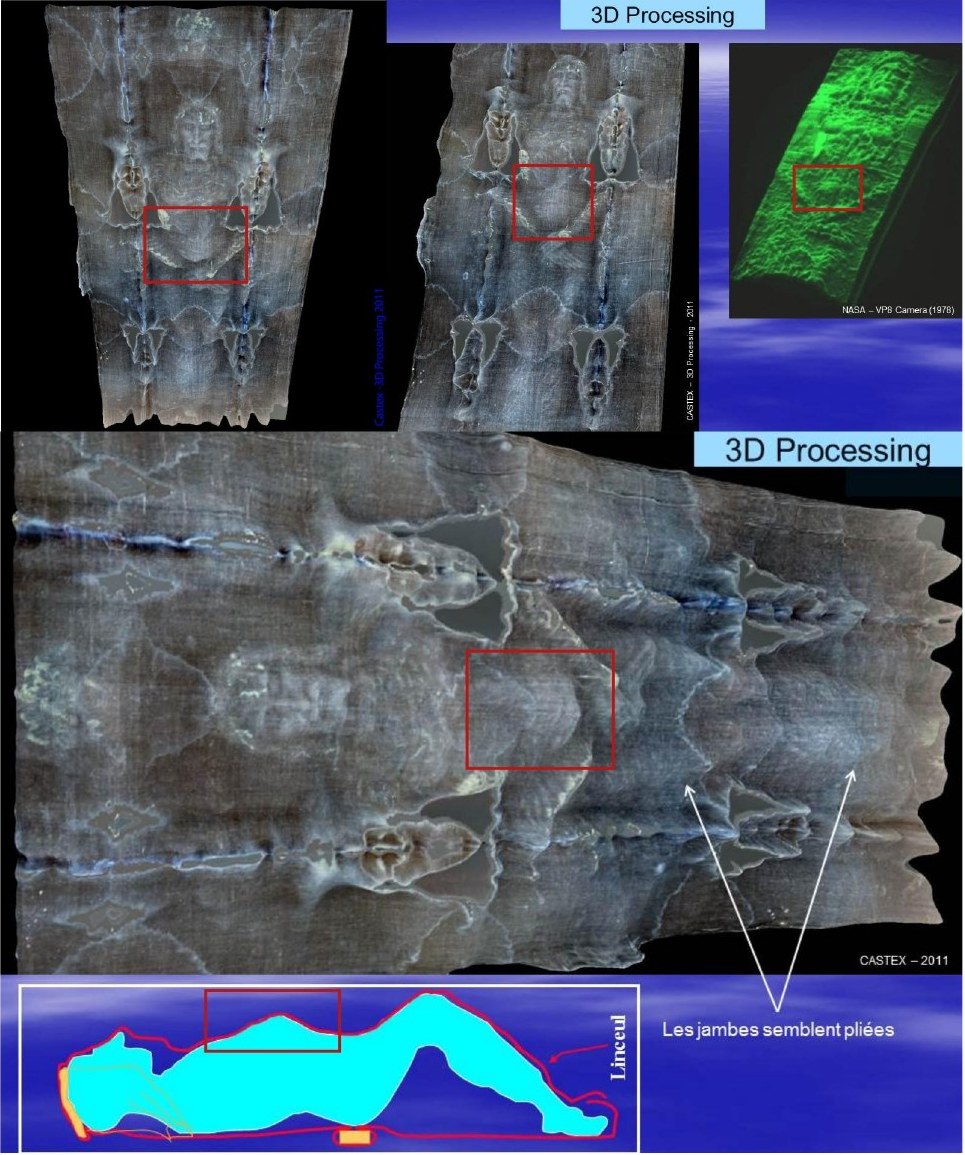
The frontal image of the Shroud has been described as showing a slight prominence in the lower abdomen. What that contour means is uncertain: the image is not a direct measurement of the body’s depth, and appearance alone cannot identify its cause.
Two observations, different explanations
Physician Pierre Barbet called attention to a “protruding hypogastrium” and connected it to his account of crucifixion posture and breathing. Frederick Zugibe, while rejecting Barbet’s proposed asphyxia mechanism, separately noted a slight abdominal bulge. In his suspension experiments, volunteers shifted toward abdominal and diaphragmatic breathing as their arms were elevated and chest movement became more restricted. These observations make breathing mechanics worth examining; they do not show that every crucified person had the same abdominal shape or that the Shroud records a particular respiratory state.
A possible mechanical explanation
Modern studies of abdominal distension describe cases in which the visible abdomen moves forward despite little increase in its contents. Changes in diaphragm position and coordination with the abdominal wall can redistribute contents toward the front and lower abdomen. Arm elevation can also change respiratory muscle recruitment. Together, these findings suggest a possible chain: a strained posture may increase the diaphragm’s role in breathing, while altered abdominal-wall activity changes the outward contour.
This is an analogy from modern physiology, not a direct crucifixion experiment. No published study appears to have measured lower-abdominal surface projection during crucifixion-like suspension. The size and duration of any change, and whether it matches the Shroud image, remain unknown.
Image and body position
A contour on a frontal image is not necessarily a preserved snapshot of active breathing. If the body was later laid supine, gravity, loss of muscle tone, rigor, arm placement, and linen drape could all affect its apparent profile. Image processing and methods that turn image intensity into three-dimensional relief can further change what seems prominent. Such relief images are not CT scans or direct millimetric measurements.
The appearance is not proof of enlarged organs, ascites, or a particular cause of death. Nor does resemblance to a proposed respiratory mechanism establish the Shroud’s authenticity. Ordinary body shape, posture, cloth contact, and image-making effects remain possible contributors.
A testable question
The prominence is best treated as a hypothesis to test. Researchers could compare minimally processed Shroud photographs and check whether the contour survives different imaging methods. Ethical suspension studies could record breathing, diaphragm movement, abdominal-wall muscle activity, and three-dimensional body shape. A second stage could examine how repositioning a body supine and placing linen changes that shape. These comparisons could help separate a posture-related effect from ordinary anatomy and postmortem or imaging effects.
At present, the contour is compatible with several explanations. Breathing mechanics offer a plausible avenue for investigation, but the evidence does not make the contour a unique sign of crucifixion or settle what caused it.
Online paper and related research
- Otangelo Grasso, Lower-Abdominal Protrusion in Crucifixion and the Turin Shroud (2026) — full paper on Academia.edu.
- Accarino et al., “Abdominal distention results from caudo-ventral redistribution of contents” (2009) — CT study of abdominal wall protrusion and diaphragm position.
- Barba et al., “Abdominothoracic mechanisms of functional abdominal distension and correction by biofeedback” (2015) — CT and EMG study of diaphragm and abdominal-wall activity.
- Barba et al., “Visible abdominal distension in functional gut disorders: Objective evaluation” (2023) — clinical CT and EMG evidence on visible distension.
- Couser, Martinez, and Celli, “Respiratory response and ventilatory muscle recruitment during arm elevation in normal subjects” (1992).
- Jackson, Jumper, and Ercoline, “Correlation of image intensity on the Turin Shroud with the 3-D structure of a human body shape” (1984).
Book: Otangelo Grasso, The Shroud of Turin: A Forensic Summary of the Evidence, third edition.