IN-DEPTH READING
The evidence in context
This chapter presents historical, scientific and medical interpretations of the Shroud. Some conclusions remain debated. A source note identifies the related work1.
Constantinople. August 15, 944 CE. The streets blazed with torchlight as an extraordinary procession wound through the ancient capital. Priests in golden vestments carried a cloth-wrapped object toward the Pharos Chapel of the Imperial Palace. The arrival of the Mandylion, an image of Christ not made by human hands, was a moment of profound religious significance.1 Emperor Romanos I Lekapenos (with Constantine VII Porphyrogennetos as co-emperor) presided over its reception; Constantine VII, who became sole emperor later that year, would go on to author the key account of the relic.2 What the crowds did not know —what perhaps even the Emperor did not fully understand —was that this cloth's influence on Christian art was only beginning to be felt. The conventional narrative places the Shroud's first undisputed historical appearance in 1355, when it surfaced in the French village of Lirey.3 Chapter 16 argued, through philological and historical evidence, that the cloth's documented biography may extend considerably further back. This chapter examines a parallel question through a different kind of evidence: not documents, but faces. Icons tha t bear intriguing resemblances. Coins that show consistent features. A medieval manuscript with illustrations that appear to reflect knowledge of the Shroud from before 1204. Each line of evidence is largely independent. Each admits of alternative explanation. Together, they ask a question that becomes increasingly difficult to answer without a common template.
PART I: THE PANTOCRATOR ENIGMA
When Art Meets Forensics
The Mathematics of a Face
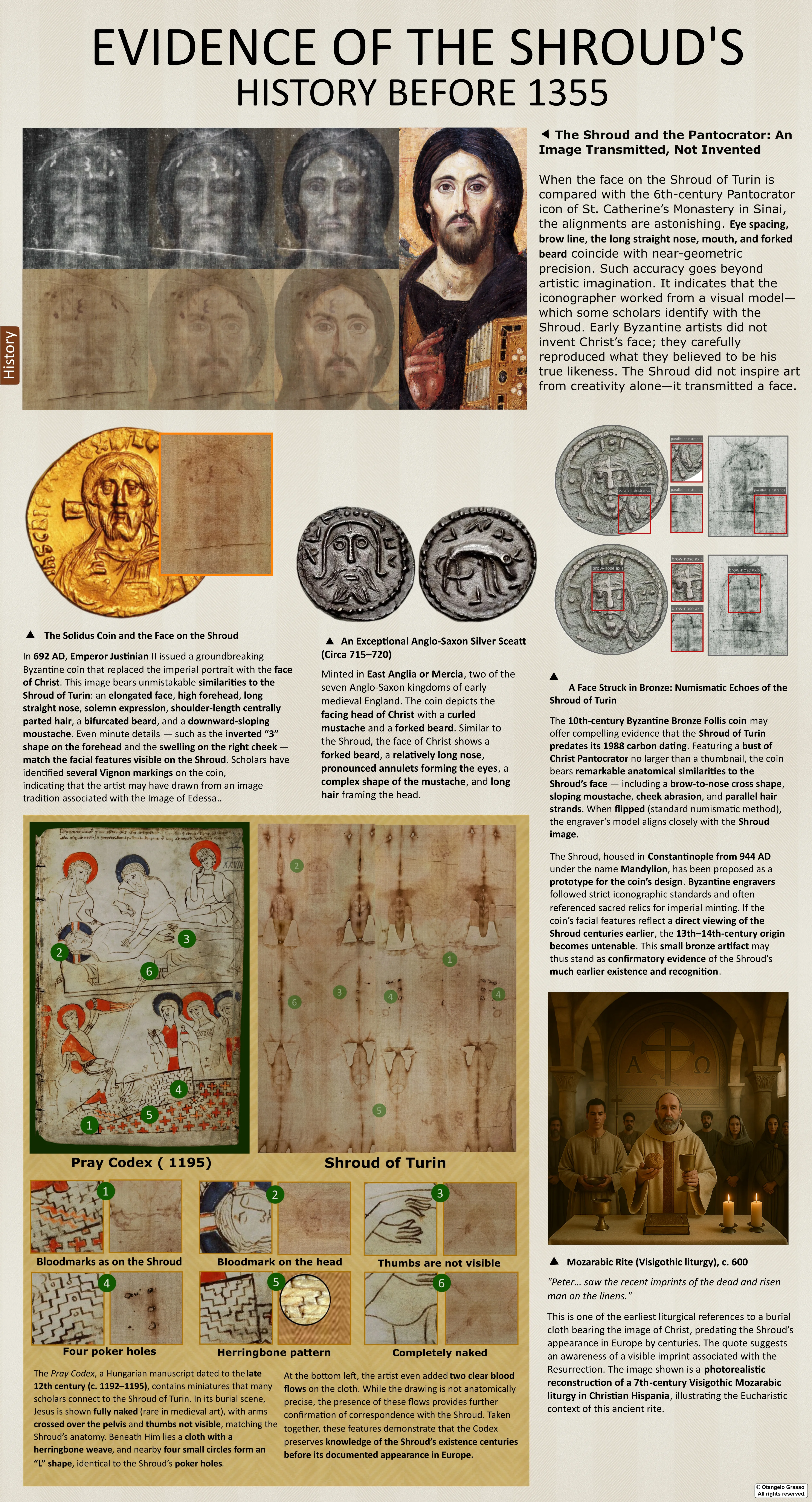
High in the remote mountains of the Sinai Peninsula, within the fortified walls of St. Catherine's Monastery, hangs an icon that has long been a subject of scholarly discussion. The Christ Pantocrator, dated securely to the mid -6th century, is a pivotal wo rk in the development of Christ's portrait.4 The question is deceptively simple: where did the artist get this face? In 2025, I conducted my own geometric morphometric analysis —a methodology used in forensic anthropology—to compare the Shroud face and the Pantocrator icon. Twenty -two anatomically defined landmarks were placed on high-resolution images of both faces. To r educe observer bias, landmarks were automatically snapped to Canny edge maps within pre-registered radii. Both faces were masked to the same elliptical facial oval, and a similarity -only Procrustes alignment was performed — optimally scaling, rotating, and translating one set of points to fit the other, while prohibiting local warping that could artificially inflate congruence.
Image 17.1: Landmark schema used to guide automated edge -snapping for 22 anatomically defined points. Blue arrows are edge-snap guides, not the landmarks themselves. Source: Link
In this personal analysis, the result was RMS/IPD = 0.049. If the distance between the pupils is taken as a standard measuring unit, the average error between corresponding facial features was less than 5% of that distance— in a face roughly 250 pixels wide, an average deviation of approximately 12 pixels. Statistical significance was assessed via a landmark -relabeling permutation test of 3,000 trials, randomly pairing icon landmarks with Shroud landmarks to create artificial comparisons. In this test, no permutation in 3,000 trials achieved an equal or better match, yielding p < 0.033% (p < 3.3 × 10⁻⁴) under this null model, though the appropriateness of the null model has not been independently evaluated. A bootstrap over landmarks (500 resamples) yielded a 95% confidence interval of [0.038,
0.053]. The result remained stable under ±3% crop jitter (median 0.040) and when only high-confidence landmarks were used (RMS/IPD = 0.047). All exploratory parameter tuning was documented before locking the final protocol.
The numbers are precise. What they describe is striking: two faces aligning—not roughly, but with precision extending to asymmetries and irregularities. Features such as the swollen right cheek, slightly crooked nose, divided beard, and T -shaped eyebrows a ppear on both the Pantocrator and the Shroud; scholars debate whether these reflect a specific individual or established Byzantine artistic conventions.
The Template Hypothesis
Art historians have long observed what they call the iconographic tradition—the tendency of religious artists to copy and perpetuate established visual formulas. But there is a profound difference between an artist copying from another artist's painting an d an artist working from a physical object that presents entirely different visual information. Consider what the Pantocrator artist would have encountered if working from the Shroud itself. Not a painting with clear lines and defined colors, but a faint, ghostly negative image on yellowed linen—an image that only fully resolves when viewed from several feet away, one that encodes three- dimensional information in its coloration such that the distance from cloth to skin determines the darkness of the stain. An image showing blood flows in the rust -brown of oxidized hemoglobin. An image that includes details—the swelling of the cheek, the asymmetry of the nose —that no artist inventing a divine portrait would necessarily choose to include.
French biologist and Shroud researcher Paul Vignon identified what he termed "Vignon markings" —a set of distinctive features (variously enumerated, with some accounts listing fifteen or more) appearing across Byzantine depictions of Christ.5
They include a transverse line across the forehead, a three -sided square between the brows, a V -shape at the bridge of the nose, a raised right eyebrow, an enlarged left nostril, an accentuated right cheek, a gap in the beard below the lower lip, a forked beard longer on one side, two strands of hair falling forward over the forehead, and a transverse line across the throat, among others. Many of these —the forehead line, the square between the brows, the throat line—appear in the Shroud to be bloodstains or wrinkles that some researchers argue Byzantine artists interpreted as essential elements of Christ's true appearance and reproduced. Critics have argued that these features are sufficiently common across Byzantine art that their appearance does not require a single physical template, and that the selection of comparison images was not conducted blind.
If artists were working from imagination or oral tradition about Christ's appearance, why would they consistently include such anatomically
specific oddities? The conventional response is that these became canonical features through centuries of copying and re -copying, arising from the artistic tradition itself. But that explanation faces a chronological observation: the bearded, long-haired Christ iconography becomes clearly visible in surviving works from approximately the mid -6th century, coinciding—though perhaps not causally —with early references to the Image of Edessa. Art historians have proposed several explanations for this shift, incl uding Syrian artistic influence and post -Chalcedonian theological emphases on Christ's humanity.6
Image 17.2: Visual transformations showing the progression from the Shroud image to an icon -like representation, demonstrating the conceptual link between the two. Scale and rotation are fixed; only opacity changes.
The Direction of Influence
My geometric study was deliberately neutral on the question of directionality. The mathematics can demonstrate congruence —that two faces match—but not which influenced which. Could a medieval forger have created the Shroud based on Byzantine icons like the Pantocrator? In principle, yes. But consider what that hypothesis requires: translating geometric proportions from a painted icon into a photographic negative (a concept not formally understood until the 19th century); creating that negative image without conventional paint, dye, or pigment; encoding three-dimensional information such that image intensity varies with cloth- to-body distance; making the image superficial, affecting primarily the topmost fibrils of the linen; including anatomically accurate b loodstains showing post -mortem serum separation —and accomplishing all of this using technology that has not yet been replicated by modern science.
The majority of STURP researchers concluded in 1981 that no paint, dye, or pigment was responsible for the image, though team member Walter McCrone independently concluded that iron oxide pigment consistent with paint was present—a disagreement that remains unresolved.7
The image is extremely superficial, confined primarily to the outermost fibrils of the linen; a 2004 study by Fanti and Maggiolo found a faint image also on the reverse side, though far less distinct.8
The alternative pathway—that a 6th-century iconographer worked from a Shroud-like cloth to create the Pantocrator —requires only that the artist could see and paint. It requires no unknown technology, no impossible foreknowledge. It asks only that we take s eriously what some historical sources suggest: that a burial cloth bearing Christ's image may have existed and been venerated during the period when the iconography of Christ underwent its transformation.
PART II: THE CURRENCY OF FAITH
Christ's Face in Metal
The Emperor's Gambit
In 692 CE, Byzantine Emperor Justinian II ordered the imperial mint to strike a new gold solidus bearing an image that had never before appeared as a standard imperial obverse type: the face of Jesus Christ.9 This was not merely an artistic choice. It was a calculated political and theological statement. Islamic armies had conquered much of the eastern Mediterranean, and the Caliph Abd al -Malik had begun replacing Christian formulae on official Egyptian papyrus documents with Quranic invocations—a change that affected documents flowing to the Byzantine administration. Justinian's response was symbolic: he would pay for that papyrus with gold coins bearing Christ's image. Abd al-Malik rejected the coins, considering figured imagery religiously problematic, and issued his own epigraphic gold coinage (the dinar) in 696 –697 CE. The political point was made.
That same year, 692 CE, the Council in Trullo (the Quinisext Council) issued Canon 82, which directed that Christ be depicted in human form rather than as the symbolic Lamb of God.11 For centuries, early Christian art had depicted Christ symbolically. When Christ appeared on earlier coinage, representations varied. Canon 82 emphasized human representation. The question was: what human form?
The Die Cutter's Dilemma
Somewhere in Constantinople, a master engraver sat down to create the die for the revolutionary solidus. He could not depict Christ as a beardless youth—that tradition was now deemphasized. He needed to show Christ in human form, and no one living in 692 CE had seen Christ. The Gospels offered no physical details. The engraver needed a model.
What emerged from the imperial mint was striking. The solidus showed Christ with long hair, a divided beard, a prominent nose, and —most
strikingly—an asymmetric face. The right cheek appeared swollen. The nose was slightly crooked. A distinctive tuft of hair appeared on the forehead. These were not the fully idealized features of divine majesty typically seen in imperial portraits. The comparison to the Shroud has been noted by some researchers for specific anatomical details that have no obvious artistic justification within Byzantine conventions.
Image 17.3: The solidus, a gold coin introduced by Constantine the Great around 310 CE and weighing approximately 4.5 grams, served as the standard gold currency of the Byzantine Empire for centuries. Originally bearing only the reigning emperor's image, Justinian II's decision to place Christ's face on it was without precedent.
The Mathematics of Numismatics
In a 2014 study, Professor Giulio Fanti applied probability analysis to this question.12 He identified multiple distinctive features shared between the Shroud face and the face on Justinian II's solidi: the asymmetry of the face (particularly unusual in imperial Byzantine art, which typically idealized and symmetrized portraits); long, uneven hair; a prominent, somewhat crooked nose; a swollen right cheek; a beard divided in two, longer on the left; a beardless area below the lower lip; a distinctive tuft of hair on the forehead; and the absence of royal symbols on the earliest versions. When the probability of each feature's independent occurrence is estimated and the values multiplied together, the combined probability of all features appearing together by chance becomes extremely small—Fanti's estimate was approximately 1 in 100 million. Str ict statistical independence may not hold for facial features, and the exact probability assignments are open to debate.
But the core observation stands: these are not generic features. Master engravers in 692 CE were perfectly capable of creating idealized, symmetrical faces—we see such faces on contemporary coins depicting the emperors themselves. When they depicted Christ with an asymmetric, imperfect face marked by trauma, that was a deliberate choice requiring explanation. Dr. Alan Whanger, using his polarized image overlay technique, claimed to find approximately 145 points of congruence between the Shroud face and Justinian II's coins. He claimed this exceeded a threshold he equated with forensic identification, though this threshold does not correspond to any established U.S. forensic standard for facial comparison, and his methodology has not been accepted by mainstre am forensic practitioners.13
While his methodology has been criticized as subjective, the basic observation is that the correspondences are numerous enough to have drawn scholarly attention.
The Tuft of Hair Mystery
Perhaps no single detail better illustrates the proposed connection than the curious tuft of hair appearing on Christ's forehead in countless coins from 692 CE onward. On the Shroud, this tuft is actually a reversed -3 shaped bloodstain, clearly visible jus t above the eyebrows —anatomically consistent with a rivulet of blood flowing from scalp wounds. To a medieval artist unfamiliar with photographic negatives and seeing the cloth for the first time, this dark mark could look like a strand or tuft of hair. Canon 82 directed that Christ be depicted in human form rather than as the symbolic Lamb of God; it did not broadly prohibit Passion imagery, which continued throughout Byzantine art.14
The Shroud was inherently an image of the Passion —every bloodstain a reminder of torture. The interpretation of bloodstains as hair would have allowed an artist to copy the Shroud's visual information while producing an image suitable for liturgical use.
The Evolution of Byzantine Christ Imagery
The chronology of Byzantine coinage provides a natural experiment in art historical influence. Coins minted before 692 generally did not bear Christ's portrait; when they did, representations varied. The 692 solidi introduce the distinctive Christ type dra matically and suddenly. When Justinian II was overthrown in 695, his successor stopped using Christ's image entirely. When Justinian regained power in 705, Christ reappeared—but with a different face, showing short curly hair and a short beard. When the long-haired, bearded Christ type returned under Emperor Michael III after the Iconoclastic period (842 –867 CE), it became the dominant iconographic model for the rest of Byzantine history.
This pattern —appearance, disappearance, reappearance —is consistent with the existence of a physical template being referenced, though it could also reflect other historical and theological developments. The Shroud-like face appears when the cloth may have been accessible and influential, and recedes when alternative artistic traditions were preferred.
Beyond Byzantium: The Reach of the Template
The influence was not confined to Constantinople. Anglo-Saxon England minted silver sceattas from approximately 710 –740 CE showing Christ imagery with Byzantine-influenced features including forked beard, long hair, and stylized eyes —features consistent wi th the transmission of Justinian II's iconography through trade.15
These coins were produced in East Anglia or Mercia —kingdoms with active trade connections to the Byzantine world but no documented possession of the Shroud itself. The most economical explanation is that Byzantine coins became transmitters of the iconograp hy. A merchant or pilgrim carrying a Justinian II solidus to England would bring with it a portable template for Christ's appearance.
Image 17.4: A 10th-century Bronze Follis coin featuring a bust of Christ Pantocrator. Some researchers have noted similarities between the coin's image and the Shroud when accounting for die -engraving orientation. Image Link The Dislocated Shoulder
One of the more intriguing details appears on later Byzantine coins —not a facial feature, but a postural one. Several gold solidi from the reigns of Justinian II and later emperors show Christ with his right shoulder noticeably lower than the left. This is not typical of triumphant or divine imagery, where symmetry and majesty are the conventions. A lowered shoulder suggests asymmetry, imperfection. Yet it appears repeatedly, reproduced by different die cutters across different reigns.
A 2014 anthropometric study of the Shroud figure found what some researchers interpret as a glenohumeral dislocation of approximately 3 centimetres, which they suggest is consistent with a heavy fall while carrying a significant weight—such as a crossbeam.16
The Byzantine engravers may have been copying what they saw, even when what they saw was anatomically unusual for a portrait of divine majesty.
The coins, in this interpretation, become more than just art. They are potential witnesses —minted in gold and silver and bronze, distributed across an empire, each one carrying an image that may derive from a common template.
PART III: THE PRAY MANUSCRIPT
When a Medieval Scribe May Have Known Too Much
The Hungarian Anomaly
In 1770, a Hungarian Jesuit scholar named György Pray identified a collection of medieval manuscripts in the Jesuit college collection; the codex, now held in the National Széchényi Library, Budapest, is dated to 1192–1195—the Pray Codex.17 For nearly two centuries, scholars valued it primarily for containing the earliest known example of continuous Hungarian prose. In the 1970s and 1980s, Shroud researchers began to notice something else: one of the manuscript's five illuminations, depicting the burial of Christ, contained details that some researchers interpret as correspondences with the Shroud of Turin.18 The conventional narrative places the Shroud's first undisputed appearance in Lirey, France, around 1355—more than 160 years after the Pray Codex was completed. If that narrative were complete, the illustration should show only what any medieval artist might include based on biblical accounts and artistic tradition. Instead, it shows details that are both highly specific and, at the time, unusual in Christian art. Four Holes and a Herringbone
The Pray Codex illustration (folio 28r) shows the burial of Christ in two panels—the upper depicting the anointing of the body, the lower the
discovery of the empty tomb. Both panels contain details requiring examination.
The figure is depicted with hands crossed over the pelvis in a pose similar to that of the Shroud figure; the degree of nudity and its significance are debated among scholars. The cloth beneath Christ's body in both panels displays a pattern that some rese archers interpret as herringbone weave consistent with the Shroud's 3-to-1 herringbone twill, though others regard it as conventional decorative hatching. In the lower panel, the cloth features four small holes in a configuration that Shroud researchers compare to the L -shaped "poker holes" on the Shroud; critics note that similar decorative hole patterns appear elsewhere in the same illustration. Finally, the Codex figure's hands show only four fingers on each hand — no thumbs. On the Shroud, the figure's th umbs are not visible; some researchers propose this reflects thumb retraction caused by nerve damage from nail placement during crucifixion, though the precise anatomical mechanism is debated and the absence of thumbs could also reflect artistic convention.
The Skeptical Counter-Arguments
Critics have offered alternative explanations for each element. The naked body may be artistic license or a theological statement about Christ's humanity and vulnerability. The herringbone pattern may be merely decorative hatching, the resemblance to the S hroud's weave a case of pareidolia. The four holes may be decorative elements similar to those on the angel's wing in the same illustration, not representations of actual damage to a physical cloth. The missing thumbs may be poor draftsmanship or an unknown stylistic convention.
Each individual explanation has some plausibility. The difficulty is cumulative. The probability that all four unusual features would appear together by chance, matching all four corresponding features of the Shroud, without the artist having seen the Shro ud or a detailed copy, becomes harder to maintain the more precisely each element is examined. If the herringbone pattern is merely decorative, why that specific pattern rather than simpler hatching? If the four holes are decorative like those on the angel's wing, why place them in that specific L -configuration rather than symmetrically? If the missing thumbs are poor draftsmanship, why get the finger count consistently wrong on both hands?
The alternatives do not fail individually. They compound. And the compounding requires the artist to have made a series of choices that align with features of a cloth that, according to the standard chronology, he may never have seen.
The Tombstone Hypothesis
The most substantial critique argues that the object beneath Christ's body in the lower panel is not a burial shroud but a tombstone or burial slab, as seen in other contemporary sacred images. The illustration shows the discovery of the empty tomb; depicting a stone slab would be natural. But if it is a stone slab, why give it a textile pattern? Stone is typically rendered as blank, smooth, or textured with stone -like features —not with the regular geometric pattern of a woven cloth. The object also appears in the upper anointing scene, where Christ clearly lies on fabric, not stone. If the artist intended stone in the lower panel but fabric in the upper panel, why use identical visual treatment for both? Most tellingly, in the lower panel the object is held up by an angel, shown draped and flexible —hardly characteristic of masonry. The illustration appears to show the angel displaying the burial cloth to the witnesses, a gesture that makes liturgical sense but not if the object is stone.
What the Codex Does Not Show
The Pray Codex illustration does not show an image on the cloth—no face, no body outline, nothing indicating that the cloth itself bears the mysterious stains we see on the Turin Shroud today. This is sometimes cited as evidence against the connection: if the artist had seen the Shroud, why not depict its most remarkable feature?
But this absence may itself be informative. The Shroud's image is notoriously difficult to see clearly at close range —it only resolves into a coherent form when viewed from several feet away. A medieval scribe examining the cloth to note its weave pattern and damage marks might well have struggled to discern the image, especially under poor lighting conditions. What he would see clearly are the fabric structure, the peculiar poker holes, and the anatomical details of how the body had been positioned. Those are exactly what the Codex shows—and precisely what a forger trying to connect his illustration to the Shroud would be expected to emphasize, not omit.
The Chronological Problem
The Pray Codex can be dated with reasonable confidence to 1192 –1195 based on internal evidence, including references to King Béla III of Hungary (1172 –1196). This places its creation 160 years before the Shroud's conventionally accepted first appearance in Lirey. If the Codex artist was working from the Shroud, the cloth must have existed —and been accessible to Hungarian artists or pilgrims—in the late 12th century. According to a prominent hypothesis, most famously advanced by Ian Wilson, the Shroud of Turin may be identified with the Mandylion, an image of Christ that was housed in Constantinople's Pharos Chapel from 944 CE until the city was sacked in 1204. This th eory is a subject of significant scholarly debate and is not universally accepted; the Mandylion was described in Byzantine sources as a cloth bearing only the face of Christ, not a full-body image. The period 1192–1195 falls squarely within
the era when the Mandylion was in Constantinople. Hungarian nobility had close ties to Constantinople through both trade and dynastic marriage. King Béla III himself had spent years in the Byzantine court as a young prince under Emperor Manuel I Komnenos; he did not marry a Byzantine princess—his wives were Anne of Antioch and Margaret of France. Access to the empire's most sacred relics, either for the king or for Hungarian ecclesiastics in his retinue, was not extraordinary. A Hungarian artist around 1192 –1195 could plausibly have seen the Mandylion in Constantinople, noted its distinctive features, and reproduced them in an illumination for a working liturgical manuscript —if the Mandylion and the Shroud were the same object.
A Silent Witness
The power of the Pray Codex as evidence lies not in what it argues but in what it assumes. The artist was not trying to prove anything about the Shroud. He was illustrating a liturgical text, incorporating details he considered important for accuracy. If h e saw the Mandylion, he included the herringbone weave because he had seen it. He included the four holes because he had noticed them. He omitted the thumbs because that is how the body was positioned. These were not necessarily theological statements. They were observational details —the kind of specificity that could come from direct experience.
EPILOGUE: THE CUMULATIVE CASE
When Evidence Converges—and Where It Stops
Taken individually, each piece of evidence in this chapter admits of alternative explanation. The Pantocrator's geometric congruence with the Shroud could, in principle, reflect a medieval forger's skill at copying Byzantine iconography into photographic n egative form using unknown methods. The Byzantine coins' correspondence to Shroud features could be artistic coincidence compounded across multiple independent choices. The Pray Codex details could be a series of unrelated conventions that happen to align with Shroud characteristics.
But consider what it means to maintain all three alternative explanations simultaneously: that a 6th-century iconographer in Sinai happened to paint a face with geometric proportions that would match, centuries later, a medieval object created in France; t hat Byzantine coin engravers in 692 CE independently chose to depict Christ with an asymmetric, trauma - marked face bearing multiple specific features that would later appear on a burial cloth; that a Hungarian illuminator in 1192 –1195 coincidentally included herringbone weave, L-pattern holes, crossed hands, and missing thumbs in a burial scene 160 years before a cloth with exactly those features appeared in Lirey. The statistical improbability compounds with each additional coincidence. At some point, the hypothesis of independent coincidence requires more
complexity than the hypothesis of a common template. This does not prove the Shroud's authenticity as Christ's burial cloth —that question remains open, and the radiocarbon evidence examined in the preceding chapters places a genuine burden of proof on any claimant to first -century origin.23 But the visual evidence in this chapter does suggest, with due caution, that a cloth matching the Shroud's description appears to have influenced Christian art and iconography long before 1355. Three largely independent lines of evidence —geometric morphom etrics, numismatic iconography, and manuscript illumination —each point toward the same direction.
The faces staring back at us from icons and coins and manuscript pages are not certainly the reflections of a first-century burial cloth. But they are not easily explained as pure coincidence either. They are data —data that the hypothesis of medieval fabri cation must account for, and that the hypothesis of an authentic ancient cloth accommodates without difficulty. What they do not do, by themselves, is resolve the question of the Shroud's ultimate origin. That question requires the integration of the visual evidence gathered here with the physical evidence gathered throughout this investigation—the blood chemistry, the image formation properties, the textile analysis, the radiocarbon controversy —into a single, honest assessment of where the preponderance of evidence points. That integration is what the final chapters of this investigation attempt. The faces have told their part of the story. What remains is to weigh it alongside everything else.
References
1. Synaxarium Ecclesiae Constantinopolitanae (10th century). The arrival of the Mandylion on August 15, 944 CE, is documented in Byzantine liturgical sources. Link
2. Wilson, I. (1978). The Shroud of Turin: The Burial Cloth of Jesus Christ? Doubleday. Constantine VII's role in the Mandylion's reception and documentation is discussed. Link
3. Freeman, C. (2014). The Origins of the Shroud of Turin. History Today, 64(11). The first undisputed historical appearance of the Shroud in Lirey c. 1355 is documented. Link
4. Weitzmann, K. (1976). The Monastery of Saint Catherine at Mount Sinai: The Icons. Princeton University Press. The Christ Pantocrator icon is dated to the mid-6th century. Link
5. Vignon, P. (1902). Le Saint Suaire de Turin . Masson. Vignon's identification of markings in Byzantine art. Link 6. Kitzinger, E. (1977). Byzantine Art in the Making . Harvard University Press. Analysis of the shift toward bearded Christ iconography in the 6th century. Link
7. McCrone, W.C. (1980 -1981). Light Microscopical Study of the Turin 'Shroud'. The Microscope . McCrone's finding of iron oxide pigment, contrary to the majority STURP conclusion. Link
8. Fanti, G. & Maggiolo, R. (2004). The double superficiality of the frontal image of the Turin Shroud. Journal of Optics A: Pure and Applied Optics, 6(6), 491-503. Study finding a faint image on the reverse side. Link
9. Grierson, P. (1982). Byzantine Coins . Methuen. Documentation of Justinian II's 692 CE solidus as the first imperial coin with Christ's portrait. Link
10. British Museum. Gold dinar of Abd al -Malik, 696 -697 CE. Documentation of the Islamic response to Byzantine coinage. Link
11. Canon 82, Council in Trullo (Quinisext Council), 692 CE. Text directing depiction of Christ in human form. Link
12. Fanti, G. (2014). Numismatic Dating of the Turin Shroud. Heritage, 4(3), 128-145. Probability analysis of shared features between Shroud and Justinian II coins. Link
13. Whanger, A. & Whanger, M. (1998). The Shroud of Turin: An Adventure of Discovery . Providence House. Polarized image overlay technique and claims of congruence points. Link
14. Maguire, H. (1996). The Icons of Their Bodies: Saints and Their Images in Byzantium . Princeton University Press. Byzantine Passion imagery and its development. Link
15. Metcalf, D.M. (1994). Thrymsas and Sceattas in the Ashmolean Museum. Royal Numismatic Society. Anglo -Saxon sceattas with Christ imagery, c. 710-740 CE. Link
16. Bevilacqua, M., Fanti, G., et al. (2014). The anthropometric study of the Turin Shroud. Injury, 45(3), 534-539. Analysis of shoulder dislocation in the Shroud figure. Link
17. National Széchényi Library. The Pray Codex (1192 -1195). Description and dating of the manuscript. Link
18. Casabianca. (2023). The influence of the Pray Codex in the Debate About the Shroud of Turin. Link
THE WIDER DEBATE
Pray Codex, Pantocrator and coins
The first thread cites the Pray Codex (Budapest, c. 1192–1195) with nine correspondences, and Alan Whanger’s overlay of the Sinai Pantocrator icon (c. 550) with over 200 points of congruence. It also discusses Vignon’s fifteen “oddities” in Byzantine images and the coinage studied by Fanti and Malfi. The second thread notes that the Pray Codex is one of the few Western images consistent with knowledge of the Shroud.
Source: the two catsboard threads of the Otangelo Grasso forum, part 1 and part 2. These are the author’s arguments, presented here as such, not established findings.
Primary collection record: Metropolitan Museum of Art: solidus of Justinian II (692–695). The coin exists; claims that its portrait was modeled on the Shroud are interpretive.
Explore the author’s additional material: The Shroud of Turin, part 1 · Part 2. The book’s bibliographic references are included where available.