IN-DEPTH READING
The evidence in context
This chapter presents historical, scientific and medical interpretations of the Shroud. Some conclusions remain debated. A source note identifies the related work1.
I. THE PROBLEM THAT REMAINED
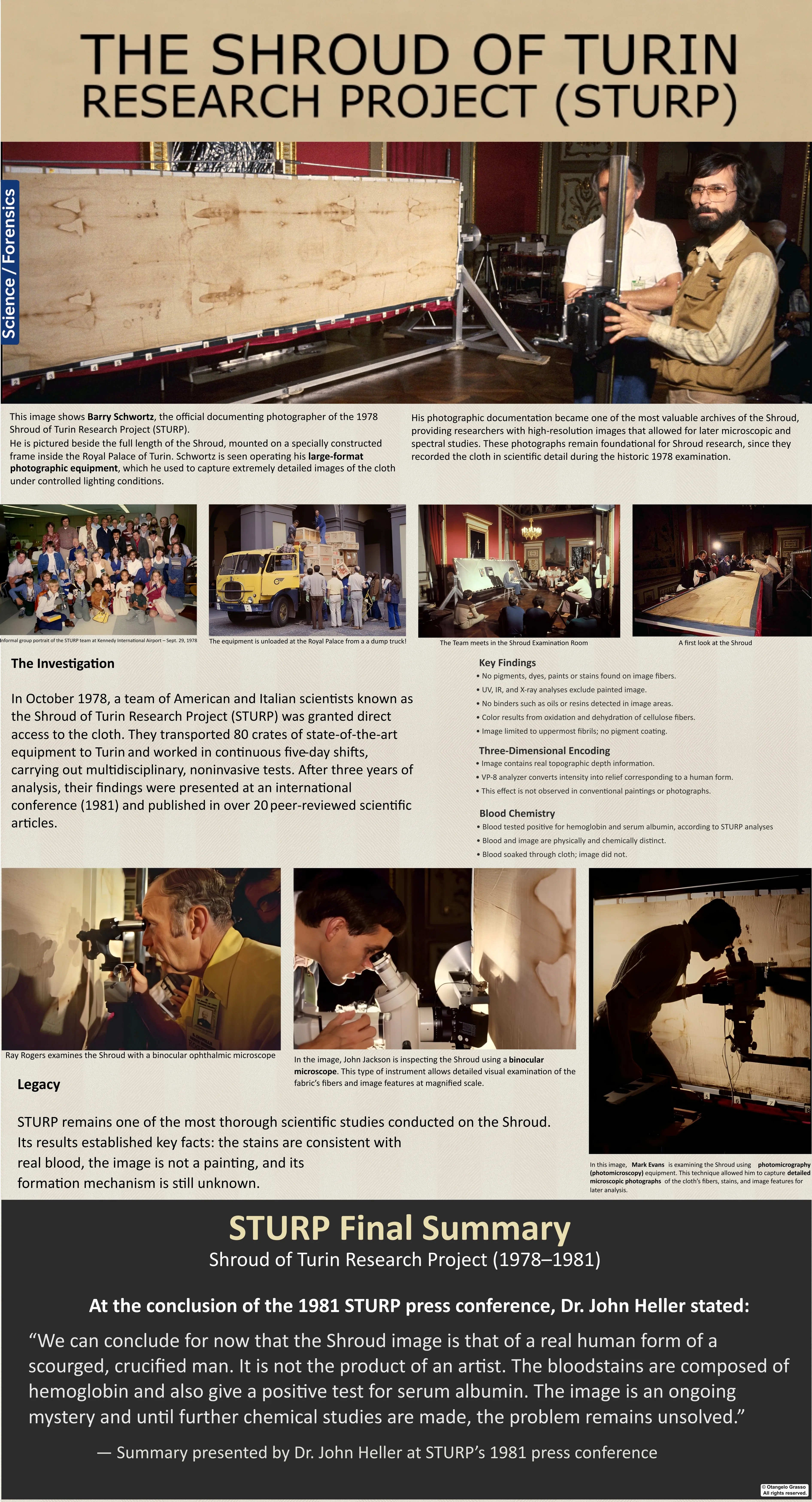
In the autumn of 1978, a team of approximately thirty -three scientists spent 120 consecutive hours examining a fourteen -foot length of ancient linen, working in shifts around the clock.1
They brought the finest instruments American laboratories could produce—spectrometers, microscopes, X -ray fluorescence detectors, ultraviolet cameras, and a machine designed to read topographic data from satellite photographs. They worked in shifts around the clock, sleeping in catnaps on marble floors, fuelled by espresso and the peculiar intensity of men who knew they would never pass this way again.
When they emerged from the Palazzo Chiablese, they carried thousands of photographs, hundreds of tape samples, and a data set that would consume the next three years of their lives.
What they did not carry was an answer.
The Shroud of Turin had been the subject of one of the most extensive scientific examinations ever conducted on a historical textile. Its chemical composition had been mapped. Its optical properties had been measured across the entire electromagnetic spectrum. Its blood had been tested for heme, porphyrin, protein, albumin, and bilirubin. Its three -dimensional information content had been quantified, correlated, and published in peer- reviewed physics journals.
And still the central question —How was this image formed? —remained unanswered.
This chapter is not another retelling of that investigation. The blood chemistry appears in Chapter 3, the forensic pathology in Chapters 8 and 12, the three-dimensional encoding in Chapter 6. What concerns us here is not the data itself, but what the scie ntists who gathered that data ultimately concluded —and failed to conclude. Because the Shroud of Turin Research Project represents one of the most unusual episodes in the history of forensic science: a team of approximately thirty-three scientists, recruited from across the United States, who volunteered their time and expertise to examine an object that many of them had never seen and about which they held a range of personal beliefs, from religious conviction to scientific curiosity. They worked without c ompensation, often at considerable professional risk. They published their findings in rigorous peer-reviewed journals. They submitted their data to independent verification and sustained critique.
And when the investigation was complete, they produced a consensus statement that was unusually cautious in its emphasis on unresolved mechanisms—emphasising what had been established while declining to pronounce on what lay beyond the evidence. They concl uded that the
image was not the product of conventional painting techniques, that the stains were consistent with real blood, that the forensic details were anatomically precise, and that the three -dimensional encoding was genuine and unexplained. They concluded that no hypothesis yet proposed could account for the totality of their observations.
And then they stopped.
They did not declare the Shroud authentic. They did not declare it a forgery. They did not invoke miracle or dismiss the object as medieval piety. They simply reported what they had found, acknowledged what they could not explain, and left the question open. This restraint was not failure. It was integrity. And it is the reason the STURP investigation remains, forty-five years later, often regarded as the most comprehensive direct examination of the Shroud ever conducted —and the source of its most enduring challenge.
II. THE AMSTON DRY RUN: SEPTEMBER 1978
The motel was the kind of place that thrived on transience. Low-slung and U-shaped, wrapped in peeling white paint, it hummed with ice machines and the white noise of nearby highway traffic. For five days in September, this forgettable waystation in rural Connecticut served as the unlikely command centre for what would become one of the most ambitious scientific investigations ever conducted on a single archaeological object.
Inside the converted banquet room, the air was thick. Ozone from soldering irons. Warm electronics giving off that particular heat -scent of transistors under load. Men in short -sleeved dress shirts knelt beside electrical outlets, checking grounds, watching oscilloscope screens bloom green with sine waves.
For eighteen months, these scientists had been phantoms to one another— voices on long -distance calls, names on a roster. Physicists and pathologists, spectroscopists and photographers, engineers and chemists: a volunteer army assembled from across the United States, bound together by a single, improbable mission. There was no Shroud here in Connecticut. There would be no second chances in Italy.
John Jackson moved through the controlled chaos with an unnerving calm. He was thirty-two, lean, intense in the way of men who have found their life's question. An Air Force physicist, he had been absorbed by the Shroud since his mother showed him a photograph when he was thirteen. Now he carried the fruit of that obsession: a sixty-five-page spiral-bound notebook, its cover already worn soft from handling. Every test, every measurement, every precious second of their planned access window with the actual cloth was scripted within those pages.
"Clock starts the moment they unlock the door," Jackson said to no one in particular, but everyone heard him. "We get one pass. No do-overs."
Image 18.1: Group photo of the STURP team. Image published with permission of Kenneth Stevenson.
In the corner, Robert Bucklin had claimed a section of wall. The forensic pathologist from Harris County, Texas—a man who had spent thirty years performing autopsies, who could read the story of death in tissue and lividity—had pinned up photographic enlargements of the Shroud. Under the harsh fluorescent light, the images looked less like religious iconography and more like evidence photos from a homicide. Bucklin used a wooden pointer, tapping the anatomical details like a professor at a lectern.
"Look at the edema here." Tap. "The swelling around the thoracic muscles. This isn't artistic interpretation. This is a man struggling to breathe." Tap, tap. "And these scourge marks —a medieval painter would give you dramatic slashes. Abstract violence. He wouldn't know —he could not know—to paint the precise, brutal geometry of Roman torture." He paused, turning to face his audience. "The wrist wounds are not in the
palms, where medieval art always placed them. Anatomically, palms cannot support body weight. The nail here is through the space of Destot. Which causes the thumbs to flex inward." He indicated the hands on the image. "Four fingers visible. No thumbs. A medieval forger working from artistic convention would never omit the thumbs. A Roman executioner working from anatomical reality would produce exactly this."
Across the room, Barrie Schwortz was locked in mortal combat with a piece of equipment that looked like an industrial sculpture. The vertical copy stand rose eight feet, a complex framework of aluminium struts and precision gears designed to hold a large -format camera perfectly parallel to the floor. It had to be flawless —they would photograph every square centimetre of the Shroud without touching a single fibre. He was thirty - two, the team's lead technical photographer from Los Angeles, and one of the team 's Jewish members, in a team investigating Christianity's most controversial relic. He had been recruited by Don Devan, an old colleague who had called him out of the blue with an offer too strange to refuse. Now, tightening a gear assembly that kept slipping, he wondered what he had gotten himself into.
The thought that kept circling through his mind, unbidden: How do you paint something you cannot see properly while you are painting it? Every photograph of the Shroud showed the same thing —an image so faint, so subtle, that from any distance closer than six feet it dissolved into meaningless sepia noise. The clarity existed only in the negative, in photographs. A forger working in the fou rteenth century, in candlelight, without photography, without film, without the ability to step back and check his work in reproduction —what kind of mind could operate that way?
The heart of the dry run occupied the centre of the room. On a long banquet table draped in black velvet lay their proxy: fourteen feet of modern linen, pristine and anonymous. Taped to its surface were high -resolution photographic prints of the Shroud's f rontal image—crude, but functional. This was their test bed, their rehearsal stage. One by one, the teams brought their instruments to the table: X -ray fluorescence spectroscopy, designed to detect elemental composition without contact; infrared thermography, a device that looked like it belonged on a Cold War satellite; ultraviolet photography, which transformed the banquet hall into a nightclub from another dimension. Each instrument had to work. Each protocol had to execute without error. In Turin, there would be no second takes.
Ray Rogers watched the ballet of technology with a chemist's sceptical eye. He was fifty -one, a veteran of Los Alamos National Laboratory, a man constructed of sharp angles and sharper opinions. His hair was starting to grey. His default expression suggest ed he had heard your hypothesis before and already knew why it was wrong. Rogers had spent months in his lab trying to crack the Shroud through pure chemistry,
subjecting linen samples to every conceivable insult—sulphuric acid, heat, radiation, enzymatic degradation —attempting to reproduce the image's singular, maddening characteristic. The coloration resided only on the topmost few hundred nanometres of each fi bril. Not the thread. Not the fibre. The fibril —the microscopic strand that composed the fibre —as if someone had painted it with a brush made of photons. Every attempt had failed. Acid penetrated too deep. Heat scorched too broadly. Pigments required binding media that were not there. The Shroud's chemistry was a locked room, and he had not found the key.
Image 18.2: In 2008, HAL9000 technicians were granted one day of direct access to the Shroud, amassing 158 gigabytes of photographic data capturing details as minute as one five -hundredth of a millimetre —a methodology pioneered when the company applied the same sectional approach used on Leonardo da Vinci's Last Supper to the cloth.
III. THE VP-8 REVELATION
The climax of the dry run came at 9:47 PM on the third day.
The VP-8 Image Analyzer sat on a rolling cart, a bulky console of knobs, switches, and a nine-inch cathode-ray screen that glowed phosphorescent green. It was a machine designed for a different purpose entirely — analysing satellite imagery, reading topographical data from photographs of distant terrain, converting brightness gradients into vertical relief. Two years earlier, in February 1976, this machine had changed everything. Jackson had brought a photograph of the Shroud to Sandia Laboratories. His colleague Bill Mottern had fed it into the VP -8 almost as a lark. And on that green screen, a three-dimensional human figure had emerged from the two -dimensional image —not the chaotic landscape produced by paintings, but a coherent, anatomically consistent reli ef map, as if brightness corresponded to cloth -to-body distance. 6 It was the discovery that had launched this entire venture. Now, in Amston, Eric Jumper prepared to recreate that moment for the team members who had not seen it. Jumper was Jackson's co -founder, an Air Force Academy colleague, pragmatic where Jackson was visionary.
He loaded a test image first: a Renaissance crucifixion scene, a masterwork of chiaroscuro and anatomical precision. The room quieted. Someone shut off the overhead fluorescents. The only light came from the VP-8's screen and the indicator LEDs on the equipment racks.
Jumper fed the Renaissance painting into the analyser. The machine processed, translating light and dark values into vertical displacement. On the green screen, an image congealed —and it was a nightmare. The face became a jagged landscape of impossible peaks and random canyons. The nose was a grotesque spire. The eye sockets were chaotic pits that violated all anatomical logic. Normal art —even photorealistic art —does not encode three -dimensional space. It encodes an artist's interpretation of light and shadow. Feed that into a machine expecting literal spatial data, and you get beautiful nonsense.
Jumper let it sit on the screen for ten seconds. Then he switched inputs.
The green screen flickered. Stabilised. And a human face emerged from the void. Not chaos. Coherence. The nose rose in a smooth, natural promontory. The eye sockets receded into gentle, anatomically consistent hollows. The cheekbones curved with the gracef ul logic of human bone. The forehead, the chin, the planes of the face—all of it mapped to a three- dimensional space that made sense, that you could take calipers to and derive measurements from.
A ghost in the machine. A silent, mathematical testimony from the past.
No one spoke. The only sound was the hum of electronics and the distant rumble of ice makers in the motel corridors. Barrie Schwortz felt the hairs on his neck stand at attention. The rational part of his brain—the part that had spent fifteen years masteri ng the technical craft of photography, understanding emulsions and exposures and the physics of light — scrambled for a ledge. Coincidence. A quirk of the machine. Pareidolia. But the pattern -recognising engine that made him good at his job knew better. This was order. This was specific, locked, encoded information.
Roger Morris, another Los Alamos veteran, broke the spell. His voice was dry, almost amused. "So we are all agreed, then. The forger —in addition to being a master of painting technique, a forensic pathologist, a textile expert, and a Roman crucifixion specialist—was also a fourteenth-century pioneer in three -dimensional data encoding and computational topography." He paused. "Did he also invent the microscope to check his work on the individual fibrils?"
A few nervous laughs rippled through the darkened room. The laugh of scientists standing at the edge of a cliff, looking down into fog, unable to see the bottom.
Later that night, after the equipment had been powered down and covered with drop cloths, a core group gathered in the motel's bar. It was the kind of establishment that sold beer in bottles and kept the television on with the sound off. The scientists looked out of place, still wearing their pocket protectors and identification badges. Jackson sat at a small table, the sixty- five-page notebook closed before him like a talisman. Around him: Rogers, Jumper, Schwortz, Bucklin, a few others. They had stopped being strangers three days ago. Now they were something else —a crew, a unit, bound by shared responsibility and shared uncertainty.
Jackson spoke quietly, but everyone leaned in. "We are not going to Turin to prove this is Jesus Christ." His words were measured, deliberate. "We are going to perform material analysis on a historical artifact. Our mission is to answer one question, and o ne question only: How was this image formed?" He looked around the circle, meeting eyes. "The world will want a different answer. They will want yes or no. Real or fake. Authentic or fraud. Our job is to follow the evidence wherever it leads—even if it leads to a wall."
Ray Rogers swirled the ice in his bourbon. "And if it leads us right through the wall, John? What then?"
Jackson allowed himself a small, tight smile. "Then we report that too. We report the wall, and the fact that we found no door."
The silence that followed was heavy. In three weeks, they would be in Turin. Every instrument had passed its test. Every protocol was rehearsed. They had proven they could execute the plan. But sitting in that dim Connecticut bar, under the flicker of a Budweiser sign and the muted glow of a television showing a football game no one was watching, they all knew the same unsettling truth: the plan was only scaffolding. The real structure—the mystery at the core of the Shroud —remained utterly unknown, waiting for them in a cathedral sacristy seven thousand miles away.
IV. TURIN: OCTOBER 1978
The Palazzo Chiablese had witnessed coronations, state dinners, the murmured intrigues of Savoy royalty. Its ballroom had once hosted orchestras and waltzes beneath crystal chandeliers. Now, at three in the morning on a cold October night, it resembled something between a crime scene and a physics laboratory. Cables snaked across marble floors, secured with duct tape. Where string quartets had played, banks of electronic monitors hummed, their screens casting cold blue -green phosphorescence across the faces of exhausted men. The chandeliers were dark. In their place: carefully positioned tungsten lamps, their colour temperature calibrated, their intensity measured to the lumen.
On the examination table—a custom-built platform of aircraft aluminium and clean linen padding —lay fourteen feet and three inches of ancient cloth. This was it. The thing itself.
Vernon Miller made another microscopic adjustment to his camera, the hundred-and-seventh of the night. His photographer's eye catalogued the impossible delicacy before him. The cloth was far more fragile than the photographs suggested. The linen had a texture like parchment, yellowed with age, marked with the violence of history —the dark burn holes from the 1532 fire at Chambéry, the water stains from desperate attempts to extinguish the flames, the geometric patterns where molten silver from the reliquary had burned through. And the image. From barely three feet away, it was almost invisible. A whisper. A suggestion. Sepia tones that seemed to float just above the fabric's surface, so faint that Miller's eyes kept losing focus. He had photographed crime sce nes, war zones, industrial accidents—but he had never photographed anything that looked so much like a memory trying to become solid.
Jackson stood at the edge of the controlled chaos, watching. One hundred twenty hours. Five consecutive days of access, hard -won after months of negotiation with the Archbishop of Turin and the Vatican, and with the consent of the Shroud's owner, the exiled King Umberto II.
Around the examination table, the STURP team moved in choreographed rotation. Ray Rogers was pulling his third consecutive shift, bent over a microscope, lifting individual threads with tweezers that cost more than some people's cars. Under forty -power magnification, the mystery only deepened. The image fibres —the threads that composed the faint sepia figure—showed coloration only on their outermost surfaces. Rogers could see it clearly: the cellulose had been altered, degraded, but only at the absolute sum mit of each fibril. Two hundred nanometres deep, maybe three hundred. A few hundred -thousandths of a millimetre. Beneath that superficial layer: pristine, unaffected linen. There was no capillary flow. No medium. No pigment binding that he could detect. Ju st molecular transformation—as if the cloth had been aged selectively, precisely, in the exact shape of a crucified man. "This should not exist," Rogers had muttered to no one in particular, six hours ago. He had stopped saying it out loud. The thought remained.13
Back in their respective laboratories, John Heller and Alan Adler were working through microchemical tests on the tape -lift samples. They had received the strips from the 1978 examination —adhesive lifts bearing microscopic fibres from the blood-marked areas—and had brought to bear reagents, test strips, and protocols refined over months. The blood areas were chemically distinct from the body image, that much was already clear from the raw samples: different colour, different fluorescence under ultraviolet, different everything. Heller applied a test for heme iron. Positive. Adler tested for porphyrin, the organic compound at the heart of
haemoglobin. Positive. The stains had the chemical signature consistent with blood—old, degraded, but blood.7
The most unnerving discovery came at 4:15 AM, during the ultraviolet photography session.10 When they killed the visible lights and fired up the UV lamps, the Shroud transformed. The cloth itself fluoresced a soft yellowish-green—normal for old linen. The burn marks from 1532 fluoresced brilliantly, almost white -hot on the photographic plates. T his was expected. Scorches fluoresce. 3 But the body image fluoresced too — differently. Subtly. Not like the burns, but not like blank cloth either. A third state, a middle ground. And the blood marks? They absorbed UV completely, appearing as dark voids against the glowing fabric, as if they were holes leading to some deeper darkness.4
Sam Pellicori made a note in his log: Blood appears to have been deposited before image formation. Image does not penetrate blood. Implication: body image formed around existing bloodstains, not through them.
Think about what this means. If you are painting a fake burial shroud, you paint the body first, then add blood for drama. That is the logical sequence. Here, the sequence was reversed. Blood first. Image second. But blood deposits when a cloth touches a bleeding body. The image—which shows no evidence of contact distortion —apparently formed later. After the blood had dried. After the body was already wrapped. How?
On the fourth night, with twenty -two hours remaining, Bucklin gave an impromptu presentation to the assembled team.8 They were all exhausted, running on coffee and adrenaline, but Bucklin wanted them to see what he was seeing. He had been treating the Shroud as a forensic document. Not a holy relic. Not a work of art. Evidence.
"Cause of death," he began, standing beside a photographic blowup of the torso, "is consistent with asphyxiation secondary to crucifixion, complicated by traumatic shock from severe scourging." He traced the blood flows from the wrist. Rivulets running at two distinct angles: one occurring while the body was vertical, arms raised, body weight pulling down; the lighter one occurring after the body was horizontal —post- mortem, the blood already beginning to clot. The side wound measured five centimetres long a t an upward angle, consistent with a Roman lancea thrust between the ribs, exhibiting post-mortem separation of blood and pleural effusion —the "blood and water" described in John 19:34. The legs showed no evidence of fracture. Standard Roman practice was crurifragium—breaking the legs to hasten death. This body's legs were not broken—again, consistent with John's Gospel, which explicitly mentions this detail.
Bucklin paused, looking around at his colleagues. "Gentlemen, if this is a forgery, the forger had access to medical knowledge that was not widely
available in the fourteenth century. Several anatomical features align strikingly with modern forensic interpretations of crucifixionThe placement of the wrist wounds contradicts every piece of medieval art ever produced. This is not an artistic representa tion. This is a medical record. The question is: a record of what?"
At approximately 11:59 PM on October 13, 1978, the examination ended. They had been granted 120 hours. They had used every second. The Shroud was carefully refolded by the Italian conservators, placed back in its climate-controlled reliquary, locked away behind bulletproof glass. The STURP team packed their equipment in exhausted silence. They had come to Turin with questions. They were leaving with more.
V. WHAT STURP ESTABLISHED
In the months that followed Turin, as the team dispersed back to their universities and laboratories, the real work began. Thousands of photographs to analyse. Spectroscopic data to interpret. Chemical samples to test and retest. The findings, published in peer-reviewed journals over the next three years, coalesced into a coherent set of empirical claims that have survived four decades of scrutiny.5
No pigments, dyes, or binding media consistent with traditional painting techniques were detected on the image fibrils. 5 X-ray fluorescence, infrared reflectance spectroscopy, ultraviolet -visible spectrophotometry, and direct microscopic examination all failed to identify any added colouring agent. The image appears to be the cloth itself —cellulose chemically altered throug h oxidation and dehydration, producing conjugated carbonyl groups that absorb visible light. The coloration resides only on the outermost 200–600 nanometres of each fibril, a depth profile inconsistent with any known application of liquid medium.
When processed through algorithms that convert brightness to vertical displacement, the Shroud's frontal and dorsal images produce remarkably coherent, anatomically consistent relief maps. This correlation between image intensity and hypothetical cloth -to-body distance is a distinctive characteristic not typical of paintings or photographs, and has not been replicated by any known artistic process.
Microchemical tests identified heme, porphyrin, protein, albumin, and bilirubin—a combination of biomarkers consistent with human blood.7 The stains were deposited before the image formed; image fibrils do not penetrate the blood marks, and the blood shows no evidence of the chemical alteration that characterises the image areas.
The forensic details are anatomically and historically precise. The scourge marks correspond to the Roman flagrum taxillatum. The wrist wounds are positioned in the space of Destot. The side wound exhibits post -mortem separation of blood and serum. The legs are unbroken. Several of these
details align strikingly with modern forensic interpretations of crucifixion, in ways that complicate simple forgery hypotheses.
The 1978 examination covered the Shroud through multiple photographic methods—standard colour, X -radiography, transmitted light, ultraviolet fluorescence, and photomicroscopy—producing one of the most complete imaging records of any textile in archaeological history.
These findings are widely reported in the peer -reviewed literature. STURP's findings remain central to the debate, though interpretations vary and key conclusions—particularly concerning blood identification and the absolute uniqueness of the 3D encoding—continue to be contested.
VI. WHAT STURP COULD NOT EXPLAIN
The same investigation that produced these positive findings also established, with equal rigour, the boundaries of explanation.
No image formation mechanism was identified. Every hypothesis tested against the STURP data failed to account for the full constellation of observed properties. Artistic hypotheses were not supported because no pigments or binders were detected on image fi brils.5 Contact-transfer hypotheses failed because the image shows no pressure distortion and the intensity correlates with distance, not pressure. 11 Vaporographic hypotheses failed because no spice or decomposition residues were detected. Scorch hypotheses failed because the image fluoresces differently from the documented 1532 fire damage, and controlled thermal experiments could not replicate the co mbination of superficiality, resolution, and distance correlation. 12 The wall Jackson had spoken of in Connecticut was real. They had found it. They had not found a door.
No consensus on age emerged from the STURP investigation itself. The team did not perform radiocarbon dating; that work fell to a subsequent generation of researchers. Their chemical analyses did raise questions that would later become central to the age d ebate. The vanillin content of the main cloth was below detectable limits, which Rogers argued was consistent with significantly older linen, though this is an indirect indicator and not a standalone dating method. 13 These observations were reported without resolution.
The question of age is not, in fact, left open by STURP alone. In 1988, three independent laboratories—at Oxford, Zürich, and the University of Arizona—conducted radiocarbon dating on samples from the Shroud and returned a medieval date range of approximat ely 1260 –1390 CE, consistent with a 13th –14th century origin. These results, if accepted, would situate the cloth well within the historical period its critics have always proposed. The dating has been subjected to sustained methodological challenges—Rogers himself argued in his 2005 paper that the sampled corner showed chemical characteristics distinct from the main
cloth, raising the possibility of a contaminated or patched sample area — but the C-14 results have not been formally retracted, and they remain the most direct scientific test of age conducted on the cloth. Any balanced account of STURP's contribution must acknowledge that the investigation's silence on age does not mean the question is unresolved: it means the answer lies in evidence STURP did not —and by design, could not—provide. The 1988 dating is addressed in Chapter 19.
No identification of the individual was possible. The forensic evidence established the manner of death with remarkable precision. It could not establish the identity of the deceased.
The STURP team was assembled from volunteers across American research institutions —physicists, chemists, pathologists, photographers, engineers. The quality of their instrumentation and the rigour of their published findings have not been seriously disputed. What has never been examined in this book, however, is a question that the philosophy of science regards as prior to any assessment of findings: who were these investigators, and what did they believe before the examination began?
The answer is not straightforwardly neutral. Several STURP members were affiliated with the Catholic faith.
John Jackson, the team's co-founder and driving organisational force, had been studying the Shroud with a conviction that it was genuine for years before 1978; by his own account the question had occupied him since childhood. One of the team's Jewish members, Barrie Schwortz, served as lead technical photographer —a role that was scientifically critical to the investigation's documentation but distinct from the principal investigative roles of the chemists, physicists, and pathologists. These observations do not impugn anyone's professional honesty. They describe a team that was, in the language of contemporary research methodology, not institutionally blinded to a prior hypothesis.14
More substantively: STURP's findings have never been independently replicated by a team assembled without prior institutional or personal orientation toward either outcome. This is not a peripheral methodological point. Independent replication by investigators with no stake in the result is the mechanism by which science distinguishes genuine findings from the well-documented distortions of motivated reasoning—the unconscious tendency to weight confirming evidence more heavily than disconfirming evidence, t o resolve ambiguous measurements in the direction of prior expectation, and to regard inconclusive results as requiring further investigation rather than reporting. 14 The STURP investigation, however thorough, was a single pass by a non -blinded team. Its central negative conclusion—that no image-formation mechanism can be identified—may be entirely correct. But it carries the provisional status appropriate to findings that have not yet completed the confirmatory cycle that reproducible science requires.
The practical consequence is limited but real. STURP's positive findings—the chemical characterisation of the image, the blood biomarkers, the three -dimensional encoding, the absence of pigments — are the evidentiary foundation for most of what follows in th is book and in Chapters 19 through 21. They deserve to be cited, as they are, as the most thorough scientific examination of the Shroud ever conducted. They should not be cited as though they carry the authority of independently replicated results—because, four decades later, they do not. The wall that Jackson and Rogers found in Turin may be exactly where they said it was. But a wall that only one team has approached, from one direction, under conditions they themselves designed, warrants a second expedition before it is declared insurmountable.
VII. THE STURP CONSENSUS STATEMENT
In 1981, the STURP team issued its official conclusion. The wording was careful, deliberate, and unusually cautious for a scientific investigation of this scale.1
"We can conclude for now that the Shroud image is that of a real human form of a scourged, crucified man. It is not the product of an artist."
"The answer to the question of how the image was produced or what produced the image remains, now, as it has in the past, a mystery."
The team had followed the evidence wherever it led. The evidence had led to a wall.
By 1981, preliminary interpretations of STURP's findings were beginning to circulate beyond academic journals. Among the outlets covering the story was Christianity Today, which published an article in its February 20, 1981 issue titled "The Shroud of Turin: Scientists Conclude It's Not a Forgery." The piece captures a pivotal historical moment —not the final verdict of science, but the emerging reaction to STURP's early pu blished results, translated into language accessible to a broader readership. Several details deserve notice. The article reflects individual scientists' public statements rather than the formal team consensus, and it appeared before the widely debated 1988 radiocarbon dating tests that would reshape the entire discourse. It records how STU RP's findings were understood and communicated at a time when the investigation into the Shroud's nature was still unfolding: the photographic negative characteristic, the absence of paint-consistent findings, the distinction between body image and blood areas, the preliminary discussions of contact versus non-contact formation mechanisms.
One passage in particular captures the tension between scientific caution and public expectation. Samuel Pellicori, a researcher at the Santa Barbara Research Center, suggested that the image might have been influenced by
prolonged contact with a body rather than by artistic techniques —a carefully hedged observation that the article's framing rendered as near - confirmation of authenticity. This gap between what STURP scientists said in their publications and what was reported in the press would become a recurring feature of the Shroud debate across the following decade. The 1981 article stands today as a historical document in its own right —not STURP's official declaration, but a snapshot of scientific reception, valuable precisely because it shows the distance between the laboratory's deliberate restraint and the public's hunger for a verdict.
VIII. THE McCRONE CONTROVERSY
No account of the STURP investigation is complete without acknowledging the one significant internal disagreement that emerged from the 1978 examination.
Walter McCrone was a microscopist of formidable reputation. He had exposed the Vinland Map as a forgery and had consulted on countless authentication cases for museums and collectors. When he examined adhesive tape samples from the Shroud, he reported find ing particles of iron oxide and vermilion —pigments consistent with medieval paint. His conclusion: the Shroud was a painting, and the blood marks were paint.
The majority of the STURP team disagreed. X -ray fluorescence analysis, directed by Morris, Schwalbe, and London, demonstrated that iron concentrations were uniform across image and non-image areas—exactly what would be expected from the retting process use d to prepare ancient linen, not what would be expected from iron -oxide-based paint applied locally.5 The vermilion particles McCrone identified were present across the entire cloth, including non -image areas, consistent with centuries of environmental contamination rather than deliberate artistic application. No binding medium was ever found. No pigment was ever found adhering to image fibrils in the manner required for a coherent painting. The disagreement was never resolved. McCrone maintained his position until his death. The STURP team maintained theirs. The published record contains both interpretations.
Subsequent analyses have generally supported the absence of paint layers consistent with McCrone's forgery hypothesis, though debates over particulate contamination persist. The debate is not primarily about whether pigments are present on the image —the bu lk of post -STURP analysis supports their absence—but about whether the particles McCrone identified in his samples were part of the image formation process or environmental contamination.
This controversy matters not because it was resolved —it was not —but because it illustrates the limits of forensic science even under ideal conditions. Competent scientists, examining the same object, using
different methodologies and interpretive frameworks, reached incompatible conclusions. The Shroud does not yield its secrets easily.
IX. THE SCIENTISTS' TESTAMENT
What became of the men who spent those 120 hours in Turin?
Ray Rogers died in 2005, still working on the chemistry problem. He never claimed to know if the Shroud was authentic. He only insisted that the evidence did not support painting, that his own chemical analyses were robust, and that the mystery remained. H is final paper, published in Thermochimica Acta twenty-seven years after Turin, was not a declaration of certainty but a meticulous chemical demonstration that the radiocarbon sample corner differed from the main cloth.13 He reported his findings. He did not overclaim them.
John Jackson founded the Turin Shroud Centre of Colorado. He has spent four decades testing image formation hypotheses, running experiments, publishing papers. He has not solved the problem. He has not stopped trying.
Barrie Schwortz, the sceptical Jewish photographer who went to Turin expecting to document a medieval painting, built shroud.com. 2 It is the most comprehensive archive of Shroud research in existence, containing thousands of photographs, papers, and technical documents. He does not claim to know whether the Shroud is authentic. He does not believe the question is answerable with curr ent evidence. He only makes the data available for anyone to examine.
These men could have walked away after 1978. They could have published their findings, collected their accolades, moved on to more tractable problems. They did not. Because they had encountered something that would not let go. Not a proof. Not a miracle. But an interface—a boundary where human knowledge meets its limit and stands there, looking across, wondering.
X. THE INTERFACE
The STURP investigation is often described as an attempt to determine whether the Shroud of Turin is authentic or a forgery. This description misframes the question. The investigation was an attempt to answer a single, well-framed scientific question: How was this image formed? That question remains unanswered.
What the investigation did establish—with a thoroughness and rigour that has not been surpassed in direct in -situ examination—is that the question is far more difficult than anyone in 1978 imagined. No pigments or binders consistent with conventional paint ing were detected. The stains are consistent with blood. The three -dimensional intensity correlation is a
distinctive and as -yet-unexplained property. The forensic details are anatomically precise. And no known mechanism, natural or artificial, can account for these facts in combination.
This is not failure. It is progress of a particular and valuable kind. Science progresses not only by answering questions but by refining them —by transforming vague mysteries into well-defined problems, and sometimes by demonstrating the limits of current knowledge with unusual clarity. The STURP investigation did both. It ruled out entire classes of explanation. It established empirical constraints that any future hypothesis must satisfy. And it demonstrated that the Shroud of Turin occupies a region where the normal operations of forensic science encounter a boundary.
That boundary is not a wall that further research will simply breach. It is the horizon of current understanding. Beyond it lies territory that cannot yet be mapped. The STURP scientists did not fail to cross that boundary. They did something more difficul t: they recognised it, mapped its contours, and reported their findings with restraint and integrity.
If you ever find yourself in the Cathedral of Saint John the Baptist in Turin, you will likely be disappointed by what you see with the naked eye. The image is faint. The linen is yellowed and marked with burn scars. Without magnification, without photographic enhancement, it barely resolves into coherence. It looks old, fragile, almost invisible.
But before you leave, consider what you are looking at: a team of approximately thirty -three scientists, 120 hours, the finest instruments American laboratories could produce, findings published in rigorous peer- reviewed journals and submitted to decades o f scrutiny. An unusually cautious consensus statement. A question without answer.
The investigation does not compel a verdict. It establishes a boundary. What lies beyond that boundary —whether the explanation is physical, chemical, historical, or something that currently falls outside the vocabulary of any of those disciplines—remains an open question. And it is, as the scientists who stood at that boundary understood, one of the more honest questions the investigation could leave behind.
That is what the interface means. That is why, forty -five years later, the question is still worth asking.
Whether the next chapter's radiocarbon dating resolves that question, deepens it, or simply shifts its terms—that is what the evidence will have to show.
References
1. Shroud of Turin Research Project. (1978). The 1978 STURP Examination. Link. (Comprehensive overview of STURP's photographic
methodologies and technical approaches to Shroud examination; primary source for team composition, access duration, and examination protocols.)
2. Schwortz, B. M. (1997). The Shroud of Turin Website. Link. (Primary archive of STURP research, photographs, and peer-reviewed publications on the Shroud of Turin.)
3. Pellicori, S. F. (1980). Spectral Properties of the Shroud of Turin. Applied Optics , 19(12), 1913 –1920. Link. (Detailed spectral analysis of the Shroud across the electromagnetic spectrum, including ultraviolet reflectance and fluorescence properties.)
4. Accetta, J. S. and Baumgart, J. S. (1980). Infrared Reflectance Spectroscopy and Thermographic Investigations of the Shroud of Turin. Applied Optics , 19(12), 1921 –1929. Link. (Infrared analysis demonstrating thermal properties and reflectance characteristics distinct from painted surfaces.)
5. Schwalbe, L. A. and Rogers, R. N. (1982). Physics and Chemistry of the Shroud of Turin: A Summary of the 1978 Investigation. Analytica Chimica Acta, 135, 3–49. Link. (Seminal STURP summary documenting absence of pigments, binders, and painting media; establishing chemical composition and cellulose degradation patterns.)
6. Jackson, J. P., Jumper, E. J., & Ercoline, W. R. (1984). Correlation of Image Intensity on the Turin Shroud with the 3 -D Structure of a Human Body Shape. Applied Optics, 23(14), 2244–2270. Link. (Landmark paper on three -dimensional encoding of the Shroud image, demonstrating correlation between image intensity and cloth-to-body distance.)
7. Heller, J. H., & Adler, A. D. (1981). A Chemical Investigation of the Shroud of Turin. Canadian Society of Forensic Science Journal , 14(3), 81–103. Link. (Detailed microchemical analysis identifying heme, porphyrin, protein, and bilirubin in blood marks; establishing blood - consistent chemical composition.)
8. Bucklin, R. (1982). The Shroud of Turin: A Pathologist's Viewpoint. Legal Medicine Annual , 33–39. Link. (Forensic pathological analysis of anatomical details, including scourging patterns, wrist wounds, side wound, and leg positioning consistent with Roman crucifixion.)
9. Jumper, E. J., Adler, A. D., Jackson, J. P., Pellicori, S. F., Heller, J. H., and Drusik, J. R. (1984). A Comprehensive Examination of the Various Stains and Images on the Shroud of Turin. Archaeological Chemistry III, ACS Advances in Chemistry No. 205, Chapter 22, 447 –476. Link. (Comprehensive multi -disciplinary examination integrating chemical, photographic, and spectroscopic data on all visible marks.)
10. Miller, V. D. and Pellicori, S. F. (1981). Ultraviolet Fluorescence Photography of the Shroud of Turin. Journal of Biological Photography , 49(3), 71 –85. Link. (Detailed UV fluorescence documentation showing distinct properties of image versus blood areas and burn damage.)
11. Ercoline, W. R., Downs, R. C., Jr., & Jackson, J. P. (1982). Examination of the Turin Shroud for Image Distortions. IEEE 1982 Proceedings of the International Conference on Cybernetics and Society. Link. (Analysis of contact -transfer and pressure -distortion hypotheses demonstrating their inconsistency with the image's properties.)
12. Jackson, J. P., Arthurs, E., Schwalbe, L. A., Sega, R. M., Windisch, D. E., Long, W. H., and Stappaerts, E. A. (1988). Infrared Laser Heating for Studies of Cellulose Degradation. Applied Optics , 27(18), 3937 – 3943. Link. (Experimental investigations demonstrating inability of thermal mechanisms to replicate Shroud image properties.)
13. Rogers, R. N. (2005). Studies on the Radiocarbon Sample from the Shroud of Turin. Thermochimica Acta , 425(1 -2), 189 –194. Link. (Analysis of vanillin content and chemical composition identifying radiocarbon sample corner differences from the main cloth; argues for greater age consistency of the main cloth, though the method is not a standalone dating technique.)
14. Nickerson, R. S. (1998). Confirmation bias: A ubiquitous phenomenon in many guises. Review of General Psychology , 2(2), 175 –220. Link. (Systematic review of the psychological and methodological literature on confirmation bias — its mechanisms, its documented effects on scientific data collection and interpretation by motivated researchers, and the structural conditions under which indep endent replication provides a corrective.
THE WIDER DEBATE
The 1978 research project
The first thread quotes STURP’s conclusion that the image is that of a real scourged and crucified man and “not the product of an artist”, and cites the 25 tests and the NIST Journal of Research article. It also quotes Kenneth Stevenson and John D. German on the role of faith in their work.
Source: the two catsboard threads of the Otangelo Grasso forum, part 1 and part 2. These are the author’s arguments, presented here as such, not established findings.
Explore the author’s additional material: The Shroud of Turin, part 1 · Part 2. The book’s bibliographic references are included where available.