IN-DEPTH READING
The evidence in context
This chapter presents historical, scientific and medical interpretations of the Shroud. Some conclusions remain debated. A source note identifies the related work1.
How One Test Redefined the Shroud of Turin, and Why It Failed to End the Debate
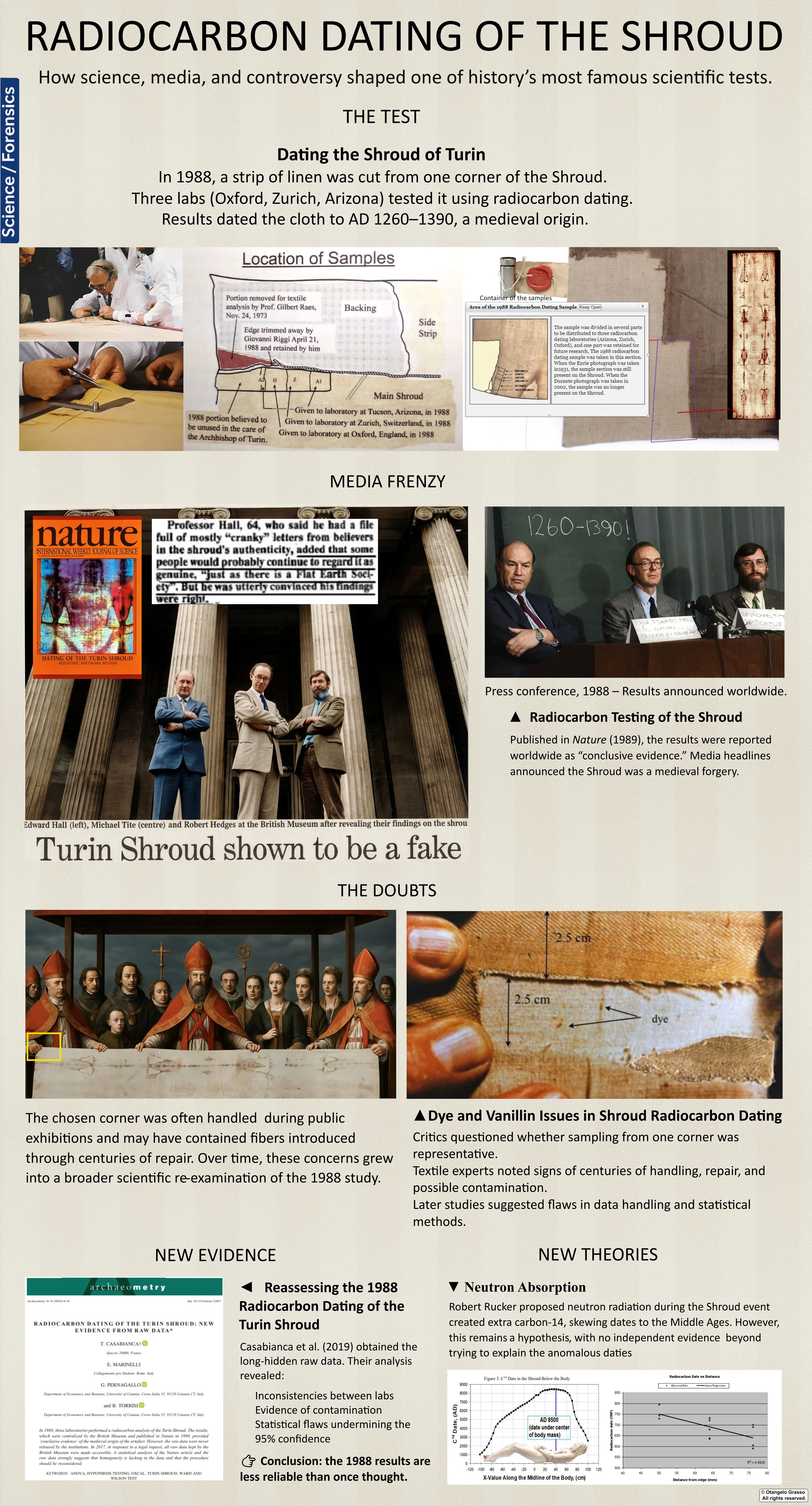
OCTOBER 13, 1988 — AN ANNOUNCEMENT AND ITS AFTERMATH
London. October 13, 1988. The press room at the British Museum was packed. Cameras were live, and reporters waited for a single number.
Professor Edward Hall of the Oxford Radiocarbon Accelerator Unit stepped forward. Behind him were colleagues from two other world-class laboratories: the University of Arizona and the Swiss Federal Institute of Technology, Zurich. He gestured to a blackboa rd displaying their conclusion: 1260–1390 CE.
Hall declared that the measurements dated the linen of the Shroud of Turin to the Middle Ages with at least 95% confidence, and stated publicly — as contemporaneous accounts reported — that he was satisfied the cloth was not authentic. His separately documented remark, widely quoted from press coverage of the announcement, captured his position plainly: "Someone just got a piece of linen, faked it up, and flogged it."1
Image 19.1: "Someone just got a piece of linen, faked it up, and flogged it" — Professor Edward Hall and the Turin Shroud. Source: Link
Image 19.2: The Sunday Times (London), September 1988, carrying a front-page headline claiming the Turin Shroud is a fake, ahead of the formal announcement of the radiocarbon dating results.
Within hours, the story was global. The New York Times announced that science had solved an ancient mystery. Time magazine ran a full -page spread. The Vatican, which had authorised the testing with considerable internal opposition, issued a carefully worded statement accepting the results while making no pronouncement on the Shroud's authenticity as a devotional object.
The mystery appeared solved. The Shroud was a medieval artefact, not a first-century relic. The debate, it seemed, was over.
But the case was not closed. It had only just fractured.
The scientific edifice built that day would soon develop cracks—not from theological doubt, not from conspiracy theories, but from within the data itself. The radiocarbon laboratories had performed their measurements with precision. They had followed estab lished protocols. Their instruments were calibrated, their technicians skilled. And yet the results, when examined with the statistical rigour that peer review demands, began to exhibit anomalies that could not be dismissed.
The central question of this chapter is not whether radiocarbon dating is valid—it is one of the most reliable and rigorously tested analytical techniques in archaeology. The question is whether the 1988 test, as executed, can legitimately tell us the age of the entire Shroud of Turin: a fourteen-foot textile that has survived fire, water, handling, repair, and seven centuries of documented history before the sample was even cut.
That question remains very much alive.
PART I: THE PITFALLS OF PRECISION What Radiocarbon Dating Measures, and What It Assumes
The Simple, Elegant Principle
Radiocarbon dating is a masterpiece of twentieth -century analytical chemistry. Carbon exists in nature as three isotopes: two stable forms, carbon-12 (¹²C) and carbon-13 (¹³C), and one radioactive form, carbon-14 (¹⁴C). ¹⁴C is continuously produced in the upper atmosphere when cosmic rays strike nitrogen atoms. It oxidises to carbon dioxide, enters the global carbon cycle, and is absorbed by plants during photosynthesis. While an organism lives, its ¹⁴C/¹²C ratio remains in equilibrium with the atmosphere. At death, the intake of carbon ceases, and the ¹⁴C trapped in the organism's tissues begins to decay at a predictable rate —a half-life of 5,730 years. By measuring the ratio of ¹⁴C to ¹²C and comparing it to the original atmospheric ratio, scientists can c alculate the time elapsed since the organism died.
For the Shroud of Turin, the organism in question is Linum usitatissimum—common flax. The date the Shroud yields, if the test is valid, is not the date of the crucifixion or the date of a medieval forger's workshop. It is the date the flax was harvested. 1 The method's power is immense. Its validity rests on four foundational assumptions that are not minor technical details but the pillars of the entire edifice.
The Four Assumptions
The first assumption is homogeneity: the sample tested must be chemically and structurally representative of the entire object. A single thread from
the hem of a garment cannot tell you the age of the collar if the garment has been repaired, patched, or selectively contaminated over centuries. This assumption is particularly vulnerable when dealing with ancient textiles, which are handled, cleaned, rep aired, and conserved across generations, with different areas accumulating very different histories.2
The second is the closed system assumption: no foreign carbon may enter or leave the sample after the death of the organism. If new carbon is added through contamination, conservation treatments, or any other mechanism, the measured ¹⁴C/¹²C ratio will reflect that addition rather than the original harvest date.
The third assumption is uncontaminated cellulose: the carbon being measured must come exclusively from the original plant material. Cellulose is chemically robust and does not exchange carbon with the environment under normal conditions —but it can be degra ded, and contaminants can become chemically bound to it in ways that resist standard pretreatment protocols.3
The fourth is atmospheric equilibrium: the initial atmospheric ¹⁴C level at the time of growth must be known or recoverable through calibration. This is not a constant; it varies with solar activity, Earth's magnetic field, and anthropogenic interventions. Calibration curves constructed from tree rings and other independently dated materials allow correction for these variations, but they introduce their own statistical uncertainties.
These assumptions are not controversial. They are standard in radiocarbon dating. The question is whether they were satisfied in the 1988 Shroud test.
The 1988 Protocol: A Plan Diverges from Practice
The original testing protocol, developed in 1986 by an international advisory committee and agreed to by the Vatican, was designed specifically to address these assumptions. It called for seven independent laboratories to participate, ensuring cross-verification and redundancy; for multiple samples taken from different, non-adjacent locations on the cloth, specifically including the main body rather than solely the edge; for a strict double-blind procedure in which laboratories would receive coded samples without knowing which was the Shroud; and for oversight by the British Museum, the Pontifical Academy of Sciences, and the Archbishop of Turin.4
What happened diverged sharply from that plan. Only three laboratories ultimately participated. Although the testing was formally described as blind, later discussions have noted that laboratory directors were aware that one of the samples was the Shroud. And most consequentially, all samples came from a single location —a corner of the main cloth, measuring approximately 70 –81 mm in length and 10 –21 mm in width (dimensions vary slightly between the primary publication and the account
of Riggi di Numana, who cut the sample), adjacent to an area that textile experts had previously sampled in 1973.4
This was a pivotal decision. The entire conclusion—that the Shroud dated to the Middle Ages—depended entirely on one unverified assumption: that this single corner sample was representative of the entire fourteen -foot cloth.
That assumption was never tested. It was simply made.
PART II: THE ANOMALIES EMERGE A Data Set That Refused to Behave
The Surface Consensus
When the results were published in Nature on February 16, 1989, they appeared impressively consistent. 1 Oxford returned 750 ± 30 BP (Before Present, where "Present" is defined as 1950 CE); Arizona returned 646 ± 31 BP; Zurich returned 676 ± 24 BP. After calibration, these measurements converged on the date range of 1260 –1390 CE with 95% confidence. The auth ors emphasised the agreement among the three laboratories and presented the result as definitive.
Media coverage was unequivocal —headlines across three continents declared that science had solved an ancient mystery, that the Shroud was officially medieval. For the general public and for many scientists who did not examine the data critically, the case was closed.
But a closer look at the statistics revealed the first crack.
The Statistical Problem: Heterogeneity Hidden in Plain Sight
The three laboratories reported mean ages that differed by more than a century. Oxford's 750 BP represents an older apparent calendar age than Arizona's 646 BP.
Standard statistical practice uses the chi-squared (χ²) test to assess whether multiple measurements of the same object are consistent with a single underlying value. When applied to the Shroud data, chi -squared analyses indicated greater dispersion than e xpected under strict homogeneity assumptions — the Damon et al. paper itself computed a T-statistic of 6.4 with 2 degrees of freedom, yielding a probability of approximately 4% that the three subsamples derived from a homogeneous piece of linen, which is within the threshold that conventionally raises questions about sample uniformity.4 The paper's authors noted this but concluded the variation was "not unexpected" given the complexity of the measurements. Subsequently, independent researchers argued the dispersion warranted more serious attention.
In scientific terms, the data indicated possible heterogeneity—the samples behaved as if they were not all the same material. This observation was prominently highlighted not by a Shroud advocate but by physicist Thomas J. Phillips of the High Energy Physi cs Laboratory at Harvard University, in a brief letter to the editor published in the same issue of Nature as the original paper on the Shroud's carbon dating.4
Phillips noted the statistical inconsistency and raised a question that would echo for decades: if the samples were all cut from the same piece of cloth, why did their radiocarbon ages differ by more than can be explained by measurement error alone?
The Raw Data Revelation: A Gradient in Time
For nearly thirty years, the raw measurement data from the three laboratories remained unpublished. Researchers who requested access were told the data were proprietary or had been lost, making independent verification impossible. In 2017, French statistic ian Tristan Casabianca and his colleagues obtained the original laboratory logs through sustained freedom of information requests to the University of Arizona and the University of Oxford. Their analysis, published in the peer -reviewed journal Archaeometry, confirmed what those who had questioned the 1988 test had long suspected.5
The Arizona data revealed a striking pattern. The subsample strip had been divided into segments for measurement, and when the radiocarbon dates were plotted against position along the strip, a possible positional trend emerged. The outer edge —the left end of the strip, closer to the cloth's perimeter—yielded consistently younger dates. The inner portion —the right end of the strip, farther from the left edge—yielded older dates. This gradient spanned approximately two centuries over the length of an eight- centimetre strip.5
Radiocarbon decay is uniform. It cannot by itself create such a positional variation across a few centimetres of cloth. Only chemical or physical differences in the material itself —or, as discussed in Part IV, spatially varying neutron irradiation —can prod uce such a pattern. Subsequent statistical re-evaluations confirmed that the heterogeneity was statistically significant and that the assumption of a single, uniform age for the sample strip was not supported by the data. 6 The laboratories had measured the ¹⁴C/¹²C ratios accurately. But what they measured was not a uniform, chemically pristine sample of ancient linen. Their own data indicated material variation within the tested sample.
PART III: EXAMINING THE CONVENTIONAL EXPLANATIONS What Contamination and Repair Theories Can and Cannot Explain
Faced with these persistent anomalies, defenders of the medieval date have proposed two main explanations. Each must be examined with the same scientific rigour applied to the original dating.
The Contamination Hypothesis: A Problem of Scale and Structure
The argument is straightforward and, on its face, plausible. If the Shroud is ancient, perhaps modern carbon from centuries of handling, candle smoke, or microbial growth contaminated the sample. Adding modern carbon—which has a high ¹⁴C content—makes the sample appear younger than it truly is. The standard Acid-Base-Acid (ABA) pretreatment used by all three laboratories is specifically designed to remove such contaminants, washing the sample successively in acid, base, and acid again to dissolve carbonates, humic acids, and other common contaminants while leaving cellulose intact.
The contamination hypothesis faces three independent challenges. First, the question of magnitude: simple contamination models typically require the measured sample to contain a substantial fraction of younger carbon — often estimated at levels considered implausibly high for environmental contamination4 — and no plausible environmental contamination source could constitute such a fraction without being visually obvious under magnification and without being removed by aggressive ABA pretreatment. Second, the question of survival: for contamination to survive ABA pretreatment and dominate the measured signal, it must be chemically bonded into the cellulose polymer itself — environmental contaminants such as smoke particles or microbial residues do not ordinarily form such bonds, remaining on the surface whe re they are stripped away. Third, the question of pattern: contamination is typically random and patchy. It does not readily generate the smooth positional variation observed in the Casabianca analysis; random contamination over centuries would more plausibly produce erratic variations in apparent age, not a systematic progression from younger at the left end (outer edge) to older at the right end (inner edge).[5]
The contamination hypothesis may explain some aspects of a shifted medieval date. It does not fully account for the structure of the data.
The Invisible Reweave Hypothesis
In 2002, textile conservator Mechthild Flury -Lemberg headed the conservation and restoration of the Shroud, an intervention which for the first time allowed examination of the reverse side of the cloth following removal of the Holland backing. 2 Her examination did not support the hypothesis of a medieval invisible reweave at the radiocarbon sampling corner. On the contrary, she concluded that performing such a repair without leaving any detectable trace would have been technically impossible, and she reported finding no evidence of a mend in her study of the Shroud.2,4 She had communicated this position to proponents of the reweave hypothesis as early as 2000 4 and reaffirmed it in her 2003 book
on the restoration. 2 Flury-Lemberg stated that the kind of invisible patching proposed by some researchers was "technically impossible," arguing that any mend would be visible on the back of the cloth. At the 2005 Dallas Shroud Conference, she again insisted there is no reweave in the radiocarbon sample area.
French invisible reweaving is a technique in which damaged threads are removed and new threads — often treated to match the aged appearance of the surrounding material — are carefully interwoven in a pattern that is nearly undetectable to the naked eye. 2 The technique is documented in textile conservation practice; however, clear primary-source evidence for its systematic use in specifically medieval textile repair, as opposed to more modern conservation work, has not been established in the scholarly literature. The documented repairs to the Shroud following the 1532 fire at Chambéry — carried out by the Poor Clare nuns, who applied fourteen large triangular patches and eight smaller ones over the damaged areas — are conspicuous, visible interventions entirely unlike the microscopic concealment that the reweave hypothesis requires.2,4 The historical record of the 1532 restoration therefore provides only limited contextual support for the hypothesis: the same documented event produced crude, visible patches rather than expert invisible mending.7
In 2005, the reweave hypothesis received its most chemically detailed published support from an unexpected source. Raymond Rogers — Director of Chemical Research for the Shroud of Turin Research Project (STURP) and a retired research chemist from Los Alamo s National Laboratory who had initially dismissed the reweave hypothesis when it was first presented to him — obtained threads from near the radiocarbon sample area and from the main body of the Shroud and subjected them to chemical analysis.3 (The actual carbon-dated material was destroyed in the measurement process; Rogers examined adjacent material that had not been subjected to dating.) His findings, published in the peer -reviewed journal Thermochimica Acta in January 2005, documented significant chemical differences across three independent markers.3
Vanillin
Linen contains vanillin, a breakdown product of lignin that decreases over time in ways sensitive to storage conditions. The degradation rate depends heavily on thermal history and humidity, and the method is not itself a chronometric dating technique, but it provides a consistency indicator. Rogers tested fibres from the main Shroud body and detected no vanillin. He tested threads from near the radiocarbon corner and found vanillin present. The main cloth thereby exhibited the chemical signature of advanced vanillin degradation, while material near the radiocarbon corner exhibited levels consistent with younger material — a finding Rogers interpreted as indicating a considerably greater age for the main cloth than the radiocarbon date suggested.3
However, vanillin degrades rapidly above 80 –100°C. The 1532 fire that damaged the Shroud exposed it to temperatures well above this range, which would have accelerated vanillin degradation in any area affected by heat. The absence of vanillin in the main c loth therefore cannot unambiguously indicate great age, as it may reflect thermal history rather than centuries of slow degradation. Moreover, no independent studies have confirmed Rogers' finding of vanillin in threads from near the radiocarbon corner using verified samples with documented provenance. Most historians, chemists, and textile experts consider the provenance of Rogers' samples uncertain and therefore his conclusions inconclusive. While his claim is taken seriously enough to be discussed in the literature, it is not considered proven or definitive.
Cotton
Material from near the radiocarbon sample area contained cotton fibres (Gossypium spp.) interwoven with the linen. Rogers found no comparable cotton-fibre interweaving in his samples from the main Shroud body, though other researchers — including microanalyst Walter McCrone, who examined adhesive-tape samples collected by STURP — have reported finding occasional cotton fibres elsewhere on the Shroud. 5 These cotton fibres could have originated from multiple sources: the many public exhibitions, the cotton gloves used by STURP researchers during their examination, or most probably from the factory that produced the Shroud, as medieval textile facilities typically produced both linen and cotton products, making cross -contamination during manufacture expected. Systematic study of cotton distribution across the entire Shroud has not been conducted.
Dye residues
Material from near the radiocarbon sample area contained alizarin and purpurin dye compounds derived from madder root, present within a plant gum and aluminium mordant coating. Rogers interpreted this as consistent with an attempt to colour -match repair threads to the aged appearance of the original cloth. Rogers found no equivalent gum/dye/mordant coating on his samples from the main Shroud body.3 It should be noted, however, that McCrone's earlier examination of STURP tape -lifted samples also reportedly identified madder -related compounds in areas of the Shroud outside the radiocarbon corner, 5 a finding that, if confirmed, would complicate the use of dye residues as a unique marker for the repaired area.
Rogers' conclusion, published in early 2005 and subjected to peer review, was characteristically direct: the radiocarbon sample area was not part of the original cloth of the Shroud of Turin, and therefore the radiocarbon date was not valid for determining the true age of the shroud.3
The reweave hypothesis has attracted significant scholarly attention, and Rogers' chemical findings remain the most detailed published challenge to the 1988 radiocarbon date. At the same time, the hypothesis faces
substantial expert criticism that bears directly on its conclusions. The most important negative finding comes from the leading textile conservator who examined the cloth in 2002: Flury-Lemberg not only found no evidence of an invisible reweave in situ, bu t concluded that performing one without any trace would have been technically impossible. 2,4 John Jackson, a longtime Shroud researcher, reiterated at the 2025 St. Louis Shroud Conference that the invisible reweave hypothesis is not supported by the evidence. Mark Antonacci strongly opposed the hypothesis in Chapter 9 ("Was the Shroud invisibly repaired?") of his 2015 book "Test the Shroud at the Atomic and Molecular Levels."
On the chemical side, a 2015 paper in Thermochimica Acta — the same journal that published Rogers — argued that the pyrolysis -mass- spectrometry differences Rogers identified between his two sample sets were attributable to the presence of a hydrocarbon contaminant, and that once that contaminant was accounted f or, the two spectra were not meaningfully different. 6 The authors of that critique did not address Rogers' cotton or vanillin evidence — their claim was narrower — but the exchange illustrates that the chemical case for a medieval repair remains an open and contested question in the peer -reviewed literature, not a settled conclusion.
Beyond chemistry, the hypothesis must also satisfy structural and statistical constraints visible in the fabric itself.
Structural Constraints on the Reweave Hypothesis
A textile repair, however skillfully executed, is a physical intervention. Threads are removed, replaced, redirected. Such operations inevitably disturb weave geometry at some scale. Even when visually discreet, repairs typically introduce detectable disco ntinuities in thread alignment, pattern rhythm, or density distribution under magnification. Multiple researchers who have examined the Shroud closely have reported finding no evidence of such discontinuities in the radiocarbon corner area.
Pre-1988 photographic documentation and transmitted -light imaging has been interpreted by some researchers as showing continuous herringbone twill banding across the radiocarbon region, with no abrupt structural interruption consistent with patch insertion clearly visible. On this reading, the weave behaves as a coherent fabric rather than a junction between two independently woven sections. However, this interpretation is itself part of the contested evidence base, and should not be taken as a settled observation.
Similarly, the seam present in the Raes sampling area has often been cited as supporting evidence for localized repair. Textile analysis by Flury - Lemberg indicates instead that this seam corresponds to the continuation of the Shroud's side -strip attachment . Its stitch architecture and mechanical function align with integral assembly rather than secondary mending.
If a French invisible reweave had been performed with sufficient precision to evade direct detection by textile specialists handling the cloth, it would represent an extraordinary level of microscopic craftsmanship. Such a repair would require near -perfect matching of thread diameter, twist direction, fiber composition, and weave rhythm — not merely at visual inspection distance, but at the level of laboratory analysis.
The absence of a clearly defined structural boundary does not disprove the repair hypothesis, but it imposes an evidential burden: the proposed intervention must explain why expected weave disturbances are not decisively observed.
The reweave hypothesis faces additional challenges from the statistical structure of the radiocarbon data. To be valid, any hypothesis must be consistent with all four aspects of the 1988 carbon dating evidence: the mean date (1260 –1390 CE), the slope of d ates along the sample strip (younger at the outer edge, older toward the interior), the distribution of the twelve individual subsample measurements, and the relationship between the Shroud date and the independently established date of the Sudarium of Oviedo (a cloth traditionally associated with the crucifixion, dated to approximately 700 CE). The reweave hypothesis does not readily account for all four elements simultaneously.
The neutron absorption hypothesis, by contrast, offers a unified explanation for these features. If the sample area consisted entirely of original cloth that had been exposed to a spatially varying neutron flux, the measured dates would show precisely the gradient observed without requiring any medieval repair material. The mean date would reflect the average neutron dose across the sampled area. The distribution of individual measurements would follow patterns consistent with radiation transport physics. A nd the Sudarium of Oviedo, if it were not present at the hypothesized neutron -emitting event, would retain its true age — explaining why it dates to approximately 700 CE while the Shroud yields a medieval apparent age.
Harry Gove, the nuclear physicist who played a central role in co - inventing the AMS radiocarbon dating technique used on the Shroud, was deeply involved in organising the 1988 testing — though his own laboratory at the University of Rochester was ultimatel y excluded from participating in the measurements — and expressed skepticism toward the invisible-reweave hypothesis, arguing that such a repair would likely have been detectable.17
His objection was specific: an invisible reweave capable of fooling Flury- Lemberg's trained eye during hands-on examination would have to match the original thread diameter, twist direction, and weave structure with a precision that no documented medieval repair technique achieved. Medieval conservators worked to make repairs structurally sound and visually acceptable at display distance; they did not work at the microscopic level required to fool twentieth -century textile analysis. If
such a repair exists, Gove argued, it should be visible to an experienced conservator handling the cloth directly —and Flury -Lemberg, who handled it directly during the 2002 restoration, did not report finding one.
The reweave hypothesis's proponents respond that Flury -Lemberg's examination occurred after the radiocarbon sampling, that the sampled area had already been cut away, and that the relevant repair, if it existed, is no longer available for re -examination. This is true, but it is also the point: the hypothesis has become structurally unfalsifiable in the only physical region where it could be tested. The influential chemical evidence Rogers compiled from retained threads remains the strongest argument, and it does not require the invisible -reweave claim to establish that the sampled corner was chemically distinct from the main cloth.
PART IV: AN ALTERNATIVE HYPOTHESIS The Nuclear Question
When both contamination and repair models face substantial challenges in accounting completely for the structure of the data, scientific integrity requires consideration of other possibilities —however unconventional they may appear. This leads to the most radical, and most physically coherent, challenge to the 1988 date: the neutron flux hypothesis — first proposed by Thomas J. Phillips in his 1989 Nature letter 4 and subsequently developed in detail as the Vertically Collimated Radiation Burst (VCRB) hypothesis by nuclear engineer Robert A. Rucker.8
The Nuclear Mechanism: Resetting the Atomic Clock
The hypothesis does not fault the radiocarbon laboratories. Their measurements were accurate. The question is what, precisely, they measured. Consider: what if new carbon -14 was created within the linen itself after the flax was harvested and woven into cloth?
The mechanism is a well -established nuclear reaction: nitrogen -14, upon capturing a neutron, transmutes into carbon-14 and ejects a proton (¹⁴N + n → ¹⁴C + p). Linen contains trace amounts of nitrogen —approximately 0.1 to 0.3 percent by mass —in residual proteins associated with the flax fibres.
If the cloth were exposed to a flux of neutrons, some of this nitrogen would be transmuted into new carbon -14 atoms, embedded directly in the molecular structure of the fibres. Radiocarbon dating cannot distinguish atmospheric carbon -14 acquired during the plant's life from carbon -14 created in situ by neutron irradiation. Both decay at the same rate; both are counted as "age." The effect would be to reset the radiocarbon clock partially, making the cloth appear younger than its true harvest date. Quantifying the Effect
Nuclear engineer Robert Rucker has modelled this scenario using standard Monte Carlo N-Particle (MCNP) transport codes—the same software used to design nuclear reactors and radiation shielding. Rucker calculates that to shift an apparent radiocarbon age fr om approximately 33 CE to approximately 1325 CE would require a neutron emission from the body of about 2 × 10¹⁸ neutrons, corresponding to an increase in the cloth's ¹⁴C content of roughly 16 percent.9 This represents approximately one neutron emitted for every ten billion atoms in the body —a tiny fraction, not a massive radiation release.
This is a high fluence by environmental standards—far above background cosmic radiation —but within the range produced by certain nuclear processes, though no such process has been observed occurring spontaneously in human remains. Rucker notes that if Jesu s' resurrection involved a transition of his body's atoms into an alternate dimensionality—a concept outside current physics—radiation may or may not have been emitted. If we assume protons and neutrons were emitted, a consistent hypothesis emerges that ad dresses multiple Shroud mysteries simultaneously.
Crucially, Rucker's models show that such a neutron flux would not be uniform. It would be strongest near the source and weaker toward the edges, naturally producing a spatial gradient in newly created ¹⁴C that is consistent with the positional variation o bserved in the 1988 data. However, the gradient runs in the opposite direction from what simple expectations might suggest: the outer edge, farther from the body and possibly receiving a reflected dose from tomb walls, would experience a different neutron environment than portions directly over the body. The interplay of direct and reflected neutrons, combined with possible repair material, produces a composite signal whose interpretation requires detailed modeling.
The VCRB Mechanism: A Coherent Sequence
Rucker's VCRB hypothesis goes beyond a simple neutron flux to propose a physically coherent mechanism for image formation itself, 8 built upon 27 distinct image characteristics identified by STURP and subsequent research. The hypothesis proposes that at the moment of an extraordinary biological event, an incredibly rapid, vertically -focused vibration of atomic nuclei within the body s plit a small fraction —approximately 0.0004 percent, according to Rucker's modelling —of deuterium atoms (heavy hydrogen, whose nucleus contains one proton and one neutron loosely bound together and is therefore the easiest nucleus to split). This splitting released protons and neutrons in a vertically collimated beam, alternating rapidly between upward and downward emission. The protons, carrying positive electrical charge, traveled the short distance through air and deposited charge onto both the upper and lower surfaces of the cloth. This rapidly alternating charge deposition created a high -frequency alternating electrical current in the topmost layer of fibres facing the body. The skin effect—the well-documented physical principle by which high -
frequency alternating current concentrates at the surface of a conductor— forced this current to flow only in an incredibly thin outer layer of each fibre, on the order of 0.2 to 0.6 micrometres, which is consistent with the depth at which STURP researchers identified the Shroud's image discoloration. The resistance to this intense, confined electrical flow generated localised heat sufficient to scorch the outer cellulose layer through dehydration and oxidation —the molecular process STURP identified—without penetrating the interior of the fibre, which remains pristine. The three -dimensional distance encoding follows from the physical attenuation of the proton beam through air: areas of cloth farther from the body received fewer protons, producing weaker curre nt, less heating, and lighter coloration, while areas closer received more, producing darker coloration. Because the beam was vertically collimated, each point on the cloth received information only from the point on the body directly above or below it, pr eserving the spatial resolution of the image.
This sequence proposes a unified explanation for superficiality, coloration, three-dimensional encoding, and the mottled pattern of image fibrils — properties that have separately resisted explanation by every other mechanism tested.
The Problem That Remains: The Source
The VCRB hypothesis has one overwhelming weakness, and it must be stated plainly. No known natural mechanism can cause the atomic nuclei inside a dead body to vibrate and split in the manner described. Proponents have invoked speculative phenomena —piezonuclear reactions triggered by earthquake -induced stress, cold fusion, unknown quantum effects — none of which have independent empirical support or acceptance in the mainstream physics community. The hypothesis requires a mechanism for which there is no independent evidence.
However, from a scientific method perspective, the relevant questions are whether the hypothesis is consistent with all the evidence and whether its predictions can be tested and verified. The VCRB hypothesis is consistent with multiple lines of evidence: the image characteristics (27 distinct properties), the radiocarbon data (mean, gradient, and distribution), and the relationship to the Sudarium of Oviedo's dating. It makes testable, falsifiable predictions, some of which are unique to this hypothesis. By the standards of forensic science, these considerations are more relevant than subjective judgments about whether the hypothesis is "highly speculative" or a "hypothesis of last resort."
Rucker does not claim to know the trigger. His work is explicitly conditional: if the image-forming event involved an extraordinary release of energy, the emission of protons and neutrons is a plausible byproduct that would logically alter the carbon datin g and form the image as described. He models the consequences of that conditional assumption; he does not assert that the assumption is proven. According to Rucker's own
statistical modelling, the VCRB hypothesis fits the distribution of the twelve radiocarbon subsamples approximately 4.5 times better than the simple medieval assumption, 9 though this conclusion derives from self - published calculations that have not been independently replicated, and depends on the validity of his specific chi -squared model and remains subject to alternative statistical interpretations.
Some researchers point to the Biblical evidence for Jesus' resurrection as independent contextual support for an event beyond current physical understanding—an event that could potentially include the radiation emissions the VCRB hypothesis requires. While this moves beyond strictly scientific evidence, it situates the hypothesis within a broader evidentiary framework.
PART V: THE ARCHITECTURAL CONTEXT The Shroud in Turin
Understanding the Shroud's modern history requires examining the physical setting that has shaped both its preservation and its public veneration since the late sixteenth century.
Translation to Turin and Dynastic Custody
The Shroud arrived in Turin in 1578, transferred by the House of Savoy from its previous repository in Chambéry, France, when Duke Emanuele Filiberto ordered the translation to bring the relic closer to the Savoyard capital and to facilitate pilgrimages im peded by Alpine passes. 10 It has remained in Turin ever since, with the exception of temporary wartime relocations.7 The Savoy dynasty's acquisition of the Shroud in 1453 from Margaret de Charny —who faced ecclesiastical censure for the transfer, though proceedings against her were ultimately resolved without a sustained formal excommunication —initiated five centuries of dynastic custody during which the relic became inextricably linked to Savoyard political ambitions, deployed as proof of divine legitimacy and in propagandistic strategies across Europe's society of princes.10
The Chapel of the Holy Shroud: Guarino Guarini's Masterpiece
The permanent architectural setting was realised between 1668 and 1694, when Guarino Guarini designed the Chapel of the Holy Shroud (Cappella della Sacra Sindone ), commissioned by Duke Carlo Emanuele II of Savoy.11 The chapel is situated between Turin Cathedral and the Royal Palace, allowing the Savoy family private access from their residence while providing public access from the cathedral —a spatial arrangement encoding the relic's dual political and devotional function.
Guarini, a Theatine priest and mathematician, created a structure of extraordinary geometric complexity. The circular plan rises through multiple levels to an intricate self-supporting dome composed of six tiers
of superimposed arches arranged in a hexagonal plan, each level rotated relative to the one below, terminating in a lantern featuring a twelve - pointed star and the dove of the Holy Spirit at its apex.11 The black marble used throughout evokes the mourning of Christ's Passion. The decorative programme incorporates olive branches, crowns of thorns, and the Titulus Crucis, connecting the architecture directly to the relic's sacred narrative. The original altar, completed after Guarini's death by Antonio Bertola in 1694, housed the Shroud in a glass case protected by a golden grate, surrounded by figures in prayer and angels bearing Passion symbols.11
The 1997 Fire and Restoration
On the night of April 11 –12, 1997, a fire caused by an electrical short circuit spread rapidly through scaffolding present for ongoing restoration work and caused extensive damage to the chapel. Firefighters broke through four layers of bulletproof glass t o rescue the Shroud, which was stored separately at the time. 12 Thermal shock from flames and extinguishing water caused deep fracturing in the interior marble. Over 80% of marble surfaces required restoration; more than 1,400 badly damaged elements were completely replaced, and over 4,000 were consolidated, with the original quarry at Frabosa in Piedmont reopened to obtain matching stone. 13 The restoration, completed in September 2018 after 21 years and costing over €30 million, was recognised with the European Heritage Award in 2019.13
The Museo della Sindone and Modern Preservation
The Museo della Sindone, housed in the crypt of the Church of the Holy Shroud, provides comprehensive documentation of the relic's history and the scientific research conducted upon it, including the original 1898 photographs by Secondo Pia that first reve aled the image's negative characteristics, and the sixteenth-century silver reliquary that guarded the Shroud until the 1997 fire. 14 A tactile route allows blind visitors to perceive the image's three-dimensional characteristics through touch.
The Shroud is currently preserved in a state -of-the-art reliquary constructed in 1998 using aerospace technology. The watertight container maintains an inert argon atmosphere monitored continuously for temperature, pressure, and humidity, with a bulletproo f laminated glass upper surface.15 PART VI: SYNTHESIS The State of the Evidence and Proportional Conclusions
We must now step back from the individual arguments and assess, as dispassionately as possible, what is established, what is plausible, and what remains unknown.
What the Evidence Establishes
The 1988 sample showed statistically significant heterogeneity. The statistical analyses based on raw laboratory data demonstrate that the subsamples measured by the Arizona and Oxford laboratories exhibited variation exceeding what would be expected from measurement error alone—the probability that the observed variation is due to measurement error is less than 5 percent. 5,6 The foundational assumption of homogeneity—essential to generalising the sample date to the entire cloth—cannot be taken as established by the data.
Material from near the sampled corner is chemically distinct from the main cloth in some respects. Rogers' vanillin analysis, dye detection, and cotton fibre identification provide evidence that the radiocarbon corner area differs from the main Shroud body in multiple independent respects.3 Material near the corner contains vanillin; the main cloth tested by Rogers did not. Material near the corner contains cotton; Rogers' main cloth samples did not. Material near the corner contains dye residues; Rogers' main cloth samples did not. However, these findings have not been independently replicated with verified samples, and alternative explanations exist for each (thermal degradation of vanillin in the 1532 fire, possible cotton contamination from multiple sources, and McCrone's reports of dye r esidues elsewhere on the Shroud). The differences are documented by measurement, but their interpretation remains contested.
The radiocarbon date of 1260 –1390 CE therefore applies specifically to the material in that corner sample; whether it represents the cloth as a whole depends on questions of representativeness that this chapter has shown cannot be assumed given the evidence of heterogeneity.
One further qualification is necessary before the plausibility assessments that follow. It concerns not the Casabianca finding itself — which is valid as far as it goes — but the inferential weight placed upon it.
The heterogeneity finding establishes that the subsamples from the Arizona and Oxford measurements varied beyond what measurement error alone can explain, and that the assumption of sample homogeneity cannot be taken as proven. This is a legitimate and imp ortant methodological point. What it does not establish unambiguously — and what the synthesis above risks implying — is that the radiocarbon date is therefore shifted toward the first century, or that the evidence now favours an ancient origin over a medieval one.16
The positional variation documented by Casabianca — younger dates at the outer edge of the sample strip, older dates toward its inner portion, spanning approximately two centuries — admits of three distinct explanations, and they carry very different impli cations for what the variation actually means.
The first explanation is repair heterogeneity. If the corner contains a blend of original ancient linen and medieval repair thread in varying proportions along its length, the outer edge — richer in repair material — would yield
younger dates, and the inner portion — richer in original linen — would yield older dates. This is consistent with the Casabianca finding. On this reading, the variation tracks the boundary between repair and original cloth, and its older end reflects older medieval repair material, not ancient linen. The dates throughout remain medieval.
The second explanation is the Rogers chemical argument, which operates independently of the gradient structure. Rogers does not interpret the gradient; he establishes that the corner area is chemically distinct from the main cloth body in three independent respects — vanillin content, cotton intrusions, dye residues — and concludes that whatever the corner contains, it is not representative of the original textile. 3 This argument stands entirely on its own and does not require the Casabianca finding to support it. However, its evidentiary weight is limited by the lack of independent replication and the unresolved questions about sample provenance.
The third explanation is Rucker's VCRB model. Under Rucker's neutron flux hypothesis, the variation is not produced by material heterogeneity at all. It is produced by spatial variation in the neutron dose received by a chemically uniform ancient cloth. 9 Neutrons emitted from the body attenuate with distance, and reflect with varying efficiency off the limestone walls of the tomb — the corner of the cloth closest to the stone wall receiving a reflected, attenuated dose, the inner portion receiving a stronger direct dose. More neutrons mean more nitrogen-14 transmuted to carbon-14, which means a more strongly reset radiocarbon clock, and therefore a younger apparent date — not an older one. On this reading, the gradient runs in the opposite direction from what repair heterogeneity would predict: the outer edge, with its weaker reflected dose, is reset less and should appear older; the inner portion, with its stronger direct dose, is reset more and should appear younger. The fact that the observed variation runs the other way — outer edge younger, inner portion older — does not necessarily refute Rucker, because the outer edge may also contain suspected repair material, and the interplay of repair carbon and neutron - reset original carbon produces a composite signal whose direction depends on the relative proportions of each component at each position along the strip. The VCRB hypothesis accounts for all four aspects of the carbon dating evidence (mean, slope, distribution, and Sudarium relationship) more comprehensively than competing explanations.
What this means for the synthesis is this: the Casabianca variation is genuinely ambiguous between three explanatory frameworks, and that ambiguity should be stated plainly. If the repair hypothesis is correct, the gradient tells us nothing about the age of the main cloth — it tells us about the age distribution within a possible medieval repair. If the Rogers chemical argument is correct, it tells us the corner cannot be used to date the main cloth regardless of what the gradient structure implies. And if Rucker is correct — conditionally, given a neutron -emitting image - forming event — the gradient is precisely what one would expect from spatially varying irradiation of ancient linen, and the raw dates are not
interpretable as ages at all without modelling the neutron dose. In no case does the gradient on its own push the date toward the first century. But in the Rucker framework, it is consistent with first -century origin in a way that the simpler repair-heterogeneity reading is not. That is a meaningful distinction.
This is not a claim about the Shroud's authenticity. It is a statement about logical inference. A measurement of one part of an object cannot be assumed to represent the whole object unless homogeneity has been demonstrated. In this case, the available evidence indicates that the tested corner may not be homogeneous with the main cloth. Generalising the radiocarbon date to the entire Shroud is an interpretive decision, not an analytical certainty.
What Is Plausible but Not Proven
The corner may contain a medieval repair, but this hypothesis faces substantial challenges: it lacks reliable direct evidence, lacks feasible mechanisms for producing invisible thread -level matching that would escape modern detection, has been disputed by multiple experts who have examined the cloth directly, and does not fully account for all four aspects of the 1988 carbon dating evidence (mean, slope, distribution, and Sudarium relationship). The chemical differences documented by Rogers are suggestive but not conclusive, given questions of sample provenance, lack of independent replication, and alternative explanations for each marker.
The VCRB / neutron flux hypothesis is physically possible, in the sense that the nuclear physics of carbon -14 creation from neutron capture by nitrogen is well understood and experimentally documented, and the required neutron emission (approximately one per ten billion atoms) is not outside the range of theoretical possibility. It provides a coherent, quantitative pathway to explain the most intractable features of both the image and the radiocarbon data. Its speculative element is the unknown trigger for the nuclear event, not the nuclear physics itself. By scientific method standards, it should be evaluated based on its consistency with all evidence and the testability of its predictions, not dismissed a priori as speculative. The hypothesis accounts for all four aspects of the carbon dating evidence, makes unique testable predictions, and offers a unified explanation for multiple Shroud mysteries. It remains conditional and unproven, but it is the only hypothesis that simultaneously addresses the image formation problem, the three-dimensional encoding, the blood flow patterns, and the full structure of the radiocarbon data.
The Unresolved Paradox
The Shroud of Turin presents a collision of evidence that resists comfortable resolution.
The corner yields a medieval radiocarbon signal and may contain chemical markers some interpret as consistent with medieval repair. The main body displays forensic and chemical properties suggesting great antiquity: complete vanillin degradation (though po ssibly from fire exposure), isotopic signatures consistent with ancient material, and an image that encodes three -dimensional information with a precision that modern science has not been able to replicate.
To consider the Shroud definitively medieval requires accepting that a fourteenth-century creator produced an image by unknown means that STURP researchers found to contain no detectable pigments or binding media, and that encodes spatial information consi stent with three - dimensional body relief under specific geometric assumptions; depicted wrist wounds contradicting every medieval artistic convention — features not analysed in forensic detail until Pierre Barbet's experimental studies in the 1930s –1950s; used material that researchers have characterised as human blood, with some immunological analyses suggesting type AB and elevated bilirubin, though these specific findings remain methodologically disputed; and left a radiocarbon sample that is heterogeneo us with a positional variation and chemical markers that some interpret as consistent with later repair, though this interpretation faces substantial expert opposition.
To consider an ancient origin requires accepting that an extraordinary event, still not understood, formed the image on the cloth; that this event may have involved physical processes that altered the cloth's atomic composition in localized and measurable ways; that the sampled corner may have been subsequently repaired or uniquely affected by its position at the cloth's edge; and that the 1988 test, while accurate for the material it measured, did not measure the original cloth.
Both frameworks require accepting propositions that strain conventional scientific expectation. The intellectually rigorous position is to recognise that the evidence does not compel either conclusion.
The Path Forward
The only means to resolve the age question definitively is to conduct new radiocarbon measurements on multiple samples taken from documented, uncontested locations on the main body of the Shroud —locations that textile experts can verify as original and tha t chemical analysis can confirm are free of repair materials or neutron -flux effects. This has not been done. The Vatican, understandably wary after the 1988 controversy, has declined to authorise new sampling. The scientific community therefore operates w ith an incomplete data set: one measurement, from one corner, on a cloth that evidence indicates may be chemically heterogeneous or physically altered.
In this context, the appropriate scientific stance is not certainty but provisionality. We do not know the age of the Shroud of Turin. We know the age of the radiocarbon corner. Those are different statements.
CONCLUSION: AN INVITATION TO EXAMINE, NOT TO BELIEVE
The 1988 radiocarbon test did not end the debate on the Shroud of Turin. It transformed it.
Before 1988, the Shroud was a mystery that attracted periodic scientific curiosity. After 1988, it became a paradox that demanded sustained interdisciplinary investigation. The test did not close the case; it opened a new chapter of questions that have proven far more resistant to resolution than anyone anticipated.
Its enduring legacy is not a verdict, but a lesson in scientific humility. A precise measurement is not the same as a true date if the sample is not representative. The most sophisticated instrumentation cannot compensate for flawed sampling protocols. Dat a do not interpret themselves; they require assumptions, and those assumptions must be tested, not merely asserted. And some objects—particularly those that have survived across centuries, across cultures, and across cataclysms of fire and water and war—accumulate histories that resist reduction to a single number.
The Shroud remains what Chapter 18 called an interface: between chemistry and physics, between archaeology and materials science, between what we can measure and what we must infer—between the date of the flax harvest and the date of the image formation, t wo events that may not be the same. The radiocarbon paradox ensures that this interface remains active. It compels experts and sceptics alike to keep examining, keep questioning, and resist the psychological comfort of a closed case.
The mystery endures not because of a lack of science, but because of its enduring, perplexing depth. What the next phase of investigation would require—new sampling, new methodologies, and perhaps a scientific culture willing to hold the question open with out forcing a premature verdict—is the subject the remaining chapters of this investigation now take up.
References
1. Damon, P. E., et al. (1989). Radiocarbon Dating of the Shroud of Turin. Nature, 337(6208), 611 –615. Link. (Original publication of the 1988 radiocarbon dating results assigning a medieval date range to the Shroud sample. Correct BP values: Oxford 750 ± 30 BP, Arizona 646 ± 31 BP, Zurich 676 ± 24 BP, per Table 2.)
2. Flury-Lemberg, M. (2003). Sindone 2002: L'intervento conservativo / The conservation of the Turin Shroud . Fondazione 3M. See also: Wikipedia contributors, "Radiocarbon dating of the Shroud of Turin," Wikipedia, The Free Encyclopedia , Link; and Wikipedia contributors, "The Shroud of Turin, a linen textile," Academia.edu, Link. (Documents the 2002 Flury -Lemberg conservation examination; her finding of no evidence of a reweave; her conclusion that invisible mending at the radiocarbon corner would have been technically impossible; and the description of the textile structure of the Shroud.)
3. Rogers, R. N. (2005). Studies on the radiocarbon sample from the Shroud of Turin. Thermochimica Acta , 425(1 –2), 189 – 194. https://doi.org/10.1016/j.tca.2004.09.029. Full text also available at shroud.it. (Primary source; peer-reviewed paper documenting chemical differences between material near the radiocarbon sample area and the main Shroud body across three markers: vanillin, cotton content, and a gum/dye/mordant coating including alizarin and purpurin compounds. Note: Rogers examined adjacent material, not the actual carbon -dated sample, which was destroyed.)
4. Phillips, T. (1989). Shroud irradiated with neutrons? Nature, 337, 594. Link. (Brief correspondence proposing neutron irradiation as a mechanism that could have altered the radiocarbon dating results of the Shroud of Turin. Note: Phillips was at Harvard University's High Energy Physics Laboratory, and his letter appeared in the sa me issue as the original dating paper.)
5. Nickell, J. (2005). "Claims of Invalid 'Shroud' Radiocarbon Date Cut from Whole Cloth." Skeptical Inquirer . Link. (Documents Walter McCrone's finding of cotton fibres and madder dye compounds in areas of the Shroud outside the radiocarbon corner, directly qualifying the use of those markers as unique identifiers of a repair.)
6. Bella, M., Garlaschelli, L., and Samperi, R. (2015). There is no mass spectrometry evidence that the C14 sample from the Shroud of Turin comes from a "medieval invisible mending." Thermochimica Acta, 617, 169–171. https://doi.org/10.1016/j.tca.2015.08.002. (Peer -reviewed critique arguing that the pyrolysis -mass-spectrometry differences Rogers reported are attributable to a hydrocarbon contaminant. Note: addresses only the mass -spectrometry component of Rogers' argument; does not engage with the cotton or vanillin evidence.)
7. Wikipedia contributors. "Shroud of Turin." Wikipedia, The Free Encyclopedia. Link. (Documents the 1532 fire at Chambéry and the Poor Clare nuns' visible patch repairs.)
8. Rucker, R. A. (2024). Hypothesis for Image Formation on the Shroud of Turin. Link. (Paper outlining 27 pieces of image evidence and development of the vertically collimated radiation burst hypothesis.)
9. Rucker, R. A. (2026). Hypothesis to Explain the Image Formation and Carbon Dating on the Shroud of Turin. Link. (Full VCRB hypothesis with MCNP calculations. Note: This is a self -published or preprint document with no peer-reviewed journal affiliation. Specific quantitative outputs — including the neutron emission figure of 2 × 10¹⁸ neutrons and the "4.5 times better fit" claim — are Rucker's own calculations and have not been independently replicated in peer -reviewed literature. Additional discussion available in Rucker's papers 33, 41, and 45 at www.shroudresearch.net.)
10. Cozzo, P., Merlotti, A., & Nicolotti, A. (Eds.). (2019). The Shroud at Court: History, Usages, Places and Images of a Dynastic Relic . Brill. Link. (Multidisciplinary analysis of the Shroud's relationship with the Savoy court from the fifteenth to twentieth centuries.)
11. Scott, J. B. (2003). Architecture for the Shroud: Relic and Ritual in Turin. University of Chicago Press. Link. (Definitive architectural and historical analysis of Guarino Guarini's Chapel of the Holy Shroud and its theological and political significance.)
12. Daley, J. (2018). 21 Years After Fire, Shroud of Turin Chapel Restored to Former Glory. Smithsonian Magazine. Link. (Report on the completion of the chapel restoration and its technical challenges.)
13. European Heritage Awards. (2019). Chapel of the Holy Shroud, Turin, Italy. Link. (Jury commendation documenting the restoration project and its conservative approach to damaged fragments.)
14. Museo della Sindone. (2022). Abbonamento Musei. Link. (Description of museum collections including Pia's photographs and exhibits on image formation hypotheses.)
15. The Reliquary. (2021). Santa Sindone. Link. (Technical documentation of the current aerospace-derived conservation system with inert argon atmosphere. Official source confirms reliquary constructed 1998.)
16. Casabianca, T., Marinelli, E., Pernagallo, G., & Torrisi, B. (2019). Radiocarbon dating of the Turin Shroud: New evidence from raw data. Archaeometry, 61(5), 1223 –1231. Link. (The primary statistical analysis of previously unpublished raw laboratory data — cited here both as the source of the finding and as the study whose inferential limits are clarified in the discussion above.)
17. Gove, H. E. (1996). Relic, Icon or Hoax? Carbon Dating the Turin Shroud. Bristol: Institute of Physics Publishing. Link. (Memoir and analysis by the nuclear physicist who co -invented the AMS radiocarbon dating technique and organised the 1988 radiocarbon testing — though his Rochester laboratory was ultimately excluded from participation —
including his assessment of the reweave hypothesis and the testing process.)
THE WIDER DEBATE
The 1988 radiocarbon date and its critics
The first thread gives the 1260–1390 result announced on 13 October 1988 and the criticisms that followed. The second thread lists three later critiques: Rogers (2005, Thermochimica Acta), Casabianca et al. (2019, Archaeometry) and Jackson (2017). It states that none has been peer-reviewed as overturning the 1988 result.
Source: the two catsboard threads of the Otangelo Grasso forum, part 1 and part 2. These are the author’s arguments, presented here as such, not established findings.
Published radiocarbon study: Damon and colleagues, Nature (1989). The paper reports a calibrated range of AD 1260–1390 at 95% confidence; the book discusses challenges and alternative interpretations.
Explore the author’s additional material: The Shroud of Turin, part 1 · Part 2. The book’s bibliographic references are included where available.