IN-DEPTH READING
The evidence in context
This chapter presents historical, scientific and medical interpretations of the Shroud. Some conclusions remain debated. A source note identifies the related work1.
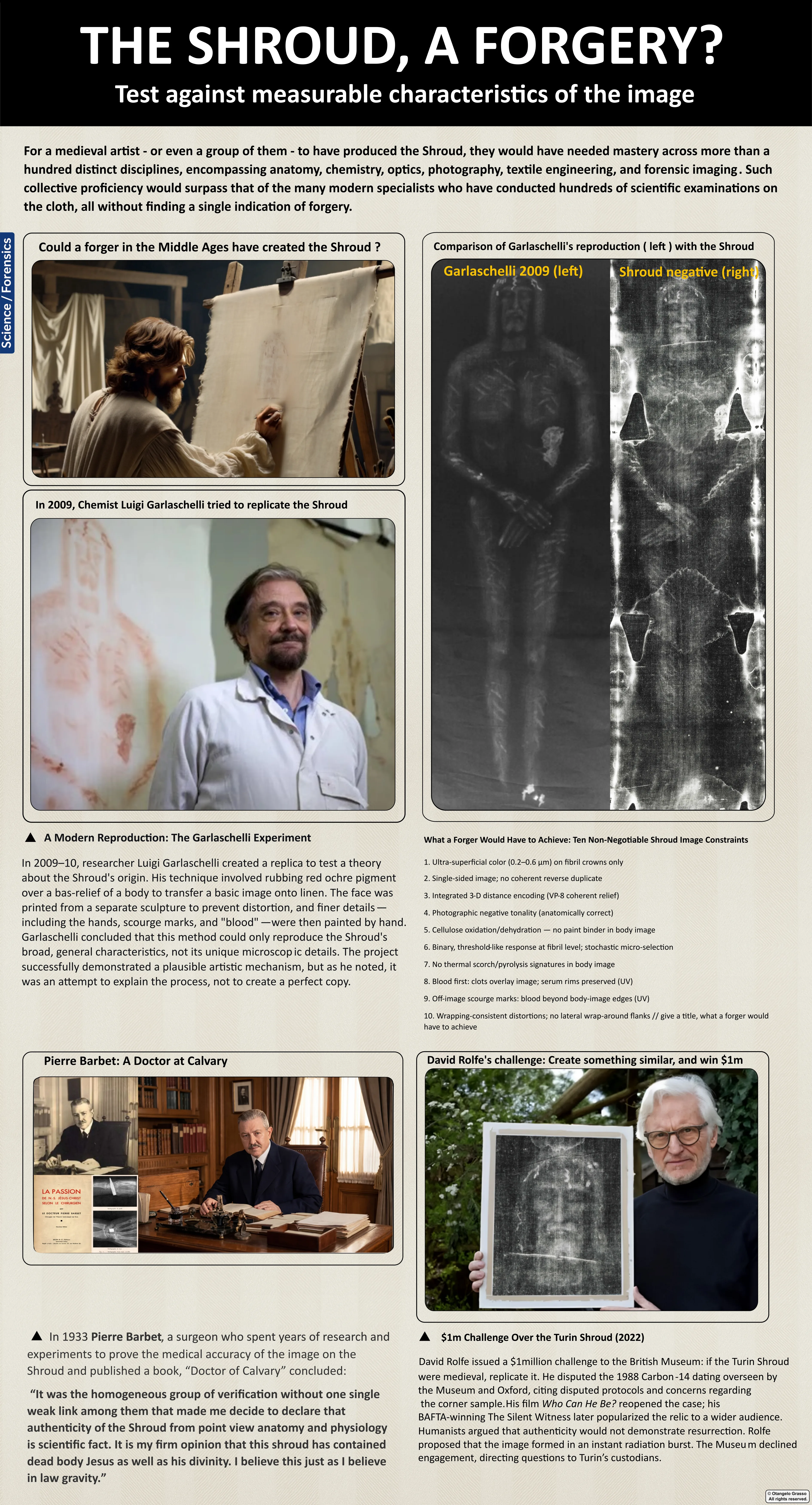
The Indictment: A Workshop in Shadow, 1350
The first rule of forgery is to know what your audience believes.
The second is to never know more than they do.
Consider the man in the dark.
He stands in a stone -flagged room, the air heavy with linseed oil, tallow smoke, and damp wool. A single candle throws his silhouette against the wall. Before him, stretched taut on a wooden frame, hangs fourteen feet of linen—blank, pale, expectant. His t ools are laid out with care: pestle and mortar, brushes of hog and sable, earthen pots of ochre, vermilion, lampblack.
And yet his hands do not move.
Because paint will not do.
Outside this room, the world is medieval. Christ hangs in every church with nails through his palms, blood rendered in tidy rubies, suffering stylized into reverent symmetry. This is what belief looks like in the 14th century. This is what sells.
But the man in the dark knows something else.
He knows —somehow—that some forensic analyses have concluded a crucified body may not be held by nails through the center of the palms without the flesh tearing free under body weight, and that the Shroud's wound location lies in the wrist area rather than the palm. 1 He knows a Roman flagrum leaves not random lashes but paired, dumbbell -shaped wounds, repeated again and again across the back.2 He knows that a lance thrust into the right side of a dead man might release not only blood, but a watery serum—separated fluid, not symbolic metaphor. 3 He knows how blood flows down arms held high, and how those rivulets shift when the body is laid flat.
He possesses, in short, the knowledge of a modern forensic pathologist.
And his task is to bury that knowledge—inside linen—using methods that must remain invisible for six hundred years.
This is our defendant: Anonymus Medievus, the hypothetical master forger of the Shroud of Turin. We have no name, no workshop, no confession. We have only the alleged crime scene: the cloth itself. And the charge is audacious fraud.
This is not a retrial of the Shroud. It is a trial of the hypothesis.
We will not ask, "Is it fake?"
We will ask, "What would it actually mean for it to be fake?"
Part I: Motive — The First Crack
In the 14th century, motive is easy to imagine. Relics meant pilgrims; pilgrims meant money. Piety and profit shared the same road. A burial cloth of Christ would be the ultimate draw.4
Perhaps the Shroud was commissioned by a nobleman —Geoffrey de Charny, lord of Lirey —seeking prestige. 5 Or perhaps by a monastery hoping to rise from obscurity.
But here the story fractures almost immediately.
De Charny did not behave like a man protecting a forgery. When he displayed the Shroud in the 1350s, he did so publicly, presenting it as an extraordinary relic—an image claimed to be not made by human hands. When Bishop Henry of Poitiers investigated and reportedly traced the image to an artist, de Charny and later his widow refused to explain its origin, even under significant ecclesiastical pressure. 5 This is not the behavior of a patron covering for a hired painter. It is the behavior of someone convinced—rightly or wrongly—that the object is extraordinary.
So let us imagine another scenario. The forger worked alone. He created a masterpiece, sold it, and vanished.
But this raises a harder question: why would a man capable of such unprecedented technique use it once, on a single object, then disappear without trace? No apprentices. No imitators. No other works. No ripple in the historical record.
Genius leaves echoes. This leaves silence.
Part II: The Knowledge Gap — Anachronism as Evidence
To produce the Shroud image, our forger must possess three categories of knowledge that did not exist in his time.
Anatomical Knowledge. Medieval iconography overwhelmingly — though not universally —places the nails through the palms. Theology demanded it. The Stigmata of Saint Francis confirmed it. Yet the Shroud shows wounds in the wrist area —which Pierre Barbet and others have argued is an atomically more consistent with crucifixion mechanics, and which is historically and iconographically anomalous in any case. 1 A forger introducing such a "flaw" would be sabotaging his own deception for an audience that didn't exist for another six centuries. Forensic Knowledge. The scourge marks are not decorative. They match the geometry of a Roman flagrum—approximately 100 –120 apparent two-lobed wounds, repeated across the back with the spacing of a multi - thonged whip tipped with lead balls. 2 The blood flows obey gravity precisely, changing direction with body position. The chest wound is positioned on the right side between the ribs —consistent with where a Roman lancea could reach the heart or pericardial region. Forensic analyses suggest the wound may have released pleural fluid and blood from the heart or surrounding pericardium, consistent with the water and blood described in the Gospel of John. 3 A medieval forger would have placed it on the left, where the heart visibly beats.
Materials Knowledge. Here the hypothesis begins to unravel entirely — and this is where we must enter the microscope.
Part III: The Medieval Technology Barrier
The image exists at a scale invisible to the medieval eye. Individual colored fibrils measure 10–15 microns in diameter—roughly one-seventh the width of a human hair. The discoloration penetrates only 0.2 microns into each fibril's surface—roughly 4 percent of its radius.6
This creates an immediate technological barrier. To create the image, our forger must accomplish five things simultaneously that lie entirely beyond his era.
1. Work at microscopic precision. He must selectively color individual fibrils without touching adjacent ones, achieving resolution beyond the limits of unaided human vision. The compound microscope will not be invented for another 250 years.
2. Stop at 200 nanometers depth. Any liquid medium—paint, dye, oil— penetrates linen by capillary action, wicking deeply into fiber bundles. The forger must somehow apply his coloring agent in a way that affects only the outermost molecular layer of each fiber, then stops—without any heat- induced scorching, without liquid penetration, without mechanical crushing of the weave.6
3. Leave no chemical trace. Spectroscopic analysis finds no pigments, dyes, oils, acids, or binding media in sufficient quantity to account for the image.7
The forger must color the cloth using a substance that, when analyzed by X-ray fluorescence, infrared spectroscopy, and microchemical testing, is chemically indistinguishable from the cloth itself.
4. Create a photographic negative. The image on the cloth is tonally reversed: dark areas represent recessed body surfaces, light areas represent protruding features. When photographed, the negative reveals a coherent, anatomically correct positive image. The tonal logic of this negative - positive relationship would not be formalized until the 1830s —when Nicéphore Niépce created the first permanent photograph (c. 1826 –27) and Henry Fox Talbot developed the calotype negative -positive process (first demonstrated c. 1835, publicly announced 1839). The forger creates a negative image trusting that a technology nearly five centuries in the future will reveal its true form.7
5. Encode three -dimensional information. Image intensity correlates mathematically with cloth -to-body distance. When processed by a VP -8 Image Analyzer—an analog image-processing device developed in 1972 that was used, among other applications, to analyze satellite and radar imagery—the Shroud yields a precise three-dimensional relief of a human
body. No painting, no rubbing, no known contact process produces this encoding.8
Medieval technology possessed none of these capabilities. Modern technology, despite repeated attempts, cannot replicate all of them simultaneously.
Part IV: The Blood-First Paradox
Ultraviolet photography indicates a sequence that contradicts every principle of artistic logic: many of the bloodstains were deposited before the image formed.9
Wherever blood contacts the linen, the body image is absent. The image stops cleanly at the borders of bloodstains, as if the image-forming process "saw" the blood and routed around it at microscopic precision. This is not how artists work. You paint the f igure first, then add blood for dramatic effect. Here, the sequence is inverted.
If our forger is working logically, he must: position a real bloody body — or apply real blood in forensically accurate patterns; allow the blood to dry and bond to the linen; remove the body or blood source; then somehow create the body image around the pre -existing bloodstains, without disturbing them, without painting over them, and without leaving gaps or irregular borders.
Why would any forger choose this backwards, risk -laden sequence? It adds enormous technical difficulty while providing no advantage. It is forensically correct and artistically insane.
Part V: The Moraes Debate — Science in Real Time
The physical impossibility of medieval forgery does not stop the scholarly conversation. In July 2025, a fierce exchange erupted in the pages of Archaeometry, demonstrating how difficult it is to settle even seemingly straightforward questions. The protagonist was Cicero Moraes, a Brazilian digital forensic artist, who published "Image Formation on the Holy Shroud—A Digital 3D Approach."10
Using open -source 3D modeling software (Blender), Moraes simulated fabric draping over both a three-dimensional human body and a bas-relief sculpture. His conclusion: the Shroud's undistorted image could only have been produced by a flat or low-relief matrix, not a real body, which would inevitably create the "Mask of Agamemnon" effect—geometric distortion visible when curved surfaces transfer to flat planes. Medieval artisans, he argued, possessed the sculptural skill and anatomical knowledge to produce su ch a work. No divine miracle or anachronistic genius required—just competent medieval craftsmanship. The article generated significant media coverage and prompted responses from multiple scholarly bodies and Church authorities.
The response was swift. The Centro Internazionale di Studi della Sindone (CISS) published a scathing dismissal, 11 arguing that Moraes's work was methodologically flawed and unoriginal —the image's orthogonal projection had been known since Vignon and Delage's 1902 studies. More fundamentally, they insisted that STURP's 1978 analyses had definitively ruled out painting , rubbing, or heated -contact methods —rendering the bas-relief hypothesis moot before it began.
Moraes's rebuttal 12,13 was precise and damaging. First, he demonstrated that the CISS had misread their own sacred text. STURP members Heller and Adler (1981) had, as a standard methodological caveat in forensic chemistry, acknowledged that the absence of detectable organic compounds does not preclude the possibility that such materials once existed but degraded over time. 6 The absence of evidence, they acknowledged, was not evidence of absence —a crucial methodological distinction the CISS had collapsed. Moraes further noted that STURP scientist Dr. Joseph Accetta—a member of the 1978 investigation team —had published a 2019 paper supporting medieval origin via woodblock printing, 14 essentially a bas-relief transfer method. The hypothesis the CISS claimed STURP had "ruled out" was now being defended by a STURP member himself.
Moraes further claimed that Jackson et al.'s (1984) VP -8 Image Analyzer study8—the cornerstone of claims that the Shroud contains "three - dimensional information" incompatible with forgery — actually supported the bas -relief hypothesis. Moraes argued that when Jackson's team processed the Shroud image through the VP -8, the resulting relief form appeared flattened —limbs compressed, features shallow—consistent, he claimed, with what one would expect from tomb effigy art. Jackson et al. themselves interpreted the VP -8 data as confirming distance-encoded 3D information consistent with a real human body; Moraes's reading was a contested reinterpretation of the same data, not a finding Jackson had himself reached.
Moraes provided extensive historical documentation: medieval low-relief tomb effigies from the 11th through 14th centuries displayed exactly the technical sophistication and iconographic conventions —modest hand positioning over the groin, frontal orientation, refined anatomical detail— necessary to produce the Shroud. The artistic infrastructure existed. The stylistic precedents existed. The required skill level demonstrably existed throughout the radiocarbon-dated period (1260–1390 CE).
What the debate reveals is not a resolution but an anatomy of the problem. Moraes is correct that contact with a three -dimensional body produces geometric distortion —any contact -based theory must address this. His critics are correct that a successful forgery hypothesis must explain all the features: the negative, the 3D encoding, the blood -first sequence, the nanometer-scale superficiality, the absence of any medium. The bas-relief theory solves one problem while failing on five others. Like squeezing a balloon, the problem bulges elsewhere.
Yet the controversy exposes something deeper: a recurring pattern in Shroud apologetics. What Moraes accomplished was not merely reiterating that the image appears orthogonal—a fact known for a century. He connected medieval sculptural traditions, computat ional simulation, and critical re -reading of forensic literature into a coherent, testable hypothesis. He showed that the "impossibility" of medieval origin rests partly on misreading the very studies cited to support it. And yet the hypothesis fails. Not because the CISS refuted it, but because it cannot account for what makes the Shroud genuinely anomalous: the blood deposited before the image, the cellulose modification at approximately 200-nanometer depth, the photographic negative, the absence of any transfer medium. A bas -relief solves the geometry problem. It does not solve the chemistry problem, the sequence problem, or the technology problem. The medieval forger remains impossible to account for. And so, it seems, does every other explanation. Part VI: The Proto -Photography Hypothesis — A Medieval Daguerreotype? Before we close the case on medieval impossibility, one final theory demands attention—not because it succeeds, but because it demonstrates how far theorists must reach to preserve a naturalistic medieval origin.
In 1993, South African art historian Nicholas Allen proposed that the Shroud was not a painting, not a contact transfer, but the world's first photograph—created using a room-sized camera obscura centuries before Nicéphore Niépce created the first permanen t photograph in 1826 – 27.15 The hypothesis gained traction when biblical scholar James Tabor championed it,16 arguing it elegantly explained the image's photographic negative quality, superficiality, and encoded three -dimensional information. The proposed method is audacious in its simplicity: a medieval artisan treats a fourteen -foot linen cloth with silver nitr ate—a light-sensitive compound known to alchemists. He positions a corpse (or more plausibly, a sculpted bas-relief) in bright sunlight outside a darkened chamber. Inside, he mounts a quartz lens in the wall, projecting the inverted image onto the sensitized cloth. After several days of continuous exposure, ultraviolet light darkens the silver salts, creating a photographic negative. Finally, he applies real blood to the appropriate wound sites.15
It is an ingenious theory. It accounts for the negative. It explains the superficiality through photochemical reaction rather than pigment penetration. It requires only technologies—camera obscura, lenses, silver compounds—that existed in fragmented form in the medieval period.
And yet it collapses under its own weight.
Allen's own replications fail to reproduce the Shroud's key characteristics. His experimental images show blurring, lack fine anatomical detail, and do not encode distance information in the mathematically precise way the Shroud does. 17 The exposure times required —up to ten days in Allen's calculations—would cause a real corpse to decompose beyond recognition
even in cold conditions. A sculpture would need to be anatomically perfect, negating the entire point of the photographic method. The hypothesis requires not just the existence of separate technologies, but their synthesis into a functioning photographic process. This is not incremental medieval innovation —it is a conceptual leap that would not occur again for five hundred years. And unlike every other medieval technology, it le aves no trace: no manuals, no failed experiments, no evolution, no second attempt.
Most fatally, the chemistry fails. A major objection concerns chemistry: silver-based photography normally leaves detectable metallic residues. STURP found no silver, no metals, no foreign compounds—only oxidized cellulose. The Shroud's image mechanism is fundamentally different from any photographic process, ancient or modern. Allen asks us to believe in a medieval genius who independently invented photography, used it once, achieved results superior to 19th -century pioneers, left no trace of his method, and somehow did all this using a chemical process that bears no resemblance to what actually appears on the cloth. This is not skepticism. It is credulity dressed in scientific language —a miracle of human achievement no less extraordinary than the miracle it attempts to replace.
Part VII: The Nicolotti Thesis — History by Exclusion
Andrea Nicolotti has emerged as the most formidable scholarly voice arguing for the Shroud of Turin's medieval origin. His work — particularly From the Mandylion of Edessa to the Shroud of Turin and Sindone: Storia e Leggenda —represents historical skepticism at its most sophisticated. Unlike amateur critics, Nicolotti commands the primary sources and rightly exposes hagiographic fabrications that have long plagued Shroud studies. His thesis rests on three foundational claims: the 1988 radiocarbon dating is de finitive, documentary silence before 1355 proves French fabrication, and pro -authenticity science represents methodologically compromised apologetics. 18 Each claim, however, collapses under scrutiny —not from external polemic, but from internal contradiction. When examined against the full body of evidence Nicolotti excludes, his thesis reveals itself as something other than dispassionate history.
I. The Radiocarbon Pillar: Sampling the Wrong Textile
Nicolotti treats the 1260–1390 radiocarbon date as an Archimedean point around which all other evidence must bend. The date, he argues, settles the question: the Shroud is a medieval artifact, and any evidence suggesting otherwise must be misinterpreted or fraudulent.
This argument never engages the foundational challenge to that date's validity: the sampled material is chemically distinct from the main cloth. Raymond Rogers, the STURP chemist who initially defended the radiocarbon result, later subjected the sample are a to rigorous chemical analysis. What he found was significant. The corner sample contained
cotton fibers interwoven with linen—a material absent everywhere else on the fourteen -foot cloth. The same area exhibited alizarin dye and gum coating, characteristic of invisible medieval repairs, while the main cloth showed neither.19 Rogers' vanillin testing —measuring the breakdown of lignin in cellulose —revealed a critical anomaly: vanillin remains detectable in medieval textiles but is entirely absent from the Shroud's main body, a result he argued indicates substantially greater age.19
Rogers' conclusions, it should be noted, have themselves been contested. Subsequent researchers including Thibault Heimburger have published critiques challenging his identification of cotton fibers and questioning the reliability of his vanillin dating me thodology. The radiocarbon contamination hypothesis, while chemically suggestive, remains scientifically debated rather than settled.
Nicolotti's response is to dismiss Rogers' work as "not peer-reviewed." Yet this methodological objection cuts both ways. If we cannot trust chemical analysis of the sample area, why should we trust the radiocarbon measurement drawn from that same area? Ni colotti cannot have it both ways: either the sample is representative and the chemistry is irrelevant, or the chemistry reveals contamination and the date is compromised. He never resolves this contradiction. The burden of proof thus shifts: Nicolotti must explain why a sample containing cotton, dye, and repair materials should be treated as representative of a cloth whose main body shows none of these features. This he has never done.
II. Documentary Silence: The Argument from Absence
Nicolotti's second pillar rests on an absence: no credible Western documentation before 1355 proves French fabrication. The Shroud emerges in the historical record at Lirey, France, around 1355, and its earlier history, he argues, is legendary accretion.
This argument commits a fundamental historical fallacy. Documentary silence proves nothing about physical objects that existed outside bureaucratic record-keeping. The Sutton Hoo ship burial contained Anglo- Saxon treasures unmentioned in any contemporary t ext—yet no historian claims they are therefore Victorian forgeries. The Dead Sea Scrolls lay undocumented for nearly two millennia —yet their discovery did not render them medieval fabrications. Absence of evidence is not evidence of absence.
More critically, Nicolotti's argument requires that we ignore the object documented in the East before Western silence begins. The Sudarium of Oviedo—a blood-stained face cloth —has been preserved in Spain since the seventh century, with its own documented transfer from Jerusalem.20 Forensic analysis reveals over 120 points of proposed correspondence with the Shroud's facial bloodstains: closely matching stain geometry, flow patterns, congruent folding deformations around nose and mouth, and compatible blood chemistry, with some rese archers
reporting the same AB blood type on both cloths —a finding subject to methodological debate given the technical challenges of blood -typing ancient degraded textile stains. 20,21 The correspondence is so precise that researchers have argued the Sudarium and Shroud contacted the same injured head during crucifixion and burial.20
Nicolotti gives limited weight to correlations proposed between the Shroud and the Sudarium of Oviedo, a decision critics argue leaves potentially relevant forensic comparisons underexplored. If the Shroud is a French creation of 1355, how did its fabricat or achieve forensic alignment with a Spanish cloth documented 650 years earlier? How did he replicate blood flow patterns he could not see, folding deformations he could not know, and blood chemistry he could not test? The "silence" Nicolotti invokes is not history's silence—it is his own.
III. The Methodological Dismissal: Defining Away Physical Reality
Nicolotti characterizes scientific Shroud research as "apologetics" driven by predetermined conclusions. This rhetorical move is effective until one examines what it requires him to dismiss.
He must dismiss the spectroscopic evidence that the "blood" is actual blood—hemoglobin, serum albumin, bilirubin —not medieval paint or pigment.22 The presence of bilirubin—a breakdown product of heme, the iron-containing component of hemoglobin —found in elevated concentrations following significant physiological trauma, is particularly significant: it indicates the individual suffered severe physic al stress before death, consistent with scourging and crucifixion.22 He must dismiss UV fluorescence showing serum halos around bloodstains, indicating clot retraction and serum separation —biological behavior invisible to the medieval eye and chemically impossible to replicate with pigments.23
He must dismiss the image's approximately 200 -nanometer superficiality—a discoloration restricted to the outermost cellulose layers of individual fibers, without pigment, dye, or binding medium penetrating the threads. 6,24 He must dismiss the image's distance -encoded three - dimensional information, which produces coherent relief when processed through VP-8 analysis—a property no painting, rubbing, contact method, or known artistic technique achieves.8 He must dismiss Jerusalem-specific pollen including Gundelia tournefortii in concentrations indicating extended Middle Eastern exposure, not casual contamination.25
It is worth noting that pollen evidence carries its own evidentiary complications. The original pollen analysis was performed by Max Frei, who was later implicated in the authentication of the fraudulent "Hitler Diaries." While subsequent researchers inclu ding Boi (2017) have corroborated some pollen findings using independent samples, the credibility question around the primary pollen data is a legitimate methodological concern that a thorough analysis must acknowledge.
He must dismiss limestone particulates matching Jerusalem tomb travertine on the foot and knee areas —particles embedded in the fibers, not surface dust. 26 He must dismiss the textile structure —a three-to-one herringbone twill—matching first-century Judean luxury burial cloths, not standard medieval European burial weaving. 27 He must dismiss anatomical precision in wound placement (wrist area, not palm; right-side lance) contradicting medieval iconography while consistent with modern forensic understanding of crucifixion mechanics.28
Nicolotti's method is to declare these findings 'not proven' or 'disputed' — but he never engages the technical literature demonstrating them. He cites none of it. He addresses none of it. The claim that his method constitutes history by exclusion rather than history by evidence is not a rhetorical label but a demonstrable pattern, and it should be demonstrated rather than merely asserted.
Nor, it should be said, does Nicolotti grapple with the most significant challenge to his radiocarbon pillar: the convergence of three independent laboratories on a 1260 –1390 CE date remains impressive as a statistical matter—and yet each laboratory sample d from the same single corner piece, meaning the three results share a common dependency on the assumption that the sample was representative. If Rogers' chemical challenge to that representativeness is even partially valid, three convergent dates become t hree measurements of the same contaminated area.
In Sindone: Storia e Leggenda, Nicolotti disposes of the image formation problem—the spectroscopic evidence of cellulose oxidation confined to the outermost fibril surface, the VP -8 three -dimensional encoding, the absence of any pigment, binding medium, or dye above detection limits— in fewer than two pages, citing no primary STURP literature and dismissing the entire body of work with the characterization that it represents conclusions reached by researchers predisposed to find confirmation of authenticity. 18 He does not engage Heller and Adler (1981), the definitive chemical investigation. He does not cite Schwalbe and Rogers (1982), the comprehensive physics and chemistry review. He does not address Jackson, Jumper, and Ercoline (1984), the VP -8 correlation study. The peer-reviewed literature establishing these findings across forty years runs to hundreds of papers. Nicolotti's treatment of it runs to a dismissal.
This is the historical method under examination. When a historian's thesis requires the exclusion of an entire scientific literature —not its refutation, not its engagement, but its exclusion by characterization —the thesis has not survived its evidence; it has avoided it. Labeling inconvenient data 'apologetic' does not refute it. It evades it.
IV. The Cumulative Case Nicolotti Cannot Accommodate
Beyond these individual evasions, Nicolotti's framework faces a deeper problem: the convergence of independent evidence streams pointing to the same conclusion. A medieval forger in 1355 would have needed knowledge of first -century Judean burial practices, including the use of luxury herringbone twill for elite interments —information unavailable in medieval Europe; access to Jerusalem-specific pollen assemblages, which he would have needed to collect, process, and embed in the cloth without leaving visible residue; familiarity with Roman crucifixion biomechanics unknown to medieval iconography and only confirmed by modern forensic medicine; understanding of blood chemistry enabling him to create hemoglobin derivatives and bilirubin using materials that would nonetheless escape spectroscopic detection as pigments; the technical ability to create a photographic negative nearly five centuries before the concept was formalized; and foresight to align his creation forensically with a Spanish cloth that would not b e scientifically compared to it for another 600 years.
Each of these individually strains credulity. Collectively, they become impossible. Nicolotti's framework cannot accommodate this convergence. Instead, it dismisses each datum individually as "not proven," ignoring the cumulative improbability of such coin cidences. This is not skepticism. It is a methodological shell game: move the burden of proof fast enough, and no amount of evidence can ever meet it.
V. The Verdict: History by Exclusion
Andrea Nicolotti has written the definitive case for medieval origin —on the condition that we accept a radiocarbon date from a chemically contested sample, give limited weight to a Spanish cloth that forensically corresponds to it, characterize spectroscop ic blood analysis as "apologetics," and overlook botanical, textile, anatomical, and forensic evidence pointing to first-century Jerusalem.
This is not history. It is history by exclusion.
When a historical argument requires the systematic dismissal of physical evidence, it has ceased to be an inquiry into what happened. It has become a defense of a predetermined conclusion. Nicolotti's thesis survives only by refusing to look at the object it claims to explain —and by asking its readers to do the same.
The Shroud of Turin may or may not be the burial cloth of Jesus of Nazareth. That question may ultimately lie beyond historical demonstration. But the medieval-origin thesis, as Nicolotti presents it, fails not because it reaches the wrong conclusion, but because it reaches its conclusion by the wrong method. It excludes what it cannot explain, dismisses what it cannot refute, and mistakes its own silences for history's. That is not scholarship. It is the appearance of scholarship, deployed in defense of a thesis that cannot survive confrontation with the evidence it refuses to see.
Part VIII: The Four Cliffs of Impossibility
We stand now at the bench, ready to render a verdict—not on the Shroud, but on the hypothesis of its human creation. To believe in a medieval forgery, the jury must accept a figure unlike any other in history.
Southern Cliff — Artistic Impossibility: He develops a process that modifies cellulose bonds at 0.2 -micron depth without tool, pigment, or detectable trace. He somehow encodes three -dimensional spatial information into his image —a concept that will not be understood until the development of holography. He creates a photographic negative without any concept of what a negative is, trusting blindly that a hidden positive image will be revealed by a technology nearly five hundred years in the future.
Northern Cliff — Forensic Impossibility: He possesses anatomical and pathological knowledge that will not be formalized for six centuries. He knows that the Shroud's wound positions in the wrist area are consistent with crucifixion mechanics and which nerve damage causes t humb retraction. He understands the geometry of Roman torture instruments and the physics of blood flow on vertical and horizontal bodies. He depicts these with clinical accuracy while deliberately contradicting every artistic and theological convention of his era.
Eastern Cliff — Sequential Impossibility: He applies blood first, in perfect anatomical distribution, then creates his image around it —in reverse of every artistic logic. He risks destroying carefully placed blood evidence to apply an image afterward, using a method that leaves no trace of its mechanism.
Western Cliff — Historical Impossibility: He then vanishes, leaving no other work, no student, no whisper of his method. No contemporary mentions this breakthrough. No other forger replicates it. No other artifact exhibits anything remotely similar. He invents techniques that remain beyond modern replication, uses them once, and disappears into historical silence.
And his artifact, rather than dissolving under scientific scrutiny, grows more precise and more resistant with every new instrument trained upon it.
A successful forgery grows simpler over time.
This object grows more complex.
The Closing Argument
Ray Rogers—the STURP chemist who spent decades analyzing the cloth and approached it with rigorous skepticism —arrived at a conclusion that science rarely permits: he could describe the molecular transformations in
precise chemical terms, but he could not explain how those transformations occurred. That question, he acknowledged, remains open.
The Shroud of Turin may be many things. But a simple medieval forgery is not among them. It is not the default, skeptical, parsimonious position. It is the most extravagant hypothesis on the table —one that requires a greater suspension of disbelief than any miracle.
The candle goes out. The workshop vanishes.
The linen remains.
And the burden of proof rests not with those who hesitate before calling it fake—but with those who ask us to believe in a forger more miraculous than the miracle he is accused of inventing.
One further step in the argument just completed requires acknowledgement — not because it weakens the forensic case, but because the forensic case is strongest when it does not claim more than it establishes.
The closing argument has demonstrated, with cumulative force, that the hypothesis of medieval human fabrication fails across four independent dimensions: artistic, forensic, sequential, and historical. That demonstration is the legitimate product of eviden ce. What follows it — the implication that what remains must therefore be a miraculous event, specifically the resurrection of Jesus of Nazareth — is a different kind of step, and it is not a step the evidence itself takes.
The logical structure here is precise. "No known human mechanism can account for this object" is a statement about the current limits of scientific knowledge. It is genuinely remarkable, and it has been established with unusual rigour. But it does not, wit hout additional argument, entail "therefore a supernatural event produced this object" — any more than the inexplicability of stellar energy before nuclear physics entailed that the sun was miraculous, or the inexplicability of the origin of species before Darwin entailed that creation was the only alternative. The history of science is in significant part the history of phenomena that resided, sometimes for centuries, in the space between "no known mechanism" and an eventual natural explanation. That space is not a shortcut to theology.29 The book does not make this inference explicitly. What it does is allow the rhetoric of the closing argument — the four cliffs, the vanishing forger, the burden of proof — to carry the reader from forensic conclusion to theological implication by momentum rather than by stated argument. The candle goes out. The workshop vanishes. The linen remains. These are beautiful sentences. They are doing argumentative work that they have not been formally licensed to do.
The distinction matters for a reason that serves the book's own purposes. The forensic impossibility argument — that no medieval forger could have done this — is the book's strongest case, and it is strong on its own terms. It does not require a theologica l conclusion to be significant. An object that demonstrably cannot be explained by any known natural or human mechanism is a genuine anomaly, and genuine anomalies are among the most important things science encounters. That finding stands regardless of what produced the Shroud, and it stands more securely when it is not attached to a theological claim that readers with different priors will resist. The case for taking the Shroud seriously is made by the evidence. The case for a specific theological interpr etation of that evidence is a separate inquiry, requiring separate argument, that this book is entitled to pursue — but entitled to pursue openly, not by implication. If the evidence points beyond the forger hypothesis, the question of what it points toward is one this investigation cannot answer on forensic grounds alone — and I do not pretend otherwise. References
1. Byard, R. W. (2016). Forensic and historical aspects of crucifixion. Journal of Forensic and Legal Medicine . Link. (Forensic review of crucifixion mechanics, nail placement, and anatomical findings; note that the question of whether nails through the palms can support body weight is contested in this literature, with Zugibe (1989, 2005) presenting experimental evidence for angled palm-nail placement.)
2. Cook, J. G. (2014). Crucifixion in the Mediterranean World . Mohr Siebeck. Link. (Archaeological study documenting Roman flagrum geometry and torture implement impact patterns.)
3. Bucklin, R. (1970). The legal and medical aspects of the trial and death of Christ. Medicine, Science and the Law , 10(1), 14 –26. (Forensic pathology analysis of crucifixion death including blood-serum separation and lance wound location.)
4. Geary, P. J. (1990). Furta Sacra: Thefts of Relics in the Central Middle Ages. Princeton University Press. Link. (Historical analysis of medieval relic trade and motivations for relic production.)
5. Drews, R. (1984). In Search of the Shroud of Turin: New Light on Its History. Biblical Archaeology Review, 10(1), 20–31. Link. (Investigation of Geoffrey de Charny's acquisition and display of the Shroud with ecclesiastical dispute documentation.)
6. Heller, J. H., & Adler, A. D. (1981). A Chemical Investigation of the Shroud of Turin. Canadian Society of Forensic Science Journal , 14(3), 81–103. Link. (Chemical characterization confirming extreme superficiality and cellulose modification without detectable foreign materials. Authors note, as standard forensic methodology requires, that absence of detectable organic compounds does not preclude the possibility that such materials once existed but degraded over time.)
7. Schwalbe, L. A., & Rogers, R. N. (1982). Physics and chemistry of the Shroud of Turin: a summary of the 1978 investigation. Analytica Chimica Acta, 135(1), 3 –49. Link. (STURP summary documenting absence of pigments and binding media through multiple spectroscopic methods. Note: the photographic negative property of the Shroud was first observed by photographer Secondo Pia in 1898 and analyzed scientifically by Vignon and Delage in 1902; Schwalbe & Rogers confirmed rather than established this property.)
8. Jackson, J. P., Jumper, E. J., & Ercoline, W. R. (1984). Correlation of Image Intensity on the Turin Shroud with the 3 -D Structure of a Human Body Shape. Applied Optics , 23(14), 2244 –2270. Link. (VP -8 study demonstrating quantitative correlation between image density and cloth - to-body distance. Jackson et al. interpreted their results as consistent with a real human body; subsequent researchers including Moraes (2025) have reinterpreted the same data as consistent with a bas-relief relief form.)
9. Pellicori, S. F., & Miller, V. D. (1981). Ultraviolet Fluorescence Photography of the Shroud of Turin. Journal of Biological Photography , 49(3), 71–85. Link. (UV imaging indicating that bloodstains predate body image formation.)
10. Moraes, C. (2025). Image Formation on the Holy Shroud —A Digital 3D Approach. Archaeometry, 68, 84 –93. Link. (Digital modeling study arguing geometric properties consistent with bas-relief contact transfer.)
11. Centro Internazionale di Studi della Sindone. (2025). Press Release Regarding the Study Published in Archaeometry. Link. (CISS statement dismissing Moraes's analysis and reaffirming STURP's exclusion of contact methods.)
12. Moraes, C. (2026). Response to the Comments of Casabianca et al. (2025). Archaeometry, 2026, 0:1 –3. Link. (Formal journal rebuttal defending geometric focus and citing contradictions in critics' radiocarbon conclusions. Note: published as an online -first article; page numbers pending final print publication.)
13. Moraes, C. (2025). My Public Response to the Centro Internazionale di Studi della Sindone (CISS) Regarding the Study in Archaeometry. ResearchGate. Link. (Informal public rebuttal documenting selective citation of STURP findings and medieval bas -relief craftsmanship precedents.)
14. Accetta, J. (2019). Probable Origins of a 14th Century Turin Shroud Image. Link. (STURP member's later analysis arguing for medieval origin via woodblock printing mechanisms; paper presents detailed historical parallels to large-format block printing traditions in medieval France and Flanders.)
15. Allen, N. P. L. (1993). Is the Shroud of Turin the First Recorded Photograph? South African Journal of Art History , 11, 23 –32. Link. (Proposal of camera obscura methodology for medieval photographic image formation, including description of the full proposed process.)
16. Tabor, J. (2020). Is the Mystery Solved? How the Shroud of Turin Was Produced. YouTube. Link. (Video presentation supporting Allen's proto - photography hypothesis.)
17. Schwortz, B. M. (2000). Is The Shroud of Turin a Medieval Photograph? A Critical Examination of the Theory. Proceedings of the 1999 Shroud of Turin International Research Conference . Link. (Technical critique of Allen's camera obscura hypothesis documenting failed replications and chemical inconsistencies.)
18. Grasso, O. (2024). A Formal Rebuttal of Andrea Nicolotti's Medieval- Icon Thesis in Light of Interdisciplinary Evidence on the Shroud of Turin. Independent research. Link. (Systematic critique of Nicolotti's methodology and exclusion of forensic, chemical, and botanical evidence.)
19. Rogers, R. N. (2005). Studies on the radiocarbon sample from the Shroud of Turin. Thermochimica Acta , 425(1 –2), 189 –194. Link. (Chemical evidence that radiocarbon sample area contains cotton and dye absent from main cloth; vanillin analysis indicating substantially greater age of main body. Note: these findings have been contested by subsequent researchers including Thibault Heimburger, who has challenged both the cotton-fiber identification and the vanillin dating methodology.)
20. Hermosilla, A. S. (2015). Commonalities between the Shroud of Turin and the Sudarium of Oviedo. SHS Web of Conferences , 15. Link. (Documents 120+ proposed forensic correspondences between the two cloths, including blood flow geometry and folding deformations.)
21. Barta, C., et al. (2015). New coincidence between Shroud of Turin and Sudarium of Oviedo. SHS Web of Conferences , 15. Link. (XRF analysis documenting compatible blood-stain chemistry between both cloths; AB blood type finding reported but subject to methodological limitations of typing ancient textile stains.)
22. Heller, J. H., & Adler, A. D. (1980). Blood on the Shroud of Turin. Applied Optics , 19(16), 2742 –2744. Link. (Spectroscopic confirmation of real blood components including hemoglobin derivatives, serum albumin, and bilirubin on linen fibers.)
23. Miller, V. D., & Pellicori, S. F. (1981). Ultraviolet Fluorescence Photography of the Shroud of Turin. Journal of Biological Photography , 49(3), 71 –85. Link. (UV imaging revealing serum halos indicating clot retraction and serum separation consistent with real biological blood.)
24. Gilbert, R., & Gilbert, M. (1980). Ultraviolet -visible reflectance and fluorescence spectra of the Shroud of Turin. Applied Optics , 19(12), 1930–1936. Link. (Spectroscopic analysis demonstrating absence of conventional pigments and confirming cellulose-based image chemistry.)
25. Boi, M. (2017). Pollen on the Shroud of Turin: The probable trace left by anointing and embalming. Archaeometry, 59, 316 –330. Link. (Identifies pollen assemblages consistent with Judean burial rituals, including Gundelia tournefortii ; represents an independent reanalysis following earlier work by Max Frei, whose credibility as a forensic authenticator was later questioned in connection with the "Hitler Diaries" scandal.)
26. Calliari, I., & Canovaro, C. (2015). Analysis of micro -particles vacuumed from the Turin Shroud. MATEC Web of Conferences, 36. Link. (Characterizes limestone dust compatible with Jerusalem tomb travertine embedded in foot and knee fiber areas.)
27. Shamir, O. (2015). A burial textile from the first century CE in Jerusalem compared to Roman textiles in the land of Israel and the Turin Shroud. SHS Web of Conferences , 15. Link. (Compares Shroud's herringbone twill to first -century Judean burial textiles; such weaves existed in medieval Europe but are more consistent with first -century Jewish burial practice.)
28. Bevilacqua, M., Fanti, G., D'Arienzo, M., et al. (2014). How was the Turin Shroud Man crucified? Injury, 45(Suppl 6), S142 –S148. Link. (Biomechanical reconstruction demonstrating wrist -area nail placement contradicting medieval iconography while consistent with crucifixion mechanics.)
29. Walton, D. N. (1996). Arguments from Ignorance . Penn State University Press. Link. (Definitive philosophical analysis of the argument from ignorance and the conditions under which the absence of a known explanation can and cannot support a positive conclusion — including the specific distinction between "no known natural mechanism" as an epistemic statement and "supernatural causation" as an ontological claim.) The investigation is finished.
Not in the sense that all questions have been answered — they have not. The mechanism by which the image formed remains, after fifty years of scientific attention and repeated failed replications, an open question. The precise route by which the cloth trav eled from first-century Jerusalem to fourteenth-century France cannot be traced without gaps. The significance of the 1988 radiocarbon result, and what it requires of us, remains contested.
These are honest uncertainties, and they have been stated as such throughout.
What is finished is the forensic work. The cloth has been examined as a material object. The evidence has been laid out in the only order that makes sense: what the cloth *is* before what it *depicts*, what it depicts before what it *means*, what it means empirically before what it might mean theologically. That sequence has been honored. And at its end, we arrive at a finding that can be stated with precision:
*No known natural process, and no known human agency, can account for all of the Shroud's observed properties simultaneously.*
That statement is not a conclusion about God. It is a conclusion about knowledge — specifically, about the current limits of what science and history can explain. It is, in the language of epistemology, a statement about what remains inside the boundaries of the explicable, and what lies beyond them. What lies beyond them is not, on that account alone, miraculous. The history of science includes many phenomena that resided for centuries in the space between *no known mechanism* and an eventual natural explanation. The edge of the explicable is not the same as the edge of the natural.
But it is a threshold.
And what a reader does at a threshold depends on what they bring to it.
For a reader who has followed this investigation with the detachment of a forensic examiner — who came for the science and found it genuinely arresting, who is satisfied to leave with a precise account of what remains unexplained — the investigation ends here. The cloth is extraordinary. Its properties are real. Its origins are, in the most careful sense of the word, mysterious. That is a significant finding. It does not require a next step.
For a reader who has followed this investigation and found themselves arriving not merely at intellectual interest but at something closer to the feeling of standing on the edge of something vast — who has looked at the image of the man in the linen and fe lt the weight not just of the evidence but of what the evidence is *about* — then there is one more chapter.
It is a different kind of chapter. It does not present forensic data. It makes no new arguments. It will not satisfy a reader who is looking for another layer of scientific demonstration, because that is not what it offers. What it offers is an invitation — to consider what it mean s, personally and not merely academically, if the man in the cloth is who the evidence suggests he might be.
That invitation is warranted by the preceding chapters. This investigation has proceeded throughout by inference to the best explanation — evaluating hypotheses not by their individual plausibility but by their ability to account for all the evidence simul taneously. Every alternative has been tested. Every alternative has failed. What remains, when the
alternatives are exhausted, is not a gap to be papered over with faith but a conclusion that faith can inhabit with intellectual integrity. The evidence does not compel a personal response — nothing can do that. But it earns one. For those willing to follow the argument to its end, faith here is not a leap away from the evidence. It is the response the evidence warrants.
The door is open.
What follows is for those who wish to walk through it.
THE WIDER DEBATE
The forgery challenge
The first thread cites David Rolfe’s $1 million challenge (2022) and lists twelve things a forger would need, from imported Middle Eastern linen to 3D information encoded in the negative. The second thread offers a probability estimate of about 1 in 4.25 × 10²³ for inauthenticity. Both are the author’s; the probability estimate is conceded to be a guess.
Source: the two catsboard threads of the Otangelo Grasso forum, part 1 and part 2. These are the author’s arguments, presented here as such, not established findings.
Explore the author’s additional material: The Shroud of Turin, part 1 · Part 2. The book’s bibliographic references are included where available.