IN-DEPTH READING - PHOTOGRAPHY AND THE SHROUD
A camera changes what the eye can see
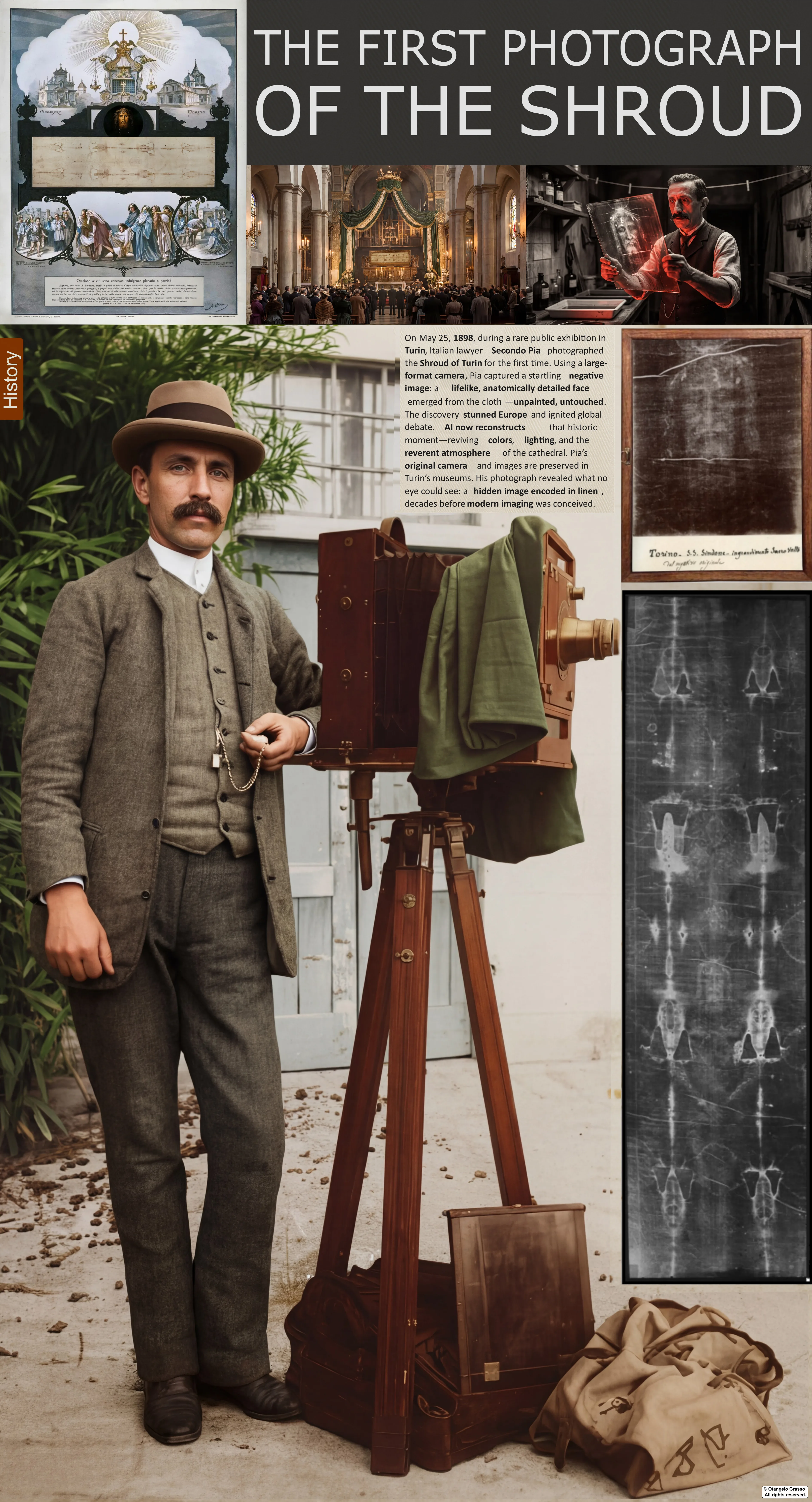
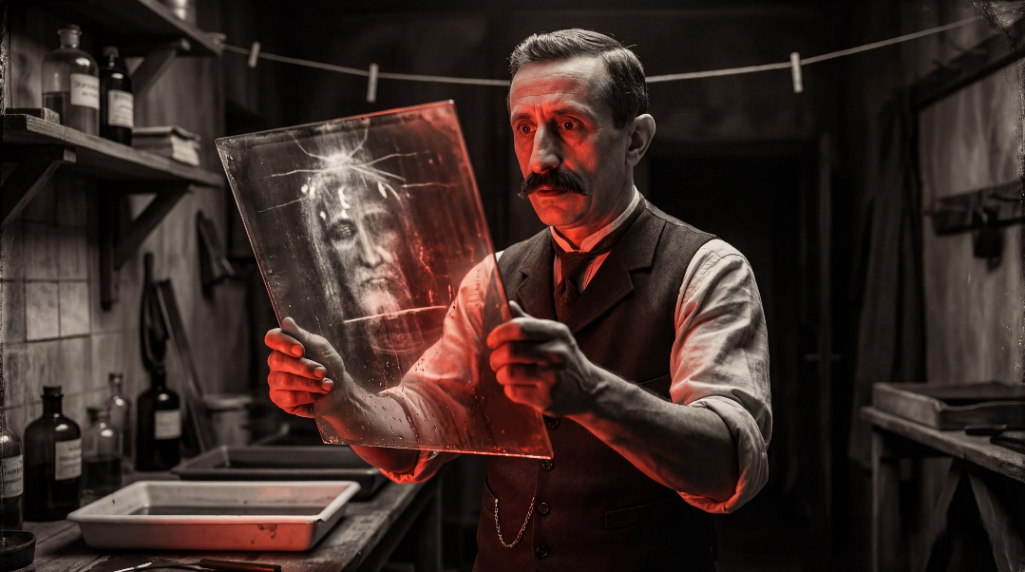
In May 1898, lawyer and photographer Secondo Pia made the first photographs of the Shroud of Turin. On the developed glass plate, the faint body image appeared with a striking tonal reversal: the figure was easier to recognize on the negative than on the cloth as seen directly. That photographic discovery brought the Shroud into a new public and scientific debate. Thirty-three years later, Giuseppe Enrie made a much more extensive photographic record during the 1931 exposition. The two campaigns document what cameras recorded; neither, by itself, explains when or how the linen image was formed.
1. Turin in 1898: a rare public display
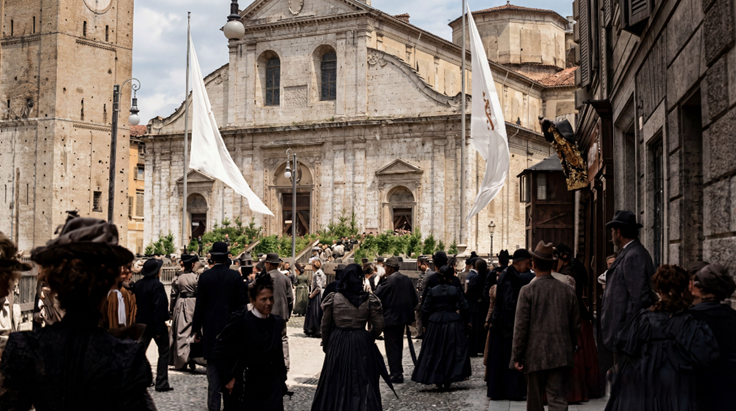
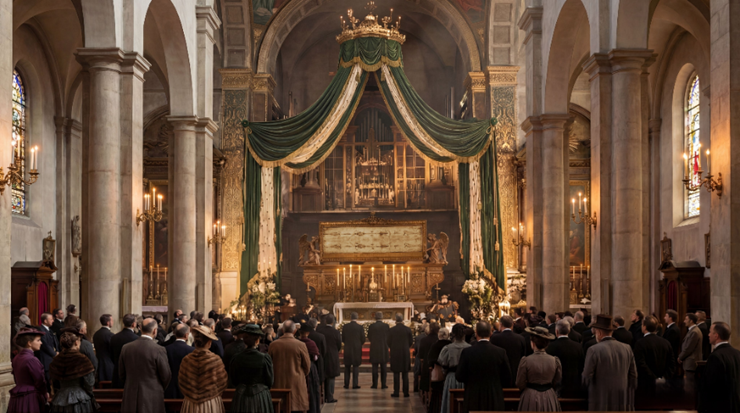
The Shroud was publicly exhibited in Turin Cathedral from 25 May to 2 June 1898. The exposition coincided with several commemorations: the fiftieth anniversary of the Statuto Albertino, the cathedral's four-hundredth anniversary, and the three-hundredth anniversary of the Confraternity of the Holy Shroud. It also took place amid celebrations surrounding the marriage of the future Victor Emmanuel III and Elena of Montenegro. The display brought a large public to the cathedral and gave the Savoy court an occasion to show the relic.1
For visitors, the central difficulty was visual: the figure on the yellowed linen was faint and hard to interpret at a distance. Its outline could be confused with stains and folds, while the face and body were not readily legible in ordinary viewing conditions. Photography offered a different kind of access. A glass plate could preserve the light pattern as seen from a fixed viewpoint, and a print could be circulated beyond the cathedral. People could compare a shared photographic record instead of relying only on memory, drawings, or verbal description.
2. Secondo Pia and the photographic sessions
Secondo Pia (1855-1941) was an Asti-born lawyer with substantial practical experience as an amateur photographer. He photographed architecture, landscapes, and local subjects, and knew the preparation and technical constraints of large-format photography. Permission to photograph the Shroud was a significant opportunity, but the task was unusually difficult: the cloth was mounted behind protective glass, the camera had to be set up inside the cathedral, and the faint image had to be recorded with the light and photographic materials then available.2
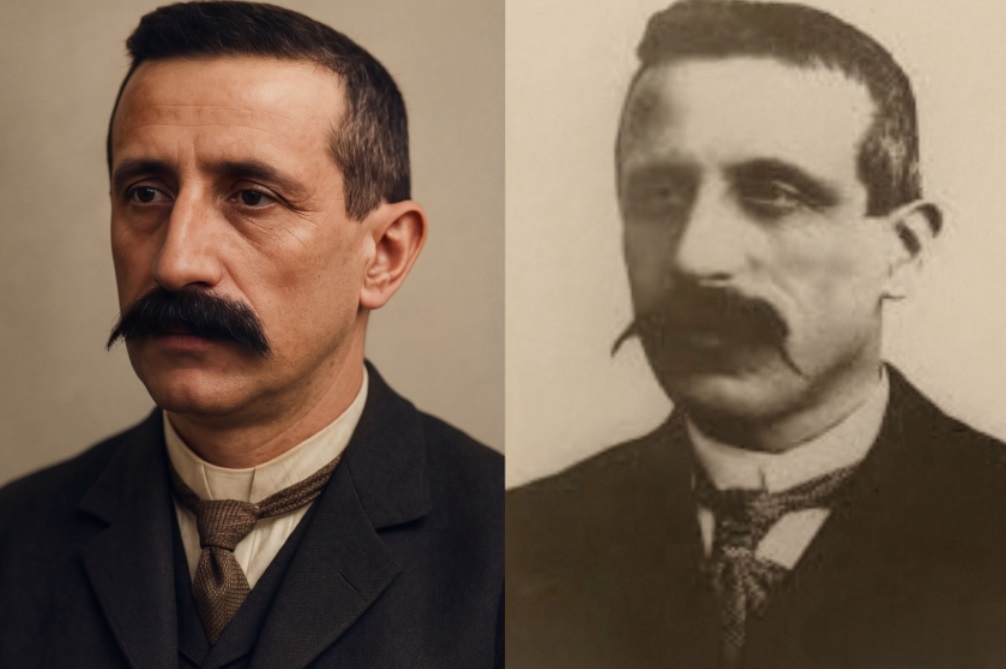
Accounts commonly distinguish an initial attempt on 25 May from the later session on 28 May whose plates became central to the story. The precise sequence of trials, exposures, and plates is reconstructed from later accounts and archival material; individual details should be attributed to those sources rather than embellished as a witnessed scene. Pia's photographs were made through protective glass, an important technical circumstance because reflections and transmitted light can affect a photographic record. Critics questioned whether the plate's appearance could be explained by photographic conditions or handling. The plates and their production conditions consequently became part of the debate, not a transparent window free of mediation.2
Pia later recalled the emotional effect of seeing the developed image. His testimony is valuable as a personal account of the discovery, but it is not evidence about the cause or date of the image on the linen. A photographer can accurately describe what appeared on a plate without that description deciding what produced the image photographed.3

3. What "negative-like" means
In a conventional black-and-white negative, parts of a subject that expose the photographic material more strongly appear darker on the plate. A positive print reverses those tones. When Pia examined the developed plate, the Shroud's faint body image had a positive-like appearance: areas that read as shadow on the cloth could appear light on the negative, while other areas appeared darker. This reversal made the body and face easier to recognize on the plate than in direct viewing of the cloth.4
"Negative-like" describes a tonal relationship; it does not mean the linen was made by a camera. The image was already on the cloth when Pia photographed it. The camera recorded light reflected from that existing surface. The negative plate then reversed the light-dark values, and a print made from it reversed them again. Later reproductions can further alter contrast, sharpness, color, and scale. A reader should be told whether an image is the cloth itself, a plate negative, a positive print, or a later digital rendering.
The observation was remarkable and historically consequential, but it is not an authenticity test. It does not prove that an artist could not have made the image, identify the person depicted, date the linen, or reveal the image-forming mechanism. A maker could intentionally create an image whose light-dark pattern produces a positive-like result when photographed. Explaining the Shroud requires evidence about its material, image distribution, and history beyond the behavior of a photographic plate.
4. From a local exposition to an international argument
The 1898 photographs circulated through reproductions and press discussion. Pia's image became more than a souvenir: it was a repeatable visual object that could be enlarged, copied, compared, and interpreted. The press clippings reproduced in the author's book give a glimpse of how the photographic event was presented to readers. Because the scans are small and their newspaper titles and text are not fully legible here, they are presented as reproductions of press material, not transcribed as independently verified quotations.8
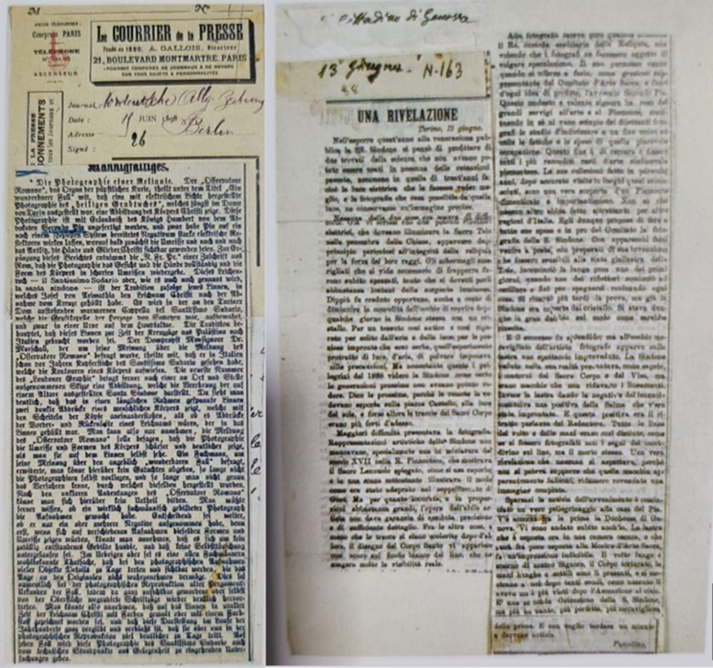
There was no instant, universal acceptance. The unusual negative-like appearance prompted questions about the plate, the glass, exposure, and development. The debate also raised a broader question about photography's authority: did the camera reveal something objectively present, or did the appearance depend on how the image was photographed and interpreted? Historian Peter Geimer's study of the Pia photograph and Paul Vignon's subsequent work emphasizes that early observers could treat the same photograph as either a revelation of the cloth's latent image or a product of photographic accident and interpretation.5
5. Vignon, Delage, and early scientific interpretations
In the years after Pia's photographs, French biologist Paul Vignon used photographic reproductions to analyze the Shroud image. In 1902 he published a proposed "vaporographic" account, suggesting that vapors associated with a body might interact with substances on linen. This was a hypothesis, not a demonstrated mechanism. Vignon's work helped move discussion from visual recognition toward questions about physical and chemical image formation, but the hypothesis itself did not settle those questions.6
Also in 1902, zoologist Yves Delage presented an argument to the French Academy of Sciences that the Shroud image merited scientific consideration. Delage's identification of the figure with Jesus was his interpretation; the photographic evidence did not compel that religious conclusion. Pia's plate shows how the cloth's image was recorded under particular conditions. Identifying the person or explaining the image requires further argument.
6. The 1931 exposition and Giuseppe Enrie's photographs
A second major public exposition took place from 3 to 24 May 1931 in connection with the marriage of Prince Umberto of Savoy and Princess Maria Jose of Belgium. The renewed display created an opportunity for a more extensive photographic campaign. The commission went to Giuseppe Enrie, a professional Turin photographer with an established studio and experience in technical photography. After three decades in which Pia's work had remained the principal photographic record, researchers could inspect images made with later equipment and a more systematic set of views.7
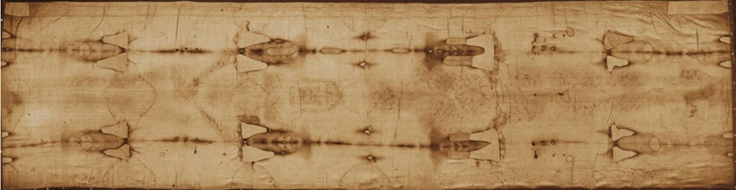
Enrie's work began on 3 May and continued through 24 May. Treccani's biographical entry, drawing on Enrie's 1933 account, describes twelve photographs: three full-cloth views in different plate sizes; five detail photographs, including views of the face, back, wrist wound, and cloth weave; three images of the cloth in sections; and a view of the Shroud displayed within its public exposition frame. Unlike Pia's best-known full-length plate, Enrie's campaign included close views that allowed features to be examined at larger scale.7
For the interior photographs, Enrie removed the protective glass so it would not intervene between lens and cloth. Treccani reports a total of 16,000 candlepower for Enrie's lighting arrangement, compared with two arc lamps of 1,000 and 900 candlepower in Pia's setup. Enrie used large glass plates, several lenses, and, for some exposures, yellow filters to increase tonal contrast. Reported exposure times varied by plate sensitivity, with three- and nine-minute exposures. These details come from the technical account associated with Enrie's 1933 book; they are not measurements independently established by the photographs themselves.7
Enrie set up a darkroom in a room of the cathedral, where plates could be developed during the campaign. The Metropolitan Museum notes that Pia, a French scientist, and a priest accompanied Enrie, and that Enrie documented exposure times, camera settings, lenses, filters, and lighting in his 1933 publication. Andrea Nicolotti's study reconstructs three operating sessions - 3, 19, and 22 May. It reports that after the cathedral closed at 10:30 p.m. on the opening night, roughly one hundred people remained inside, including officials, researchers such as Paul Vignon, and Pia himself. This describes a carefully witnessed technical operation; it does not make the photographic campaign a proof of authenticity.89
Enrie's later photographs displayed the same broad negative-like tonal behavior that had drawn attention to Pia's plate. They also offered clearer detail and broader coverage. This confirmed that the photographic effect was not confined to one famous image by one amateur photographer. But the campaign photographed the cloth; it did not recreate the process by which the cloth's image originated. It therefore cannot establish whether the image was produced by contact, pigment, heat, chemical action, or another proposed process, nor does the presence of witnesses prove the Shroud's age or identity.

7. What the two photographic campaigns establish
Pia's 1898 photographs transformed the visibility and circulation of the Shroud image. Enrie's 1931 series supplied a broader, technically improved record, made by a professional photographer and including both full-cloth and detail views. The episode is a sequence: a public exposition created the opportunity; a photographer recorded a faint image; the negative's tonal reversal changed how it could be seen; reproductions carried it into public debate; researchers proposed interpretations; and a later campaign repeated and expanded the photographic observation.
The evidence supports a precise conclusion: the photographic negatives made the Shroud's image easier to recognize and study, and Enrie's later work showed that this tonal behavior was reproducible in photographs made during a second campaign. The photographs do not, by themselves, establish the relic's age, the identity of the person, or the physical mechanism that created the linen image. Those are separate historical and scientific questions that must be assessed from their own evidence.
References and further reading
- Remi Van Haelst, "The First Shroud Photo" (1997), a secondary reconstruction of the 1898 exposition and photographic work. For broader context, see Andrea Nicolotti, "Le fotografie della Sindone di Secondo Pia (1898) e di Giuseppe Enrie (1931) e le polemiche tecniche che le accompagnarono" (2019).
- Wojciech Kucewicz and Jakub S. Prauzner-Bechcicki, "Photographs of the Shroud," Digital Sindonological Lexicon; Remi Van Haelst, "The First Shroud Photo." These are secondary accounts; exact details of Pia's sessions vary among retellings.
- Roberto Falcinelli, "Two Unpublished Letters of Secondo Pia about the 1898 Shroud Photography," proceedings of the International Workshop on the Scientific Approach to the Acheiropoietos Images (2010), pp. 519 onward.
- Wojciech Kucewicz and Jakub S. Prauzner-Bechcicki, "Photographs of the Shroud," Digital Sindonological Lexicon, on the 1898 photographic record and the tonal reversal observed on its negative.
- Peter Geimer, "A Self-Portrait of Christ or the White Noise of Photography? Paul Vignon and the Earliest Photograph of the Shroud of Turin," Grey Room 59 (2015): 6-43, on photography as a mediated record and early interpretive debate.
- "M. Vignon's Researches and the 'Holy Shroud,'" Nature 66 (1902): 13-14, doi:10.1038/066013a0; Paul Vignon, Le Linceul du Christ: etude scientifique (Paris: Masson, 1902).
- "Enrie, Giuseppe," Dizionario Biografico degli Italiani, Treccani. The entry gives biographical and technical details and cites Giuseppe Enrie, La Santa Sindone rivelata dalla fotografia (Turin, 1933).
- Andrea Nicolotti, "Le fotografie della Sindone di Secondo Pia (1898) e di Giuseppe Enrie (1931) e le polemiche tecniche che le accompagnarono," in Santi in posa. L'influsso della fotografia sull'immaginario religioso (Rome: Viella, 2019), 239-272; see the available scholarly text.
- Otangelo Grasso, The Shroud of Turin: A Forensic Summary of the Evidence (third edition, 2026) - buy on Amazon. The supplied source manuscript was titled Forensic Summary Version 2, chapter 5. Used here for its illustrations and reproductions. Reconstructions are labeled; historical claims have been checked against independent sources listed above.
- The Metropolitan Museum of Art, "Giuseppe Enrie - Detail of the Shroud of Turin," May 1931, object no. 2015.421.
- Wikimedia Commons, "Grabtuch Enrie HiRes", high-resolution reproduction of Giuseppe Enrie 1931 photograph, described as scanned from a contemporary publication; file record supplies the Public Domain Mark and original-source information.