IN-DEPTH READING
The evidence in context
This chapter presents historical, scientific and medical interpretations of the Shroud. Some conclusions remain debated. A source note identifies the related work1.
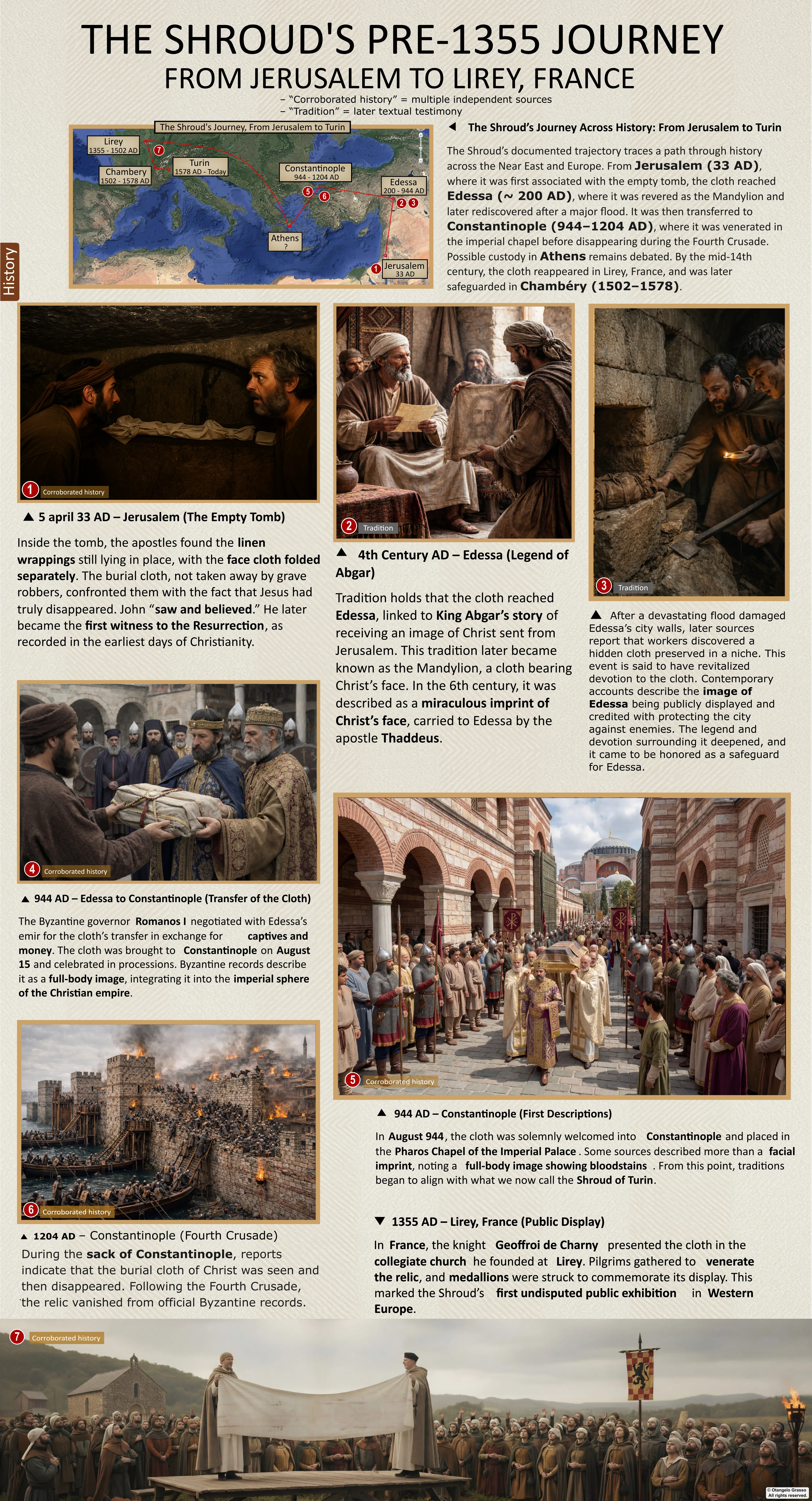
A Ghost in the Archives Constantinople. August 15–16, 944. The imperial galley Theophano glided through the Golden Horn as dusk settled over the gilded crosses of the city’s thousand churches. Aboard, in a cypress-wood reliquary sealed with imperial wax, rested a cloth that had traveled from a forgotten niche in a Syrian city gate to the very heart of the Byzantine Empire. The following dawn, crowds lining the waterfront would witness the formal reception of the Mandylion—the Holy Face of Edessa, an image not made by human hands. They celebrated a face. They did not know—if one influential modern hypothesis is correct—that they were welcoming a shroud. This moment represents the central paradox of the Shroud’s early history: for centuries before its dramatic emergence in France in the 1350s, its trail is not one of explicit documentation, but of echoes, silences, and tantalizing transformations. To trace this thread is not to follow a continuous, well -lit path, but to work as a textual detective, piecing together a history written in philological clues, geopolitical absences, and the silent testimony of the cloth itself. This chapter presents the most coherent chronological reconstruction of the Shroud’s journey from a first-century Judean tomb to a knight’s chapel in Champagne. The reconstruction hinges on a single, contested identification: that the Shroud of Turin is the same object as the venerated Mandylion—the Image of Edessa—perceived differently across time and culture because it was displayed differently. This identification, built in its influential modern form by Ian Wilson in 1978, is contested among Byzantine s pecialists and is presented here as the most explanatorily coherent reconstruction available, not as established fact. [14] The reader should weigh it against the serious objections raised throughout. PART I: JERUSALEM TO EDESSA (c. 30–525 CE) The Era of Concealment The Documentary Silence and Its Meaning The story begins, as all stories of this cloth must, with the burial accounts. The Synoptic Gospels speak of Joseph of Arimathea wrapping the body in a sindōn—a clean linen shroud. John’s Gospel adds the separate soudarion, found neatly folded apart from the rest in the empty tomb. For the Shroud to be authentic, its existence in the decades after the Crucifixion was almost certainly closely guarded within a small circle of early followers. Jewish purity laws concerning cor pse contamination, the political d anger of displaying the burial cloth of an executed man
venerated as God, and the early Christian emphasis on the risen Christ rather than the material relics of his Passion —all would have demanded discretion. Ian Wilson calls this the period of the “hidden relic.” Its very nature required concealment. The first five centuries present what appears to be a historical void. No text from the 1st to 6th centuries explicitly describes a full -length burial cloth bearing an imprinted image of Christ. But this silence is itself a piece of evidence, not an absence of it. Absence of Western documentation does not entail Western non-existence; it entails only that those who possessed the object had strong reasons not to advertise it. The silence is precisely what we would expect if the cloth existed but was kept in discreet, perhaps esoteric, custody. Echoes in the Shadows: The Early Clues Despite the silence, fragmentary traces in early texts suggest a developing tradition of an image -bearing burial cloth. The Acts of Thomas (c. 200– 250 CE), a Syriac apocryphal text, contains an allegorical reference to a royal image-bearing garment: a cloth upon which “the image of the King of kings was depicted entirely.” The language is clearly metaphorical, but it suggests early awareness of a cloth associated with Christ’s image. The fragmentary Gospel of the Hebrews , preserved only in quotation by Origen, mentions Jesus giving “the linen cloth to the servant of the priest” after the Resurrection —a tantalizing hint of the cloth’s post -resurrection journey, though its historical weight remains contested. [7] The critical shift comes in the liturgical sphere. Theodore of Mopsuestia’s Catechetical Homilies (c. 400 CE) describe deacons spreading altar linens that “represent the figure on the linen cloths at the burial.” This is not abstract symbolism but a specific liturgical claim: the burial cloths bore a visible figure. Theodore’s instruction provides what scholars call “liturgical DNA” —evidence that the practice of associating an i mage- bearing burial cloth with the altar rite was established enough to structure formal worship, even if the physical object remained hidden. By the sixth century, the whispers become more explicit. The Mozarabic Rite, rooted in Visigothic liturgical practice and preserved in manuscripts from the 10th and 11th centuries, contains a prayer elaborating on John 20:5–6. Some scholars render a key ph rase as Peter seeing “the recent imprints of the dead and risen man on the linens.” This is a theological and devotional elaboration within a liturgical prayer, not a retranslation of Scripture—its evidentiary weight is as liturgical commentary. That this elaboration appears in a rite used throughout the Iberian church suggests
that belief in an image -bearing burial cloth had penetrated Christian consciousness even in the distant West. [7]
Image 16.1: A photorealistic reconstruction of a 7th-century Visigothic Mozarabic liturgy in Hispania, showing the altar draped in undyed linen consistent with the period's liturgical prescriptions. Source: Link
This period ends not with a clear sighting but with the establishment of a powerful legend: the story of King Abgar of Edessa and a miraculous image of Christ’s face. Critically, later Greek recensions of the Abgar legend shift the moment of image formation from a painted portrait during Christ’s lifetime to a miraculous imprint formed “in the tomb”—linking it directly to the Resurrection and to burial cloth tradition. This legend would become the narrative vessel carrying the physical object for centuries. PART II: EDESSA (c. 525–944 CE) The Mandylion and the Folded Cloth The Image Emerges from the Wall The first undeniable historical reference to a specific image-bearing cloth occurs in the sixth century. The historian Evagrius Scholasticus, writing around 593 CE in his Ecclesiastical History (Book IV , Chapter 27), records that during a Persian siege of Edessa in 544, the city’s bishop discovered a miraculous image not made by human hands, hidden in a niche above the city gate. This marks the transition from pure legend to the veneration of a specific physical object —the Mandylion. The image was now publicly known, housed in Edessa, and credited with supernatural
protection. For the next four centuries it would remain there, its fame spreading throughout Christendom. The Core Hypothesis: The Shroud as Tetradiplon Here we encounter the central thesis of the pre -1355 reconstruction: the Image of Edessa was not a small facial portrait but the full Shroud of Turin, folded in such a way that only the face was visible. The evidence for this identification is a convergenc e of textual, lexical, physical, and iconographic strands —each independent, none alone decisive. The identification has been vigorously contested by Byzantine specialists, whose objections are engaged directly below and in the chapter’s conclusion. The Tetradiplon: A Disputed Hapax Legomenon The Greek term tetradiplon (τετράδιπλον)—meaning roughly “doubled in four”—appears in the Acts of Thaddaeus (Acta Thaddaei), a 7th-century Syriac-derived narrative about the Abgar legend. It does not appear in the Narratio de Imagine Edessena , which is a separate 10th -century account of the Mandylion’s transfer to Constantinople and uses different vocabulary entirely. Attributing tetradiplon to the Narratio—an error that has circulated in some secondary literature —conflates two distinct texts. [3] Tetradiplon is a hapax legomenon, appearing only once in all surviving ancient Greek literature. Its exact meaning is accordingly contested and cannot be settled from the word alone. Wilson’s folding reconstruction— folding the Shroud in half lengthwise, then twice mo re—is a plausible interpretation of its component elements, but it is not a philologically established reading. If Wilson’s interpretation is correct, the result is an eight-layered packet approximately the size of a small portrait icon, with the facial image centered and visible on the outermost layer. This creates a face-only display from a full-body cloth, explaining how the same object could be described across centuries as both a facial icon and a full burial shroud. But the interpretation must be held as a hypothesis, not a certainty.
Image 16.2: The Greek term tetradiplon (τετράδιπλον) appears in the Acts of Thaddaeus, a 7th -century Syriac -derived text. The word combines elements for “four” (τετρα -) and “fold over in two” (διπλόω), though Greek compound formation creates interpretive a mbiguity around its precise folding configuration. It does not appear in the 10th -century Narratio de Imagine Edessena. Physical corroboration exists, though it is contested. The Shroud bears a series of distinct, pre -1532 fold marks. John Jackson and his team have identified a set of crease marks, including one designated “Location C,” which they argue are consistent with long-term storage in a tetradiplon configuration. Other researchers have proposed different storage histories for the same crease patterns. The tetradiplon folding explanation remains one interpretation among several, not a settled conclusion. The Lexical Shift: From Himation to Sindon In the 8th century, St. John of Damascus, defending icons in his On the Holy Icons, referred to the Edessa image not with words for a small towel (soudarion or maphorion) but with the word himation—a large, rectangular outer garment or wrap, far more consistent with a shroud-sized cloth than a portrait. Byzantine writers were meticulous in their vocabulary. The choice of himation suggests John of Damascus understood the object to be substantially larger than its displayed face-only appearance indicated. Supporting this lexical observation, a 10th -century Latin manuscript — Codex V ossianus Lat. Q. 69 —contains a marginal note stating that the
image depicted “not only the figure of the face, but the figure of the whole body.” Scholars including Averil Cameron and Mark Guscin have identified this as a scribal gloss—a literary or theological commentary on what the image represented —rather than an eyewitness account of the cloth’s physical dimensions. Its evidentiary weight is as marginal annotation, not direct testimony. The Geopolitical Shield: Explaining the Iconoclastic Silence One of the strongest arguments for the Edessa provenance is its elegant explanation for a major historical puzzle. From 726 –787 CE and again from 814–843 CE, the Byzantine Empire was torn apart by Iconoclasm— the violent theological war over the veneration of religious images. If a full-body image of Christ not made by human hands had existed in the imperial capital during this period, it would have been the ultimate weapon in the iconophile arsenal. Yet it is never mentioned in the extensive records of the Iconoclastic debates. Wilson’s reconstruction solves this with geographic logic: from 639 CE until 944, Edessa was under Arab Muslim rule. The Mandylion was geographically and politically isolated from the Byzantine conflict. Its absence from the Iconoclastic debates is not a mysterious silence—it is the expected consequence of its location. It was not hidden from the debate; it was simply outside the empire where the debate raged. CORRECTION NOTE—Pope Stephen III and Theodore the Studite: Pope Stephen III, in a 769 CE sermon delivered to a papal synod —not a letter to Charlemagne, for which no primary -source attestation exists — retold the Abgar legend in the voice of Christ: “I send you the picture of my face divinely transferred onto a cloth.” The original sermon refers to a face image only. Some later manuscript copies contain an interpolation replacing “face” with “body,” but this is a post-Stephanian scribal addition and should not be cited as 8th -century papal testimony to a full -body imprint. Similarly, Theodore the Studite, defending icons in the early 9th century, referenced the Abgar legend—that Christ impressed his image on a cloth and sent it to Abgar. This is a reference to a face image, not explicitly to a burial shroud. No verified text of Theodore has been located in which he identifies a burial shroud specifically as a prototype for icon veneration; claims to this effect in secondary literature have not been traced to a primary-source edition and should be treated as unverified. At the Second Council of Nicaea in 787 CE, the council fathers justified icon veneration by referencing the Edessa image as a pre-70 CE relic. The pattern is consistent: Western and Byzantine theologians knew of a cloth-
image tradition rooted in the Abgar story, but the physical object remained in Muslim-controlled Edessa, insulated from the theological firestorm. PART III: CONSTANTINOPLE (944–1204 CE) The Revelation Unfolds The Imperial Translation In 943 CE, the Byzantine general John Kourkouas besieged Edessa. Byzantine and Muslim sources give differing accounts of what followed. The Muslim account describes a military campaign with recovery of the Mandylion as the primary objective. The Byzantine Narratio de Imagine Edessena, written by Emperor Constantine VII Porphyrogenitus two years after the transfer, describes a negotiated exchange: the Emir voluntarily accepted an offer of silver and the release of prisoners in return for the cloth, with no military coercion forcing the issue. The Skylitzes Chronicle records that the people of Edessa themselves offered the cloth to end the siege. The transfer was, according to the Byzantine record, ultimately diplomatic rather than military in character. On August 16, 944 —now commemorated in the Eastern Orthodox calendar as the Feast of the Holy Mandylion —the cloth was formally received in a triumph meticulously recorded by court historians. The official sermon for the occasion was delivered by Gregory Referendarius, Archdeacon of Hagia Sophia. He describes the image as formed from the sweat of Christ’s prayer in Gethsemane, and makes a separate theological allusion to the blood from the side wound as part of the broader Passion narrative. These are references to two distinct events at two different times —the pre -crucifixion sweat -cloth and the post - crucifixion lance wound —not a description of a single relic bearing evidence of both. Mark Gusci n’s 2004 translation, which suggested the sermon implied a side wound visible on the image itself, was formally retracted by Guscin in 2007 after further study of the Greek text. Andrea Nicolotti’s independent translation reaches the same conclusion. [9] The corrected reading of the Gregory sermon offers no evidence that the Archdeacon saw a full -body or passion -wound image; the language maintains the two Passion moments as distinct.
Image 16.3: The Madrid Skylitzes, a 12th -century Byzantine chronicle, contains a miniature depicting the handover of the Mandylion in Edessa in 944. The scene shows the revered face -image and, beneath it, a long cloth. A number of researchers align this de tail with Ian Wilson's tetradiplon thesis, though others — including Andrea Nicolotti — have argued the long purple cloth is a handling cloth used to protect sacred objects from unclean hands, and that the Greek text accompanying the illustration rules out the tetradiplon interpretation of the scene. The identification remains debated.
From Face to Full Form: The Testimonies Accumulate Once secured in the Pharos Chapel—the private reliquary of the Byzantine emperors within the Great Palace [4]—knowledge of the cloth’s full dimensions began, according to the reconstruction, to seep into wider awareness. Several documentary claims commonly cited in pro -Shroud literature require careful correction here. On Vatican manuscript Gr. 511: This manuscript contains a copy of the sermon of Gregory Referendarius, not an imperial letter from Constantine VII Porphyrogenitus. No verified primary text has been located in which Constantine VII states that the Mandylion’s image was impressed by sweat “not only from the face but from the whole body” ( ὅλου τού σώματος ). This claim, in the form in which it circulates in some secondary literature, cannot be substantiated from the primary source and should not be cited until a verified document is identified. On the Greek Synaxarion: The Synaxarion for the Feast of the Holy Mandylion (c. 950 –980 CE) describes Christ wiping his holy face on a towel, with his divine form imprinted on it—a face image, not a full-body figure. The Synaxarion tradition consistently presents the Mandylion as a
facial image. Claims that the Synaxarion confirms “an entire figure” are not supported by the liturgical text’s actual content and represent a misreading that should be corrected in any scholarly treatment. What the documentary record does offer is a genuine progression, more modest but still significant. Georgios Kedrenos (c. 1050–1100 CE), in his Synopsis Historiarum, became the first historian to explicitly merge the Mandylion and burial cloth traditions, describing the Image of Edessa as “a sweat image not made by hands” that was “buried with Christ and found again in the tomb.” What had been implicit is now stated as historical fact by a respected Byzantine chronicler. A significant counter -argument requires direct acknowledgement. Byzantine documentary inventories—including materials associated with Constantine VII’s period—at times list the sindon and the Mandylion as separate objects. Multiple pilgrim accounts distinguish the two relics. If the Mandylion were the Shroud folded, one would expect that, once the cloth was available for examination in Constantinople, documents would merge the two identifications rather than continue to distinguish them. The persistent sepa rate listing of the Mandylion and burial cloths in independent Byzantine inventories constitutes one of the most substantive internal documentary arguments against Wilson’s identification. Readers should weigh this inventory evidence seriously. The Theotokos of Blachernae Complex The Theotokos of Blachernae stood as the foremost Marian sanctuary of Constantinople, combining pilgrimage devotion, imperial ceremony, and defensive ideology into a single sacred landscape. Strategically positioned in the city’s northwestern corner near t he Theodosian Land Walls and overlooking the Golden Horn, the complex occupied terrain that naturally integrated architecture, procession, and ritual movement. Founded in the mid-5th century under Pulcheria and Marcian, its earliest core was the Hagia Soros—a small centralized reliquary chapel constructed to house the Virgin’s Maphorion (Sacred Robe) and later her Girdle. Around 500 CE, Emperor Leo I expanded the sanctuary by adding a grand three-aisled basilica and incorporating the Hagiasma (holy spring) with its associated Lousma (ritual bath), establishing the definitive tripartite ensemble that persisted, through fires and reconstructions, into the middle Byzantine period.
Image 16.4: Locating the Theotokos of the Pharos (red circle): the chapel occupies the sea -terrace of the Great Palace, east/southeast of the Chrysotriklinos and just inland of the Pharos lighthouse. A vaulted passage linked it directly to the Chrysotrikli nos, confirming the intimate palatine connection. Link
Image 16.5: An intimate sanctuary sits beneath a gold-mosaic dome. Four polished shafts frame a pyramidal silver ciborium whose facets catch dozens of pin-points of lamplight. On the centerline, two veiled capsulae descend on heavy silver chains. Gold -ground mosaics ring the nave — calm, frontal saints between pilasters. The effect is concentrated luxury in disciplined ceremonial geometry: silver planes, gold accents, and purple textiles The main basilica functioned as the ceremonial heart, designed to accommodate large congregations and imperial liturgies, with galleries, marble pavements, polychrome revetments, and a templon screen defining the sanctuary. The Hagia Soros served as an int imate treasury-oratory, its scale intensifying the veneration of Marian relics through precious materials, veils, ciborium structures, and concentrated lamplight. The Hagiasma and Lousma formed the ritual threshold—pilgrims encountered sacred water associa ted with purification and healing before ascending toward the Soros and Basilica, a vertical progression that structured both devotional and ceremonial experience. [5]
Image 16.6 Reconstruction of the Blachernae complex Western Pilgrimage Testimony: The Vocabulary Shifts By the mid -12th century, Western pilgrims to Constantinople were recording what they saw with increasing specificity. Nicolaus
Sæmundarson, Abbot of Þineyrar in Iceland (1151–1154 CE), compiled a relic inventory that includes “fasciae cum sudario et sanguine Christi ”— the bands with the soudarion and the blood of Christ —indicating knowledge of multiple burial cloths consistent with John’s Gospel account. William, Archbishop of Tyre, recorded his official visit to Emperor Manuel I Komnenos in 1171 CE. Among the imperial relics shown to him, he explicitly mentions witnessing “the sindon.” A contemporary French version of his chronicle clarifies: “the sheet which is called synne where he was wrapped.” William was not a credulous pilgrim but a learned prelate and historian. His use of sindon—the precise Gospel term for Christ’s burial shroud —demonstrates that by 1171, the vocabulary had decisively shifted from face-cloth to burial shroud. The object’s full identity was no longer esoteric knowledge.
Image 16.7: Reconstructions of the Hagiasma threshold and the interior of the Hagia Soros tradition at Blachernae, showing the Friday elevation of the cloth for veneration. Image: Link
The Eyewitness and the Knight: Convergent Testimony Two pieces of evidence from the turn of the 13th century provide compelling testimony that a shroud identified with Christ was present in Constantinople. Nicholas Mesarites, keeper of the Pharos Treasury, delivered a sermon in 1201 defending the imperial chapel during a coup attempt. His testimony is extraordinary because he had direct, privileged access to the relics. He describes the burial cloths in explicit anatomical terms: “The burial cloths of Christ are of cheap material as is customary, they still retain the perfume, they defy corruption, because they have wrapped the ineffable dead, naked and embalmed after the Passion.” The words “naked” and “wrapped” are significant. Mesarites is describing a cloth that bore the
image of a nude, wrapped body —consistent with the Shroud of Turin’s characteristic of depicting frontal and dorsal images of a naked crucified man. This is not a description of a face-only icon. The French knight Robert de Clari, a participant in the Fourth Crusade, wrote a chronicle ( La Conquête de Constantinople ) describing his 1203 visit to the Church of Saint Mary of Blachernae. His account is preserved in the sole surviving manuscript of the chronicle —Copenhagen, Kongelige Biblioteket, GKS 487 f° (copied c. 1300, believed connected to the Abbey of Corbie). De Clari’s account reads: “There was another church called Saint Mary of Blachernae, where was kept the shroud ( sydoine) in which our Lord had been wrapped, which was raised up every Friday so that the figure of our Lord could be plainly seen there.” De Clari describes a public, weekly display of a full-length shroud bearing a visible figure. The phrase “raised up” ( drechoit sus) suggests vertical display. This is consistent with a description of the Turin Shroud being exhibited vertically, and irreconcilable with the Mandylion as a small, framed facial icon—if de Clari’s account is taken at face value. De Clari’s account, while vivid, is an isolated testimony. No Byzantine source—no liturgical typikon, no imperial inventory, no other pilgrim account—corroborates the existence of a public, weekly veneration of Christ’s full -body shroud at the Church of Bl achernae. The church’s primary, well-documented relic was the Maphorion (Robe) of the Virgin. De Clari was a relatively unsophisticated soldier-observer in an unfamiliar city, writing in retrospect. His account may describe what he genuinely saw, or may reflect a misidentification, a conflation of multiple relics, or embellishment in the retelling. The absence of Byzantine corroboration for his specific claim is a significant limitation on its evidentiary weight. The Scholarly Objection: Cameron and Nicolotti Byzantine historian Averil Cameron argued that the Mandylion identification founders on material problems: in its documented Byzantine descriptions, the Mandylion was consistently characterized as a facial image on a cloth of towel -like dimensions, not a f ull-body burial shroud. The Greek liturgical texts surrounding the Mandylion feast day describe properties inconsistent with a folded full -body image. Cameron further noted that the Byzantine artistic tradition surrounding the Mandylion remained limited to facial imagery, with no hint in Eastern Christian iconography of the full -body features that would inevitably have influenced artists if they had had access to the complete cloth displayed as such. If the Shroud had been in Constantinople as a royal treas ure
periodically unfolded, its full -body image should have entered the iconographic tradition. It largely did not. [8] These objections force precision on what the tetradiplon proposal actually claims: not that the Shroud was displayed as a full -body cloth, but that it was known to a restricted elite as such while displayed publicly as a folded facial image. This is a plausible but necessarily speculative reconstruction, and th e distinction between what was publicly visible and what court theologians knew privately is a hypothesis rather than a documented fact. Cameron’s skepticism should be acknowledged as representing legitimate Byzantine scholarship. The fullest recent development of these objections appears in Andrea Nicolotti’s 2020 monograph From the Mandylion of Edessa to the Shroud of Turin (Brill), [9] which presents a comprehensive philological case: the word “Mandylion” derives from Byzantine/Arabic terms for a small towel or napkin; no pre-944 source describes the object as anything other than a facial image on a small cloth; and key 10th -century tex ts—including Gregory Referendarius’s own sermon —explicitly describe the image as impressed on a cloth wiped across Christ’s face, not a burial shroud. Nicolotti’s work represents the current state of specialist scholarly objection and significantly raises the evidentiary bar for the identification thesis. De Clari’s final words carry their own weight: “Nor did anyone know what became of this shroud when the city was taken.” The mystery of the cloth’s post-1204 location would persist for 150 years. c. 1192–1195 CE: The Pray Codex—Iconographic Evidence The Pray Codex, a Hungarian illuminated manuscript (Budapest, National Széchényi Library, Cod. Lat. 404), contains a depiction of Christ’s entombment that proponents have argued displays a combination of details reminiscent of the Shroud of Turin.
The body is depicted completely nude —unusual for medieval art, which typically showed Christ with a loincloth. The hands are crossed over the pelvis with only four fingers visible on each hand, thumbs hidden —a feature that in medieval illumination often re flects artistic convention rather than anatomical observation, and that does not by itself constitute evidence of knowledge of the Shroud. The median nerve severing hypothesis proposed by surgeon Pierre Barbet to explain the Shroud’s hidden thumbs remains a hypothesis, not an established mechanism. The burial cloth in the illustration displays a woven pattern, and in the lower portion of the depicted cloth appears a pattern of circles in an L -shaped arrangement—suggestive of, though not precisely matching, a set of pre- 1532 burn marks (the “poker holes”) on the actual Shroud of Turin.
The four -fingered hand is a well -documented artistic convention in medieval illumination. The woven pattern, while notable, reflects a textile design not exclusive to the Shroud’s herringbone twill. The L -shaped marks do not match exactly —the number and co nfiguration of holes on the Shroud varies across different clusters, and the Pray Codex marks may represent decorative elements such as clasps or ornamental bosses. Multiple peer-reviewed analyses, including those by Casabianca (2023) and Mo (2012), have c ontested the direct link as non -specific. The Pray Codex remains an intriguing and genuinely unusual piece of iconographic evidence—particularly the nude depiction —but its connection to the Shroud is contested and far from established. Taken together, these unusual features are suggestive: they indicate that detailed knowledge of a cloth resembling the Turin Shroud may have circulated in Central Europe before 1195. But the case rests on circumstantial convergence, not documented provenan ce, and alternative art-historical explanations for each individual feature exist. Then came the catastrophe. PART IV: THE LOST CENTURY (1204–c. 1350) From Sack to Re-Emergence The Vanishing On April 12, 1204, Crusader armies breached the walls of Constantinople and began three days of systematic looting. The greatest collection of Christian relics in the world was plundered and scattered across Europe. Theodore Angelus, a member of the Byzant ine imperial family, wrote to Pope Innocent III in 1205 protesting the theft of “the most sacred linen in which Christ was wrapped, now in Athens.” The papal envoy Nicholas of Otranto confirmed in 1208 that spargana (burial wraps) were being venerated in Athens following the sack. The chronicler Gunther of Pairis described the systematic division and redistribution of Constantinople’s sacred relics among the crusader leadership. But then, silence. For 150 years the Shroud vanishes from the historical record. This lost century represents the most vulnerable gap in the reconstruction—the period where chain of custody is not documented and must be inferred from circumstantial connections. Plausible Pathways: The Knights Templar Hypothesis The most frequently proposed theory for this gap involves the Knights Templar. It must be acknowledged at the outset that this remains speculative, lacking definitive documentary proof. The circumstantial connections, however, are worth examining.
During the suppression and trials of the Knights Templar (1307 –1314), among the charges of heresy was the accusation that Templars secretly worshiped an idol called a “ caput”—a bearded male head. Some trial records describe it as a painted image on cloth or board, shown only to high-ranking members in secret ceremonies. If the Shroud had come into Templar possession —perhaps looted from Athens or acquired through networks of crusader nobility—and was still kept folded in its tetradiplon configuration showing only the face, it would match these descriptions: a bearded face on cloth, venerated in secret by an elite inner circle. The most discussed connection is genealogical. Geoffroi de Charney, Preceptor of Normandy for the Knights Templar, was burned at the stake alongside Grand Master Jacques de Molay in Paris on March 18, 1314. Geoffroi de Charny—the documented first owner of the Shroud at Lirey around 1353—has been proposed as a near relative. The Templar died in 1314, while the Lirey knight was born c. 1300–1306; the relationship was most likely that of great -uncle and grand -nephew, or uncle and nephew, rather than grandfather and grandson. Even this relationship is disputed by some researchers —including Dorothy Crispino and Malcolm Barber — and no primary genealogical documentation definitively establishes a close family connection. The similar but not identical names (Charney vs. Charny) belong to related but distinct lines. No document explicitly states that the Templars possessed the Shroud. The hypothesis offers a proposed mechanism for the 1204–1350 gap, not proof. The Re-Emergence at Lirey Around 1353, in the small town of Lirey in Champagne, a collegiate church founded by the knight Geoffroi de Charny began exhibiting a linen cloth bearing the double image of a crucified man. There was no fanfare about a new discovery, no claim of a recent miracle or acquisition. It was presented simply as the burial Shroud of Christ. Geoffroi de Charny was no obscure figure. He was one of the most celebrated knights of his age: a founding member of the Order of the Star, established by King Jean II of France in 1351; [2] author of works on chivalry, including at least two certainly attributed works and a third whose authorship has been questioned by recent scholarship; a trusted advisor to King John II of France, and bearer of the Oriflamme—the sacred battle standard of France. He died heroically at the Battle of Poitiers in 1356, protecting his king with his own body. The founding charter of his collegiate church at Lirey, dated 20 June 1353, micro -manages the church’s operations and the lives of its six canons in meticulous detail. It contains not a single mention of a burial cloth of Christ —a silence that
scholars have interpreted variously as evidence of later acquisition, deliberate concealment, or cautious discretion. A further difficulty deserves to be named before passing from Lirey to the public exhibitions. Neither Geoffroi de Charny nor any member of his family ever made, on the surviving record, an explicit claim that the cloth was a first-century Palestinian linen—that it had traveled from Jerusalem to Edessa to Constantinople and thence to Champagne across fourteen centuries of custodial history. The founding charter does not mention the cloth at all. [9] The pilgrim medallions present it as the suaire—the shroud—of Christ, a designation that is devotional rather than historical, asserting sacred identity rather than documentary provenance. [14] When Bishop Pierre d’Arcis pressed de Charny’s widow for an explanation of the cloth’s origin, she declined to provide one. [9]
Image 16.8.: From a 14th -century book called 'Demandes de la Chevalerie' held in the Spanish National Library. The image is attributed to artist Jean de Noir and depicts Geoffroi de Charny.
The elaborate reconstruction offered in this chapter —the Edessa thread, the Byzantine sindon, the tetradiplon geometry, the Templar gap—was not the story the de Charny family told. It is a story assembled, in its modern form, primarily by twentieth-century researchers working backward from the cloth’s physical properties and forward from fragmentary documents. The chain -of-identity argument connecting the Lirey suaire to the Constantinople sindon to the Edessa himation was built, in its influential modern version, by Ian Wilson in 1978—six centuries after de Charny first displayed the cloth outdoors. [14] This does not make the reconstruction wrong. It does mean that the book is not simply reporting what medieval
owners claimed: it is constructing a historical argument that those owners neither made nor, apparently, possessed. The physical case for the Shroud’s antiquity —the forensic, chemical, photographic, and three -dimensional evidence accumulated across the following chapters—rests on the cloth itself. It does not require de Charny to have understood what he possessed, nor d oes it require him to have claimed a first-century provenance that medieval relic culture would not have framed in those terms in any case. What it does require is intellectual clarity about where the evidence for antiquity actually resides: in the object, not in the custody record. It should also be noted that the d’Arcis Memorandum (1389) is a stronger document than a vague allegation of forgery. Bishop Pierre d’Arcis of Troyes claimed specifically that his predecessor, Henri de Poitiers, had investigated the exhibitions and located the actual artist who created the cloth. While the memorandum is a partisan document produced by a bishop in an active dispute, its specific claim of an artistic confession — from a contemporary ecclesiastical authority with investigative access — deserves to be weighed alongside the physical evidence. Public Display Under the Open Sky Unlike later cathedral -centered exhibitions, the earliest documented Shroud expositions at Lirey were conducted outdoors. The collegiate church at Lirey was relatively modest in scale and structurally unsuited to accommodate the crowds drawn by the cloth’s display. Contemporary accounts indicate that the exposition took place in the church precincts, with the Shroud elevated before gatherings assembled in the open air. The primary evidence comes from the Pilgrim Medallions of Lirey—small lead badges dating to the second half of the 14th century. These souvenirs depict two clerics holding the Shroud fully extended between them, presenting it frontally to the faithful. The iconography shows no enclosing architectural frame; the cloth is not suspended within a chapel or hung from an altar screen, but manually displayed—consistent with an outdoor elevation intended for visibility by large crowds. Large textiles were commonly shown from platforms, church porches, or temporary wooden stages erected in churchyards. The outdoor exposition was therefore not incidental but functional. It transformed the Shroud from a liturgical treasure into a civic spectacle of devotion. [6]
Image 16.9: In the small French village of Lirey, the Shroud was first presented to the public in the mid-fourteenth century, transforming a local collegiate church into a destination of intense curiosity, devotion, and controversy. Image: Link
Image 16.10: The Lirey pilgrim badge (Machy mold) depicts two clerics holding the cloth with Christ's front and back body shown in herringbone weave, flanked by coats of arms symbolizing Geoffroi de Charny and Jeanne de Vergy. Below, a bearded face evokes the holy image.
Image 16.11: The Cluny badge 6 (Musée de Cluny, Paris, discovered in the Seine in 1855) shows two clerics in albs and stoles holding the Shroud, its herringbone weave and body images clearly discernible. The Charny arms (gules, three escutcheons argent) appear on the privileged left. A banner at the bottom is reconstructed as reading simply "SVAIRE," consistent with the cautious nomenclature policy of the period.2
When Bishop Pierre d’Arcis of Troyes protested the exhibitions in his 1389 memorandum to Pope Clement VII, alleging the cloth was a painted forgery, he did not dispute the object’s physical description. His complaint accepts it as a specific shroud bearing an image—the object’s identity as a full-length burial cloth with dual images was already established and recognized. [8] The cloth did not “appear” in 1355; it re-emerged—entering the historical record not as a novelty, but as a relic with a mature, recognized identity, as if it had merely stepped out of a century and a half of protective shadow, ready to begin its modern history. V . The Convergence the Reconstruction Must Answer A serious historical investigation owes its reader the strongest version of the opposing case. Here, that case is not merely the argument from documentary silence—addressed throughout this chapter. It is something more formidable: a consilience. The Shroud’s first unambiguous appearance in the Western documentary record dates to approximately 1355. [9] The three radiocarbon laboratories that tested a corner sample of the cloth in 1988, using physicochemical methods entirely independent of any archive or chronicle, returned a calibrated date range of 1260–1390 CE. [10] These two evidence streams— one philological and archival, the other analytical chemistry —are genuinely independent. The historians who identified 1355 as the first credible Western appearance did not know the carbon date; the radiocarbon laboratories did not know the documentary date when they ran their measurements. Neither result is derived from the other. And yet they converge, without coordination, on the same century. This is what scientists call consilience of inductions—independent lines of evidence, developed from different data by different methods, converging on the same conclusion. [11] Formalized by William Whewell in the nineteenth century, consilience is regarded across the natural sciences as among the most powerful confirmatory structures available, precisely because coordinated error across genuinely independent methods is so much harder to arrange than error in a single method. The skeptic is entitled to press this point directly: the Mandylion reconstruction, the tetradiplon argument, and the Constantinople sindon records respond to the archival half of the problem. They do not address the physicochemical half. And since the force of a consilience argument lies in the independence of its components, answering one while leaving the other standing is not sufficient. The consilience argument is only as strong as its weakest link, and the radiocarbon link has been challenged. Chapter 19 documents in detail the
chemical analysis by Raymond Rogers, a STURP chemist, who published a peer-reviewed paper in Thermochimica Acta (2005) arguing that threads from the radiocarbon sample area are chemically distinct from the main cloth—containing cotton fibers and possible dye residues —and concluding this area was likely a medieval repair. On Rogers’s hypothesis, the 1988 date applies only to the repair, not the original cloth. [12] Rogers’s 2005 paper is a serious scientific critique, but his interpretation is not accepted by the majority of textile and radiocarbon specialists. His findings have not been replicated by an independent laboratory on the same material. Statistical re -analyses and textile expert assessments, including work subsequent to Rogers’s paper, continue to uphold the sample’s general representativeness. The repair hypothesis remains a live scientific debate, not a resolved one. The 1988 result —three independent laboratories, a pre-agreed protocol, a calibrated range of 1260–1390 CE— remains the only direct radiocarbon dating of the cloth, and its core finding has not been overturned by a new, peer -reviewed dating from a different sample location. On the documentary half: the argument from silence before 1355 rests on the premise that absence of Western documentation entails Western non - existence. This premise does not hold as a general historical principle. The Sutton Hoo treasure left no contempor ary textual record, yet its 7th - century date is securely established by archaeological context and the datable style of its artifacts. [13] The analogy is instructive but imperfect: Sutton Hoo’s date rests on datable physical and art -historical evidence independent of any textual chain, whereas the Shroud’s pre -1355 reconstruction relies precisely on such a chain. The Shroud lacks the kind of unambiguous, archaeologically datable physical corroboration from the 1st century that anchors Sutton Hoo’s chronology. More specifically, the silence the skeptic invokes is Western and Latin silence—a silence entirely consistent with an object in Edessa, then in Constantinople, then in the turbulent shadows of the period following the Templar dissolution, never in a scriptorium’s purview until Champagne. The Edessa -Constantinople thread reconstructed above is contested testimony, but it is not absent testimony. What remains, when both components are examined closely, is a consilience argument whose physicochemical leg rests on a sample of disputed representativeness, and whose archival leg rests on a silence that the pre-1355 reconstruction directly challenges. This does not dissolve the convergence—the skeptic’s combined argument remains the most powerful available, and this chapter would be intellectually dishonest to pretend otherwise. It does mean that the convergence is provisional rather than decisive. Its resolution depends on a single empirical question: does
the radiocarbon date represent the main cloth or only the repaired corner? New sampling from multiple uncontested locations on the cloth body would answer that question. Until it is authorized and conducted, neither the consilience argument nor its rebuttal can claim finality. The thread, for now, remains open. CONCLUSION: THE CONVERGENT THREAD The pre-1355 history of the Shroud of Turin, as reconstructed here, is not a chain of irrefutable documents marching in lockstep through the centuries. It is a convergent argument —a tapestry woven from multiple, independent strands that, when brought toget her, form a coherent and challenging picture. The philological strand traces a logical progression from a contested tetradiplon in the Acts of Thaddaeus and John of Damascus’s use of himation to Constantinople’s explicit sindon—a movement in vocabulary from folded face -cloth to unfolded shroud among Byzantine writers for whom these terms were diagnostic, not interchangeable. The material strand provides corroboration independent of any text: the Shroud’s pre - 1532 crease marks consistent with tetradiplon folding, the L-shaped marks in the Pray Codex, th e herringbone weave. The cloth itself is a witness. The historical-contextual strand turns the silence of the Iconoclastic period into evidence: the pattern of absence matches the hypothesis of geopolitical isolation in Muslim -controlled Edessa with an ele gance that would be difficult to construct after the fact. The iconographic strand provides the Pray Codex—pre-1355 visual testimony combining unusual features including nudity and possible weave and mark parallels—though each individual feature admits of alternative art-historical explanation and the combination falls short of definitive proof. And the custodial strand traces a trajectory through the political and religious upheavals of the age—hidden relic in persecuted Jerusalem, protected icon in Edessa , imperial treasure in Constantinople, looted artifact after 1204, a possible connection to a knightly family in Champagne —each transition with historical precedent and plausible mechanism, none with unbroken documentation. Each strand, taken alone, admits of alternative explanation. The tetradiplon could be a scribal peculiarity whose meaning is unrecoverable. The liturgical references could be theological metaphor. The Pray Codex features could be conventional artistic choices. The eyewitness accounts could be confused or mistaken. The proposed family connection could be mere genealogical coincidence or may not exist at all. But together, these strands form a web of mutually reinforcing details that is difficult to attribute entirely to coincidence or coordinated fabrication across centuries
and cultures. The question is not whether we can prove beyond all doubt that the Shroud followed this path—that may be impossible for any ancient relic lacking unbroken notarized custody. The question is whether the available evidence, evaluated fairly and comprehensively, points toward a coherent historical biography, or toward medieval fabrication ex nihilo. This reconstruction presents the Shroud not as an object that inexplicably materialized in 14th -century France, but as one with a deep, albeit often obscured, historical biography—a linen sheet surviving empire, conquest, theological firestorm, and war, its identity shifting from hidden witness to Holy Face to silent witness, while its physical reality remained constant: a first-century herringbone weave bearing the faint, inexplicable image of a crucified man. The thread, though frayed by time, stained by fire, and tangled by circumstance, does not break in the reconstruction presented here. Whether it breaks under scrutiny —whether the convergent case holds against the radiocarbon evidence and the philological objections of Cameron and Nicolotti—remains a question each reader must weigh with the seriousness those objections deserve. That evidence, and the fiercely contested science surrounding it, is where the investigation turns next. References 1. Wilson, I. (2010). The Shroud: Fresh Light on the 2000 -Year-Old Mystery. Bantam. Link. (Synthesis emphasizing the liturgy-history fusion in 944 and the fold -display geometry that reconciles a face -window presentation with a larger himation-scale textile.) 2. Wilson, I., and Bryant, N. (ed./trans.) (2021). The Book of Geoffroi de Charny with the Livre Charny . Boydell Press. Link. (Revises our understanding of Charny’s life, writings, and manuscripts; provides detailed genealogical information on the de Charny family including Jeanne de Vergy, with analysis of the Lirey pilgrim badges and their heraldic evidence.) 3. Grasso, O. (2025). Pre -1350 Shroud Trajectories: Wilson vs. Markwardt—A Comparative Historical Analysis. Academia.edu. Link. (Adjudicates between the two principal pre -1350 historical reconstructions, applying rigorous methodological criteria; concludes that Wilson’s model achieves superior explanatory coherence through the integration of tetradiplon terminology, himation vocabulary, physical crease patterns, and the geopolitical explanation for the Iconoclastic silence.)
4. Grasso, O. (2025). The Church of the Virgin of the Pharos (Theotokos of Pharos). Academia.edu. Link. (Detailed reconstruction of the Pharos Chapel within the Great Palace complex of Constantinople, examining its function as the primary reliquary of the Byzantine emperors.) 5. Grasso, O. (2025). The Theotokos of Blachernae Complex: A Comprehensive Reconstruction Dossier. Academia.edu. Link. (Comprehensive architectural and liturgical reconstruction of the Blachernae sanctuary complex from its 5th-century foundation through the late Byzantine period; contextualizes the weekly Friday cloth elevation recorded by Robert de Clari.) 6. Laynesmith, J. L. (2010). The Shroud in the Pilgrim Badge Tradition. Peregrinations: Journal of Medieval Art and Architecture , 3(1). Link. (Analysis of the Lirey and Cluny pilgrim badges as material evidence for the Shroud’s early public exhibitions.) 7. Grasso, O. (2025). Chronological List of Pre -1356 Literature Mentioning the Shroud and Christ’s Burial Cloth. Academia.edu. Link. (Comprehensive chronological catalogue of all known pre -1356 textual references to Christ’s burial cloth and the Shroud, from the 3rd -century Acts of Thomas through Robert de Clari’s 1203 eyewitness account.) 8. Grasso, O. (2025). The Shroud of Turin: From Medieval Relic to Scientific Enigma. Academia.edu. Link. (Narrative reconstruction of the Shroud’s documented history from its mid -14th-century emergence in Lirey through the d’Arcis controversy and the transition into modern scientific scrutiny.) 9. Nicolotti, A. (2020). From the Mandylion of Edessa to the Shroud of Turin: The Metamorphosis and Manipulation of a Legend . Brill. Link. (The most rigorous current scholarly argument against the Mandylion identification, providing comprehensive philological evidence that the Mandylion was consistently described as a small face -cloth and that no pre-944 source describes it as a full-body burial shroud.) 10. Damon, P. E., et al. (1989). Radiocarbon dating of the Shroud of Turin. Nature, 337(6208), 611 –615. Link. (Original publication of the three - laboratory AMS dating, establishing the calibrated date range of 1260 – 1390 CE.) 11. Whewell, W. (1840). The Philosophy of the Inductive Sciences, Founded Upon Their History . John W. Parker. Link. (Foundational epistemological text establishing consilience of inductions as a criterion of scientific confirmation.)
12. Rogers, R. N. (2005). Studies on the radiocarbon sample from the Shroud of Turin. Thermochimica Acta, 425(1–2), 189–194. Link. (Peer- reviewed chemical analysis arguing that the radiocarbon sample corner is chemically distinct from the main cloth body. Rogers’s conclusions are not accepted by the majority of textile and radiocarbon specialists and remain contested.) 13. Evans, A. C. (1994). The Sutton Hoo ship burial. Proceedings of the Cambridge Antiquarian Society , 83, 1 –24. Link. (Archaeological case study whose 7th-century dating rests on datable physical and art-historical evidence independent of any contemporary textual record.) 14. Wilson, I. (1978). The Shroud of Turin: The Burial Cloth of Jesus Christ? Doubleday. Link. (The foundational modern reconstruction connecting the Lirey suaire to the Constantinople sindon and the Edessa Mandylion.) 15. Nicolotti, A. (2014). From the Mandylion of Edessa to the Shroud of Turin (Italian ed.). Edizioni dell’Orso. Link. (Earlier Italian publication of the philological case, providing the groundwork for the 2020 Brill monograph.) 16. Guscin, M. (2009). The Image of Edessa. Brill. Link. [Note: Guscin’s 2004 translation of the Gregory Referendarius sermon, which implied a side-wound visible on the image, was formally retracted by Guscin in 2007. The corrected reading, independently confirmed by Nicolotti, is that the sermon refers to two distinct events: the sweat of Gethsemane and the blood from the lance wound, not a single relic bearing evidence of both.]
THE WIDER DEBATE
The Edessa and Constantinople route
The second thread argues that the Mandylion and the Turin cloth are “one long linen” and sets out the Edessa–Constantinople route against Jack Markwardt’s Antioch hypothesis. Its evidence includes the 944 translation account (tetradiplon), Robert de Clari (1203–04) and Nikolaos Mesarites (c. 1201). Dubarle’s backward-search method and Guscin’s philology are discussed. The thread gives its own verdict as conditional on a pre-1204 origin for the folding pattern.
Source: the two catsboard threads of the Otangelo Grasso forum, part 1 and part 2. These are the author’s arguments, presented here as such, not established findings.
Historical proposal: The author’s comparison of the Edessa and Antioch hypotheses distinguishes evidence for a route from evidence identifying the object.
Explore the author’s additional material: The Shroud of Turin, part 1 · Part 2. The book’s bibliographic references are included where available.