AQUIFEX AEOLICUS VF5 · ORGANISM-SPECIFIC DESCRIPTION
How this system works in Aquifex
VF5 annotations identify transcription components, ribonucleases and RNA-modifying enzymes, aminoacyl-tRNA synthetases, ribosomal proteins, translation factors, recycling factors and SmpB-associated rescue machinery. RNA maturation, translation and recovery of stalled machinery are related but distinct functions. This atlas hotspot combines two reconstruction categories: transcription/RNA maturation and translation/ribosome assembly/protein folding. Their counts are combined here only through the explicit crosswalk. Annotated ribosomal proteins are not presented as the entire ribosome or as a list of independently proven essential genes.
203 proteins are assigned to this function in the 912-protein working reconstruction (Transcription and RNA maturation; Translation, ribosome assembly and protein folding).
The working reconstruction retains 912 proteins; 338 additional proteins remain undetermined. These are model selections, not a demonstrated viable minimum or individual VF5 knockout results. The 16 atlas hotspots and the reconstruction categories use different partitions.
Inspect the 912-protein inventory and model evidence →REFERENCE ORGANISM · AQUIFEX AEOLICUS VF5
Aquifex system diagram
139 selected annotated proteins · 6 functional modules
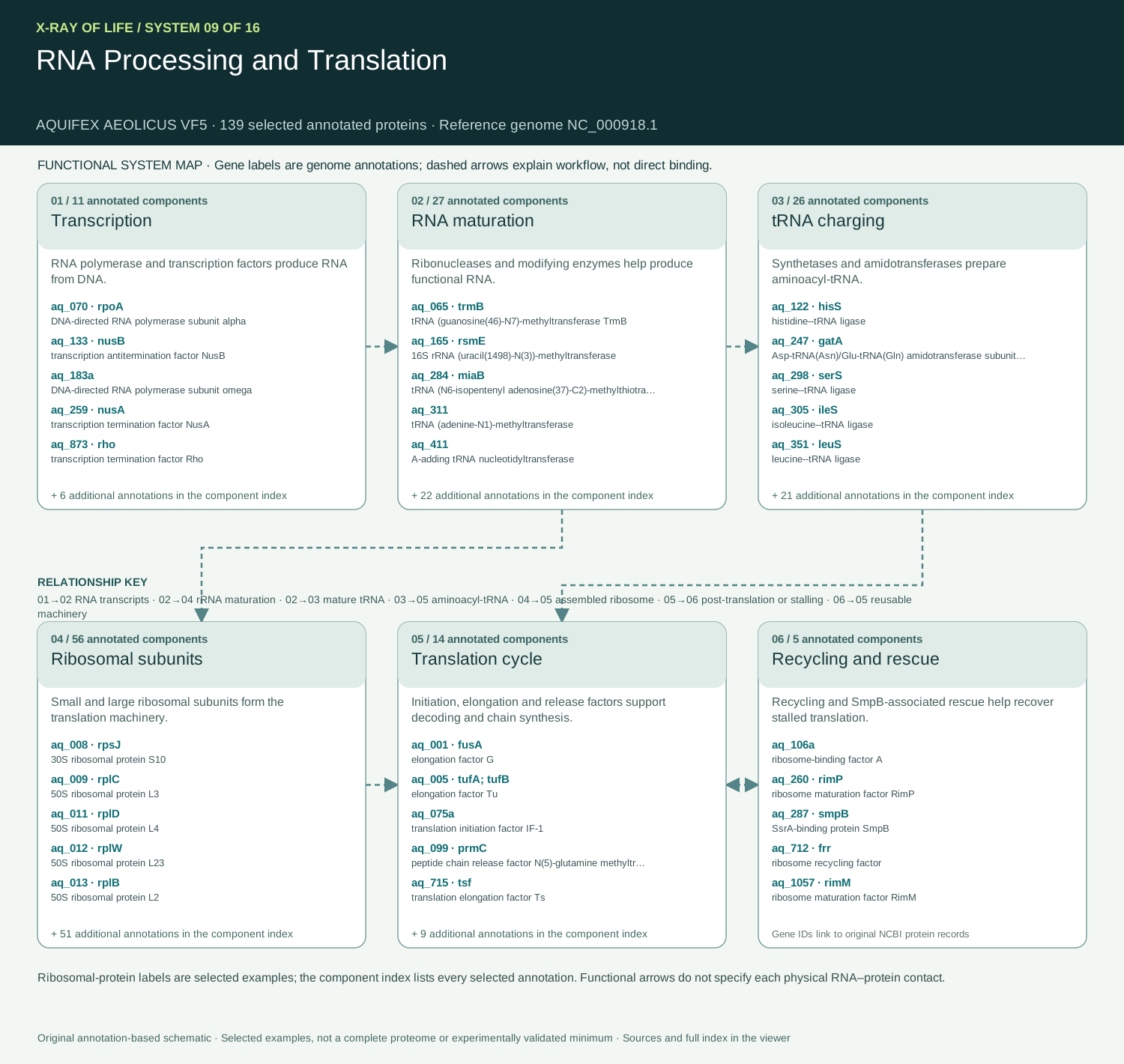 Open the full diagram and component evidence ↗
Transcription, RNA maturation, tRNA charging and ribosome cycling produce proteins. Click to read the full diagram and inspect the annotated protein records.
Original schematic from VF5 RefSeq annotations. Dashed arrows describe functional relationships; they are not measured protein interactions. Sources: Deckert et al. (1998), complete VF5 genome · NCBI reference genome.
Ribosomal-protein labels are selected examples; the component index lists every selected annotation. Functional arrows do not specify each physical RNA–protein contact.
FUNCTION AND MECHANISM
How this system works
FOLLOW THE FLOW
DNA transcription to RNA translation and protein production
DNA → transcription → mRNA → translation → protein chain → folding and assembly
RNA Processing and Translation
Reading genes and making proteins
A gene’s DNA sequence is first copied into RNA. A ribosome then reads a protein-coding RNA message.
A protein-coding gene in DNA
The sequence specifies the message to be transcribed.
Make messenger RNA (mRNA)
RNA polymerase builds an RNA copy of the gene. This is a message the ribosome can read.
Prepare the message and ribosome
Ribosomal RNA and proteins form the ribosome, the protein-building machine.
Supply loaded transfer RNAs
Each loaded tRNA carries an amino acid and helps match it to a three-letter RNA unit called a codon.
Read the message and join amino acids
The ribosome repeatedly selects a matching tRNA and extends the chain until it reaches a stop signal.
Release, fold and assemble the protein
The chain takes on a functional shape and may join other parts. Ribosomes and tRNAs are reused.
Read from top to bottom. Side-by-side panels show branches or supplies that come together; their labels explain the relationship. Detailed mechanisms and sources follow below.
Starting inputs: DNA templates, RNA nucleotides, RNA polymerase, mature ribosomes and tRNAs, amino acids, charging enzymes, energy, and supporting factors.
- Transcribe the DNA template: RNA polymerase initiates at an appropriate promoter, extends a complementary RNA transcript, and terminates transcription. A protein-coding gene supplies an mRNA message.
- Prepare functional RNA and charged tRNAs: RNA maturation and modification produce functional rRNAs and tRNAs. Synthetases and related pathways assign amino acids to tRNAs; these supporting operations can run alongside mRNA production.
- Initiate translation: The ribosome, initiator tRNA, and factors assemble on mRNA and establish the reading frame at a start site.
- Elongate the protein chain: Select a matching charged tRNA, form a peptide bond, and translocate by one codon. Repeat this cycle; bacterial EF-Tu and EF-G participate in GTP-dependent delivery and movement.
- Terminate, recycle, and mature the product: At a stop codon, release factors promote chain release. Recycle ribosomes and tRNAs; folding, processing, targeting, and assembly produce functional machinery. Folding can also begin while translation is ongoing.
Usable outputs: RNA transcripts and protein products, with RNA turnover and translation machinery returning to their cycles.
rRNA and tRNA are transcribed from DNA but are not translated into protein. In bacteria, translation can begin before transcription of that mRNA has finished. The sequence shows information flow, not a requirement for separate compartments or non-overlapping stages.
Evidence for selected mechanisms
Transcription–translation coupling · Time-resolved ribosomal translocation
These papers examine the named mechanisms or networks. The numbered order is an explanatory overview; it is not an experimentally established history of cellular origins.
Transcribing and preparing RNA
RNA polymerase reads a DNA template and joins ribonucleotides into RNA. Bacterial sigma factors help recognize selected promoters, and termination mechanisms end transcription. Ribosomal and transfer RNAs are processed and modified as they mature. RNA turnover recovers material and helps control how long messages remain available.
Assigning an amino acid to a message
A codon is a three-nucleotide segment of messenger RNA. A transfer RNA presents an anticodon that pairs with an appropriate codon and carries an amino acid at its other end. Aminoacyl-tRNA synthetases and, in some organisms, indirect pathways establish the amino-acid assignments. The ribosome checks decoding interactions but does not independently verify every amino acid attached upstream.
The ribosomal working cycle
The bacterial 70S ribosome comprises 30S and 50S subunits made from ribosomal RNAs and proteins. Initiation establishes a reading frame. During elongation, a charged tRNA is selected, the growing peptide is transferred to its amino acid, and the message and tRNAs move forward. EF-Tu and EF-G use GTP-associated reaction cycles to support delivery and translocation. Ribosomal RNA forms the catalytic center responsible for peptide bond formation.
Stopping and reusing the machinery
A stop codon is recognized by a release factor, which promotes release of the completed chain. Ribosome recycling makes subunits available for another round. Rescue pathways handle selected stalled complexes. Protein folding and localization then determine whether a new chain becomes functional machinery.
A closer look at the evidence
Time-resolved cryo-electron microscopy captured bacterial ribosome–EF-G intermediates during GTP-associated translocation, directly examining movement within the translation cycle.1
Follow the consequence
A misplaced reading frame changes how downstream codons are grouped, potentially producing a very different protein or an early stop.
Component families in this system (19)
- RNA recycling
- Early life essential proteins
- Transcription factors
- Regulatory proteins
- RNA Polymerase
- Sigma factors
- Primary sigma factor σ70
- Transcription regulation
- Transcription termination
- Early transcription processing
- Transcription fidelity
- Aminoacyl-tRNA synthetase
- tRNA synthesis and modification
- tRNA modification
- tRNA recycling
- Translation initiation
- Ribosomal proteins - small subunit
- Ribosomal proteins - large subunit
- Translation termination
FUNCTIONALLY INTEGRATED
What it depends on, and why
A functional dependency means that one process supplies material, energy, machinery, or suitable conditions to another. It does not necessarily mean that two proteins physically touch.
| Other system | Relationship | Why the connection matters |
|---|---|---|
| 08 · DNA processing | Receives from this system | Translation produces the proteins that carry out DNA replication, repair, and segregation. |
| 08 · DNA processing | Provides to this system | Maintained DNA provides templates encoding mRNAs, functional RNAs, and the translation machinery. |
| 05 · Nucleotides | Provides to this system | Ribonucleotides supply RNA synthesis; ATP and GTP also serve as substrates in translation-related reactions. |
| 06 · Amino acids | Provides to this system | Amino acids are the building blocks loaded onto tRNAs and joined into proteins. |
| 03 · Energy production | Provides to this system | ATP supports tRNA charging and GTP supports major translation steps; energy supply must replenish these currencies. |
| 12 · Quality control | Provides to this system | RNA maturation, ribosome assembly, folding, and rescue help maintain productive translation. |
| 04 · Mineral ions | Provides to this system | Appropriate ions, especially magnesium, support RNA structure and ribosome activity. |
| 10 · Signaling & regulation | Receives from this system | Regulators, sensors, kinases, and phosphatases are protein products of translation. |
| 11 · Transport | Receives from this system | Translation supplies channels, pumps, and other transport proteins. |
| 12 · Quality control | Receives from this system | Translation produces chaperones, nucleases, assembly factors, and proteases. |
| 13 · Division & structure | Receives from this system | Translation provides structural and division proteins. |
| 14 · Homeostasis | Provides to this system | Compatible pH, ionic strength, and redox conditions support RNA and protein function. |
| 15 · Stress response | Receives from this system | Translation replaces damaged proteins and produces stress-response factors. |
| 16 · Metal clusters | Receives from this system | Translation supplies scaffolds, sulfur-mobilization enzymes, and maturation factors. |
REASON & SCIENCE LIBRARY · ORGANIZING QUESTIONS
Library basis for this article
The library connects transcription, adaptor charging, ribosome construction, translation and error handling. This article follows that chain while separating the mechanisms and the evidence for each. Its detailed ribosome guide is restricted to bacteria. Eukaryotic ribosome biogenesis and Pol II transcription remain comparative background, rather than components assigned to this cell.L
FUNCTIONAL ORGANIZATION · AUTHOR’S FRAMEWORK
Hallmarks of design
RNA and translation illustrates the following organizational features in the supplied papers. These descriptions identify biological functions; interpreting their origin as design is the author’s comparative argument.H1, H2
mRNA sequence becomes amino-acid sequence through adaptors, charging enzymes and ribosomes.
Translation produces components required for further gene expression; closure belongs to the interacting system.
Charging, decoding, maturation and rescue handle errors at different stages.
Origin hurdles and abductive assessment · Assessment method · All 40 hallmarks. Biological evidence: the mechanism, accession records and scientific references on this page.
SOURCE-BASED SYNTHESIS
The origin problem in brief
How could a code, matching adaptors, and the machinery that reads those instructions originate together?
- Connect readable genetic instructions to RNA production and preparation.
- Establish compatible codon assignments, charged adaptors, and peptide-making machinery.
- Maintain accuracy and reproduce machinery whose components depend on that same system.
Source notes and how the count is used
51 / 115 book-listed challenges. Transcription / translation; separate lists.
Numbers reproduce the source’s reported section totals. They are not a new count of unique questions or an independent assessment of which issues remain scientifically unresolved. Overlapping lists are not added together.
Source passages: X-ray of Life, Volume I, Chapters 6–8; RNA problem summary, pp. 279–346; 413–414; X-ray of Life, Volume II, Chapters 10–11; §§14.7–14.8, pp. 493–610; 759–761; X-ray of Life, Volume III, §§13.3–13.5; §§17.3–17.4, pp. 474–476; 635–652; The Cell: An Unsolved Mystery, Chapters 10–11; Chapter 14, pp. 190–221; 263–276.
The overview follows the cell-specific scope of Forty Hallmarks of Design in the Cell: later eukaryotic machinery, specialized immune systems, and model-specific numerical probabilities are not treated as universal first-cell requirements.
ORIGINS
What needs to be explained
An origins explanation must connect available chemistry to a system that can persist, reproduce useful functions, and pass them to descendants. Explaining how a modern system works and explaining how its predecessors arose are different tasks. Simpler catalysts, environmental assistance, and alternative chemistries must be evaluated rather than assuming that the complete modern machinery appeared at once.
Scope of the question
The ribosome animation illustrates selected bacterial translation steps. It is not a reconstruction of the first translation apparatus or a complete account of all RNA processing.
Major hurdles to investigate
These are requirements to test in proposed scenarios. Their importance depends on the environment and on which intermediate system is proposed.
Functional RNAs
Produce and retain RNAs that fold and catalyze reactions in compatible conditions.
Code assignments
Establish reproducible relationships between nucleotide patterns and amino acids.
Adapters and charging
Link amino acids to suitable adapters with enough accuracy to support useful peptides.
Coupled improvement
Explain viable intermediate systems as RNA catalysts and peptide functions become mutually supportive.
Supply and heredity
Connect translation to monomer production, energy supply, and reliable reproduction of its own components.
EXPERIMENTAL PROGRESS
What has been demonstrated, and what it leaves open
RNA polymerase ribozymes have copied and amplified selected RNA templates in laboratory systems. Catalytic RNA supports the chemical plausibility of RNA-centered models, but these experiments do not reproduce the origin of tRNA assignments, a complete ribosome, or an autonomous translation system.2
Condensed origin challenges
- Connect readable genetic instructions to RNA production and preparation.
- Establish compatible codon assignments, charged adaptors, and peptide-making machinery.
- Maintain accuracy and reproduce machinery whose components depend on that same system.
Three condensed themes from the source passages above; they are not the complete numbered catalogue.
The integration test
Experiments that connect precursor chemistry across molecular classes help test compatibility.3 A strong next test for this system would combine its relevant chemical steps with continued material supply, energy use, retention, and reproduction under an explicitly specified environmental sequence. The open questions above are research questions, not claims that every intermediate is impossible.
Engineered minimal cells help reveal present cellular dependencies, but their construction starts from existing biological machinery and growth conditions. They therefore answer a different question from a prebiotic synthesis experiment.4
Explore prebiotic synthesis challengesTERMS IN PLAIN LANGUAGE
Glossary
- transcription
- Copying one gene from DNA into RNA by RNA polymerase.
- RNA polymerase
- The enzyme that builds an RNA chain matching a DNA template.
- sigma factor
- A protein that helps bacterial RNA polymerase find the start (promoter) of a gene.
- promoter
- The DNA sequence in front of a gene where transcription starts.
- rRNA (ribosomal RNA)
- The RNA that forms the core of the ribosome and catalyzes peptide bonds; it is not translated.
- start / stop codon
- The codons where translation begins and ends.
- peptide bond
- The chemical link between two neighboring amino acids in a protein chain.
- release factor
- A protein that recognizes a stop codon and frees the finished chain.
- protein
- A chain of amino acids whose shape and chemical properties let it perform a cellular task.
- amino acid
- One of the small molecules joined together to form a protein.
- GTP
- Guanosine triphosphate: an energy-coupling molecule used by several translation factors. It is chemically distinct from ATP.
- tRNA
- Transfer RNA: an adapter that pairs with an mRNA codon and carries its corresponding amino acid when charged.
- charged tRNA
- A tRNA with an amino acid attached. A synthetase enzyme performs this loading step, using ATP.
- codon
- A group of three RNA letters. In translation it specifies an amino acid or a stop signal.
- anticodon
- The three-letter region of a tRNA that pairs with a codon in the mRNA.
- ribosome
- The RNA-and-protein complex that reads mRNA and joins amino acids into a protein chain.
- peptide
- A chain of amino acids. A polypeptide is a longer chain that may become part or all of a protein.
- EF-Tu
- A bacterial elongation factor that delivers most aminoacyl-tRNAs to the ribosome while bound to GTP.
- EF-G
- A bacterial elongation factor that promotes movement of tRNAs and mRNA through the ribosome.
- 30S and 50S
- The small and large subunits of a bacterial 70S ribosome. S is a sedimentation measure; these numbers do not add arithmetically.
- translocation
- Movement of the tRNAs and their paired mRNA codons through the ribosome by one codon.
Related library threads
Ensuring Precision in Ribosome and Protein Synthesis: Mechanisms of Quality Control, Error Identification, Rectification, Degradation, and Recycling · Error check and repair during messenger RNA translation in the ribosome: by chance, or design ? · Translation through ribosomes, amazing nano machines · Error detection and repair during the biogenesis & maturation of the ribosome, tRNA's, Aminoacyl-tRNA synthetases, and translation: by chance, or design? · Aminoacyl-tRNA synthetases point to design · The RNA polymerase enzyme and its function, evidence of design
The author’s library essays and research compilations provide context and arguments. Biological mechanisms should be assessed through the scientific references; the design inference is a separate, revisable assessment.
SCIENTIFIC LITERATURE
Scientific papers
Linked superscript numbers in the text lead to the papers below, numbered in order of first citation on this page. Each entry links to the publisher and bibliographic record; open full text is included where available. These studies support the specified mechanisms or experiments, not every possible origin scenario.
Carbone CE, Loveland AB, Gamper HB, Hou YM, Demo G, Korostelev AA. (2021). Time-resolved cryo-EM visualizes ribosomal translocation with EF-G and GTP. Nat Commun, 12, 7236.
Horning DP, Joyce GF. (2016). Amplification of RNA by an RNA polymerase ribozyme. Proc Natl Acad Sci U S A, 113, 9786-9791.
Patel BH, Percivalle C, Ritson DJ, Duffy CD, Sutherland JD. (2015). Common origins of RNA, protein and lipid precursors in a cyanosulfidic protometabolism. Nat Chem, 7, 301-307.
Hutchison CA, Chuang RY, Noskov VN, Assad-Garcia N, Deerinck TJ, Ellisman MH, Gill J, Kannan K, Karas BJ, Ma L, Pelletier JF, Qi ZQ, Richter RA, Strychalski EA, Sun L, Suzuki Y, Tsvetanova B, Wise KS, Smith HO, Glass JI, Merryman C, Gibson DG, Venter JC. (2016). Design and synthesis of a minimal bacterial genome. Science, 351, aad6253.
Further scientific reading
11 additional papers. Each title links to its article or bibliographic record.
Search and filter this system’s reference list →