AQUIFEX AEOLICUS VF5 · ORGANISM-SPECIFIC DESCRIPTION
How this system works in Aquifex
VF5 annotations identify ABC-transporter binding, permease and ATPase components, ion-coupled carriers, channels and dedicated ion-uptake proteins. These are parallel transport mechanisms, with different sources of driving force. Protein targeting and Sec/Tat export form a separate branch from small-solute uptake. The diagram does not infer a unique binding-protein/permease pairing from a family label, or assume one dedicated transporter per chemical element. Nutrient availability outside the cell and an effective uptake route are separate requirements in the reconstruction scenario.
62 proteins are assigned to this function in the 912-protein working reconstruction (Essential ion and nutrient transport).
The working reconstruction retains 912 proteins; 338 additional proteins remain undetermined. These are model selections, not a demonstrated viable minimum or individual VF5 knockout results. The 16 atlas hotspots and the reconstruction categories use different partitions.
Inspect the 912-protein inventory and model evidence →REFERENCE ORGANISM · AQUIFEX AEOLICUS VF5
Aquifex system diagram
58 selected annotated proteins · 6 functional modules
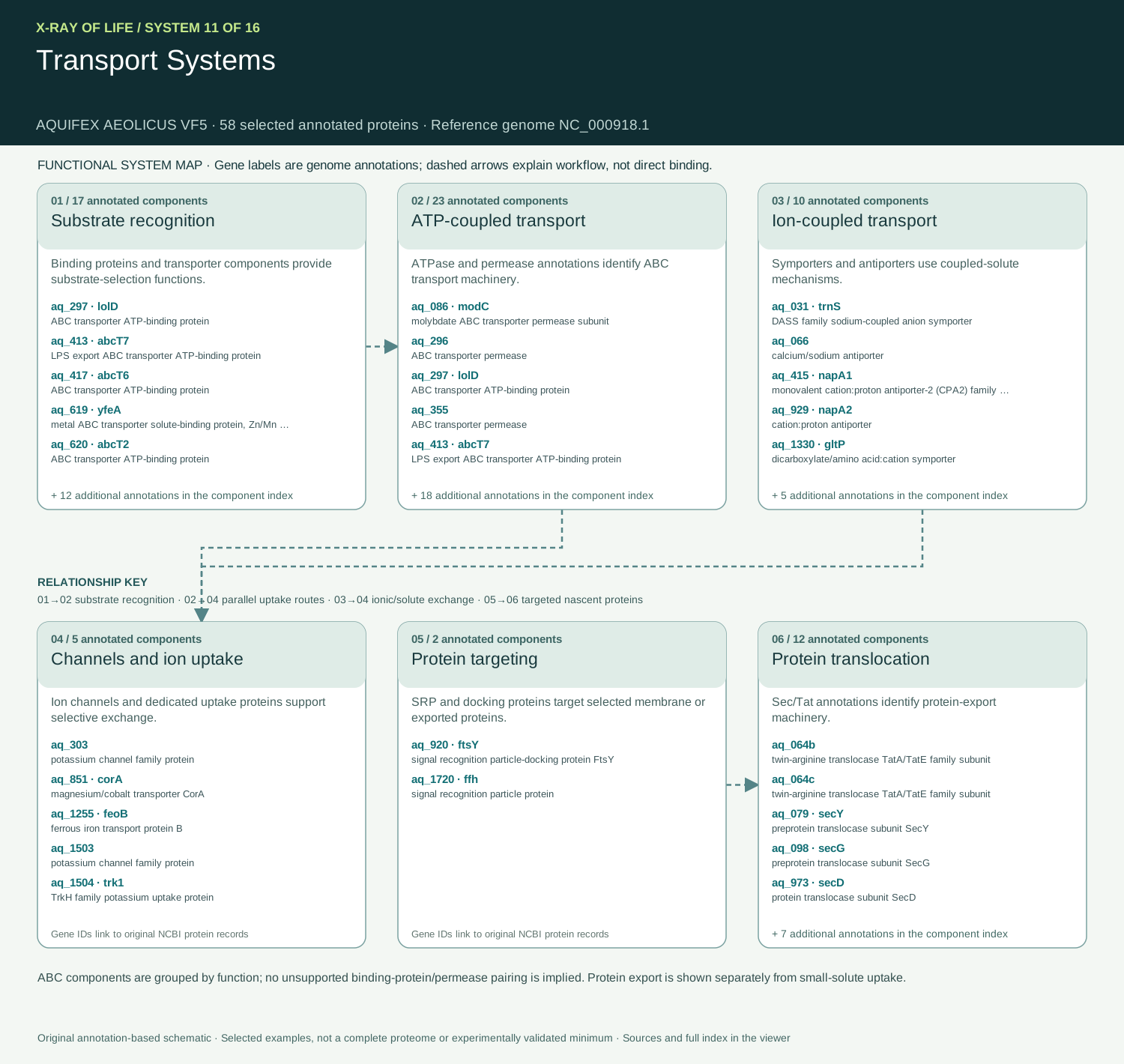 Open the full diagram and component evidence ↗
Parallel membrane routes couple substrate exchange to ATP or ion gradients. Click to read the full diagram and inspect the annotated protein records.
Original schematic from VF5 RefSeq annotations. Dashed arrows describe functional relationships; they are not measured protein interactions. Sources: Deckert et al. (1998), complete VF5 genome · NCBI reference genome.
ABC components are grouped by function; no unsupported binding-protein/permease pairing is implied. Protein export is shown separately from small-solute uptake.
FUNCTION AND MECHANISM
How this system works
FOLLOW THE FLOW
Selective movement across the cell boundary
Substrate availability + driving force → selective transport mechanism → membrane crossing → release and transporter reuse
Transport Systems
Moving substances through the membrane
Transport proteins control how nutrients, ions and selected wastes cross the cell boundary.
A substance is available
The concentration and electrical differences between the two sides help determine its movement.
Channels: selective passages
Let suitable ions or molecules move down their electrochemical gradient.
Carriers and active transporters
Carriers bind substances and change shape. Active transport couples movement to ATP use or another ion’s downhill movement.
Deliver the substance to the other side
The direction depends on the substance, conditions and transporter. Transport may bring material in or move it out.
Use the import or remove the export
Imported nutrients feed metabolism; export can remove waste or excess ions. Carriers and pumps repeat their cycles.
Read from top to bottom. Side-by-side panels show branches or supplies that come together; their labels explain the relationship. Detailed mechanisms and sources follow below.
Starting inputs: A suitable substrate, a membrane route selective for it, and the gradient or energy source required by that route.
- Present the substrate and driving conditions: A molecule or ion is available on one side of the membrane. Its electrochemical gradient and the transporter determine the possible direction of movement.
- Use the appropriate transport branch: Channels provide selective passages; carriers alternate access between sides; ATP-powered pumps and secondary transporters use distinct energy-coupling mechanisms.
- Cross the membrane: A channel permits downhill movement. A carrier binds and changes accessibility; active transport couples movement to ATP use or another substance's downhill movement.
- Release and reuse the route: A carrier or pump releases substrate on the destination side and returns to another transport cycle. Channels gate independently rather than using the carrier cycle.
- Integrate uptake or efflux with metabolism: Use imported material, export selected waste or harmful compounds, and regulate further transport as internal conditions change.
Usable outputs: Controlled nutrient uptake, ion movement, water exchange, and efflux according to the selected mechanism.
Channels, primary pumps, and secondary carriers are alternatives, not three steps through which every substrate passes. Energy metabolism must replenish gradients consumed by coupled transport.
Evidence for selected mechanisms
Structure of the BtuCD–F ABC transporter
These papers examine the named mechanisms or networks. The numbered order is an explanatory overview; it is not an experimentally established history of cellular origins.
Channels, carriers, and pumps
A channel forms a selective route through which suitable molecules or ions can move down an electrochemical gradient. A carrier binds a substrate and changes shape to expose it to the other side. Pumps couple transport to an energy source, enabling movement that would not occur favorably on its own.
Three ways to couple movement
ATP-powered transporters use ATP-associated conformational cycles. Secondary transporters couple one substance’s downhill movement to another’s uphill movement. Symport moves coupled substances in the same direction; antiport exchanges them in opposite directions. P-type ATPases and ABC transporters use distinct molecular mechanisms despite both involving ATP.
Nutrients and ions need different solutions
A cell may require uptake systems for phosphate, sugars, amino acids, vitamin precursors, and particular metals. Aquaporins facilitate water movement in organisms that possess them. Transporter selection depends on what the environment provides and what the cell can synthesize. No single transporter moves all useful molecules.
Exchange changes the whole cell
Transport affects acidity, osmotic balance, electrical potential, and nutrient availability. An influx that benefits one pathway can disturb another if it brings excess ions or drains the driving gradient. Efflux can reduce exposure to harmful compounds, but excessive export wastes useful material and energy.
A closer look at the evidence
A structure of the BtuCD–F vitamin B12 transporter bound to an ATP analogue reveals a nucleotide-associated state of an ABC uptake system.1
Follow the consequence
A proton-coupled nutrient transporter uses part of an existing proton gradient. Energy metabolism must replenish that gradient if uptake is to continue.
Component families in this system (26)
- Ion Channels and Transporters
- P-Type ATPase
- Metal ion transporters
- Aquaporins
- Symporter and antiporter
- ABC transporters
- Nutrient uptake
- Sugar transporters
- Carbon source transporters
- Amino acid transporters
- Co-factor transporters
- Folate transporters
- Phosphate transport
- Magnesium transport
- Additional amino acid transport
- SAM transporters
- Third amino acid transport
- Fatty Acid transport
- Additional phosphate transport
- Nucleotide/serine/ethanolamine
- Additional ABC transport
- TrkA family potassium uptake
- P4-ATPase family
- Drug efflux pumps
- Sodium/proton pumps
- Specialized transporters
FUNCTIONALLY INTEGRATED
What it depends on, and why
A functional dependency means that one process supplies material, energy, machinery, or suitable conditions to another. It does not necessarily mean that two proteins physically touch.
| Other system | Relationship | Why the connection matters |
|---|---|---|
| 04 · Mineral ions | Receives from this system | Transporters bring required ions into the cell and export excess ions. |
| 06 · Amino acids | Receives from this system | Uptake supplies nitrogen, sulfur, or other environmental substrates needed by the selected biosynthetic routes. |
| 10 · Signaling & regulation | Receives from this system | Uptake and transport determine intracellular nutrient and ion availability, providing inputs to selected regulatory responses. |
| 07 · Lipids & membrane | Provides to this system | A membrane provides the physical environment in which transport channels and carriers operate. |
| 03 · Energy production | Provides to this system | ATP or ion gradients drive active transport, depending on transporter type. |
| 09 · RNA & translation | Provides to this system | Translation supplies channels, pumps, and other transport proteins. |
| 14 · Homeostasis | Receives from this system | Ion transport and solute exchange maintain intracellular pH, osmolarity, and nutrient balance. |
REASON & SCIENCE LIBRARY · ORGANIZING QUESTIONS
Library basis for this article
The library distinguishes substrate transport from protein targeting and secretion. That distinction guides this article: a nutrient importer, a signal-recognition system and a protein-translocation channel solve different problems. Energy coupling and selectivity must be described for the relevant route, and the presence of an ATP-binding protein alone does not establish a complete transporter.L
FUNCTIONAL ORGANIZATION · AUTHOR’S FRAMEWORK
Hallmarks of design
Transport illustrates the following organizational features in the supplied papers. These descriptions identify biological functions; interpreting their origin as design is the author’s comparative argument.H1, H2
Binding sites and channels select transported molecules or ions.
ATP or an ion gradient can power transport, depending on the transporter.
Membrane exchange connects nutrient supply to internal balance.
Origin hurdles and abductive assessment · Assessment method · All 40 hallmarks. Biological evidence: the mechanism, accession records and scientific references on this page.
SOURCE-BASED SYNTHESIS
The origin problem in brief
How could selective transport and its energy supply operate within a growing, stable membrane?
- Exchange useful substances without losing the compartment’s essential contents.
- Couple selective carriers and channels to usable energy or gradients.
- Integrate membrane insertion, targeting, and transport regulation with metabolism.
Source notes and how the count is used
142 book-listed challenges. Transport category; secretion list not added.
Numbers reproduce the source’s reported section totals. They are not a new count of unique questions or an independent assessment of which issues remain scientifically unresolved. Overlapping lists are not added together.
Source passages: X-ray of Life, Volume II, Chapter 13; §14.9, pp. 646–751; 761–762; X-ray of Life, Volume III, Chapter 6; §13.10; Chapter 20, pp. 314–321; 480; 696–703.
The overview follows the cell-specific scope of Forty Hallmarks of Design in the Cell: later eukaryotic machinery, specialized immune systems, and model-specific numerical probabilities are not treated as universal first-cell requirements.
ORIGINS
What needs to be explained
An origins explanation must connect available chemistry to a system that can persist, reproduce useful functions, and pass them to descendants. Explaining how a modern system works and explaining how its predecessors arose are different tasks. Simpler catalysts, environmental assistance, and alternative chemistries must be evaluated rather than assuming that the complete modern machinery appeared at once.
Scope of the question
A transporter demonstrated in one organism is an example of a mechanism. Its inclusion in this catalogue does not make that exact protein universal or indispensable in every environment.
Major hurdles to investigate
These are requirements to test in proposed scenarios. Their importance depends on the environment and on which intermediate system is proposed.
Early permeability
Allow substrates to enter without losing catalysts or useful products.
Selectivity
Discriminate among chemically similar molecules or competing ions.
Powered uptake
Connect energy-releasing movement or reactions to uphill transport.
Insertion and orientation
Place emerging transport molecules in a boundary with a productive orientation and stable structure.
System balance
Coordinate influx, efflux, gradients, and internal consumption.
EXPERIMENTAL PROGRESS
What has been demonstrated, and what it leaves open
Simple vesicles can take up selected small molecules without modern transport proteins, depending on membrane composition and conditions. This offers possible starting points, while the transition toward selective, powered, inherited transport remains a distinct explanatory task.2
Condensed origin challenges
- Exchange useful substances without losing the compartment’s essential contents.
- Couple selective carriers and channels to usable energy or gradients.
- Integrate membrane insertion, targeting, and transport regulation with metabolism.
Three condensed themes from the source passages above; they are not the complete numbered catalogue.
The integration test
Experiments that connect precursor chemistry across molecular classes help test compatibility.3 A strong next test for this system would combine its relevant chemical steps with continued material supply, energy use, retention, and reproduction under an explicitly specified environmental sequence. The open questions above are research questions, not claims that every intermediate is impossible.
Engineered minimal cells help reveal present cellular dependencies, but their construction starts from existing biological machinery and growth conditions. They therefore answer a different question from a prebiotic synthesis experiment.4
Explore prebiotic synthesis challengesTERMS IN PLAIN LANGUAGE
Glossary
- membrane transport
- Moving a substance across the cell membrane, which most molecules cannot cross unaided.
- channel
- A protein pore that lets a specific ion or water flow downhill, from high to low concentration.
- carrier
- A protein that binds a substance, changes shape and releases it on the other side.
- pump
- A transporter that uses energy, usually ATP, to move a substance uphill against its gradient.
- symport / antiport
- Carriers that move two substances together in the same direction (symport) or in opposite directions (antiport).
- primary / secondary active transport
- Primary transport uses ATP directly; secondary transport uses the downhill flow of another ion.
- ABC transporter
- A large family of ATP-powered pumps that import nutrients or export unwanted molecules.
- P-type ATPase
- A pump that briefly attaches phosphate from ATP to itself while moving ions such as Mg²⁺ or metals.
- aquaporin
- A channel that lets water molecules pass quickly through the membrane.
- efflux pump
- A transporter that pushes waste or toxic compounds, including some drugs, out of the cell.
- protein
- A chain of amino acids whose shape and chemical properties let it perform a cellular task.
- ATP
- Adenosine triphosphate: a molecule whose chemical reactions can be coupled to many energy-requiring cellular processes. It is continually used and regenerated.
- gradient
- A difference across space, such as a difference in ion concentration or electrical potential across a membrane.
- peptide
- A chain of amino acids. A polypeptide is a longer chain that may become part or all of a protein.
Related library threads
ABC transporters · Bacterial Secretion Systems · Signal Recognition Particle: An essential protein targeting machine
The author’s library essays and research compilations provide context and arguments. Biological mechanisms should be assessed through the scientific references; the design inference is a separate, revisable assessment.
SCIENTIFIC LITERATURE
Scientific papers
Linked superscript numbers in the text lead to the papers below, numbered in order of first citation on this page. Each entry links to the publisher and bibliographic record; open full text is included where available. These studies support the specified mechanisms or experiments, not every possible origin scenario.
Korkhov VM, Mireku SA, Locher KP. (2012). Structure of AMP-PNP-bound vitamin B12 transporter BtuCD-F. Nature, 490, 367-372.
Hanczyc MM, Fujikawa SM, Szostak JW. (2003). Experimental models of primitive cellular compartments: encapsulation, growth, and division. Science, 302, 618-622.
Patel BH, Percivalle C, Ritson DJ, Duffy CD, Sutherland JD. (2015). Common origins of RNA, protein and lipid precursors in a cyanosulfidic protometabolism. Nat Chem, 7, 301-307.
Hutchison CA, Chuang RY, Noskov VN, Assad-Garcia N, Deerinck TJ, Ellisman MH, Gill J, Kannan K, Karas BJ, Ma L, Pelletier JF, Qi ZQ, Richter RA, Strychalski EA, Sun L, Suzuki Y, Tsvetanova B, Wise KS, Smith HO, Glass JI, Merryman C, Gibson DG, Venter JC. (2016). Design and synthesis of a minimal bacterial genome. Science, 351, aad6253.
Further scientific reading
2 additional papers. Each title links to its article or bibliographic record.
Search and filter this system’s reference list →