AQUIFEX AEOLICUS VF5 · ORGANISM-SPECIFIC DESCRIPTION
How this system works in Aquifex
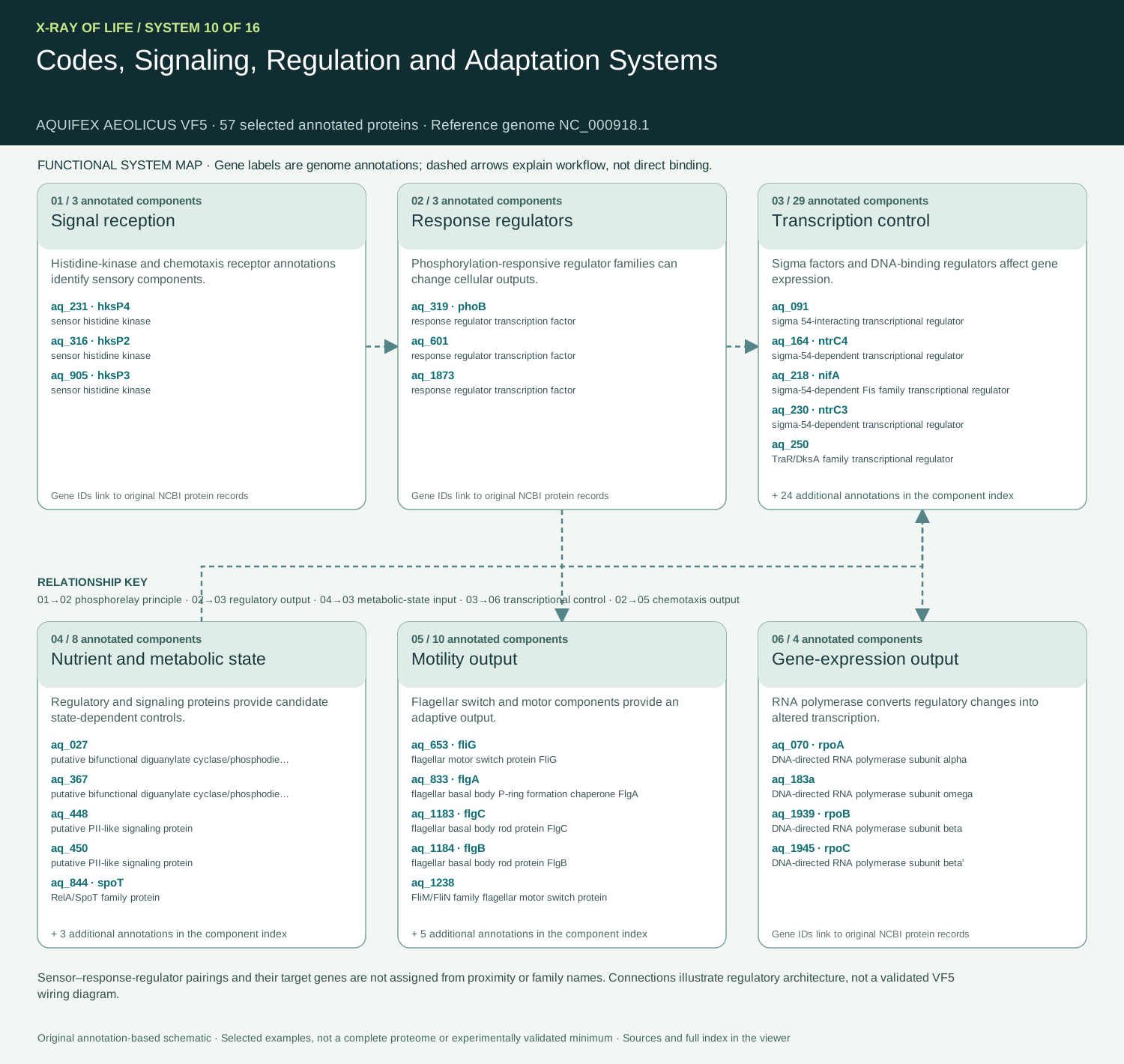
VF5 annotations include sensor histidine kinases, response-regulator transcription factors, sigma factors, DNA-binding regulators and nucleotide-signaling candidates. Regulatory output can alter gene expression or another cellular activity. The diagram groups these by function without pairing each sensor with a particular response regulator or assigning untested target genes. The full reference genome contains more regulatory candidates than the small subset retained under the minimal-reconstruction scenario; reference-genome presence and retention in the 912 set answer different questions.
4 proteins are assigned to this function in the 912-protein working reconstruction (Necessary gene regulation).
The working reconstruction retains 912 proteins; 338 additional proteins remain undetermined. These are model selections, not a demonstrated viable minimum or individual VF5 knockout results. The 16 atlas hotspots and the reconstruction categories use different partitions.
Inspect the 912-protein inventory and model evidence →REFERENCE ORGANISM · AQUIFEX AEOLICUS VF5
Aquifex system diagram
57 selected annotated proteins · 6 functional modules
 Open the full diagram and component evidence ↗
Sensors, regulators and transcriptional machinery connect signals to responses. Click to read the full diagram and inspect the annotated protein records.
Original schematic from VF5 RefSeq annotations. Dashed arrows describe functional relationships; they are not measured protein interactions. Sources: Deckert et al. (1998), complete VF5 genome · NCBI reference genome.
Sensor–response-regulator pairings and their target genes are not assigned from proximity or family names. Connections illustrate regulatory architecture, not a validated VF5 wiring diagram.
FUNCTION AND MECHANISM
How this system works
FOLLOW THE FLOW
A sensed change to a regulated response
Signal → sensor/regulator → altered activity or gene expression → cellular response → feedback
Codes, Signaling, Regulation and Adaptation Systems
Detecting change and adjusting activity
Molecular sensors connect changes in conditions to a useful cellular response.
A nutrient, salt level or other signal
The change can occur outside the cell or within it.
A sensor or regulator changes state
Binding or chemical modification passes information to the response machinery. Different circuits use different mechanisms.
Adjust existing machinery
Change how active an enzyme, channel or transporter is. This can happen quickly.
Change which proteins are made
Regulators alter the reading of selected genes; RNA and protein production then change the available machinery.
The response changes the conditions
The sensor encounters the new conditions and the circuit adjusts or resets.
Read from top to bottom. Side-by-side panels show branches or supplies that come together; their labels explain the relationship. Detailed mechanisms and sources follow below.
Starting inputs: A chemical or physical signal, an appropriate sensing mechanism, regulators, and energy where the mechanism requires it.
- Detect the relevant condition: A nutrient, metabolite, ion level, redox state, or other input changes a sensor or regulator through binding or another interaction.
- Transmit or integrate the signal: In a two-component example, a histidine kinase transfers phosphate to a response regulator. Other circuits use different mechanisms.
- Choose an output branch: Alter the activity of existing enzymes or transporters directly, or change transcription of selected genes.
- Execute the response: For a gene-expression response, DNA → RNA → protein production changes the available machinery. Direct activity changes can act before new proteins accumulate.
- Feed the changed condition back: The response changes the sensed variable, signal pool, or regulator state. Feedback, dephosphorylation, or signal turnover can reset or sustain the response.
Usable outputs: Adjusted enzyme activity, transport, resource allocation, or protein production.
Regulation is a feedback network. Quorum sensing and particular two-component pathways are examples from selected organisms, not compulsory consecutive stages in every cell.
Evidence for selected mechanisms
Experimental analysis of phosphate signaling in Escherichia coli
These papers examine the named mechanisms or networks. The numbered order is an explanatory overview; it is not an experimentally established history of cellular origins.
From chemical change to cellular response
A signal can be an external nutrient, an internal metabolite, an energy-related nucleotide ratio, or a change in redox state. Binding or chemical modification changes the activity of a sensor or regulator. The response depends on molecular interactions rather than conscious interpretation.
Phosphorylation and two-component systems
Adding a phosphate group can change a protein’s activity or interactions; removing it can reverse a signal. In a bacterial two-component system, a sensor histidine kinase and a response regulator pass a phosphate-associated signal. PhoR–PhoB regulates phosphate responses in selected bacteria, with uptake proteins and cellular phosphate status contributing to signaling. It is an example of a circuit, not a universal circuit required in every minimal cell.
Controlling production and activity
Transcription regulators affect which genes are expressed. Other mechanisms change the activity of enzymes already present, allowing responses without making a complete new protein set. Feedback can reduce further production when a product accumulates. Regulatory metabolites connect carbon, nitrogen, nucleotide, and energy availability.
Cell-to-cell signals and adaptation
Quorum-sensing circuits respond to signals influenced by population density and environmental transport. Particular Lux pathways belong to particular lineages. A minimal free-living cell needs regulation appropriate to its niche, but it need not contain all known population-signaling systems. Regulation can be distributed across many interacting molecules rather than concentrated in one master controller.
A closer look at the evidence
Genetic and structural analyses connect phosphate transport-associated proteins with PhoR–PhoB signaling in Escherichia coli. This investigates a particular regulatory mechanism, rather than every bacterial phosphate response.1
Follow the consequence
During phosphate shortage, a suitable regulatory circuit can increase phosphate-acquisition capacity while adjusting resource-consuming activities.
Component families in this system (13)
- Protein phosphorylation code
- Protein dephosphorylation code
- Post-translational modification code
- PhoR-PhoB signaling system
- Quorum sensing system
- LuxPQ-LuxU-LuxO system
- Signaling metabolites
- ATP/ADP Energy Balance Code
- Redox Code pathway
- Energy sensing and adaptation
- Nutrient sensing and adaptation
- Gene regulators
- Calcium gradient sensing
FUNCTIONALLY INTEGRATED
What it depends on, and why
A functional dependency means that one process supplies material, energy, machinery, or suitable conditions to another. It does not necessarily mean that two proteins physically touch.
| Other system | Relationship | Why the connection matters |
|---|---|---|
| 09 · RNA & translation | Provides to this system | Regulators, sensors, kinases, and phosphatases are protein products of translation. |
| 03 · Energy production | Provides to this system | ATP supports phosphorylation and other energy-dependent regulatory processes. |
| 11 · Transport | Provides to this system | Uptake and transport determine intracellular nutrient and ion availability, providing inputs to selected regulatory responses. |
REASON & SCIENCE LIBRARY · ORGANIZING QUESTIONS
Library basis for this article
The library’s organizing question is how sensors, regulatory sequences and effectors acquire useful connections. This article examines control through identifiable bacterial mechanisms. Terms such as code, program and feedback must name a concrete relationship; they do not establish that every signal is a symbolic code or that every modern regulatory circuit was required in the first cells.L
FUNCTIONAL ORGANIZATION · AUTHOR’S FRAMEWORK
Hallmarks of design
Signaling and regulation illustrates the following organizational features in the supplied papers. These descriptions identify biological functions; interpreting their origin as design is the author’s comparative argument.H1, H2
Production can change with physiological demand.
Regulatory feedback links activity to later activity through identifiable signals.
Sensors and effectors connect selected conditions to responses; circuits require organism-specific evidence.
Origin hurdles and abductive assessment · Assessment method · All 40 hallmarks. Biological evidence: the mechanism, accession records and scientific references on this page.
SOURCE-BASED SYNTHESIS
The origin problem in brief
How could sensing, signal interpretation, and controlled responses become a coordinated regulatory system?
- Establish molecular recognition that connects a signal to a suitable response.
- Coordinate regulatory components and their targets with inherited information.
- Integrate feedback, energy use, and resource allocation across changing conditions.
Source notes and how the count is used
49 / 44 book-listed challenges. Molecular codes / signaling; separate lists.
Numbers reproduce the source’s reported section totals. They are not a new count of unique questions or an independent assessment of which issues remain scientifically unresolved. Overlapping lists are not added together.
Source passages: X-ray of Life, Volume III, Chapters 1–2; §§13.3–13.4, pp. 24–182; 474–475; The Cell: An Unsolved Mystery, Chapter 15, pp. 277–290.
The overview follows the cell-specific scope of Forty Hallmarks of Design in the Cell: later eukaryotic machinery, specialized immune systems, and model-specific numerical probabilities are not treated as universal first-cell requirements.
ORIGINS
What needs to be explained
An origins explanation must connect available chemistry to a system that can persist, reproduce useful functions, and pass them to descendants. Explaining how a modern system works and explaining how its predecessors arose are different tasks. Simpler catalysts, environmental assistance, and alternative chemistries must be evaluated rather than assuming that the complete modern machinery appeared at once.
Scope of the question
Present regulatory interdependence does not establish that every named modern signaling pathway existed in the first cells. Each proposed precursor network needs its own mechanism and evidence.
Major hurdles to investigate
These are requirements to test in proposed scenarios. Their importance depends on the environment and on which intermediate system is proposed.
Signal–response coupling
Connect a measurable environmental or internal change to a useful chemical effect.
Specificity
Limit harmful cross-reactions among sensing and response molecules.
Timing
Make responses fast enough for the environmental change but stable enough to avoid uncontrolled switching.
Benefit and cost
Ensure regulation improves reproduction or persistence enough to justify its material and energy costs.
Inheritance
Make useful response patterns reproducible across compartment generations.
EXPERIMENTAL PROGRESS
What has been demonstrated, and what it leaves open
Bacterial experiments show a nucleotide messenger directly controlling a purine-synthesis regulator. Such findings explain modern chemical feedback and motivate tests of simpler precursor circuits, but they do not show how the first regulatory networks originated.2
Condensed origin challenges
- Establish molecular recognition that connects a signal to a suitable response.
- Coordinate regulatory components and their targets with inherited information.
- Integrate feedback, energy use, and resource allocation across changing conditions.
Three condensed themes from the source passages above; they are not the complete numbered catalogue.
The integration test
Experiments that connect precursor chemistry across molecular classes help test compatibility.3 A strong next test for this system would combine its relevant chemical steps with continued material supply, energy use, retention, and reproduction under an explicitly specified environmental sequence. The open questions above are research questions, not claims that every intermediate is impossible.
Engineered minimal cells help reveal present cellular dependencies, but their construction starts from existing biological machinery and growth conditions. They therefore answer a different question from a prebiotic synthesis experiment.4
Explore prebiotic synthesis challengesTERMS IN PLAIN LANGUAGE
Glossary
- signal
- Any change the cell can detect, such as a nutrient level, ion level, redox state or the density of neighbors.
- sensor
- A protein (or RNA) that changes shape or activity when it detects a signal.
- regulator
- A protein that changes what the cell does in response, for example by switching genes on or off.
- two-component system
- A common bacterial circuit: a sensor kinase detects a signal and passes a phosphate to a response regulator.
- histidine kinase
- The sensor half of a two-component system; it phosphorylates itself on a histidine and passes the phosphate on.
- response regulator
- The output half of a two-component system; once phosphorylated it usually changes gene expression.
- phosphorylation
- Adding a phosphate group to a protein, which can switch its activity on or off.
- PhoR–PhoB
- A two-component system that switches on phosphate-scavenging genes when phosphate is scarce.
- quorum sensing
- Cells release and detect signal molecules so that they can respond to how many neighbors are nearby.
- gene expression
- Making RNA and protein from a gene; it can be switched up or down.
- feedback
- When the result of a response changes the original signal, so the response can stop, continue or adjust.
- enzyme
- A molecule, usually a protein, that speeds up a chemical reaction without being consumed by it.
- protein
- A chain of amino acids whose shape and chemical properties let it perform a cellular task.
Related library threads
Adaptation of cells to new environments · Control of Gene Expression, and gene regulatory networks point to intelligent design · Evolution, adaptaion, homeostasis, and the preprogrammed processes essential for life to survive in a changing environment
The author’s library essays and research compilations provide context and arguments. Biological mechanisms should be assessed through the scientific references; the design inference is a separate, revisable assessment.
SCIENTIFIC LITERATURE
Scientific papers
Linked superscript numbers in the text lead to the papers below, numbered in order of first citation on this page. Each entry links to the publisher and bibliographic record; open full text is included where available. These studies support the specified mechanisms or experiments, not every possible origin scenario.
Gardner SG, Miller JB, Dean T, Robinson T, Erickson M, Ridge PG, McCleary WR. (2015). Genetic analysis, structural modeling, and direct coupling analysis suggest a mechanism for phosphate signaling in Escherichia coli. BMC Genet, 16 Suppl 2, S2.
Anderson BW, Schumacher MA, Yang J, Turdiev A, Turdiev H, Schroeder JW, He Q, Lee VT, Brennan RG, Wang JD. (2022). The nucleotide messenger (p)ppGpp is an anti-inducer of the purine synthesis transcription regulator PurR in Bacillus. Nucleic Acids Res, 50, 847-866.
Patel BH, Percivalle C, Ritson DJ, Duffy CD, Sutherland JD. (2015). Common origins of RNA, protein and lipid precursors in a cyanosulfidic protometabolism. Nat Chem, 7, 301-307.
Hutchison CA, Chuang RY, Noskov VN, Assad-Garcia N, Deerinck TJ, Ellisman MH, Gill J, Kannan K, Karas BJ, Ma L, Pelletier JF, Qi ZQ, Richter RA, Strychalski EA, Sun L, Suzuki Y, Tsvetanova B, Wise KS, Smith HO, Glass JI, Merryman C, Gibson DG, Venter JC. (2016). Design and synthesis of a minimal bacterial genome. Science, 351, aad6253.
Further scientific reading
6 additional papers. Each title links to its article or bibliographic record.
Search and filter this system’s reference list →