AQUIFEX AEOLICUS VF5 · ORGANISM-SPECIFIC DESCRIPTION
How this system works in Aquifex
VF5 annotations include FtsZ and FtsA, FtsQ/DivIB-related and other cell-cycle proteins, peptidoglycan-precursor enzymes and envelope-remodeling activities. The system map separates structural organization of division from the synthesis of material used at the growing boundary. It does not transplant the complete E. coli divisome or the Caulobacter regulatory cycle into Aquifex. The functional connections describe coordinated tasks; the exact timing and recruitment order of all VF5 components are not established by annotation alone.
28 proteins are assigned to this function in the 912-protein working reconstruction (Cell division and structural integrity).
The working reconstruction retains 912 proteins; 338 additional proteins remain undetermined. These are model selections, not a demonstrated viable minimum or individual VF5 knockout results. The 16 atlas hotspots and the reconstruction categories use different partitions.
Inspect the 912-protein inventory and model evidence →REFERENCE ORGANISM · AQUIFEX AEOLICUS VF5
Aquifex system diagram
37 selected annotated proteins · 6 functional modules
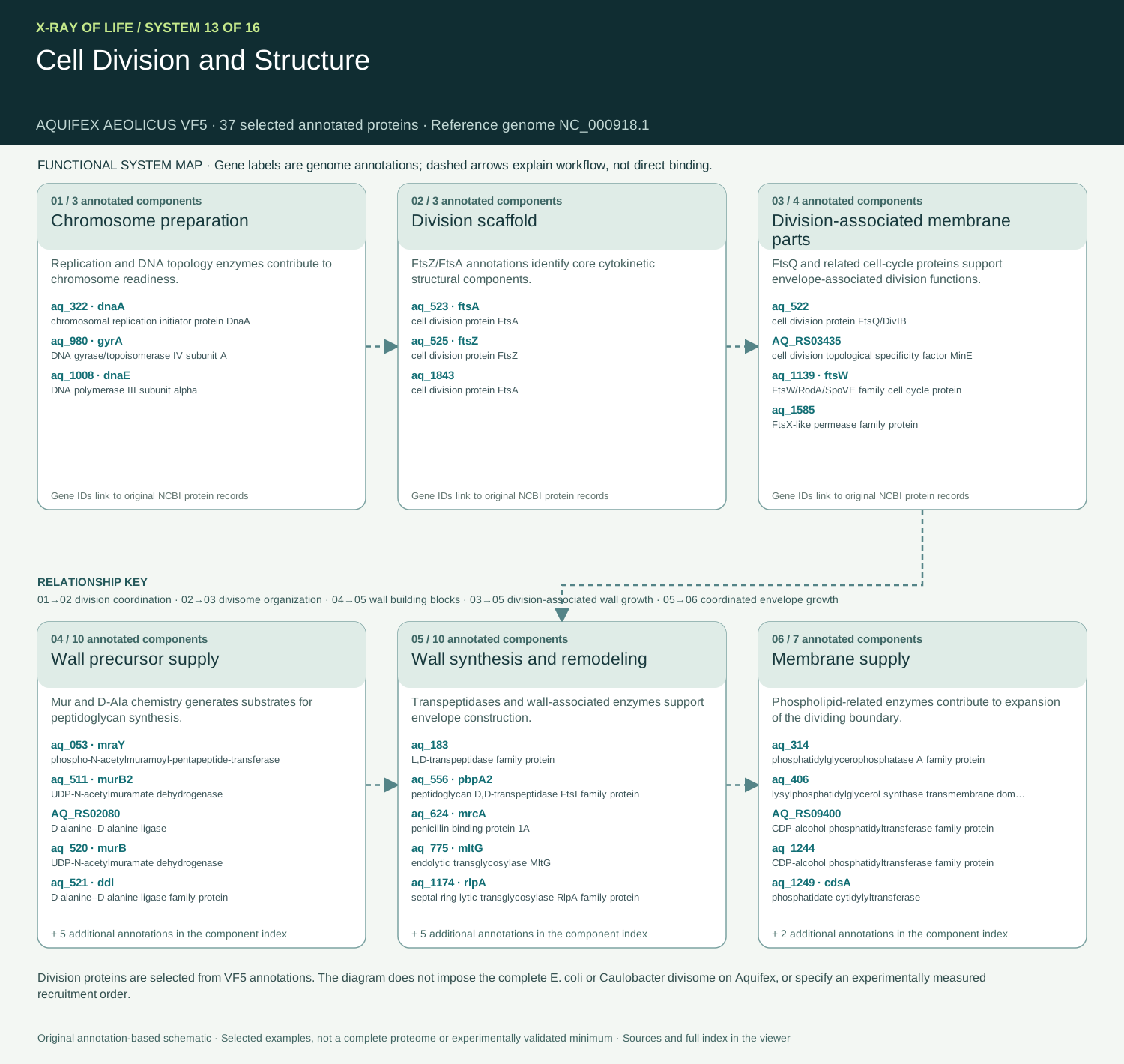 Open the full diagram and component evidence ↗
Chromosome handling, divisome formation and envelope growth support daughter-cell formation. Click to read the full diagram and inspect the annotated protein records.
Original schematic from VF5 RefSeq annotations. Dashed arrows describe functional relationships; they are not measured protein interactions. Sources: Deckert et al. (1998), complete VF5 genome · NCBI reference genome.
Division proteins are selected from VF5 annotations. The diagram does not impose the complete E. coli or Caulobacter divisome on Aquifex, or specify an experimentally measured recruitment order.
FUNCTION AND MECHANISM
How this system works
FOLLOW THE FLOW
Coordinated growth to two viable daughter compartments
Growth and genome replication → coordinated segregation and division-site assembly → constriction and boundary growth → separation
Cell Division and Structure
Growing and separating into daughter cells
Division must coordinate DNA, cell contents and the boundary so each daughter can continue functioning.
Grow the cell
Make membrane material and cellular machinery.
Copy the genome
System 08 supplies new DNA copies.
Separate DNA and position the division machinery
The division site must avoid trapping or cutting the hereditary material. Timing overlaps with growth and copying.
Constrict the membrane
Division machinery organizes inward movement at the division site.
Build and remodel the wall, where present
In walled bacteria, wall construction and remodeling cooperate with membrane constriction.
Produce two daughter compartments
Each needs DNA, a closed membrane and enough functional machinery to continue life.
Read from top to bottom. Side-by-side panels show branches or supplies that come together; their labels explain the relationship. Detailed mechanisms and sources follow below.
Starting inputs: A growing cell, usable genome copies, sufficient membrane and other boundary material, division machinery, energy, and molecular contents.
- Grow and duplicate hereditary material: Accumulate cellular components and replicate DNA with timing appropriate to the organism.
- Coordinate chromosomes and the division site: Segregate DNA and position division machinery so division does not cut through or exclude the chromosome. These processes overlap in time.
- Assemble and activate the division machinery: Many bacteria organize FtsZ and partner proteins at the future division site; other organisms use different arrangements.
- Constrict while building the boundary: Coordinate membrane invagination with material supply. In walled bacteria, septal peptidoglycan synthesis and remodeling cooperate with constriction.
- Separate and continue cellular function: Complete enclosure and separation of the daughter compartments, with hereditary material and enough molecular machinery for continued growth.
Usable outputs: Daughter cells with boundaries, genetic templates, and functional cellular contents.
This is an overlapping cell cycle, not an instruction that every step must finish before the next begins. Min systems, FtsZ partners, and wall requirements vary; secretion and horizontal gene transfer are separate cooperating functions, not stages of division.
Evidence for selected mechanisms
Genetic requirements for division in a minimal cell
These papers examine the named mechanisms or networks. The numbered order is an explanatory overview; it is not an experimentally established history of cellular origins.
Positioning a division site
Many bacteria use FtsZ, a protein that forms dynamic filaments associated with the future division site. Additional proteins connect the assembly to the membrane and coordinate other division processes. Min proteins help position division in some bacteria, but other cells use different positioning mechanisms.
Constriction and boundary construction
In walled bacteria, membrane constriction cooperates with synthesis and remodeling of the peptidoglycan wall. In wall-free cells, the mechanical requirements differ. The cell must add enough boundary material while reorganizing its surface so that both daughters become enclosed compartments.
Partitioning genetic and chemical resources
Daughter cells need hereditary material and sufficient molecular machinery to continue metabolism. Chromosome organization, replication timing, and segregation reduce the risk that division excludes or damages DNA. Small molecule pools and protein assemblies also partition, with stochastic effects becoming especially important in small compartments.
Related structural and export functions
Protein export and secretion place molecules at or across a boundary, supporting envelope construction and other tasks. Horizontal gene transfer changes genetic content but is not identical to ordinary cell division. The broad catalogue groups these functions together; their biological roles should remain distinct.
A closer look at the evidence
Gene-addition experiments in engineered minimal cells identify contributors to division and morphology. These cells depend on provided culture conditions and are not a reconstructed prebiotic cell.1
Follow the consequence
A daughter compartment that receives membrane but no usable hereditary template cannot reproduce the parent’s functions across subsequent generations.
Component families in this system (10)
- Membrane maintenance
- General secretion
- Acidocalcisome components
- HGT mechanisms
- Protein secretion systems
- Protein export machinery
- Cell division proteins
- Min system proteins
- DNA management proteins
- Regulation and timing
FUNCTIONALLY INTEGRATED
What it depends on, and why
A functional dependency means that one process supplies material, energy, machinery, or suitable conditions to another. It does not necessarily mean that two proteins physically touch.
| Other system | Relationship | Why the connection matters |
|---|---|---|
| 07 · Lipids & membrane | Provides to this system | Daughter-cell formation requires expansion and partitioning of the cell envelope. |
| 08 · DNA processing | Provides to this system | Chromosome replication and segregation must be coordinated with cellular partitioning. |
| 09 · RNA & translation | Provides to this system | Translation provides structural and division proteins. |
REASON & SCIENCE LIBRARY · ORGANIZING QUESTIONS
Library basis for this article
The verified library coverage concerns dynamic FtsZ organization and spatial organization in bacteria. This article connects those ideas to division, envelope growth and inheritance. Eukaryotic actin contraction and spindle checkpoints are not bacterial divisome components. The historical question also leaves room for division mechanisms that differ from the modern FtsZ-based case.L
FUNCTIONAL ORGANIZATION · AUTHOR’S FRAMEWORK
Hallmarks of design
Division and structure illustrates the following organizational features in the supplied papers. These descriptions identify biological functions; interpreting their origin as design is the author’s comparative argument.H1, H2
Division components must assemble at an appropriate location and geometry.
Chromosome handling and physical division contribute different requirements for viable descendants.
DNA inheritance, envelope growth and division must be coordinated.
Origin hurdles and abductive assessment · Assessment method · All 40 hallmarks. Biological evidence: the mechanism, accession records and scientific references on this page.
SOURCE-BASED SYNTHESIS
The origin problem in brief
How could growth, genome copying, and division give both daughter cells a functioning inherited system?
- Coordinate boundary growth and physical separation.
- Distribute genome copies and useful cellular machinery to daughter compartments.
- Link spatial organization and division timing to replication, energy, and structural integrity.
Source notes and how the count is used
57 book-listed challenges. Cell-division and structure category.
Numbers reproduce the source’s reported section totals. They are not a new count of unique questions or an independent assessment of which issues remain scientifically unresolved. Overlapping lists are not added together.
Source passages: X-ray of Life, Volume I, Chapter 9, pp. 347–367; X-ray of Life, Volume II, Chapter 12; §14.10, pp. 611–645; 762–763; The Cell: An Unsolved Mystery, Chapters 6,16, pp. 121–135; 309–328.
The overview follows the cell-specific scope of Forty Hallmarks of Design in the Cell: later eukaryotic machinery, specialized immune systems, and model-specific numerical probabilities are not treated as universal first-cell requirements.
ORIGINS
What needs to be explained
An origins explanation must connect available chemistry to a system that can persist, reproduce useful functions, and pass them to descendants. Explaining how a modern system works and explaining how its predecessors arose are different tasks. Simpler catalysts, environmental assistance, and alternative chemistries must be evaluated rather than assuming that the complete modern machinery appeared at once.
Scope of the question
The requirements of a modern bacterial division apparatus are not identical to the requirements of a primitive compartment. An origins explanation must connect these stages rather than equate them.
Major hurdles to investigate
These are requirements to test in proposed scenarios. Their importance depends on the environment and on which intermediate system is proposed.
Coordinated growth
Increase boundary area and internal material at compatible rates.
Content retention
Divide while retaining catalysts and avoiding catastrophic dilution.
Hereditary partitioning
Deliver useful template information into offspring compartments.
Reproductive continuity
Repeat cycles with enough functional material for daughters to grow again.
Selectable improvement
Link improved growth or partitioning mechanisms to an inherited advantage.
EXPERIMENTAL PROGRESS
What has been demonstrated, and what it leaves open
Simple vesicle experiments demonstrate growth and physical division without a modern division apparatus. Studies of engineered minimal cells separately identify genes affecting modern division and morphology. These are complementary experimental questions, not a demonstration that a modern minimal cell arose from prebiotic vesicles.2
Condensed origin challenges
- Coordinate boundary growth and physical separation.
- Distribute genome copies and useful cellular machinery to daughter compartments.
- Link spatial organization and division timing to replication, energy, and structural integrity.
Three condensed themes from the source passages above; they are not the complete numbered catalogue.
The integration test
Experiments that connect precursor chemistry across molecular classes help test compatibility.3 A strong next test for this system would combine its relevant chemical steps with continued material supply, energy use, retention, and reproduction under an explicitly specified environmental sequence. The open questions above are research questions, not claims that every intermediate is impossible.
Engineered minimal cells help reveal present cellular dependencies, but their construction starts from existing biological machinery and growth conditions. They therefore answer a different question from a prebiotic synthesis experiment.4
Explore prebiotic synthesis challengesTERMS IN PLAIN LANGUAGE
Glossary
- cell division
- Splitting one cell into two daughter cells, each with a genome and working machinery.
- FtsZ
- A protein that forms a ring at the future division site and recruits the rest of the division machinery.
- divisome
- The full set of division proteins gathered at the FtsZ ring.
- Min system
- Proteins that oscillate between the cell poles and stop the FtsZ ring forming there, so it forms at mid-cell.
- chromosome segregation
- Moving the two genome copies apart before the cell splits.
- septum
- The new wall and membrane that grow inward to separate the two daughter cells.
- constriction
- The narrowing of the cell at the division site as the ring tightens.
- peptidoglycan
- The mesh-like cell wall of most bacteria; new wall is built at the septum during division.
- secretion system
- Machinery that moves proteins across the membrane to the outside of the cell.
- horizontal gene transfer (HGT)
- Exchange of DNA between cells other than from parent to offspring.
- protein
- A chain of amino acids whose shape and chemical properties let it perform a cellular task.
Related library threads
Microfilaments · Bacterial cells are far more organized than previously thought
The author’s library essays and research compilations provide context and arguments. Biological mechanisms should be assessed through the scientific references; the design inference is a separate, revisable assessment.
SCIENTIFIC LITERATURE
Scientific papers
Linked superscript numbers in the text lead to the papers below, numbered in order of first citation on this page. Each entry links to the publisher and bibliographic record; open full text is included where available. These studies support the specified mechanisms or experiments, not every possible origin scenario.
Pelletier JF, Sun L, Wise KS, Assad-Garcia N, Karas BJ, Deerinck TJ, Ellisman MH, Mershin A, Gershenfeld N, Chuang RY, Glass JI, Strychalski EA. (2021). Genetic requirements for cell division in a genomically minimal cell. Cell, 184, 2430-2440.e16.
Hanczyc MM, Fujikawa SM, Szostak JW. (2003). Experimental models of primitive cellular compartments: encapsulation, growth, and division. Science, 302, 618-622.
Patel BH, Percivalle C, Ritson DJ, Duffy CD, Sutherland JD. (2015). Common origins of RNA, protein and lipid precursors in a cyanosulfidic protometabolism. Nat Chem, 7, 301-307.
Hutchison CA, Chuang RY, Noskov VN, Assad-Garcia N, Deerinck TJ, Ellisman MH, Gill J, Kannan K, Karas BJ, Ma L, Pelletier JF, Qi ZQ, Richter RA, Strychalski EA, Sun L, Suzuki Y, Tsvetanova B, Wise KS, Smith HO, Glass JI, Merryman C, Gibson DG, Venter JC. (2016). Design and synthesis of a minimal bacterial genome. Science, 351, aad6253.
Further scientific reading
3 additional papers. Each title links to its article or bibliographic record.
Search and filter this system’s reference list →