AQUIFEX AEOLICUS VF5 · ORGANISM-SPECIFIC DESCRIPTION
How this system works in Aquifex
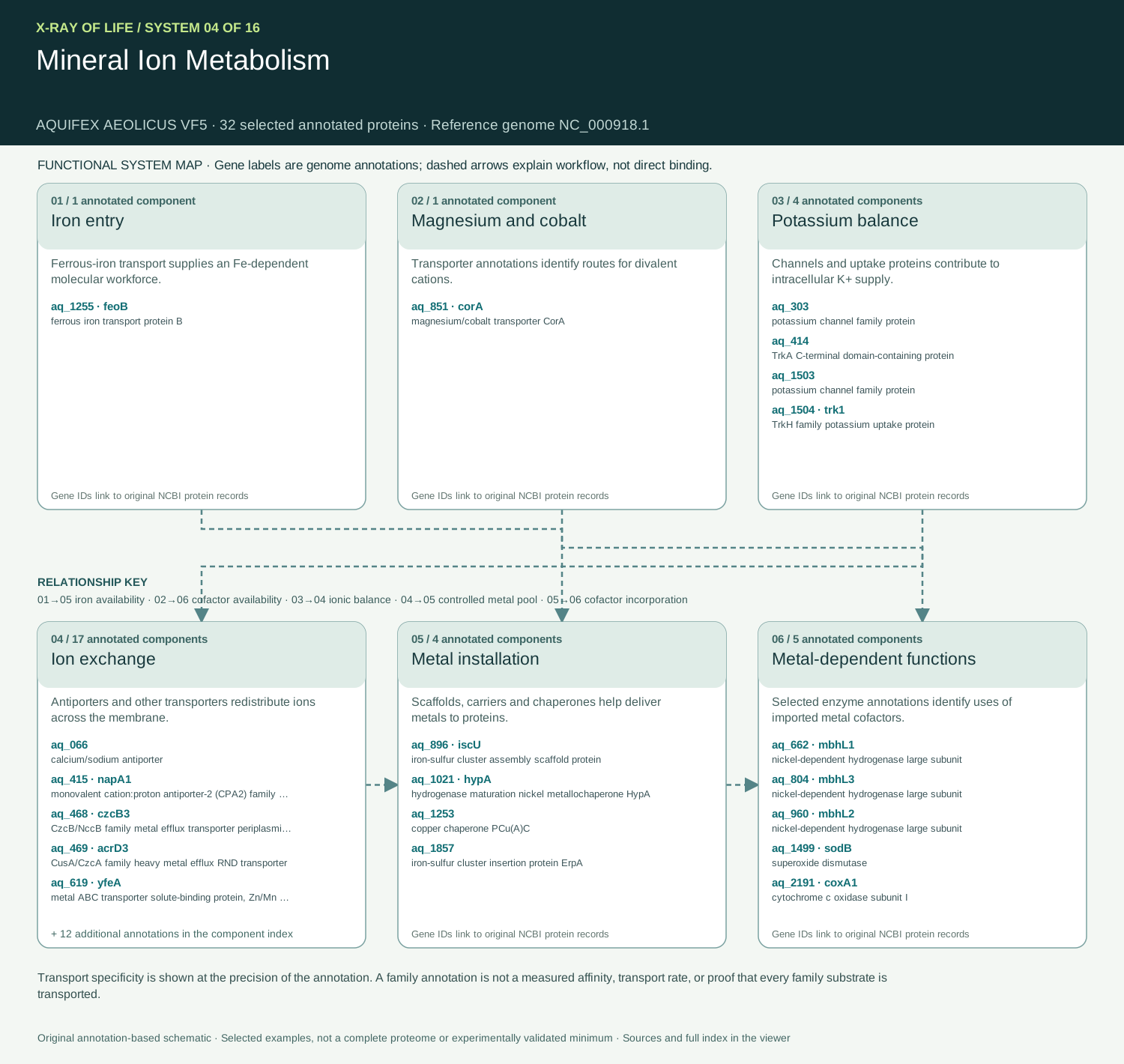
VF5 annotations include ferrous-iron transport protein FeoB, the magnesium/cobalt transporter CorA, potassium-channel and uptake proteins, ion exchangers, and selected metal-delivery factors. These functions connect the external mineral supply to enzyme catalysis, RNA stability and intracellular ionic conditions. Acquiring a metal and installing it in a cofactor are different tasks. The same transport or maturation protein can therefore contribute to this atlas category and another category without being counted twice in the 912-protein reconstruction. Transporter family names do not establish measured substrate affinities.
No separate exclusive total: mineral-ion handling is distributed across transport and metal-cluster maturation in the 912-protein reconstruction.
The working reconstruction retains 912 proteins; 338 additional proteins remain undetermined. These are model selections, not a demonstrated viable minimum or individual VF5 knockout results. The 16 atlas hotspots and the reconstruction categories use different partitions.
Inspect the 912-protein inventory and model evidence →REFERENCE ORGANISM · AQUIFEX AEOLICUS VF5
Aquifex system diagram
32 selected annotated proteins · 6 functional modules
 Open the full diagram and component evidence ↗
Selective uptake, controlled handling and incorporation of inorganic ions. Click to read the full diagram and inspect the annotated protein records.
Original schematic from VF5 RefSeq annotations. Dashed arrows describe functional relationships; they are not measured protein interactions. Sources: Deckert et al. (1998), complete VF5 genome · NCBI reference genome.
Transport specificity is shown at the precision of the annotation. A family annotation is not a measured affinity, transport rate, or proof that every family substrate is transported.
FUNCTION AND MECHANISM
How this system works
FOLLOW THE FLOW
Mineral availability to controlled cellular use
Available environmental ions → selective uptake → intracellular allocation → catalytic or structural use
Mineral Ion Metabolism
Obtaining and controlling mineral nutrients
Cells need dissolved minerals in suitable amounts: too little prevents work; too much can cause damage.
Minerals dissolve in surrounding water
The usable charged particles are called ions. Examples include magnesium, potassium and iron in appropriate chemical forms.
Transport proteins control uptake
Different proteins admit particular ions; a mineral must be chemically available before it can be acquired.
Deliver ions where they are needed
Binding and storage keep the freely available supply under control.
Support molecular structures and reactions
Magnesium, for example, helps many enzymes and RNA-containing machines work.
Supply metal-part assembly
Selected metal ions go to System 16 to build metal-containing enzyme parts.
Adjust uptake, storage and export
The cell changes these activities as its needs and surroundings change.
Read from top to bottom. Side-by-side panels show branches or supplies that come together; their labels explain the relationship. Detailed mechanisms and sources follow below.
Starting inputs: Chemically available mineral ions, selective transport routes, binding partners, and appropriate intracellular conditions.
- Establish chemical availability: Ion solubility, oxidation state, and binding determine what can be acquired; total mineral abundance alone does not.
- Control entry: Use appropriate transporters or channels to obtain needed ions while limiting unsuitable or excessive entry.
- Allocate and buffer the internal pool: Binding partners, storage mechanisms, and delivery pathways control accessible concentrations and destinations.
- Use or mature the metal-dependent component: Bind an ion at a suitable site or deliver mineral inputs to the separate cofactor-assembly machinery of System 16.
- Adjust uptake, retention, and export: Respond to sufficiency or excess by changing channel gating, transport, storage, or efflux. Specific mechanisms differ among ions and organisms.
Usable outputs: Usable ions for enzymes, RNA, membranes, and metal-containing cofactors.
Metal acquisition and metal-cluster assembly are distinct functions. Feedback acts throughout this process; there is no single universal transport route for all minerals.
Evidence for selected mechanisms
Magnesium-dependent MgtE gating and homeostasis
These papers examine the named mechanisms or networks. The numbered order is an explanatory overview; it is not an experimentally established history of cellular origins.
Availability is not the same as total abundance
A metal can be abundant in a rock but poorly available in water. Solubility, acidity, oxidation state, and binding to other substances determine what the cell can actually obtain. Inside the cell, much of a metal pool is bound rather than freely dissolved. A total metal measurement does not directly reveal the amount accessible to an enzyme.
Selective uptake and distribution
Transport proteins discriminate among ions and control entry or export. Internal binding partners and delivery pathways help metals reach appropriate destinations. Magnesium transport provides an example of uptake regulated by intracellular conditions. Simply opening a membrane to all ions would undermine selectivity and cellular balance.
Using metals without poisoning the cell
Metal-binding sites position ions for catalysis or molecular stability. The wrong ion can interfere with activity. Excess redox-active iron can promote damaging chemistry when oxidants are present. Too little available magnesium can impair ribosomal and nucleotide-associated processes. Cells balance supply with storage, binding, use, and removal.
Relation to metal cluster assembly
An individual ion and a multi-atom cofactor are different chemical objects. This system provides and manages the raw mineral inputs; metal cluster assembly organizes selected atoms into cofactors and installs them in proteins. Both depend on transport and suitable internal chemistry.
A closer look at the evidence
Structural and functional experiments on MgtE link magnesium-dependent channel gating with magnesium homeostasis, providing a concrete example of regulated ion uptake.1
Follow the consequence
An enzyme can remain inactive when its binding site contains an unsuitable metal, even if the correct metal is also present elsewhere in the environment.
Component families in this system (9)
- Iron-Sulfur Clusters - electron transport
- Iron-Sulfur Clusters - electron transfer
- Magnesium Ions (Mg2+) - phosphate transfer
- Magnesium Ions (Mg2+) - second system
- Molybdenum Cofactor - oxidation-reduction
- Molybdenum Cofactor - sulfur/nitrogen metabolism
- Manganese Ions (Mn2+) - antioxidant defense
- NAD+ transporter
- Beta-alanine biosynthesis
FUNCTIONALLY INTEGRATED
What it depends on, and why
A functional dependency means that one process supplies material, energy, machinery, or suitable conditions to another. It does not necessarily mean that two proteins physically touch.
| Other system | Relationship | Why the connection matters |
|---|---|---|
| 11 · Transport | Provides to this system | Transporters bring required ions into the cell and export excess ions. |
| 14 · Homeostasis | Provides to this system | pH and ion buffering constrain metal availability and prevent damaging imbalances. |
| 09 · RNA & translation | Receives from this system | Appropriate ions, especially magnesium, support RNA structure and ribosome activity. |
| 16 · Metal clusters | Receives from this system | Available iron, sulfur-related substrates, nickel, and other metals support the chosen cofactor assembly pathways. |
| 16 · Metal clusters | Provides to this system | Metal binding and cofactor incorporation help allocate available metals into functional enzymes. |
REASON & SCIENCE LIBRARY · ORGANIZING QUESTIONS
Library basis for this article
The library’s metal-ion discussions emphasize the need to obtain useful elements while avoiding incorrect metal loading and toxicity. The resulting article distinguishes environmental availability, selective entry, intracellular handling and catalytic incorporation. A metal’s usefulness somewhere in biology does not establish that every listed metal is essential to this particular bacterium or growth condition.L
FUNCTIONAL ORGANIZATION · AUTHOR’S FRAMEWORK
Hallmarks of design
Mineral ions illustrates the following organizational features in the supplied papers. These descriptions identify biological functions; interpreting their origin as design is the author’s comparative argument.H1, H2
Transport and binding sites distinguish useful ions from competing or toxic alternatives.
Ion availability must remain compatible with catalysis and osmotic balance.
Metal availability must connect to successful cofactor insertion and maturation.
Origin hurdles and abductive assessment · Assessment method · All 40 hallmarks. Biological evidence: the mechanism, accession records and scientific references on this page.
SOURCE-BASED SYNTHESIS
The origin problem in brief
How could early cells obtain useful ions selectively while avoiding toxicity and maintaining balance?
- Obtain the required ions in usable chemical forms and concentrations.
- Distinguish useful ions from competing or damaging substances.
- Coordinate uptake, delivery, and internal ion balance with energy and enzyme function.
Source notes and how the count is used
Mineral handling overlaps transport and homeostasis. No separate atlas-aligned total is assigned.
Numbers reproduce the source’s reported section totals. They are not a new count of unique questions or an independent assessment of which issues remain scientifically unresolved. Overlapping lists are not added together.
Source passages: X-ray of Life, Volume I, §11.1, pp. 410; X-ray of Life, Volume II, Chapter 13; §14.9, pp. 646–751; 761–762; X-ray of Life, Volume III, Chapter 3; §13.11, pp. 183–226; 480–481.
The overview follows the cell-specific scope of Forty Hallmarks of Design in the Cell: later eukaryotic machinery, specialized immune systems, and model-specific numerical probabilities are not treated as universal first-cell requirements.
ORIGINS
What needs to be explained
An origins explanation must connect available chemistry to a system that can persist, reproduce useful functions, and pass them to descendants. Explaining how a modern system works and explaining how its predecessors arose are different tasks. Simpler catalysts, environmental assistance, and alternative chemistries must be evaluated rather than assuming that the complete modern machinery appeared at once.
Scope of the question
There is no single universal concentration range for all cell types. Mineral requirements depend on the selected catalysts, environment, and chemical speciation.
Major hurdles to investigate
These are requirements to test in proposed scenarios. Their importance depends on the environment and on which intermediate system is proposed.
Geochemical accessibility
Make required ions available in the same place as organic synthesis.
Selectivity
Favor useful metal binding over inhibition by competing ions.
Compatible concentrations
Balance catalytic benefits against damage to polymers, membranes, or other reactions.
Localization
Retain useful ions near catalysts without immobilizing them in inaccessible precipitates.
Control
Explain the transition from environmental buffering to inherited uptake and distribution mechanisms.
EXPERIMENTAL PROGRESS
What has been demonstrated, and what it leaves open
Prebiotic iron–sulfur experiments show that selected metal-containing assemblies can form and associate with short peptides under tested conditions. They illustrate possible chemistry before dedicated metal-handling proteins, while leaving mineral availability and competing-ion effects to be established for each setting.2
Condensed origin challenges
- Obtain the required ions in usable chemical forms and concentrations.
- Distinguish useful ions from competing or damaging substances.
- Coordinate uptake, delivery, and internal ion balance with energy and enzyme function.
Three condensed themes from the source passages above; they are not the complete numbered catalogue.
The integration test
Experiments that connect precursor chemistry across molecular classes help test compatibility.3 A strong next test for this system would combine its relevant chemical steps with continued material supply, energy use, retention, and reproduction under an explicitly specified environmental sequence. The open questions above are research questions, not claims that every intermediate is impossible.
Engineered minimal cells help reveal present cellular dependencies, but their construction starts from existing biological machinery and growth conditions. They therefore answer a different question from a prebiotic synthesis experiment.4
Explore prebiotic synthesis challengesTERMS IN PLAIN LANGUAGE
Glossary
- mineral ion
- A charged atom from the environment, such as Mg²⁺, K⁺ or Fe²⁺, that the cell needs in small amounts.
- bioavailability
- Whether a mineral is in a dissolved form the cell can actually take up; much iron, for example, is locked in insoluble rust.
- selective uptake
- Taking in a particular ion through a transporter or channel that lets that ion pass but blocks others.
- internal pool
- The ions inside the cell, mostly bound to proteins or other molecules rather than floating freely.
- buffering
- Holding a level steady by binding or releasing ions as conditions change.
- efflux
- Pumping an ion or molecule out of the cell, for example to remove an excess.
- Mg²⁺ (magnesium)
- Needed by almost every reaction that uses ATP, and to hold RNA and ribosomes in their working shape.
- Mn²⁺ (manganese)
- Used by some enzymes, including antioxidant enzymes that destroy harmful oxygen species.
- molybdenum cofactor (Moco)
- A molybdenum atom held by a special organic frame; used by enzymes in sulfur, nitrogen and carbon chemistry.
- metal cluster
- A small group of metal and other atoms (such as iron and sulfur) built into a protein; assembled by System 16.
- enzyme
- A molecule, usually a protein, that speeds up a chemical reaction without being consumed by it.
- protein
- A chain of amino acids whose shape and chemical properties let it perform a cellular task.
- cofactor
- A non-protein chemical helper required by some enzymes, such as an organic molecule or metal ion.
- ion
- An atom or molecule with a net electrical charge.
Related library threads
Metal ions in biological cells, essential for life · Iron Uptake and Homeostasis in Prokaryotic Microorganisms
The author’s library essays and research compilations provide context and arguments. Biological mechanisms should be assessed through the scientific references; the design inference is a separate, revisable assessment.
SCIENTIFIC LITERATURE
Scientific papers
Linked superscript numbers in the text lead to the papers below, numbered in order of first citation on this page. Each entry links to the publisher and bibliographic record; open full text is included where available. These studies support the specified mechanisms or experiments, not every possible origin scenario.
Hattori M, Iwase N, Furuya N, Tanaka Y, Tsukazaki T, Ishitani R, Maguire ME, Ito K, Maturana A, Nureki O. (2009). Mg(2+)-dependent gating of bacterial MgtE channel underlies Mg(2+) homeostasis. EMBO J, 28, 3602-3612.
Bonfio C, Valer L, Scintilla S, Shah S, Evans DJ, Jin L, Szostak JW, Sasselov DD, Sutherland JD, Mansy SS. (2017). UV-light-driven prebiotic synthesis of iron-sulfur clusters. Nat Chem, 9, 1229-1234.
Patel BH, Percivalle C, Ritson DJ, Duffy CD, Sutherland JD. (2015). Common origins of RNA, protein and lipid precursors in a cyanosulfidic protometabolism. Nat Chem, 7, 301-307.
Hutchison CA, Chuang RY, Noskov VN, Assad-Garcia N, Deerinck TJ, Ellisman MH, Gill J, Kannan K, Karas BJ, Ma L, Pelletier JF, Qi ZQ, Richter RA, Strychalski EA, Sun L, Suzuki Y, Tsvetanova B, Wise KS, Smith HO, Glass JI, Merryman C, Gibson DG, Venter JC. (2016). Design and synthesis of a minimal bacterial genome. Science, 351, aad6253.
Further scientific reading
1 additional papers. Each title links to its article or bibliographic record.
Search and filter this system’s reference list →