AQUIFEX AEOLICUS VF5 · ORGANISM-SPECIFIC DESCRIPTION
How this system works in Aquifex
Ribose-phosphate chemistry and PRPP formation connect central carbon metabolism to purine and pyrimidine synthesis. Annotated ring-building enzymes, salvage enzymes and nucleotide kinases support the nucleotide pools, while ribonucleotide-reduction and thymidylate-related chemistry connect RNA-type precursors to DNA-type precursors. Nitrogen donors, folate-linked carbon units and ATP connect this system to other biosynthetic branches. The VF5 diagram separates nucleotide formation, interconversion and polymer use; it does not assume that salvage from the environment can replace de novo synthesis in the reconstruction scenario.
47 proteins are assigned to this function in the 912-protein working reconstruction (Nucleotide biosynthesis and recycling).
The working reconstruction retains 912 proteins; 338 additional proteins remain undetermined. These are model selections, not a demonstrated viable minimum or individual VF5 knockout results. The 16 atlas hotspots and the reconstruction categories use different partitions.
Inspect the 912-protein inventory and model evidence →REFERENCE ORGANISM · AQUIFEX AEOLICUS VF5
Aquifex system diagram
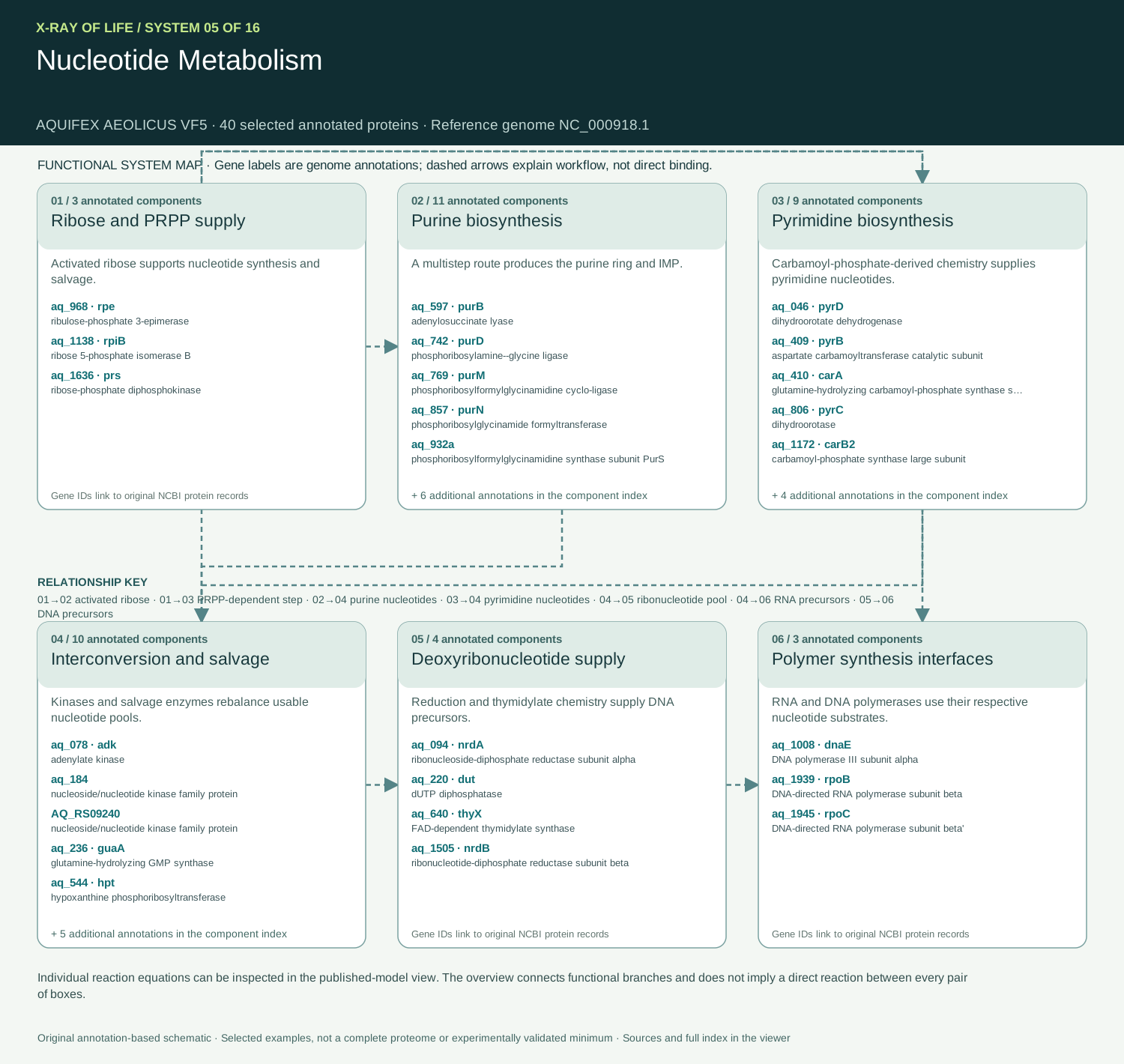
40 selected annotated proteins · 6 functional modules
 Open the full diagram and component evidence ↗
Ribose activation, ring synthesis and nucleotide interconversion supply RNA and DNA. Click to read the full diagram and inspect the annotated protein records.
Original schematic from VF5 RefSeq annotations. Dashed arrows describe functional relationships; they are not measured protein interactions. Sources: Deckert et al. (1998), complete VF5 genome · Braakman & Smith (2014), metabolic reconstruction · NCBI reference genome.
Individual reaction equations can be inspected in the published-model view. The overview connects functional branches and does not imply a direct reaction between every pair of boxes.
FUNCTION AND MECHANISM
How this system works
FOLLOW THE FLOW
Precursors to RNA and DNA nucleotide pools
Carbon and nitrogen precursors → purine/pyrimidine pathways → nucleotide pools → RNA/DNA synthesis or other cellular uses
Nucleotide Metabolism
Making the units of DNA and RNA
Nucleotides are small chemical units that can be joined into DNA or RNA.
Carbon and nitrogen from metabolism
Sugar-derived material and nitrogen-containing molecules supply the atoms.
Recovered material
Some pathways reuse bases or nucleosides from old molecules instead of building everything afresh.
Assemble nucleotide molecules
Separate enzyme pathways make the two families of bases, then produce usable nucleotide supplies.
RNA units
Activated RNA nucleotides are joined into RNA by transcription machinery (09).
DNA units
Additional reactions make and balance DNA nucleotide supplies for copying and repairing DNA (08).
Replace what is consumed
Production responds to demand; breakdown products can return through recycling pathways.
Read from top to bottom. Side-by-side panels show branches or supplies that come together; their labels explain the relationship. Detailed mechanisms and sources follow below.
Starting inputs: Sugar-phosphate precursors, nitrogen donors, other carbon inputs, energy, and pathway-specific cofactors.
- Supply precursors or salvageable material: Metabolism supplies sugar and ring precursors. Salvage can instead recover bases or nucleosides and reconnect them to nucleotide pools.
- Build purines and pyrimidines by separate routes: Purine rings are built on an activated ribose-containing substrate. In de novo pyrimidine synthesis, the ring is formed before attachment to the ribose-phosphate framework.
- Prepare the RNA nucleotide pool: Further reactions and phosphorylation generate the ribonucleoside triphosphates used in transcription.
- Branch toward DNA precursors: Ribonucleotide reduction generates deoxyribonucleotide precursors. Additional processing, including thymidylate synthesis and phosphorylation, provides balanced dNTP pools for DNA synthesis.
- Use, recycle, and regulate: Supply RNA synthesis, DNA replication and repair, energy transfer, and signaling as appropriate. Recover material through turnover and regulate production as demand changes.
Usable outputs: RNA substrates for System 09, DNA substrates for System 08, and nucleotides with other metabolic roles.
RNA and DNA precursor synthesis are linked branches. RNA itself does not need to be made first and then converted into DNA. Salvage is an alternative entry route, not a mandatory final stage.
Evidence for selected mechanisms
Nucleotide-dependent regulation of purine biosynthesis · Biosynthetic network connections
These papers examine the named mechanisms or networks. The numbered order is an explanatory overview; it is not an experimentally established history of cellular origins.
Building purines and pyrimidines
Purines include adenine and guanine; pyrimidines include cytosine, uracil, and thymine. Cells construct their rings through distinct pathways using carbon and nitrogen inputs from metabolism. Purine synthesis builds the ring on an activated ribose-containing substrate, whereas pyrimidine synthesis builds a ring before attaching it to a ribose-phosphate framework.
Preparing RNA and DNA substrates
RNA polymerases use ribonucleoside triphosphates. DNA polymerases use deoxyribonucleoside triphosphates, whose sugar lacks RNA’s 2′ hydroxyl group. Enzymes interconvert phosphate states and supply the appropriate nucleotide pools. DNA precursors are generally connected to ribonucleotide metabolism through reduction and additional processing.
Salvage and recycling
Breaking down RNA can release reusable nucleotide material. Salvage pathways recover bases or nucleosides rather than rebuilding every atom from small precursors. Recycling reduces synthesis costs but depends on the availability of recoverable material and enzymes that route it back into useful pools.
Keeping the pools coordinated
Too little substrate slows polymer synthesis, while an imbalance can influence copying accuracy and regulation. Carbon metabolism supplies sugar precursors, amino acid metabolism provides nitrogen donors, and cofactors support selected transformations. Nucleotide signals can adjust synthesis to nutritional conditions; they are part of regulation rather than an independent supply of raw material.
A closer look at the evidence
Experiments in Bacillus show that the nucleotide signal (p)ppGpp binds the regulator PurR and changes control of purine biosynthesis during amino acid starvation.1
Follow the consequence
If DNA precursors are not supplied as the chromosome is copied, replication can stall even when the DNA polymerase itself is intact.
Component families in this system (10)
- De novo purine biosynthesis
- Purine biosynthesis - adenine pathway
- Purine biosynthesis - guanine pathway
- De novo pyrimidine biosynthesis
- Uracil biosynthesis
- Cytosine nucleotide biosynthesis
- Thymine biosynthesis
- Nucleotide phosphorylation
- Nucleotide Salvage
- RNA processing and degradation
FUNCTIONALLY INTEGRATED
What it depends on, and why
A functional dependency means that one process supplies material, energy, machinery, or suitable conditions to another. It does not necessarily mean that two proteins physically touch.
| Other system | Relationship | Why the connection matters |
|---|---|---|
| 01 · Carbon metabolism | Provides to this system | Carbon precursors supply the ribose and ring-building substrates needed for nucleotide synthesis. |
| 06 · Amino acids | Provides to this system | Amino acids donate nitrogen and other atoms to purine and pyrimidine biosynthesis. |
| 02 · Cofactors | Provides to this system | Selected nucleotide reactions require one-carbon or redox cofactors. |
| 03 · Energy production | Provides to this system | Energy investment supports nucleotide synthesis and phosphorylation. |
| 08 · DNA processing | Receives from this system | Deoxyribonucleotides are the monomers used to replicate and repair DNA. |
| 09 · RNA & translation | Receives from this system | Ribonucleotides supply RNA synthesis; ATP and GTP also serve as substrates in translation-related reactions. |
REASON & SCIENCE LIBRARY · ORGANIZING QUESTIONS
Library basis for this article
The library distinguishes synthesis of new nucleotide material from salvage, and highlights the additional chemistry connecting ribonucleotides to DNA precursors. This article therefore treats precursor supply, molecular identity and reuse as separate tasks. Its origin discussion asks about a transition between chemical supply and controlled metabolism, without treating the modern pathway as a literal reconstruction of prebiotic chemistry.L
FUNCTIONAL ORGANIZATION · AUTHOR’S FRAMEWORK
Hallmarks of design
Nucleotide metabolism illustrates the following organizational features in the supplied papers. These descriptions identify biological functions; interpreting their origin as design is the author’s comparative argument.H1, H2
Carbon and nitrogen precursors supply RNA, DNA and energy-carrier synthesis.
Salvage routes can recover material from nucleotide turnover where those pathways are present.
Specific catalysts distinguish substrates in nucleotide precursor chemistry.
Origin hurdles and abductive assessment · Assessment method · All 40 hallmarks. Biological evidence: the mechanism, accession records and scientific references on this page.
SOURCE-BASED SYNTHESIS
The origin problem in brief
How could the right nucleotide units be made, activated, and supplied for reliable information copying?
- Produce and preserve the appropriate bases, sugars, phosphate groups, and stereochemistry.
- Connect activation and polymer formation to usable energy under compatible conditions.
- Maintain a balanced supply linked to copying, metabolism, and compartmentalization.
Source notes and how the count is used
137 book-listed challenges. Nucleotide synthesis and metabolism category.
Numbers reproduce the source’s reported section totals. They are not a new count of unique questions or an independent assessment of which issues remain scientifically unresolved. Overlapping lists are not added together.
Source passages: X-ray of Life, Volume I, Chapter 3; Chapter 11, nucleotide and RNA summaries, pp. 135–196; 411–414; X-ray of Life, Volume II, Chapter 7; §14.4, pp. 338–406; 755–756; X-ray of Life, Volume III, §§18.1–18.2, pp. 656–665.
The overview follows the cell-specific scope of Forty Hallmarks of Design in the Cell: later eukaryotic machinery, specialized immune systems, and model-specific numerical probabilities are not treated as universal first-cell requirements.
ORIGINS
What needs to be explained
An origins explanation must connect available chemistry to a system that can persist, reproduce useful functions, and pass them to descendants. Explaining how a modern system works and explaining how its predecessors arose are different tasks. Simpler catalysts, environmental assistance, and alternative chemistries must be evaluated rather than assuming that the complete modern machinery appeared at once.
Scope of the question
A nucleotide is not a genetic instruction by itself. The sequence, copying behavior, and functional consequences of polymers must also be explained.
Major hurdles to investigate
These are requirements to test in proposed scenarios. Their importance depends on the environment and on which intermediate system is proposed.
Feedstocks and synthesis
Supply bases, sugar-derived intermediates, and phosphate through chemically compatible routes.
Correct connectivity
Favor useful sugar–base attachments and phosphate positions among competing products.
Chirality and purity
Determine how mixed chemical products affect polymer formation and copying.
Activation and stability
Provide reactive building blocks while limiting hydrolysis and other decomposition.
Replication integration
Combine monomer supply with copying, strand separation, retention, and replenishment.
EXPERIMENTAL PROGRESS
What has been demonstrated, and what it leaves open
Experiments have demonstrated routes to activated pyrimidine ribonucleotides under proposed prebiotic conditions. Producing these building blocks is a substantial chemical step; obtaining a compatible nucleotide supply, polymerization chemistry, and continuing replication requires additional work.2
Condensed origin challenges
- Produce and preserve the appropriate bases, sugars, phosphate groups, and stereochemistry.
- Connect activation and polymer formation to usable energy under compatible conditions.
- Maintain a balanced supply linked to copying, metabolism, and compartmentalization.
Three condensed themes from the source passages above; they are not the complete numbered catalogue.
The integration test
Experiments that connect precursor chemistry across molecular classes help test compatibility.3 A strong next test for this system would combine its relevant chemical steps with continued material supply, energy use, retention, and reproduction under an explicitly specified environmental sequence. The open questions above are research questions, not claims that every intermediate is impossible.
Engineered minimal cells help reveal present cellular dependencies, but their construction starts from existing biological machinery and growth conditions. They therefore answer a different question from a prebiotic synthesis experiment.4
Explore prebiotic synthesis challengesTERMS IN PLAIN LANGUAGE
Glossary
- nucleotide
- A building block of RNA and DNA: a base, a sugar (ribose or deoxyribose) and one or more phosphates.
- purine
- The larger, two-ring bases adenine (A) and guanine (G).
- pyrimidine
- The smaller, one-ring bases cytosine (C), uracil (U) and thymine (T).
- ribose-5-phosphate
- The five-carbon sugar that forms the backbone of RNA nucleotides.
- PRPP
- Phosphoribosyl pyrophosphate: an activated form of ribose onto which bases are built or attached.
- de novo synthesis
- Making a molecule from simple starting materials, as opposed to salvage.
- salvage
- Recovering bases or nucleosides from broken-down RNA and DNA and turning them back into nucleotides.
- NTPs
- Nucleoside triphosphates (ATP, GTP, UTP, CTP): the activated building blocks of RNA.
- ribonucleotide reductase
- The enzyme that removes one oxygen from the ribose of a nucleotide, giving a DNA building block.
- dNTPs
- Deoxynucleoside triphosphates (dATP, dGTP, dCTP, dTTP): the activated building blocks of DNA.
- thymidylate synthesis
- Making thymine nucleotides by adding a methyl group to a uracil nucleotide (dUMP → dTMP).
- amino acid
- One of the small molecules joined together to form a protein.
Related library threads
Nucleotide Biosynthesis · Ribonucleotide reductase, one of the most essential enzymes of life, and how it buries the RNA world
The author’s library essays and research compilations provide context and arguments. Biological mechanisms should be assessed through the scientific references; the design inference is a separate, revisable assessment.
SCIENTIFIC LITERATURE
Scientific papers
Linked superscript numbers in the text lead to the papers below, numbered in order of first citation on this page. Each entry links to the publisher and bibliographic record; open full text is included where available. These studies support the specified mechanisms or experiments, not every possible origin scenario.
Anderson BW, Schumacher MA, Yang J, Turdiev A, Turdiev H, Schroeder JW, He Q, Lee VT, Brennan RG, Wang JD. (2022). The nucleotide messenger (p)ppGpp is an anti-inducer of the purine synthesis transcription regulator PurR in Bacillus. Nucleic Acids Res, 50, 847-866.
Powner MW, Gerland B, Sutherland JD. (2009). Synthesis of activated pyrimidine ribonucleotides in prebiotically plausible conditions. Nature, 459, 239-242.
Patel BH, Percivalle C, Ritson DJ, Duffy CD, Sutherland JD. (2015). Common origins of RNA, protein and lipid precursors in a cyanosulfidic protometabolism. Nat Chem, 7, 301-307.
Hutchison CA, Chuang RY, Noskov VN, Assad-Garcia N, Deerinck TJ, Ellisman MH, Gill J, Kannan K, Karas BJ, Ma L, Pelletier JF, Qi ZQ, Richter RA, Strychalski EA, Sun L, Suzuki Y, Tsvetanova B, Wise KS, Smith HO, Glass JI, Merryman C, Gibson DG, Venter JC. (2016). Design and synthesis of a minimal bacterial genome. Science, 351, aad6253.
Further scientific reading
4 additional papers. Each title links to its article or bibliographic record.
Search and filter this system’s reference list →