AQUIFEX AEOLICUS VF5 · ORGANISM-SPECIFIC DESCRIPTION
How this system works in Aquifex
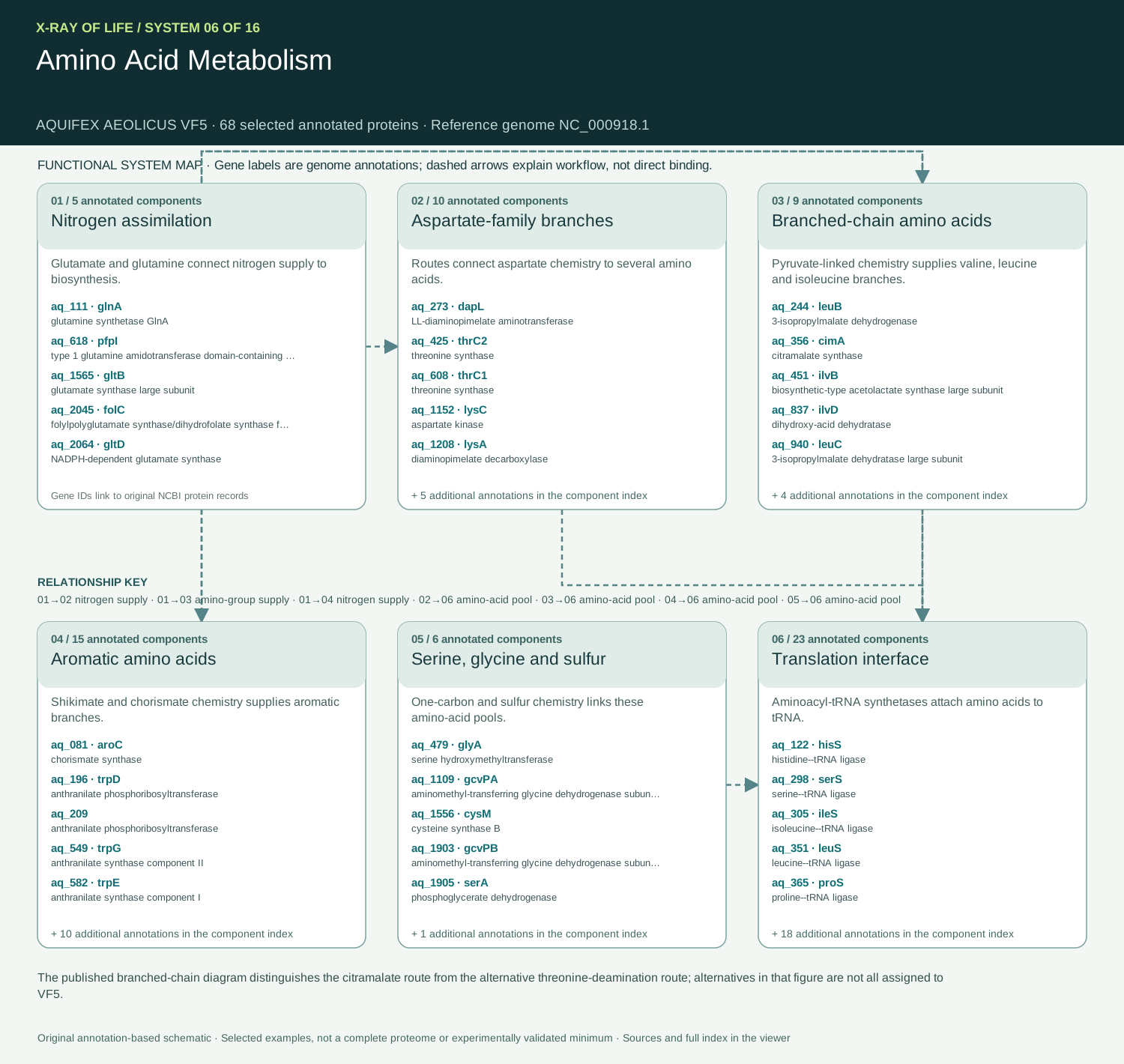
VF5 annotations identify glutamate/glutamine chemistry, aspartate-family branches, aromatic-amino-acid pathways and branched-chain biosynthetic enzymes. The published reconstruction specifically examines the citramalate route to the isoleucine precursor 2-ketobutyrate; the comparative threonine-deamination route in the published figure is not thereby established in VF5. Glycine, serine and sulfur-containing amino-acid chemistry link this category to folate and sulfur metabolism. Aminoacyl-tRNA synthetases form a downstream interface with translation rather than a substitute for amino-acid production.
95 proteins are assigned to this function in the 912-protein working reconstruction (Amino-acid biosynthesis).
The working reconstruction retains 912 proteins; 338 additional proteins remain undetermined. These are model selections, not a demonstrated viable minimum or individual VF5 knockout results. The 16 atlas hotspots and the reconstruction categories use different partitions.
Inspect the 912-protein inventory and model evidence →REFERENCE ORGANISM · AQUIFEX AEOLICUS VF5
Aquifex system diagram
68 selected annotated proteins · 6 functional modules
 Open the full diagram and component evidence ↗
Carbon skeletons and nitrogen feed branched amino-acid biosynthetic routes. Click to read the full diagram and inspect the annotated protein records.
Original schematic from VF5 RefSeq annotations. Dashed arrows describe functional relationships; they are not measured protein interactions. Sources: Deckert et al. (1998), complete VF5 genome · Braakman & Smith (2014), metabolic reconstruction · NCBI reference genome.
The published branched-chain diagram distinguishes the citramalate route from the alternative threonine-deamination route; alternatives in that figure are not all assigned to VF5.
FUNCTION AND MECHANISM
How this system works
FOLLOW THE FLOW
Metabolic precursors to amino acids and charged tRNAs
Carbon skeletons + nitrogen → amino acid pathways → amino acid supply → tRNA charging → translation
Amino Acid Metabolism
Making the units of proteins
Amino acids are the small molecules joined together to make proteins.
Carbon building blocks + nitrogen
Central metabolism supplies carbon frameworks. Nitrogen donors, such as glutamate and glutamine, supply nitrogen. Some amino acids also need sulfur.
Available amino acids from outside
Where suitable food is available, uptake can supply amino acids directly.
Different pathways make different amino acids
Enzymes modify the starting materials. Feedback helps match each supply to demand.
Attach each amino acid to its matching carrier
Enzymes use ATP to load transfer RNA (tRNA). The loaded tRNA carries an amino acid to the ribosome.
Join amino acids into a protein chain
The ribosome follows the messenger RNA instructions. Empty tRNAs return to be loaded again.
Read from top to bottom. Side-by-side panels show branches or supplies that come together; their labels explain the relationship. Detailed mechanisms and sources follow below.
Starting inputs: Carbon skeletons, usable nitrogen and sulfur sources, energy, enzymes, and suitable cofactors; environmental amino acids can supplement synthesis.
- Provide carbon and assimilated nitrogen: Central metabolism supplies carbon skeletons. Glutamate, glutamine, and other donors distribute nitrogen through the relevant reactions.
- Run the required biosynthetic branches: Different precursor families feed different amino acids. Sulfur incorporation and other specialized transformations occur in the appropriate branches.
- Balance the amino acid supply: Feedback and nutrient availability regulate production. Uptake can feed the pool directly where the environment supplies suitable amino acids.
- Attach amino acids to appropriate tRNAs: Aminoacyl-tRNA synthetases use ATP to charge tRNAs; some assignments use indirect pathways. Charging is a separate operation from amino acid synthesis.
- Deliver charged tRNAs to translation: System 09 uses them to add amino acids to protein chains and returns deacylated tRNAs for charging again.
Usable outputs: Amino acids for multiple cellular uses and charged tRNAs for protein synthesis.
The amino acid families are parallel branches, not a single chain in which one amino acid must be synthesized after another. The tRNA-charging loop continues during translation.
Evidence for selected mechanisms
Connections among amino acid and central metabolic pathways
These papers examine the named mechanisms or networks. The numbered order is an explanatory overview; it is not an experimentally established history of cellular origins.
Building carbon frameworks and adding nitrogen
Different amino acid families arise from different metabolic precursors. Glutamate and glutamine connect nitrogen assimilation to many other reactions. Transamination transfers an amino group between molecules, allowing the cell to distribute nitrogen onto suitable carbon frameworks. Particular reactions require chemical helpers such as pyridoxal phosphate.
Multiple linked biosynthetic families
Serine and glycine participate in one-carbon chemistry. Sulfur assimilation contributes to cysteine and methionine. Branched-chain amino acid pathways supply valine, leucine, and isoleucine; aromatic pathways supply phenylalanine, tyrosine, and tryptophan. Shared intermediates and branch points mean that these routes cannot be understood as isolated production lines.
Regulation avoids waste
Enzymes can respond to their own end products or to indicators of nutritional state. This helps prevent excessive synthesis of one amino acid while another is limiting. Import can supplement synthesis where environmental amino acids are available. A cell that must make its complete amino acid supply has different requirements from one growing in a nutrient-rich medium.
Delivering amino acids to translation
Aminoacyl-tRNA synthetases and related pathways connect usable amino acids to the appropriate transfer RNAs. Making amino acids and assigning them to tRNAs are separate tasks. The translation apparatus needs both adequate supply and sufficiently accurate assignment to produce functional proteins.
A closer look at the evidence
A reconstructed biosynthetic network connects carbon assimilation with amino acid, nucleotide, and cofactor production. This provides a systems view of shared chemical inputs; a reconstruction is not an experimental demonstration of the first cell.1
Follow the consequence
An abundant supply of nineteen amino acids cannot compensate for the complete absence of an amino acid required by a particular protein sequence.
Component families in this system (23)
- Serine biosynthesis
- Glycine cleavage system
- Serine and sulfide to cysteine
- Lysine biosynthesis via diaminopimelate
- Alanine metabolism
- Valine biosynthesis
- Leucine biosynthesis
- Isoleucine biosynthesis
- Histidine biosynthesis
- Tryptophan biosynthesis
- Tyrosine biosynthesis
- Phenylalanine biosynthesis
- Aspartate metabolism
- Asparagine metabolism
- Methionine biosynthesis
- Threonine biosynthesis
- Glutamate-related essential group
- Expanded glutamate-related
- Ornithine and arginine biosynthesis
- Ornithine and proline metabolism
- Amino acid synthesis regulation
- Additional regulation
- Urea cycle
FUNCTIONALLY INTEGRATED
What it depends on, and why
A functional dependency means that one process supplies material, energy, machinery, or suitable conditions to another. It does not necessarily mean that two proteins physically touch.
| Other system | Relationship | Why the connection matters |
|---|---|---|
| 02 · Cofactors | Receives from this system | Amino-acid-derived precursors contribute to pathways such as SAM and other cofactor biosynthesis. |
| 05 · Nucleotides | Receives from this system | Amino acids donate nitrogen and other atoms to purine and pyrimidine biosynthesis. |
| 01 · Carbon metabolism | Provides to this system | Central metabolism provides carbon skeletons for amino acid biosynthesis. |
| 02 · Cofactors | Provides to this system | Cofactors support amino-group transfer, reduction, and other amino acid biosynthetic reactions. |
| 03 · Energy production | Provides to this system | ATP and reducing power drive energy-requiring amino acid biosynthesis. |
| 11 · Transport | Provides to this system | Uptake supplies nitrogen, sulfur, or other environmental substrates needed by the selected biosynthetic routes. |
| 09 · RNA & translation | Receives from this system | Amino acids are the building blocks loaded onto tRNAs and joined into proteins. |
| 16 · Metal clusters | Receives from this system | Cysteine supplies sulfur to selected Fe–S cluster assembly systems. |
REASON & SCIENCE LIBRARY · ORGANIZING QUESTIONS
Library basis for this article
The library asks how amino-acid production became connected to the set used in proteins. This article separates three issues: availability of building blocks, enzyme-mediated biosynthesis and assignment to tRNAs. The Aquifex pathway evidence determines which enzymes and alternatives belong in this model; a general list of amino-acid routes is not an organism-specific inventory.L
FUNCTIONAL ORGANIZATION · AUTHOR’S FRAMEWORK
Hallmarks of design
Amino-acid metabolism illustrates the following organizational features in the supplied papers. These descriptions identify biological functions; interpreting their origin as design is the author’s comparative argument.H1, H2
Ordered enzyme reactions convert precursors into amino acids used in protein synthesis.
Carbon skeletons, nitrogen, cofactors and energy connect this supply to other systems.
Catalysts distinguish substrates and stereochemical products; tRNA charging adds another selection step.
Origin hurdles and abductive assessment · Assessment method · All 40 hallmarks. Biological evidence: the mechanism, accession records and scientific references on this page.
SOURCE-BASED SYNTHESIS
The origin problem in brief
How could a suitable amino-acid supply, selective synthesis, and protein production become coordinated?
- Obtain a useful repertoire with suitable concentration, stability, and handedness.
- Establish selective catalysts and the connected energy and cofactor supplies.
- Link biosynthetic output to protein production while controlling competing reactions.
Source notes and how the count is used
225 book-listed challenges. Amino-acid synthesis and metabolism category.
Numbers reproduce the source’s reported section totals. They are not a new count of unique questions or an independent assessment of which issues remain scientifically unresolved. Overlapping lists are not added together.
Source passages: X-ray of Life, Volume I, Chapter 2; §11.2, pp. 65–134; 410–411; X-ray of Life, Volume II, Chapter 6; §14.3, pp. 240–337; 754–755; X-ray of Life, Volume III, §17.2, pp. 611–634.
The overview follows the cell-specific scope of Forty Hallmarks of Design in the Cell: later eukaryotic machinery, specialized immune systems, and model-specific numerical probabilities are not treated as universal first-cell requirements.
ORIGINS
What needs to be explained
An origins explanation must connect available chemistry to a system that can persist, reproduce useful functions, and pass them to descendants. Explaining how a modern system works and explaining how its predecessors arose are different tasks. Simpler catalysts, environmental assistance, and alternative chemistries must be evaluated rather than assuming that the complete modern machinery appeared at once.
Scope of the question
The first peptide-forming chemistry need not have used today’s complete twenty-amino-acid set or modern biosynthetic routes.
Major hurdles to investigate
These are requirements to test in proposed scenarios. Their importance depends on the environment and on which intermediate system is proposed.
Supply diversity
Produce or obtain an adequate selection of amino acids in a common environment.
Chemical compatibility
Avoid losing useful products through side reactions or dilution.
Stereochemistry
Explain how early systems handled mixed handedness and how biological stereoselectivity became established.
Polymerization and function
Join monomers into products that perform useful tasks and persist long enough to matter.
Inheritance
Connect useful peptide production with replicating information and improved compartment reproduction.
EXPERIMENTAL PROGRESS
What has been demonstrated, and what it leaves open
Wet–dry cycling experiments with amino acids and hydroxy acids have produced peptide-containing products through ester-mediated chemistry. This addresses bond formation under specified conditions, rather than the complete production of sequence-defined proteins or a translating cell.2
Condensed origin challenges
- Obtain a useful repertoire with suitable concentration, stability, and handedness.
- Establish selective catalysts and the connected energy and cofactor supplies.
- Link biosynthetic output to protein production while controlling competing reactions.
Three condensed themes from the source passages above; they are not the complete numbered catalogue.
The integration test
Experiments that connect precursor chemistry across molecular classes help test compatibility.3 A strong next test for this system would combine its relevant chemical steps with continued material supply, energy use, retention, and reproduction under an explicitly specified environmental sequence. The open questions above are research questions, not claims that every intermediate is impossible.
Engineered minimal cells help reveal present cellular dependencies, but their construction starts from existing biological machinery and growth conditions. They therefore answer a different question from a prebiotic synthesis experiment.4
Explore prebiotic synthesis challengesTERMS IN PLAIN LANGUAGE
Glossary
- carbon skeleton
- The carbon framework of a molecule, onto which nitrogen and other atoms are added.
- amino acid family
- A group of amino acids made from the same starting molecule, for example the pyruvate family (alanine, valine, leucine).
- pyruvate
- A three-carbon central molecule; starting point for alanine, valine and leucine.
- oxaloacetate
- A four-carbon central molecule; starting point for aspartate and the amino acids made from it.
- 2-oxoglutarate
- A five-carbon central molecule (also called α-ketoglutarate); starting point for glutamate and its relatives.
- 3-phosphoglycerate
- A three-carbon sugar-acid; starting point for serine, glycine and cysteine.
- PEP + E4P
- Phosphoenolpyruvate and erythrose-4-phosphate: the two starting molecules of the aromatic amino acids.
- glutamate / glutamine
- The main carriers that hand nitrogen to other amino acids and to nucleotides.
- feedback inhibition
- When the end product of a pathway slows the first enzyme of that pathway, so production matches demand.
- aminoacyl-tRNA synthetase
- The enzyme that attaches the correct amino acid to its tRNA, using ATP.
- charged tRNA
- A tRNA with its amino acid attached, ready for protein synthesis.
- protein
- A chain of amino acids whose shape and chemical properties let it perform a cellular task.
- amino acid
- One of the small molecules joined together to form a protein.
- tRNA
- Transfer RNA: an adapter that pairs with an mRNA codon and carries its corresponding amino acid when charged.
- peptide
- A chain of amino acids. A polypeptide is a longer chain that may become part or all of a protein.
Related library threads
The Chorismate pathway · How biosynthesis of amino acids points to a created process · Amino Acids: Origin of the canonical twenty amino acids required for life
The author’s library essays and research compilations provide context and arguments. Biological mechanisms should be assessed through the scientific references; the design inference is a separate, revisable assessment.
SCIENTIFIC LITERATURE
Scientific papers
Linked superscript numbers in the text lead to the papers below, numbered in order of first citation on this page. Each entry links to the publisher and bibliographic record; open full text is included where available. These studies support the specified mechanisms or experiments, not every possible origin scenario.
Wimmer JLE, Vieira ADN, Xavier JC, Kleinermanns K, Martin WF, Preiner M. (2021). The Autotrophic Core: An Ancient Network of 404 Reactions Converts H2, CO2, and NH3 into Amino Acids, Bases, and Cofactors. Microorganisms, 9, 458.
Forsythe JG, Yu SS, Mamajanov I, Grover MA, Krishnamurthy R, Fernández FM, Hud NV. (2015). Ester-Mediated Amide Bond Formation Driven by Wet-Dry Cycles: A Possible Path to Polypeptides on the Prebiotic Earth. Angew Chem Int Ed Engl, 54, 9871-9875.
Patel BH, Percivalle C, Ritson DJ, Duffy CD, Sutherland JD. (2015). Common origins of RNA, protein and lipid precursors in a cyanosulfidic protometabolism. Nat Chem, 7, 301-307.
Hutchison CA, Chuang RY, Noskov VN, Assad-Garcia N, Deerinck TJ, Ellisman MH, Gill J, Kannan K, Karas BJ, Ma L, Pelletier JF, Qi ZQ, Richter RA, Strychalski EA, Sun L, Suzuki Y, Tsvetanova B, Wise KS, Smith HO, Glass JI, Merryman C, Gibson DG, Venter JC. (2016). Design and synthesis of a minimal bacterial genome. Science, 351, aad6253.
Further scientific reading
2 additional papers. Each title links to its article or bibliographic record.
Search and filter this system’s reference list →