AQUIFEX AEOLICUS VF5 · ORGANISM-SPECIFIC DESCRIPTION
How this system works in Aquifex
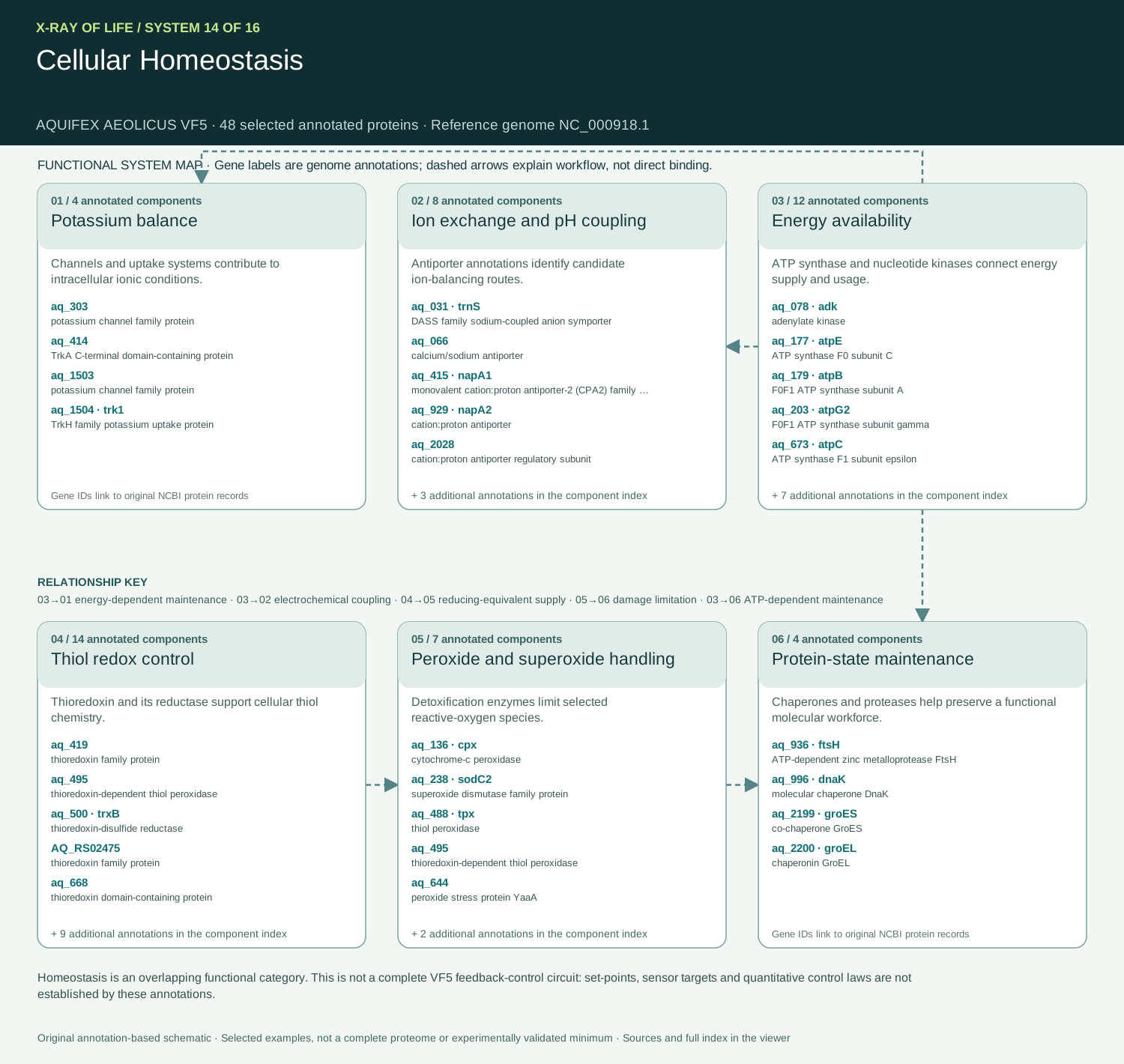
Potassium handling, ion exchange, ATP supply, thioredoxin-related chemistry, oxidant defense and protein maintenance provide different contributions to this task. The reference-genome diagram shows those functional connections. The reconstruction assigns only a small exclusive subset to its homeostasis category because many contributing proteins are counted under energy, transport or other systems. A small exclusive category count therefore does not mean that only those proteins maintain the intracellular environment. The diagram does not specify experimentally measured VF5 set-points or a fully resolved feedback circuit.
5 proteins are assigned to this function in the 912-protein working reconstruction (pH, osmotic and redox homeostasis).
The working reconstruction retains 912 proteins; 338 additional proteins remain undetermined. These are model selections, not a demonstrated viable minimum or individual VF5 knockout results. The 16 atlas hotspots and the reconstruction categories use different partitions.
Inspect the 912-protein inventory and model evidence →REFERENCE ORGANISM · AQUIFEX AEOLICUS VF5
Aquifex system diagram
48 selected annotated proteins · 6 functional modules
 Open the full diagram and component evidence ↗
Ion balance, energy supply, redox control and protein maintenance work in parallel. Click to read the full diagram and inspect the annotated protein records.
Original schematic from VF5 RefSeq annotations. Dashed arrows describe functional relationships; they are not measured protein interactions. Sources: Deckert et al. (1998), complete VF5 genome · NCBI reference genome.
Homeostasis is an overlapping functional category. This is not a complete VF5 feedback-control circuit: set-points, sensor targets and quantitative control laws are not established by these annotations.
FUNCTION AND MECHANISM
How this system works
FOLLOW THE FLOW
Disturbance to restored operating conditions
Change in internal conditions → sensing → transport/metabolic adjustment → changed conditions → continuing feedback
Cellular Homeostasis
Keeping the interior within workable limits
Homeostasis means continually keeping internal conditions suitable for cellular reactions.
Acidity, salts, water balance or energy state changes
The cell’s enzymes and other molecules work only within compatible ranges.
Chemical buffers and regulatory systems respond
Some responses follow directly from chemistry; others use sensors and regulators.
Change transport
Move selected ions or dissolved substances across the membrane.
Change metabolism
Adjust reactions, energy supply and the handling of reducing or oxidizing substances.
Conditions move toward a workable range
The changed conditions affect transport and metabolism again, continually adjusting the response.
Read from top to bottom. Side-by-side panels show branches or supplies that come together; their labels explain the relationship. Detailed mechanisms and sources follow below.
Starting inputs: A functioning membrane, metabolic and transport machinery, sensing or intrinsic regulatory mechanisms, and available energy and materials.
- Register a deviation: pH, ion activity, osmotic conditions, energy state, or redox balance changes from a workable range.
- Engage the relevant control mechanisms: Sensors, metabolite binding, buffering chemistry, and other regulatory interactions affect the appropriate response.
- Adjust fluxes and activities: Change ion or solute transport, metabolic reactions, energy regeneration, or protective activities. Different variables require different effectors.
- Rebalance the coupled variables: The actions alter intracellular conditions. A beneficial change in one variable can also affect another, such as proton-coupled uptake changing pH and membrane energy.
- Continue feedback within tolerance limits: Reduce, maintain, or redirect the response as conditions change; the system continually spends resources to stay functional.
Usable outputs: Intracellular conditions compatible with enzyme activity, RNA function, transport, and growth.
Homeostasis is a dynamic control loop, not a one-time restoration or an unchanging interior. Small cells generally follow environmental temperature and adjust tolerance and molecular composition rather than heating an independently regulated interior.
Evidence for selected mechanisms
Ion-dependent channel gating as a homeostatic feedback example
These papers examine the named mechanisms or networks. The numbered order is an explanatory overview; it is not an experimentally established history of cellular origins.
Acidity and ion balance
Acidity affects molecular charge, enzyme activity, and membrane energetics. Buffering reactions reduce some pH changes, while transport and metabolism move or consume acid–base equivalents. Cells also control selected ions so that enzymes and RNA can function without harmful excesses.
Water and osmotic pressure
Water movement responds to differences in chemical potential across the boundary. Accumulating solutes can support internal reactions but also change osmotic stress. Solute transport, compatible osmolytes, and—in many bacteria—a cell wall help the cell tolerate changing surroundings. A stable-looking boundary does not guarantee a workable water balance.
Energy and redox state
ATP use must be matched by regeneration, and reduced electron carriers must be balanced by reactions that use or regenerate them. Redox balance is not the same as eliminating all oxidants: it concerns maintaining chemically useful states while limiting damaging reactions. Changes in one metabolic branch can propagate through shared carrier pools.
Temperature and coordinated responses
Small cells generally experience the temperature of their surroundings rather than maintaining an independently heated interior. They can adjust molecular composition, protein expression, and protective activities within their tolerance limits. Regulation integrates these responses with available resources and the costs of maintenance.
A closer look at the evidence
Structural and functional experiments on MgtE link magnesium-dependent channel gating with magnesium homeostasis, providing a concrete example of regulated ion uptake.1
Follow the consequence
Importing nutrients together with protons can change internal acidity. Nutrient uptake and pH regulation therefore have to be considered together.
Component families in this system (20)
- Protein phosphorylation
- Protein dephosphorylation
- DNA repair group
- ATP/ADP balance
- Redox pathway
- Osmoregulation
- Cytoskeleton pathway
- PhoR-PhoB system
- Signaling metabolites
- Quorum sensing
- LuxPQ-LuxU-LuxO
- Gene regulators
- Post-translational modification
- Calcium gradient
- Osmosis regulation
- Energy metabolism
- pH regulation
- Nutrient homeostasis
- Ion concentration
- Temperature regulation
FUNCTIONALLY INTEGRATED
What it depends on, and why
A functional dependency means that one process supplies material, energy, machinery, or suitable conditions to another. It does not necessarily mean that two proteins physically touch.
| Other system | Relationship | Why the connection matters |
|---|---|---|
| 04 · Mineral ions | Receives from this system | pH and ion buffering constrain metal availability and prevent damaging imbalances. |
| 11 · Transport | Provides to this system | Ion transport and solute exchange maintain intracellular pH, osmolarity, and nutrient balance. |
| 07 · Lipids & membrane | Provides to this system | Selective membrane permeability allows internal conditions to differ from the surroundings. |
| 03 · Energy production | Provides to this system | Energy supply supports pumps and other active maintenance processes. |
| 09 · RNA & translation | Receives from this system | Compatible pH, ionic strength, and redox conditions support RNA and protein function. |
REASON & SCIENCE LIBRARY · ORGANIZING QUESTIONS
Library basis for this article
The library treats viability as continuing maintenance of compatible conditions, not merely the presence of cellular ingredients. This article uses that theme to connect transport, ion handling, redox chemistry and feedback. Each proposed controller must be linked to a regulated variable and a bacterial mechanism; a general statement about homeostasis does not identify a specific circuit. The potassium-homeostasis thread provides additional comparative reading; its animal sodium–potassium pump examples are not automatically bacterial mechanisms.L
FUNCTIONAL ORGANIZATION · AUTHOR’S FRAMEWORK
Hallmarks of design
Homeostasis illustrates the following organizational features in the supplied papers. These descriptions identify biological functions; interpreting their origin as design is the author’s comparative argument.H1, H2
Viable pH, osmotic and redox ranges depend on regulated transport and reactions.
Feedback can connect disturbance to compensating activity.
Internal conditions affect enzyme function and membrane energetics together.
Origin hurdles and abductive assessment · Assessment method · All 40 hallmarks. Biological evidence: the mechanism, accession records and scientific references on this page.
SOURCE-BASED SYNTHESIS
The origin problem in brief
How could acidity, ions, water balance, and redox conditions remain compatible as the environment changed?
- Maintain workable internal conditions while exchanging matter with the environment.
- Coordinate feedback across ion, acidity, water, redox, and energy balances.
- Keep mutually dependent control and maintenance processes supplied and responsive.
Source notes and how the count is used
Homeostasis overlaps several source categories. No separate atlas-aligned total is assigned.
Numbers reproduce the source’s reported section totals. They are not a new count of unique questions or an independent assessment of which issues remain scientifically unresolved. Overlapping lists are not added together.
Source passages: X-ray of Life, Volume III, Chapter 3; §15.5; §25.2.33, pp. 183–226; 568–578; 769; The Cell: An Unsolved Mystery, Chapters 12,15, pp. 222–249; 277–290.
The overview follows the cell-specific scope of Forty Hallmarks of Design in the Cell: later eukaryotic machinery, specialized immune systems, and model-specific numerical probabilities are not treated as universal first-cell requirements.
ORIGINS
What needs to be explained
An origins explanation must connect available chemistry to a system that can persist, reproduce useful functions, and pass them to descendants. Explaining how a modern system works and explaining how its predecessors arose are different tasks. Simpler catalysts, environmental assistance, and alternative chemistries must be evaluated rather than assuming that the complete modern machinery appeared at once.
Scope of the question
Homeostasis overlaps the other categories because it is an outcome of their coordination. Shared components should not be counted as additional independent proteins merely because they serve several functions.
Major hurdles to investigate
These are requirements to test in proposed scenarios. Their importance depends on the environment and on which intermediate system is proposed.
Compatible operating ranges
Find conditions that support several reactions and structures at once.
Exchange without collapse
Admit resources without destroying pH, water balance, or useful gradients.
Feedback
Connect departures from workable conditions to compensating reactions.
Energy budget
Sustain maintenance costs while leaving enough resources for growth and reproduction.
Environmental transition
Explain how initially buffered environments gave way to greater cellular control.
EXPERIMENTAL PROGRESS
What has been demonstrated, and what it leaves open
Simple compartments can exhibit selective permeability, and metal-binding or buffering chemistry can moderate particular conditions. These are possible precursors of some homeostatic functions. Maintaining several coupled variables over repeated growth and reproduction cycles requires a broader demonstration.2
Condensed origin challenges
- Maintain workable internal conditions while exchanging matter with the environment.
- Coordinate feedback across ion, acidity, water, redox, and energy balances.
- Keep mutually dependent control and maintenance processes supplied and responsive.
Three condensed themes from the source passages above; they are not the complete numbered catalogue.
The integration test
Experiments that connect precursor chemistry across molecular classes help test compatibility.3 A strong next test for this system would combine its relevant chemical steps with continued material supply, energy use, retention, and reproduction under an explicitly specified environmental sequence. The open questions above are research questions, not claims that every intermediate is impossible.
Engineered minimal cells help reveal present cellular dependencies, but their construction starts from existing biological machinery and growth conditions. They therefore answer a different question from a prebiotic synthesis experiment.4
Explore prebiotic synthesis challengesTERMS IN PLAIN LANGUAGE
Glossary
- homeostasis
- Keeping internal conditions within a workable range despite changes outside.
- pH
- A measure of acidity; many enzymes work only within a narrow pH range.
- osmotic balance
- The balance of water moving in or out of the cell, driven by differences in dissolved-particle concentration.
- osmolyte
- A small molecule the cell accumulates or releases to balance water pressure without disturbing its enzymes.
- turgor
- The internal pressure that pushes the membrane against the cell wall.
- redox balance
- Keeping the right ratio of electron-loaded and empty carriers (such as NADH and NAD⁺).
- energy charge
- How much of the cell’s adenine nucleotides are in the high-energy form ATP rather than ADP or AMP.
- buffer
- A substance that soaks up or releases H⁺ to keep pH steady.
- set point
- The range a controlled variable is held within; it may itself shift with growth conditions.
- feedback loop
- A cycle in which a correction is checked again and adjusted as needed.
- enzyme
- A molecule, usually a protein, that speeds up a chemical reaction without being consumed by it.
- protein
- A chain of amino acids whose shape and chemical properties let it perform a cellular task.
- ATP
- Adenosine triphosphate: a molecule whose chemical reactions can be coupled to many energy-requiring cellular processes. It is continually used and regenerated.
- ion
- An atom or molecule with a net electrical charge.
Related library threads
Regulation of Potassium Homeostasis · Evolution, adaptaion, homeostasis, and the preprogrammed processes essential for life to survive in a changing environment · Iron Uptake and Homeostasis in Prokaryotic Microorganisms
The author’s library essays and research compilations provide context and arguments. Biological mechanisms should be assessed through the scientific references; the design inference is a separate, revisable assessment.
SCIENTIFIC LITERATURE
Scientific papers
Linked superscript numbers in the text lead to the papers below, numbered in order of first citation on this page. Each entry links to the publisher and bibliographic record; open full text is included where available. These studies support the specified mechanisms or experiments, not every possible origin scenario.
Hattori M, Iwase N, Furuya N, Tanaka Y, Tsukazaki T, Ishitani R, Maguire ME, Ito K, Maturana A, Nureki O. (2009). Mg(2+)-dependent gating of bacterial MgtE channel underlies Mg(2+) homeostasis. EMBO J, 28, 3602-3612.
Hanczyc MM, Fujikawa SM, Szostak JW. (2003). Experimental models of primitive cellular compartments: encapsulation, growth, and division. Science, 302, 618-622.
Patel BH, Percivalle C, Ritson DJ, Duffy CD, Sutherland JD. (2015). Common origins of RNA, protein and lipid precursors in a cyanosulfidic protometabolism. Nat Chem, 7, 301-307.
Hutchison CA, Chuang RY, Noskov VN, Assad-Garcia N, Deerinck TJ, Ellisman MH, Gill J, Kannan K, Karas BJ, Ma L, Pelletier JF, Qi ZQ, Richter RA, Strychalski EA, Sun L, Suzuki Y, Tsvetanova B, Wise KS, Smith HO, Glass JI, Merryman C, Gibson DG, Venter JC. (2016). Design and synthesis of a minimal bacterial genome. Science, 351, aad6253.
Further scientific reading
3 additional papers. Each title links to its article or bibliographic record.
Search and filter this system’s reference list →