AQUIFEX AEOLICUS VF5 · ORGANISM-SPECIFIC DESCRIPTION
How this system works in Aquifex
VF5 annotations identify superoxide dismutases, peroxidase-related activities, thioredoxin-dependent redox chemistry, chaperones, proteases and DNA-repair proteins. Superoxide dismutation and peroxide removal address different chemical species; protein refolding and DNA repair address different damaged substrates. The reconstruction retains a subset under its stated growth scenario, while the reference diagram also shows related annotated functions. It does not establish one universal stress pathway, an E. coli-like regulon, or a measured time to death after removal of a VF5 gene.
6 proteins are assigned to this function in the 912-protein working reconstruction (Essential stress protection).
The working reconstruction retains 912 proteins; 338 additional proteins remain undetermined. These are model selections, not a demonstrated viable minimum or individual VF5 knockout results. The 16 atlas hotspots and the reconstruction categories use different partitions.
Inspect the 912-protein inventory and model evidence →REFERENCE ORGANISM · AQUIFEX AEOLICUS VF5
Aquifex system diagram
29 selected annotated proteins · 6 functional modules
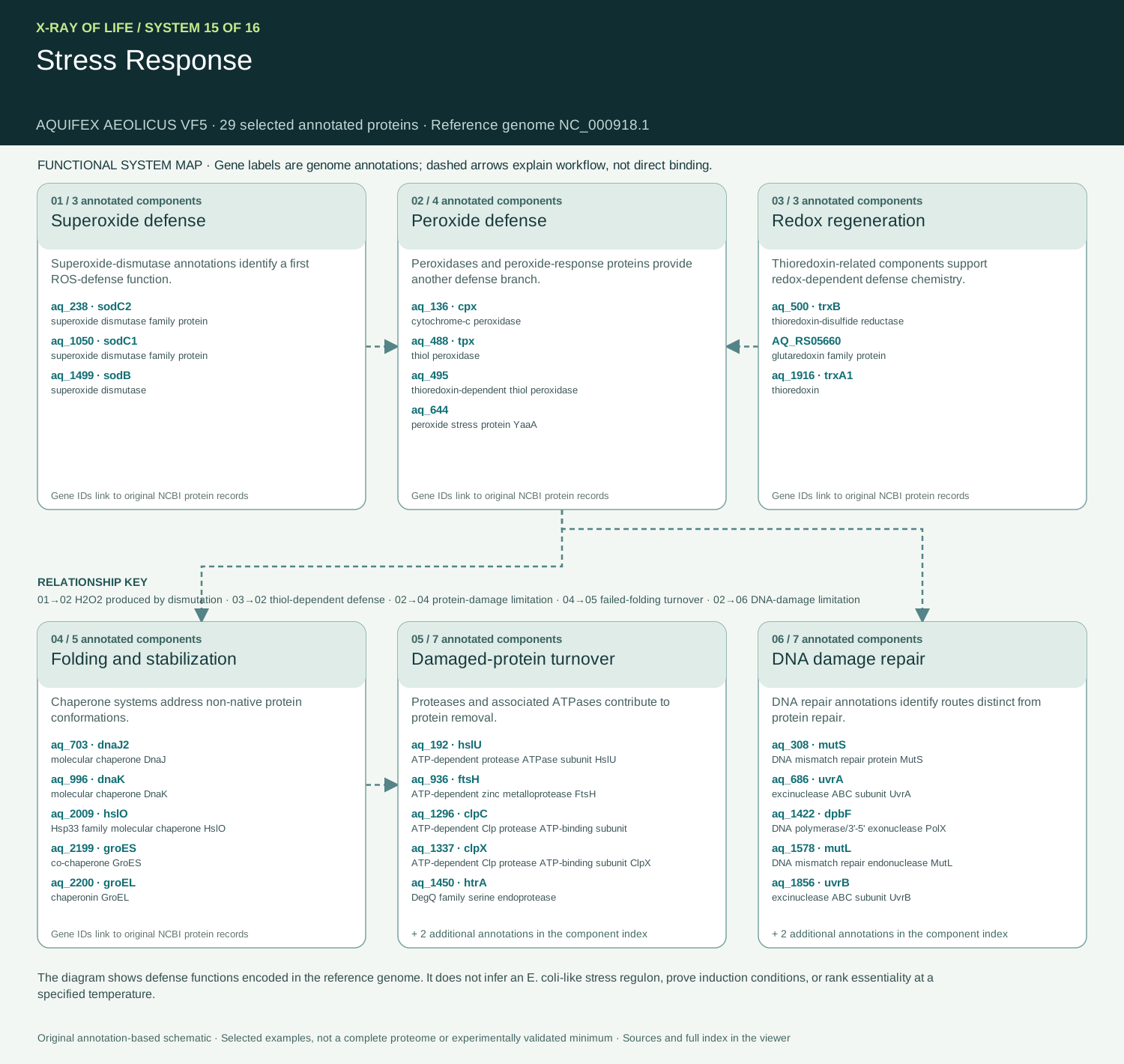 Open the full diagram and component evidence ↗
Oxidant defense, refolding, turnover and DNA repair address distinct damage routes. Click to read the full diagram and inspect the annotated protein records.
Original schematic from VF5 RefSeq annotations. Dashed arrows describe functional relationships; they are not measured protein interactions. Sources: Deckert et al. (1998), complete VF5 genome · NCBI reference genome.
The diagram shows defense functions encoded in the reference genome. It does not infer an E. coli-like stress regulon, prove induction conditions, or rank essentiality at a specified temperature.
FUNCTION AND MECHANISM
How this system works
FOLLOW THE FLOW
Stress detection to protection and recovery
Stress or damage → sensing and regulation → protection + repair/removal → recovery or continued survival response
Stress Response
Protecting the cell during stress
Heat, harmful chemicals and other disturbances can damage cellular molecules.
Heat, oxidants, salt change or nutrient shortage
Different stresses affect different molecular targets.
Regulators redirect cellular activity
Some defenses are already present. Others require changes in gene activity and protein production.
Limit further damage
Stabilize molecules or remove harmful reactive chemicals using suitable defenses.
Repair or remove damaged material
Repair DNA, assist damaged proteins, or break down material that cannot be recovered.
Restore function or sustain protection
If conditions improve, growth may resume. Persistent stress can slow growth; damage beyond tolerance can prevent recovery.
Read from top to bottom. Side-by-side panels show branches or supplies that come together; their labels explain the relationship. Detailed mechanisms and sources follow below.
Starting inputs: A stressor or damage signal, regulatory mechanisms, protective and repair machinery, energy, and replacement materials.
- Encounter and detect stress: Heat, nutrient shortage, salt changes, oxidants, or other disturbances alter molecules or cellular conditions.
- Redirect cellular activity: Regulators alter existing activities and, where needed, transcription and translation of protective proteins. Some defenses are already active before stress is detected.
- Limit further damage: Use the relevant protective branch, such as managing reactive oxygen species, limiting exposure, or stabilizing proteins and osmotic conditions.
- Repair or remove damaged material: DNA repair, chaperones, proteases, and other pathways act on different substrates in parallel. Replace lost catalysts and cofactors using the corresponding biosynthetic systems.
- Recover or sustain protection: As the disturbance subsides, restore workable pools and growth. If it persists, continued resource allocation to survival can slow growth; damage beyond tolerance can prevent recovery.
Usable outputs: Reduced damage, repaired or replaced components, recycled material, and an adjusted growth or survival state.
Protection, repair, and degradation overlap. Oxidative stress pathways depend on exposure and ecology; host-interaction mechanisms are not a universal stage of free-living cellular stress response.
Evidence for selected mechanisms
Hydrogen peroxide damage to iron–sulfur enzymes
These papers examine the named mechanisms or networks. The numbered order is an explanatory overview; it is not an experimentally established history of cellular origins.
Preventing and limiting damage
Protective proteins, binding molecules, and changes in gene expression can reduce damage. Heat can destabilize proteins; nutrient shortages can require resource conservation; altered salt conditions can disturb water balance. There is no single stress-response molecule that solves every disturbance.
Reactive oxygen chemistry
Superoxide and hydrogen peroxide can arise when electrons reach oxygen through unintended reactions. Antioxidant enzymes and chemical systems help manage them in organisms exposed to these species. Some iron–sulfur enzymes are vulnerable to oxidation, linking stress response to energy metabolism and metal handling. Oxygen-dependent stress systems should not be assumed to have identical importance in an anoxic environment.
Repair and replacement
DNA repair addresses selected genetic lesions. Chaperones can assist damaged proteins, while proteases remove some molecules that cannot be recovered. Lon and other proteolytic systems contribute to turnover in particular organisms. Degradation products can re-enter metabolism, but replacing a damaged catalyst still requires energy and material.
Balancing protection against growth
A stress response can slow growth while resources are redirected to survival. Sensors and regulators must therefore coordinate protection with metabolism. Host-interaction functions belong to particular ecological settings; they are not an automatic requirement for an independently living cell.
A closer look at the evidence
Experiments in Escherichia coli show that hydrogen peroxide can damage selected iron–sulfur enzymes and interfere with metabolism, linking protective chemistry to continued enzyme function.1
Follow the consequence
Oxidation of an exposed iron–sulfur cluster can inactivate a metabolic enzyme. Restoring growth can require both limiting oxidants and repairing or replacing the damaged enzyme.
Component families in this system (10)
- Stress response system
- Cellular defense
- Bacterial-Host Interactions
- ROS management
- Proteolysis pathway
- Proteolytic systems
- Lon protease
- Metalloprotease pathway
- Serine protease pathway
- Peptidase pathway
FUNCTIONALLY INTEGRATED
What it depends on, and why
A functional dependency means that one process supplies material, energy, machinery, or suitable conditions to another. It does not necessarily mean that two proteins physically touch.
| Other system | Relationship | Why the connection matters |
|---|---|---|
| 12 · Quality control | Provides to this system | Folding, rescue, and degradation systems mitigate stress-induced molecular damage. |
| 03 · Energy production | Provides to this system | Energy supply supports many protective, repair, and protein-turnover responses. |
| 09 · RNA & translation | Provides to this system | Translation replaces damaged proteins and produces stress-response factors. |
REASON & SCIENCE LIBRARY · ORGANIZING QUESTIONS
Library basis for this article
The library’s focused superoxide-dismutase thread connects protective enzyme chemistry with the hazards accompanying oxygen use. Its broader stress discussions add questions about sensing and response. This article distinguishes the protective reaction, the need to manage resulting products and the regulation appropriate to a bacterial cell. Mammalian stress pathways are comparative material, not an Aquifex inventory.L
FUNCTIONAL ORGANIZATION · AUTHOR’S FRAMEWORK
Hallmarks of design
Stress response illustrates the following organizational features in the supplied papers. These descriptions identify biological functions; interpreting their origin as design is the author’s comparative argument.H1, H2
Stress recognition and regulation can change protective activity.
Damage can require refolding or degradation, depending on the lesion.
Protection limits particular threats rather than providing universal immunity.
Origin hurdles and abductive assessment · Assessment method · All 40 hallmarks. Biological evidence: the mechanism, accession records and scientific references on this page.
SOURCE-BASED SYNTHESIS
The origin problem in brief
How could early cells detect damage, select a suitable response, and sustain the cost of protection?
- Protect useful molecules against the stresses of the proposed environment.
- Connect damage recognition to suitable protection, repair, or removal.
- Balance response costs with continued energy supply and cellular maintenance.
Source notes and how the count is used
11 book-listed problem categories. Defense/stress source scope includes specialized systems.
Numbers reproduce the source’s reported section totals. They are not a new count of unique questions or an independent assessment of which issues remain scientifically unresolved. Overlapping lists are not added together.
Source passages: X-ray of Life, Volume III, Chapter 4; §13.6; §§25.2.35–25.2.37, pp. 227–254; 476–477; 769–770; The Cell: An Unsolved Mystery, Chapter 12, pp. 222–249.
The overview follows the cell-specific scope of Forty Hallmarks of Design in the Cell: later eukaryotic machinery, specialized immune systems, and model-specific numerical probabilities are not treated as universal first-cell requirements.
ORIGINS
What needs to be explained
An origins explanation must connect available chemistry to a system that can persist, reproduce useful functions, and pass them to descendants. Explaining how a modern system works and explaining how its predecessors arose are different tasks. Simpler catalysts, environmental assistance, and alternative chemistries must be evaluated rather than assuming that the complete modern machinery appeared at once.
Scope of the question
The severity of a hurdle depends on exposure. Modern oxidative defenses cannot be imposed unchanged on every proposed early-Earth setting.
Major hurdles to investigate
These are requirements to test in proposed scenarios. Their importance depends on the environment and on which intermediate system is proposed.
Environmental exposure
Specify the actual damaging agents in a proposed origin setting.
Persistence
Keep catalysts and polymers intact long enough for productive cycles.
Protection tradeoffs
Provide shielding or chemical protection without excluding necessary resources.
Turnover
Replenish damaged components before useful functions are lost.
Inherited response
Connect protective benefits to the reproduction of the compartment that produces them.
EXPERIMENTAL PROGRESS
What has been demonstrated, and what it leaves open
Experiments on metal-containing peptides and simpler compartments help test chemical stability before modern repair systems. Such models can examine survival under selected exposures, but they do not establish a complete ancestral stress network or a universal minimum defense system.2
Condensed origin challenges
- Protect useful molecules against the stresses of the proposed environment.
- Connect damage recognition to suitable protection, repair, or removal.
- Balance response costs with continued energy supply and cellular maintenance.
Three condensed themes from the source passages above; they are not the complete numbered catalogue.
The integration test
Experiments that connect precursor chemistry across molecular classes help test compatibility.3 A strong next test for this system would combine its relevant chemical steps with continued material supply, energy use, retention, and reproduction under an explicitly specified environmental sequence. The open questions above are research questions, not claims that every intermediate is impossible.
Engineered minimal cells help reveal present cellular dependencies, but their construction starts from existing biological machinery and growth conditions. They therefore answer a different question from a prebiotic synthesis experiment.4
Explore prebiotic synthesis challengesTERMS IN PLAIN LANGUAGE
Glossary
- stress
- Any condition that threatens the cell’s molecules or function, such as heat, oxidants, starvation or salt.
- ROS (reactive oxygen species)
- Damaging forms of oxygen, such as superoxide and hydrogen peroxide, that harm DNA, proteins and lipids.
- antioxidant enzyme
- An enzyme such as superoxide dismutase or catalase that destroys reactive oxygen species.
- heat-shock proteins
- Chaperones and proteases made in larger amounts when heat damages proteins.
- protease
- An enzyme that cuts proteins, used to remove damaged ones and recycle their amino acids.
- Lon protease
- An ATP-powered protease that destroys misfolded and some regulatory proteins.
- osmolyte
- A small molecule accumulated to protect the cell against salt or drying stress.
- DNA repair
- Systems that fix damaged or wrongly paired bases and breaks in DNA (System 08).
- stress response
- A coordinated change in gene expression and activity that protects the cell and repairs damage.
- tolerance limit
- The point beyond which damage is too great for the cell to recover.
- enzyme
- A molecule, usually a protein, that speeds up a chemical reaction without being consumed by it.
Related library threads
High-speed nanotechnology Superoxide Dismutase enzymes - by evolution, or design? · Evolution, adaptaion, homeostasis, and the preprogrammed processes essential for life to survive in a changing environment · Metal ions in biological cells, essential for life
The author’s library essays and research compilations provide context and arguments. Biological mechanisms should be assessed through the scientific references; the design inference is a separate, revisable assessment.
SCIENTIFIC LITERATURE
Scientific papers
Linked superscript numbers in the text lead to the papers below, numbered in order of first citation on this page. Each entry links to the publisher and bibliographic record; open full text is included where available. These studies support the specified mechanisms or experiments, not every possible origin scenario.
Jang S, Imlay JA. (2007). Micromolar intracellular hydrogen peroxide disrupts metabolism by damaging iron-sulfur enzymes. J Biol Chem, 282, 929-937.
Bonfio C, Valer L, Scintilla S, Shah S, Evans DJ, Jin L, Szostak JW, Sasselov DD, Sutherland JD, Mansy SS. (2017). UV-light-driven prebiotic synthesis of iron-sulfur clusters. Nat Chem, 9, 1229-1234.
Patel BH, Percivalle C, Ritson DJ, Duffy CD, Sutherland JD. (2015). Common origins of RNA, protein and lipid precursors in a cyanosulfidic protometabolism. Nat Chem, 7, 301-307.
Hutchison CA, Chuang RY, Noskov VN, Assad-Garcia N, Deerinck TJ, Ellisman MH, Gill J, Kannan K, Karas BJ, Ma L, Pelletier JF, Qi ZQ, Richter RA, Strychalski EA, Sun L, Suzuki Y, Tsvetanova B, Wise KS, Smith HO, Glass JI, Merryman C, Gibson DG, Venter JC. (2016). Design and synthesis of a minimal bacterial genome. Science, 351, aad6253.
Further scientific reading
1 additional papers. Each title links to its article or bibliographic record.
Search and filter this system’s reference list →